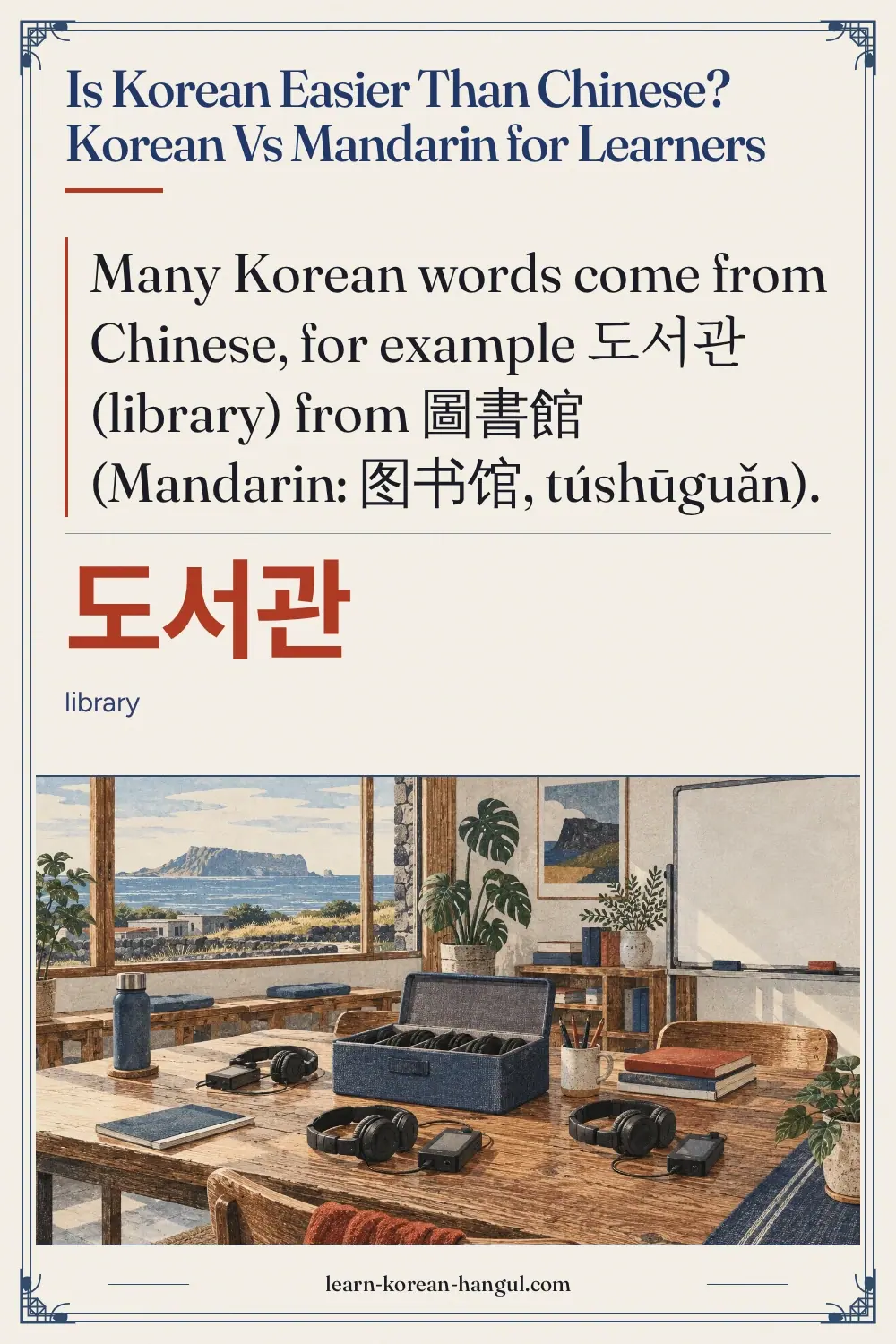
Is Korean Easier than Chinese? the Verdict
Korean is easier than Mandarin on writing and pronunciation, harder on grammar and politeness, and equal on total time. Learning to read Korean aloud takes about a week, and reading Mandarin takes years. But a Korean sentence needs a verb ending and a politeness level, and a Mandarin sentence needs neither. Both are in the FSI's hardest group, so neither is "easy".
The honest score by skill:
- Reading: Korean wins by a wide margin.
- Tones and sounds: Korean wins, with one caveat (the three-way consonant contrast).
- Grammar: Mandarin wins.
- Politeness: Mandarin wins.
- Vocabulary: a tie for English speakers; Korean gains a big head start for Mandarin speakers.
- Time to a working level: a tie.
How you weigh those depends on who you are, which the next section sorts out.
Quick Verdict by Learner Type
Pick the language that matches your goal, because the difficulty difference is small compared with the effect of motivation. This table gives one line per learner type.
| You are... | Easier choice | Why |
|---|---|---|
| A K-drama or K-pop fan | Korean | You already hear it, and motivation drives the hours |
| Planning business in China or Taiwan | Mandarin | Korean will not help with the work |
| A heritage speaker of either | The heritage language | Your ear and family contact help most |
| Learning Japanese already | Korean | Shared word order and particles shorten the grammar |
| A Mandarin or Cantonese speaker | Korean | Hangul is quick, and Sino-Korean words are partly familiar |
| Worried about tones | Korean | No tones to master |
| Wanting the widest use across regions | Mandarin | It has far more speakers worldwide |
Korean vs Mandarin at a Glance
The master table below compares the two languages on six criteria, with a specific value in every cell. Sections after it take each criterion in turn.
| Criterion | Korean | Mandarin | Easier for English speakers |
|---|---|---|---|
| Writing system | Hangul: 24 basic letters (14 consonants, 10 vowels), read in about a week | Characters: thousands to read a newspaper, plus Pinyin for sound | Korean |
| Tones | None in standard Seoul Korean | 4 tones plus a neutral tone | Korean |
| Verb forms | Endings for tense, politeness, mood and connection | No conjugation; time shown by words and markers | Mandarin |
| Word order | Subject-object-verb, with particles | Subject-verb-object, like English | Mandarin |
| Politeness | Speech levels built into verb endings | Polite words and 您 (nín), "you" in respectful style | Mandarin |
| FSI category | Category IV, about 88 weeks | Category IV, about 88 weeks | Equal |
Where the table says "easier", it refers to a typical English speaker starting from zero. A learner with a tonal first language, such as Vietnamese or Thai, will score tones differently. A speaker of Japanese will score grammar differently.
Which Writing System Is Easier?
Hangul is much easier to learn than Chinese characters. Hangul is an alphabet with 24 basic letters, which you can learn in about a week and which tells you how to pronounce any word. Chinese characters are not an alphabet: each represents a word or a part of a word, and sound is not reliably visible from the shape.
What the difference looks like in practice:
- Hangul: 한 (han) is built from ㅎ + ㅏ + ㄴ. The letters give the sound.
- Chinese: 学 (xué, "learn") must be learned as a shape, a sound and a meaning, one character at a time.
- Volume: commonly cited estimates put reading a newspaper at about 2,000 to 3,500 Chinese characters, while the whole Hangul system is 40 letters in everyday use.
- Typing: both can be typed phonetically, but Mandarin needs Pinyin input and the choice of the right character from a list.
Mandarin has a mitigating tool: Pinyin, a Roman spelling with tone marks, lets you speak and type without characters. Many learners study speaking first with Pinyin and add characters later. Korean has Revised Romanization, but this site treats it as an aid and teaches Hangul from the start, because Hangul takes days, not years. See how Hangul differs from Hanja for the Korean side of the story.
Winner on writing: Korean. One week of Hangul gets you reading, while characters take years.
Does Korean Have Tones Like Chinese?
Korean has no lexical tones, and Mandarin has four. A lexical tone is a pitch pattern that changes the meaning of a word. In Mandarin, the syllable ma means different things in each tone: mā (妈, mother), má (麻, hemp), mǎ (马, horse) and mà (骂, to scold), plus a neutral tone in some words. Using the wrong tone can make a different word.
Standard Seoul Korean works differently. Pitch carries sentence-level meaning, such as a rising voice on a yes/no question, but not word meaning. 밥 먹었어? with a rising voice asks "Did you eat?", and the same words with a falling voice state it. Some southeastern dialects of Korean do have a pitch-accent system, so a speaker of those dialects may sound different, but standard Korean for learners does not require tones.
Korean has its own sound challenge instead: a three-way consonant contrast. The consonants ㄱ, ㅋ and ㄲ are plain, aspirated (with a puff of air) and tense (tight, no puff). English speakers hear one sound. Mandarin has an aspirated and unaspirated contrast, so Mandarin speakers often find this easier.
Winner on pronunciation: Korean, because you can speak with a flat pitch and be understood. In Mandarin, a wrong tone can change the word, even when your consonants and vowels are correct.
Is Korean Grammar Harder than Chinese Grammar?
Yes. Mandarin grammar is simpler than Korean grammar for an English speaker, because Mandarin verbs do not change form and its word order matches English. Korean verbs take endings that mark tense, politeness and mood, and Korean puts the verb last.
Compare the same idea in both languages:
| English | Korean | Mandarin |
|---|---|---|
| I eat rice. | 저는 밥을 먹어요. | 我吃饭。Wǒ chī fàn. |
| I ate rice. | 저는 밥을 먹었어요. | 我吃饭了。Wǒ chī fàn le. |
| Did you eat? | 밥 먹었어요? | 你吃饭了吗?Nǐ chī fàn le ma? |
What the table shows:
- Verb forms. In Korean, 먹어요 becomes 먹었어요 for the past. In Mandarin, 吃 stays the same and the particle 了 marks the completed action.
- Particles. Korean marks the topic with 는 and the object with 을, while Mandarin marks neither.
- Word order. Mandarin is subject-verb-object like English; Korean is subject-object-verb.
Mandarin has its own grammar load: measure words (一本书, yì běn shū, "one book"), aspect markers and a very sensitive word order for adverbs. Korean has counters too (한 명, 두 개). But for a beginner, Mandarin's missing conjugation is a clear advantage.
Winner on grammar: Mandarin. The gap grows at higher levels, when Korean adds connecting endings, honorific forms and many exceptions.
Politeness and Honorifics
Politeness is built into every Korean verb, while Mandarin handles it through word choice. In Korean you pick a speech level for each sentence: casual 먹어, polite 먹어요, or formal 먹습니다. You also change words for elders, as in 드세요 ("please eat") for 먹어요 when respecting someone. See Korean speech levels for the system.
Mandarin has respectful forms, such as 您 (nín) for "you" and polite phrases such as 请 (qǐng, "please"), but a verb does not change with the listener. A learner can speak politely in Mandarin from day one by choosing a few words. In Korean, a beginner must choose a level for every sentence, and a wrong choice can sound rude or too stiff.
Winner on politeness: Mandarin, with the caveat that the Korean system becomes natural after a few months of using polite -요 forms by default.
Does Korean Share Vocabulary with Chinese?
Yes, a lot. Korean borrowed a large layer of vocabulary from Chinese over many centuries. These Sino-Korean words are about half of the dictionary's headwords in commonly cited estimates, though the figure depends on how headwords are counted. Many are formal, written and abstract words, so Sino-Korean vocabulary matters more at higher levels.
The words match in meaning and echo in sound:
| Korean | Meaning | Chinese (traditional / simplified) | Mandarin |
|---|---|---|---|
| 도서관 | library | 圖書館 / 图书馆 | túshūguǎn |
| 학교 | school | 學校 / 学校 | xuéxiào |
| 대학 | university | 大學 / 大学 | dàxué |
| 전화 | telephone | 電話 / 电话 | diànhuà |
| 학생 | student | 學生 / 学生 | xuésheng |
For an English speaker the overlap is a small bonus at first, because you are learning the sound and the meaning of each word anyway. For a Mandarin speaker it is a large head start: the meanings are known, and the sound mapping is regular. Read the Sino-Korean vocabulary page and the broader Korean language versus Chinese comparison for the linguistic side, and Hanja for the characters.
Two cautions:
- False friends. 愛人 means spouse or lover in Mandarin (àirén), but 애인 means boyfriend or girlfriend in Korean. 工夫 (gōngfu) is time and effort in Mandarin, while 공부 means study in Korean.
- Sound shifts. Korean preserves older final consonants. 十 is shí in Mandarin but 십 (sip) in Korean, and Cantonese sap. This is why Cantonese often sounds closer to Korean than Mandarin does.
Winner on vocabulary: a tie for English speakers, and clearly Korean for Mandarin speakers.
Which Language Has More Learning Resources?
Mandarin has a larger number of speakers, schools, textbooks and exam preparation materials, and Korean has grown quickly with its media. This is a judgement based on how widely each language is studied, not a measured count. A Mandarin learner can find a class or tutor in almost any large city. A Korean learner can find a very large amount of free media, K-drama and music, plus free courses such as this one.
For listening practice, both are well served. For structured exams, Mandarin has the HSK, and Korean has TOPIK. See TOPIK for the Korean exam.
Winner on resources: Mandarin for breadth, with Korean strong for media-based learning.
Hearing Korean and Mandarin Compared
Both are hard to hear for different reasons: Korean changes sounds at word boundaries, and Mandarin changes tones in context. Neither is transparent at native speed.
In Korean, written sounds shift in predictable ways when words meet. 같이 ("together") is spelled with ㅌ but said [가치], 국물 ("broth") is said [궁물], and 맛있어 ("it's tasty") is usually said [마시써]. The rules are few, but they must become automatic before fast speech is clear. See the sound change rules for the Korean set.
In Mandarin, tones shift too. When two third tones meet, the first becomes a second tone, so 你好 (nǐ hǎo, "hello") is said close to ní hǎo. Mandarin also drops tones in unstressed syllables, and a speaker's tones blur at speed.
The practical difference is where the learner starts. A Korean learner who reads Hangul can match what they hear to a spelling, which makes the sound rules learnable. A Mandarin learner who does not know the characters can still use Pinyin with tone marks, but must hold sound, tone and character in mind together.
Winner on listening: a tie. Korean is more regular in its changes, and Mandarin is more regular in its syllables.
The First Week in Each Language
A first week in Korean is mostly reading, and a first week in Mandarin is mostly sound. The two plans below are typical, not official.
| Day | Korean | Mandarin |
|---|---|---|
| 1 | Vowels ㅏ ㅓ ㅗ ㅜ ㅡ ㅣ and reading simple syllables | Pinyin vowels and the four tones on one syllable (ma) |
| 2 | The plain consonants ㄱ ㄴ ㄷ ㄹ ㅁ ㅂ ㅅ ㅇ ㅈ ㅎ in syllables | Pinyin consonants, including the b/p and d/t contrast |
| 3 | Building syllable blocks | Tone pairs: two-syllable words and the third-tone rule |
| 4 | Aspirated and double consonants | First characters: 人, 大, 小 and basic strokes |
| 5 | Compound vowels | Ten survival phrases (你好, 谢谢) with tones |
| 6 | Final consonants (batchim) | Numbers 1-10 and counting |
| 7 | Read real words aloud | Say a short self-introduction |
By day 7, the Korean learner can read any Hangul word aloud, including words they do not understand. The Mandarin learner can say a few phrases correctly but cannot yet read most words in characters. That difference is the main reason Korean feels easier in the first weeks.
How Long Does Each Language Take?
Both take a long time. The U.S. Foreign Service Institute (FSI) places Korean in Category IV, its hardest group for native English speakers, at about 88 weeks (2,200 class hours) of full-time training to reach professional working proficiency. The FSI places Mandarin Chinese in the same category.
Read that figure with care. It describes intensive classroom study to professional level, not a typical self-study schedule. For a personal timeline, see how long Korean takes to learn and why Korean is hard for English speakers. The shape of the effort differs: Korean is quick to start reading and slow to reach natural listening, and Mandarin is slow to start reading and quick to reach simple sentences.
Winner on time: a tie. Choose by how you want the effort distributed.
Common Beginner Mistakes in Each Language
Beginners in each language make a small set of predictable mistakes, and most come from the language's hardest feature. Knowing them in advance saves weeks.
| Korean | Mandarin | |
|---|---|---|
| Skipping the script | Reading romanization instead of Hangul, which hides sounds | Relying on Pinyin only, so characters never arrive |
| Hardest sound feature | Mixing ㄱ/ㅋ/ㄲ and ㅓ/ㅗ | Wrong tones that make a different word |
| Grammar slip | Forgetting the verb at the end or the particle | Overusing 了 or misplacing time words |
| Politeness | Using casual speech with strangers | Using direct commands without 请 |
| Fix | Learn Hangul first and use polite -요 as default | Practise tones with audio from day one |
An expert rule of thumb: the fastest way to improve in either language is to fix the first mistake in the table early. A wrong habit in script or sound is harder to correct after six months than it is to prevent in week one.
Should You Learn Korean or Chinese?
Choose the language you will use. If you have no strong reason, choose the one whose media or people you want to meet, because use predicts success. These profiles give a firm recommendation for each situation.
A Five-Question Checklist
Answer these five questions, and count your answers.
- Will you meet Korean media, people or work in the next year? If yes, Korean scores one.
- Will you meet Chinese media, people or work in the next year? If yes, Mandarin scores one.
- Do you want to read real text within a month? If yes, Korean scores one.
- Are you comfortable training your ear for pitch? If yes, Mandarin scores one; if no, Korean does.
- Would you rather learn endings and politeness levels than tones and characters? If yes, Korean scores one; otherwise Mandarin does.
The higher score is your starting language. A tie means taking the one-week Hangul trial and seeing how it feels. The check is a prompt for thinking, not a test, and your own motivation counts for more than any score.
For K-Media Fans
Choose Korean. You already hear it, you have a reason to practise daily, and Hangul gives you a quick reward. Start with the one-week Hangul course and then the K-drama fan course. Expect subtitles for a long time: following dramas without them usually needs upper-intermediate Korean.
For Business in China
Choose Mandarin. Korean will not help you negotiate in Shanghai. If your work involves both countries, learn the language of the market where you spend more working time, and use a translator for the other.
For Learning Both
Learn one first, and learn the second after you reach B1 in the first. Learning both together splits your hours and makes it easy to confuse the two. Order matters: Mandarin first gives you Sino-Korean vocabulary for Korean; Korean first gives you Hangul and a feel for particles. If you already know Mandarin, Korean has the shorter route to reading. If you already know Korean, Mandarin characters become easier to guess, because of the Sino-Korean base.
For Japanese Learners and Heritage Speakers
If you already study Japanese, choose Korean when your goal is media or travel in Korea. The two languages share verb-last order, particles and many words of Chinese origin, so the early grammar feels familiar and the main new work is Hangul and the Korean sounds. If you are a heritage speaker of Korean or a Chinese language, study the language of your family first. The ear you already have is worth more than any difference in difficulty, and family conversation gives practice no course can match.
For the Japanese comparison, read Korean versus Japanese.
What This Comparison Cannot Tell You
This comparison cannot predict your own speed, and it does not cover every dimension of difficulty. It compares standard Mandarin and standard Seoul Korean for English speakers, with typical estimates. Four limits to remember:
- Your first language matters. A Japanese, Vietnamese or Thai speaker meets these languages differently.
- Tones and politeness are skills, not facts. Tones improve with ear training, and politeness improves with exposure.
- "Easier" depends on the level. Korean feels easier in the first month and Mandarin feels easier in grammar at the middle levels.
- Estimates are not measurements. The FSI figures describe class hours at a school, and the character counts are commonly cited ranges.
If you still cannot decide, take the cheap test: spend a week on Hangul and see whether you want to continue. The Korean learning questions hub has more questions on cost, time and method.
Frequently Asked Questions
Is Korean similar to Chinese?
Only in vocabulary. Korean and Chinese are unrelated languages with different grammar and sounds. Korean borrowed a large layer of words from Chinese over centuries, so many Korean words match Chinese words in meaning and echo them in sound. Hangul, word order, particles and verb endings are not Chinese at all.
Is Cantonese closer to Korean than Mandarin?
In sound, often yes. Cantonese kept final consonants such as -p, -t and -k, as Korean did, so 十 is sap in Cantonese and 십 (sip) in Korean, but shí in Mandarin. Grammar is still unrelated. The match helps a Cantonese speaker recognise Sino-Korean words, not speak Korean.
Do Koreans learn Chinese characters at school?
Some, but not heavily. A list of 1,800 basic Hanja (Chinese characters) exists for secondary school, and how much is taught has varied over time. Everyday Korean text is almost entirely Hangul, so learners can read newspapers and signs without Hanja. Hanja knowledge helps with vocabulary, not with reading.
Which language is faster to start speaking?
Mandarin lets you build simple sentences sooner, because verbs do not change, but you must get the tones right. Korean needs a verb ending and a politeness choice in every sentence, yet its sounds are easier to read after a week of Hangul. Either usually gives you a few basic exchanges within the first month.