
제 이름은 김민수입니다
제 이름은 김민수입니다
What you'll learn
- Say your name in the formal, polite and casual styles.
- Choose 이에요 or 예요 by the last sound of your name.
- Pronounce 입니다 as [임니다] and 이름은 as [이르믄].
- Avoid the three mistakes that make a first introduction sound rude or odd.
Before you start: knowing hello in Korean helps, because a name almost always follows 안녕하세요. Time: about 12 minutes. Audio plays only when you press a button.
Key facts
- 제 이름은 ...입니다 (je ireumeun imnida) is the formal my name is, for interviews, speeches and first meetings with seniors.
- 제 이름은 ...이에요 and 저는 ...이에요 are the polite everyday forms. 이에요 follows a consonant and 예요 follows a vowel.
How Do You Say My Name Is in Korean?
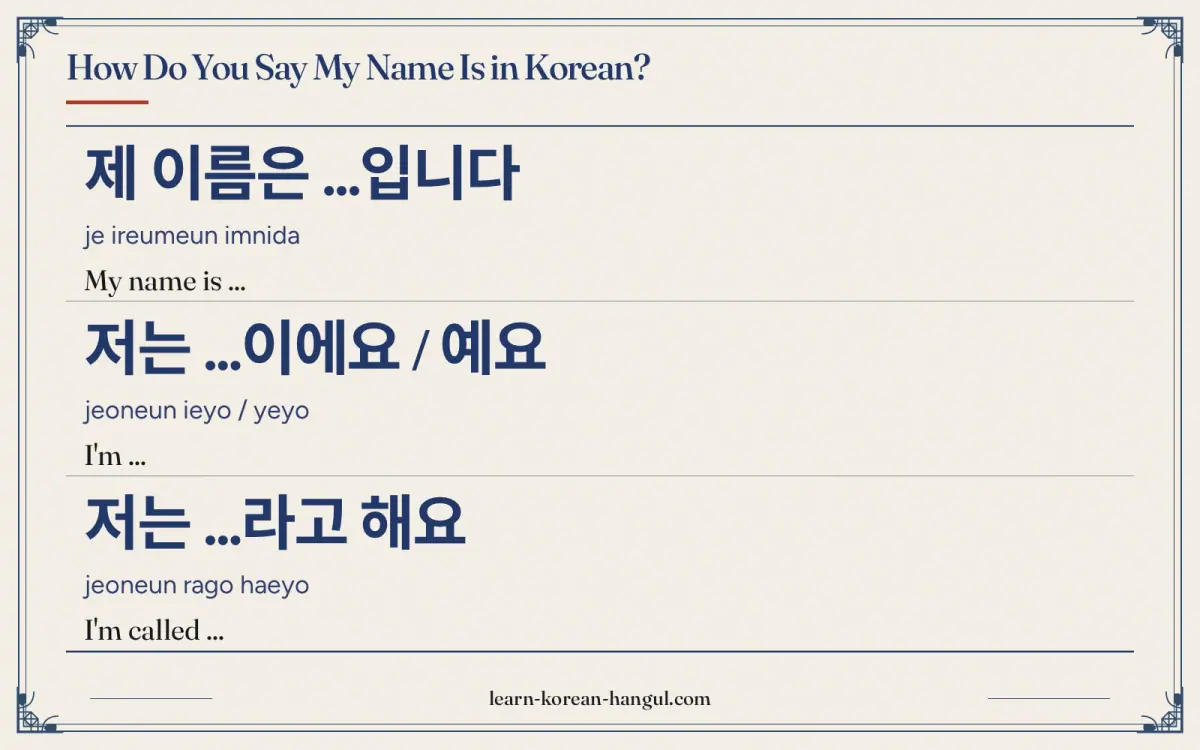
The standard way to say my name is in Korean is 제 이름은 [name]입니다 in formal speech and 제 이름은 [name]이에요 or 예요 in polite speech. The sentence has three parts: 제 (my), 이름은 (name, as the topic) and your name with an ending that means "is".
| Form | Korean | Romanization | Meaning | Best for |
|---|---|---|---|---|
| Formal | 제 이름은 ...입니다 | je ireumeun imnida | My name is ... | Interviews, speeches, seniors |
| Polite | 제 이름은 ...이에요 / 예요 | je ireumeun ieyo / yeyo | My name is ... | Everyday first meetings |
| Polite | 저는 ...이에요 / 예요 | jeoneun ieyo / yeyo | I'm ... | Shops, classes, small talk |
| Polite | 저는 ...라고 해요 | jeoneun rago haeyo | I'm called ... | Giving a name or nickname |
| Casual | 나는 ...야 | naneun ya | I'm ... | Friends and younger people |
제 is the contracted form of 저의, the humble "my", so it already shows respect. 이름은 uses the topic particle 은/는, which marks what the sentence is about. Each form is explained below with an example.
What Are the Formal, Polite and Casual Ways to Say My Name Is?
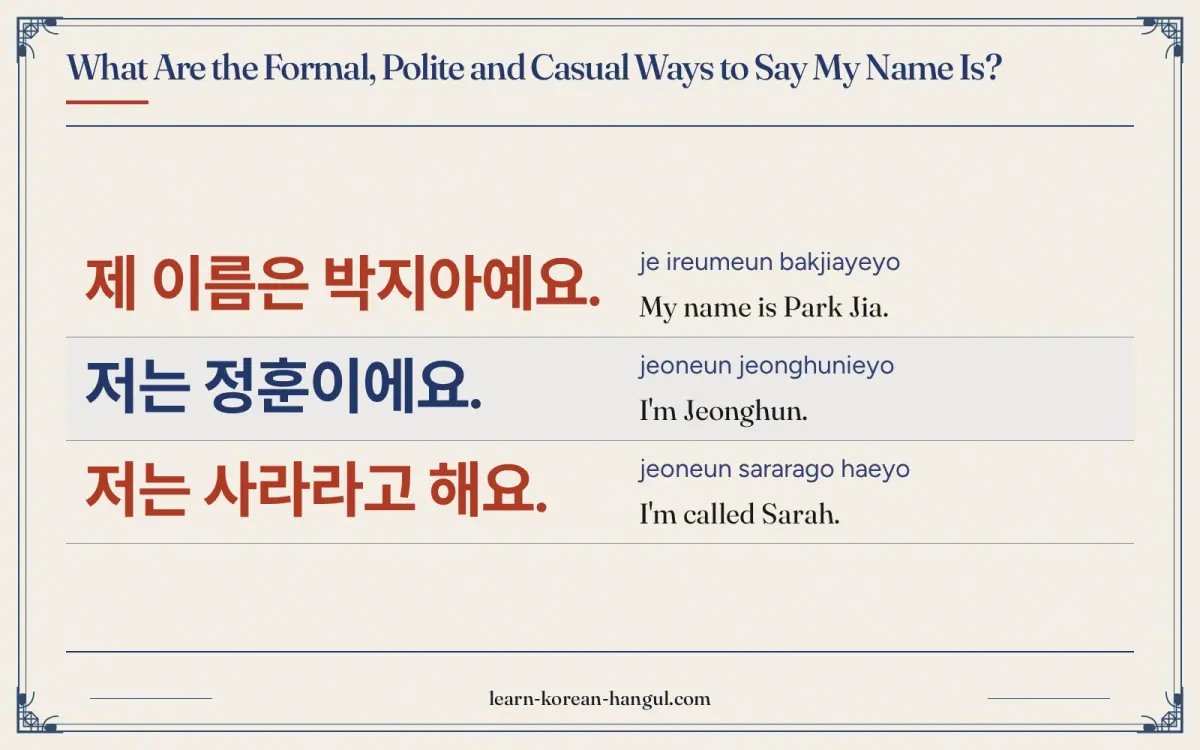
Korean changes the sentence ending to match the listener, a system called speech levels. The guide to Korean speech levels covers all of them, and this page uses three: formal (합쇼체), polite (해요체) and casual (해체). The same name sits inside every form.
Formal: 제 이름은 ...입니다 (je ireumeun imnida)
Formal · 합쇼체제 이름은 ...입니다 is the introduction for job interviews, presentations, speeches and meetings with people clearly senior to you. 입니다 needs no change for any name, whether it ends in a consonant or a vowel.
안녕하세요. 제 이름은 이서연입니다.
annyeonghaseyo. je ireumeun iseoyeonimnida
Hello. My name is Lee Seoyeon.
Polite: 제 이름은 ...이에요 (je ireumeun ieyo)
Polite · 해요체제 이름은 ...이에요 is the friendly default for classes, shops, clubs and meeting a neighbour. After a name that ends in a vowel, 이에요 shortens to 예요, so 박지아 takes 예요: 박지아예요.
제 이름은 박지아예요.
je ireumeun bakjiayeyo
My name is Park Jia.
Polite: 저는 ...이에요 (jeoneun ieyo)
Polite · 해요체저는 ...이에요 drops 이름 and says "I am ..." directly. Native speakers use it more often than the longer sentence, because the name is already the point of the introduction. 저 is the humble "I", and 는 marks it as the topic.
저는 정훈이에요.
jeoneun jeonghunieyo
I'm Jeonghun.
정훈 ends in the consonant ㄴ, so the ending is 이에요 and the two sounds link, giving [정후니에요].
Polite: 저는 ...라고 해요 (jeoneun rago haeyo)
Polite · 해요체저는 ...라고 해요 literally means "I am called ...". It suits nicknames, English names and moments when you want to say "you can call me ...". After a name ending in a consonant, the particle becomes 이라고, as in 정훈이라고 해요.
저는 사라라고 해요.
jeoneun sararago haeyo
I'm called Sarah.
Casual: 나는 ...야 (naneun ya)
Casual · 반말나는 ...야 is for friends, classmates your age and children. Use 야 after a vowel and 이야 after a consonant: 나는 민수야 but 나는 정훈이야. Never use it with a teacher, a coworker or any stranger older than you.
나는 민수야.
naneun minsuya
I'm Minsu.
Five forms may feel like a lot, but you only need two to start: 저는 ...이에요/예요 for most people and 제 이름은 ...입니다 for formal moments. The next step is making them sound right.
How Do You Pronounce 제 이름은 ...입니다?
제 이름은 김민수입니다 is pronounced [제 이르믄 김민수임니다], with the sounds of 이름은 linked and the ㅂ of 입 turned into an m. Say it slowly in four beats.
- 제 (je): like "jeh", short and light.
- 이르믄 (ireumeun): the written 이름은 is read as i-reu-meun.
- 김민수 (gim-min-su): your name, with the surname first.
- 임니다 (im-ni-da): the written 입니다, with "im" instead of "ip".
Sound Changes to Listen For
Two rules explain every difference between the spelling and the sound.
- Liaison (연음). A final consonant moves to an empty ㅇ in the next syllable. The ㅁ of 이름 moves onto 은, so 이름은 sounds like [이르믄]. See Korean liaison.
- ㅂ becomes ㅁ before ㄴ. The National Institute of Korean Language Standard Pronunciation rules (표준 발음법) turn the ㅂ of 입 into ㅁ before the ㄴ of 니, giving [임니다]. See ㅂ-to-ㅁ nasalization.
Knowing the sound is half the skill; the other half is knowing when each form is appropriate.
When Should You Use 제 이름은 ...입니다, and When Should You Not?
Use 제 이름은 ...입니다 when the situation is formal or the listener is clearly senior to you. Use 저는 ...이에요 or 예요 for everyday introductions, and keep 나는 ...야 for friends. Pick the form before you speak, because Korean listeners hear the ending first.
Situations Where It Fits
- Job interview or company meeting. 안녕하세요. 제 이름은 이서연입니다.
- Speech or self-introduction to a group. Start with 안녕하세요, then 제 이름은 ...입니다.
- Meeting a friend's parents. 안녕하세요. 저는 민수 친구 지아예요. (Hello. I'm Jia, Minsu's friend.)
- Class or club. 저는 ...이에요 is friendly without being stiff.
Situations to Avoid
- Strangers or elders with 나는 ...야. It sounds childish or rude.
- Chatting with classmates using 제 이름은 ...입니다. Too stiff for a casual group; 저는 ...예요 is warmer.
- Adding 씨 to your own name. See the culture section.
A short exchange shows how the forms sound in real conversation.
What Does My Name Is Sound Like in a Real Conversation?
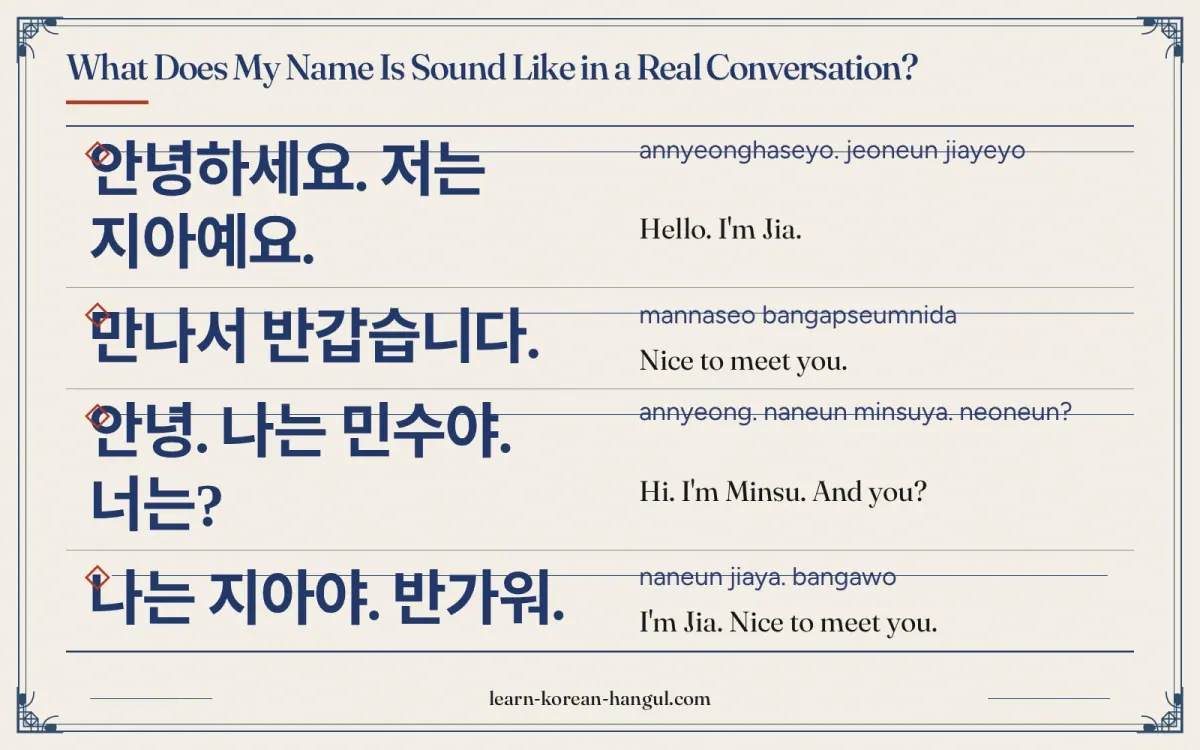
A name introduction is usually the second line of the meeting, right after the hello. The listener replies with their own name and 만나서 반갑습니다 (nice to meet you).
First Day of Korean Class
Minsu
안녕하세요. 제 이름은 김민수입니다.
annyeonghaseyo. je ireumeun gimminsuimnida
Hello. My name is Kim Minsu.
Jia
안녕하세요. 저는 지아예요.
annyeonghaseyo. jeoneun jiayeyo
Hello. I'm Jia.
Jia
만나서 반갑습니다.
mannaseo bangapseumnida
Nice to meet you.
What to notice: Minsu uses the formal form with the full name, and Jia answers with the shorter polite form and only her given name. Both are correct. The reply 만나서 반갑습니다 is the topic of nice to meet you in Korean.
Meeting a Classmate Your Age
Minsu
안녕. 나는 민수야. 너는?
annyeong. naneun minsuya. neoneun?
Hi. I'm Minsu. And you?
Jia
나는 지아야. 반가워.
naneun jiaya. bangawo
I'm Jia. Nice to meet you.
What to notice: 너는? (and you?) is the casual way to hand the turn over. The polite version is what's your name in Korean.
A Foreign Name at a Language Exchange
Sarah
안녕하세요. 저는 사라라고 해요.
annyeonghaseyo. jeoneun sararago haeyo
Hello. I'm called Sarah.
Jeonghun
사라 씨, 반갑습니다. 저는 정훈이에요.
sara ssi, bangapseumnida. jeoneun jeonghunieyo
Sarah, nice to meet you. I'm Jeonghun.
What to notice: Jeonghun adds 씨 to Sarah's name because he is speaking to her, while Sarah never added it to her own. The same exchange leads naturally to where are you from in Korean. These habits come from how Korean treats names.
What Should You Know about the Culture behind My Name Is?
Korean names are said surname first, then the given name, and people avoid dropping the surname in formal introductions. In 김민수, 김 (Kim) is the surname and 민수 (Minsu) is the given name, which usually has two syllables.
- Full name first, given name after. In a formal setting, say the full name once: 제 이름은 김민수입니다. Afterwards, others may call you by the given name plus 씨 (민수 씨) or by the full name plus 씨.
- Titles belong to other people. 씨 (Mr, Ms) and 님 (a more respectful suffix) are attached to someone else's name, never your own.
- Foreign names are written in Hangul by sound. John becomes 존 and Sarah becomes 사라. Learn to write your own with the guide to your name in Korean.
- Names often carry meaning. Many given names are built from Chinese-character roots; the guide to Korean name meaning explains how they work.
An expert insight: learners often add 제 이름은 to every introduction. In everyday speech, 저는 지아예요 is shorter, more natural and just as polite. Keep 제 이름은 for the moment when you want the name to stand out. The word itself is covered in name in Korean, which is useful when you need to ask for a name in writing.
What Mistakes Do Learners Make with My Name Is in Korean?
Most mistakes in this introduction come from copying the English word order or from picking an ending without checking the listener.
| Mistake | Why it is a problem | Fix |
|---|---|---|
| 이름은 김민수입니다 (no 제) | Sounds like "the name is Kim Minsu" and drops "my" | Say 제 이름은 김민수입니다 |
| 저는 김민수 씨입니다 | 씨 is for other people, not for yourself | Say 저는 김민수입니다 |
| 나는 민수야 to a teacher or stranger | Casual speech sounds rude or childish | Say 저는 민수예요 |
| 정훈예요 or 지아이에요 | The ending does not match the last sound | Say 정훈이에요 and 지아예요 |
| Reading 입니다 as "ip-ni-da" | Sounds foreign | Say [임니다] |
Learners often assume 이에요 is always correct. Actually, after a vowel, 예요 is the normal contraction of 이에요, and the uncontracted 지아이에요 is rarely heard. Choose by the last sound of the name: consonant gets 이에요, vowel gets 예요.
Is It the Same as My Name Is Formal or My Name Is Casual?
Not quite. Each of the searches below points to one form on this page, and the short answers show which.
- My name is formal in Korean: 제 이름은 ...입니다.
- My name is casual in Korean: 나는 ...야, only with friends and younger people.
- I am called in Korean: 저는 ...라고 해요, or 저는 ...라고 합니다 in formal speech.
- Introduce my name in Korean: 안녕하세요. 저는 ...예요/이에요. 만나서 반갑습니다.
- Hi, my name is in Korean: 안녕하세요, 저는 ...예요/이에요. The casual 안녕, 나는 ...야 is only for friends.
The one-line summary is that the polite 저는 ...이에요 or 예요 covers almost every meeting, and the other forms add formality or friendliness. Time to practise.
Practice: Say It Aloud
Play the slow clip of 제 이름은 김민수입니다 three times and say it with your own name. Then choose a form for each situation. Answers follow.
- You introduce yourself in a job interview.
- You meet a classmate your age on the first day.
- Your name is 정훈 and you meet a neighbour.
- You want to say you are called Sarah.
Answers
- 안녕하세요. 제 이름은 ...입니다.
- 안녕. 나는 ...야.
- 저는 정훈이에요.
- 저는 사라라고 해요.
The phrase flashcards drill these forms with audio.
Related Phrases to Learn Next
An introduction leads straight into a question about the other person and a greeting, so these are the natural next phrases.
- What's your name in Korean: 이름이 뭐예요? and its polite versions.
- Nice to meet you in Korean: 만나서 반갑습니다 and its relatives.
- Where are you from in Korean: the next question in most introductions.
This guide belongs to the introduce yourself in Korean collection. What this page does not cover: writing your own name in Hangul, Korean name meanings and Chinese-character roots, which have their own lessons. Match the ending to the listener and the final sound of your name, and you can say my name is in Korean in any first meeting.
Frequently Asked Questions
What is the difference between 제 이름은 ...입니다 and 제 이름은 ...이에요?
Both mean my name is ... and both are polite. 입니다 belongs to the formal style used in interviews, speeches and first meetings with seniors. 이에요 or 예요 belongs to the polite style used in everyday introductions. If you are unsure, 이에요 or 예요 sounds friendly and is never wrong with strangers.
Should I add 씨 or 님 to my own name?
No. Honorific words such as 씨 and 님 are for other people. Adding 씨 to your own name sounds as if you were honouring yourself, which Korean listeners find odd. Say 저는 김민수입니다, not 저는 김민수 씨입니다. Use 씨 only when you speak to or about someone else, as in 민수 씨.
How do I say my name if it ends in a consonant or a vowel?
Check the last sound of your name in Hangul. After a consonant, use 이에요 or 이라고: 정훈이에요, 정훈이라고 해요. After a vowel, use 예요 or 라고: 지아예요, 지아라고 해요. The formal 입니다 needs no change, so 정훈입니다 and 지아입니다 both work.
Can I say my name in Korean without saying 제 이름은?
Yes. In real conversation, 저는 민수예요 (I am Minsu) is more common than 제 이름은 민수예요, because the name is obvious from context. Use 제 이름은 when you want to stress the name itself, for example when writing it down or spelling it for someone.
How do I introduce my name when my name is not Korean?
Write your name in Hangul the way it sounds, then add the ending. John becomes 존, so you say 존이에요. Sarah becomes 사라, so you say 사라예요. Say the name slowly once, then repeat it, because Korean listeners may need a second hearing for a foreign name.