This page explains how Korean given names are built and why you cannot read a meaning off the Hangul alone. It covers the three sources of names, the sound-first habit of parents, the shared syllable some families give to a whole generation, and a short method for finding what a name means. It also answers a question many learners type into a search box: what is my Korean name, and can my birthday decide it? For the family-name half of a name, see Korean last names. For example names, see Korean girl names and Korean boy names, and for using a name in conversation, see how to address people by name. Every name topic is gathered on the Korean names hub.
Korean Name Meaning: the Essentials
A Korean given name is usually two syllables, and each syllable normally stands for a hanja (Chinese character) or a native Korean word. The sound is chosen first, the meaning second. Names come from three sources:
| Source | What it is | Example | How common |
|---|---|---|---|
| Hanja-based | Each syllable is matched with a Chinese character that has a meaning | 민준 (敏 quick + 俊 excellent, one possible pair) | Most names |
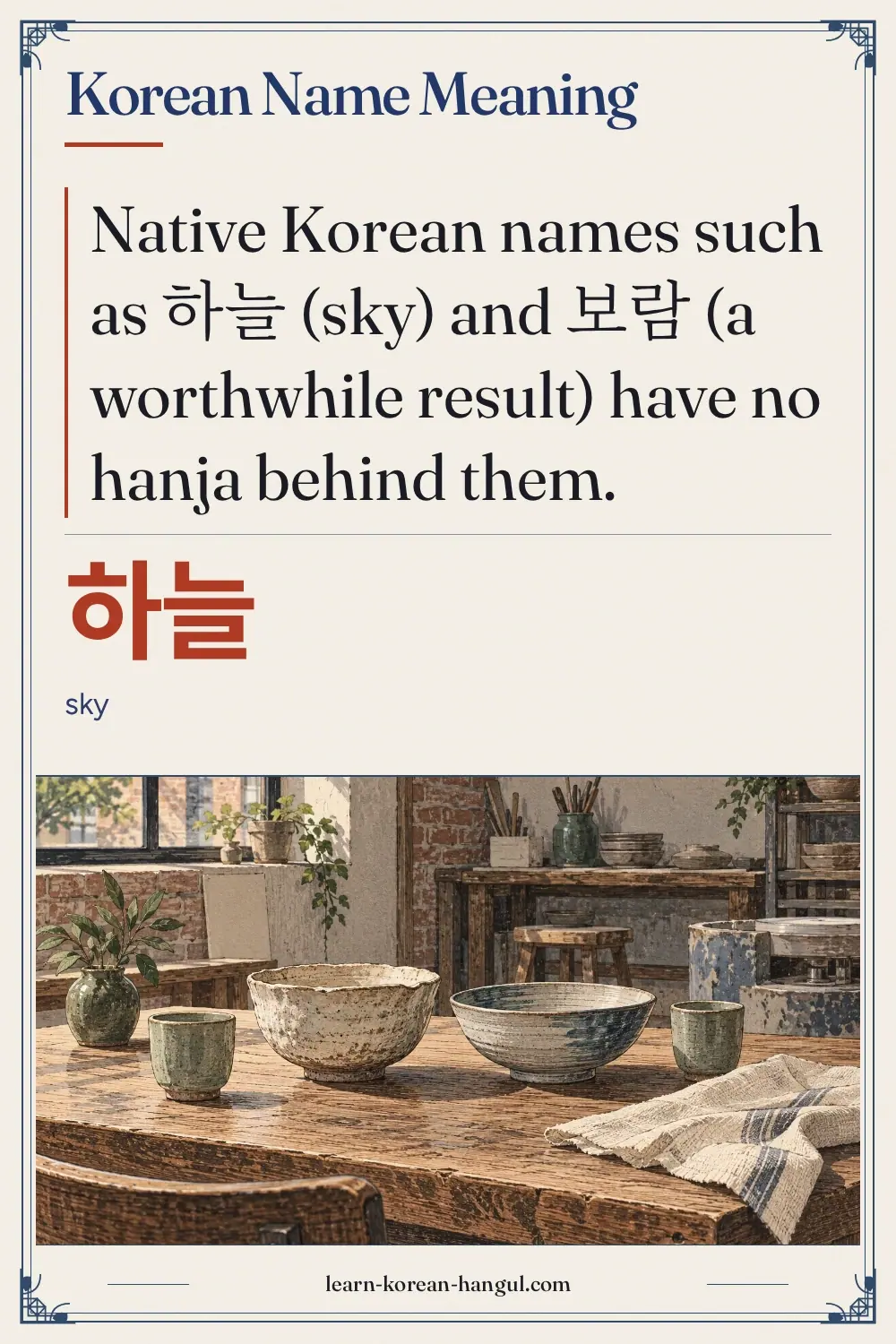
| Native Korean | A pure Korean word, with no hanja behind it | 하늘 (haneul, "sky") | A clear minority |
| Loan or foreign-sound | A sound taken from another language and written in Hangul | A name chosen to be easy to say abroad | Rare |
This page keeps to the pattern and gives no counts, because fashions shift from year to year. Anyone who needs a figure should look for a current survey from the civil registration authorities or the courts.
The key idea is that Hangul records sound. 민 on its own could stand for many characters, and the meaning belongs to whichever one the family picked. Two people called 민준 may have different hanja and different meanings, and a person may not know their own hanja unless the family told them.
How Is a Korean Name Built?

A Korean name has a one-syllable surname followed by a two-syllable given name, written together without spaces. Take 김민준 (Gim Minjun):
| Part | Hangul | Role | One possible reading |
|---|---|---|---|
| Surname | 김 | Family name | 金 |
| First given-name syllable | 민 | In some families, the generation syllable (돌림자) | 敏 (quick, clever) |
| Second given-name syllable | 준 | The personal syllable, or the shared one in some families | 俊 (excellent, talented) |
Spoken, the whole name is [김민준] with no sound change at the joints. Both syllables of the given name carry weight, and in Korean you can address someone by the two-syllable given name, as in 민준 씨, or in a casual friendship with the given name alone, as in 민준아. Names with one given syllable or three also exist, but two is the usual length.
What Are Hanja-Based Names?
Hanja-based names choose a Chinese character for each syllable, so the name has a meaning you can look up. Korean has many characters that share one sound, and that is both the charm and the difficulty. The Sino-Korean sound 민 could belong to several characters:
| Sound | Character | Meaning | Sound | Character | Meaning |
|---|---|---|---|---|---|
| 민 | 民 | people | 준 | 俊 | excellent |
| 민 | 敏 | quick, clever | 준 | 峻 | high, steep |
| 민 | 珉 | a fine jade-like stone | 준 | 準 | standard, level |
| 서 | 瑞 | auspicious | 지 | 智 | wisdom |
| 서 | 書 | book, writing | 지 | 知 | to know |
| 서 | 序 | order | 지 | 志 | will, purpose |
Each row is an example of one sound with several characters, which is why two people with the same Hangul name can have different meanings. A parent who likes the sound 서연 may then pick 瑞 and 蓮 ("auspicious lotus"), or other characters, to match what they hope for.
The meaning of a character name is a hope. Parents choose characters that express a wish: wisdom, brightness, health, kindness. They are not claims about the person. A name such as 지호 may be written 智浩 ("wise and vast") in one family and with other characters in another.
Hanja-based names make up the bulk of Korean given names because Sino-Korean vocabulary is large in Korean generally. Read more in the lesson on Sino-Korean vocabulary and in the comparison of Hangul and hanja.
Why Does One Sound Have so Many Characters?
Korean has far fewer distinct syllables than Chinese has characters. Each Chinese character was given a Korean reading when Sino-Korean words entered the language, and many characters landed on the same syllable. The overlap is why a Korean name sounds the same for many meanings. Hearing 화 you cannot tell whether the speaker means 花 (flower), 火 (fire), 和 (harmony) or 華 (splendid) without the written form.
What Are Native Korean Names?
Native Korean names use pure Korean words, so the meaning is open to anyone who knows the word. They are a smaller group, and they became more visible in recent decades as parents looked for names that did not depend on hanja. Common choices come from nature and from virtues.
| Name | Hangul | RR | Meaning |
|---|---|---|---|
| Haneul | 하늘 | Haneul | sky |
| Boram | 보람 | Boram | a worthwhile result, a sense of reward |
| Garam | 가람 | Garam | river (an older word) |
| Iseul | 이슬 | Iseul | dew |
| Seulgi | 슬기 | Seulgi | wisdom, good sense |
| Narae | 나래 | Narae | wing |
Native names are easy to explain, because the name is the word. A person called 하늘 can answer the question about meaning in one sentence.
제 이름은 하늘이에요.
je ireumeun haneurieyo.
My name is Haneul.
하늘이라는 뜻이에요.
haneuriraneun tteusieyo.
It means "sky".
In the first sentence 이름은 is said [이르믄] and 하늘이에요 is said [하느리에요], because the final consonants link to the vowels that follow. In the second, 뜻이 is said [뜨시]. Many native names can also be given hanja at registration. Others, like the loan or foreign-sound names, do not have hanja at all, and the Hangul form is the whole name.
Foreign-sound names are the third and smallest source. Parents may choose a sound that is easy to say in another language and write it in Hangul. Some of these names later receive a hanja pair, so the line between categories is loose.
How Do You Read a Name, Step by Step?
Three walk-throughs show the method. Each one is an illustration of how the pieces fit, with the usual caution that other hanja are possible.
서연 (Seoyeon). Split it into 서 and 연. One possible pair is 瑞 (auspicious) and 蓮 (lotus), which a family might read as a wish for a lucky, pure life. Another family could use 序 and 然, or a different pair. The Hangul sound is the same in all of them. It is said [서연].
지호 (Jiho). Split it into 지 and 호. One possible pair is 智 (wisdom) and 浩 (vast). Another is 志 (will) and 昊 (sky). Again the sound is fixed and the meaning is the family's choice. It is said [지호].
하늘 (Haneul). This one needs no split, because it is a native word of two syllables that means "sky". There is no hanja to look up, so the Hangul spelling is the whole meaning.
The same checking habit works on every name you meet. First decide whether the name could be a native word. If it is, look it up as a word. If not, treat each syllable as a Sino-Korean sound and ask for the characters.
How Do You Talk about a Name's Meaning in Korean?
You say the meaning with a short pattern: the name, then 라는 뜻이에요 ("it means ..."). For hanja you can name the characters one by one. A friend might explain their name like this.
슬기 지, 넓을 호예요.
seulgi ji, neolbeul hoyeyo.
It is the ji of "wisdom" and the ho of "wide".
지혜롭다는 뜻이에요.
jihyeropdaneun tteusieyo.
It means wise.
The first line follows the traditional way of naming a character by its meaning plus its sound, so 슬기 지 is "the ji that means wisdom". It is said [슬기 지, 널블 호예요]. The second is said [지혜롭따는 뜨시에요]. When a friend explains their name this way, you can reply 좋은 이름이에요 ("It is a nice name") before you ask anything more.
Do Koreans Have Other Names besides the Official One?
Yes, several, and each has a different job.
- 태명 (taemyeong). A nickname that parents give a baby during pregnancy, used until birth and sometimes a while after. It is a common practice today.
- 아명 (amyeong). A childhood name used in earlier times, before the official name was given. It is mostly historical now.
- 호 (ho). A pen name or art name, used by scholars and artists in the past and by some calligraphers and writers today.
- Nicknames and English names. Many Koreans use a short nickname with friends, and some use an English name at work or abroad.
None of these replaces the registered name, which is the one on legal documents.
How Do Parents Choose a Name?
Parents choose the sound first and the characters second, and they weigh several things at once. These are the common considerations:
- How it sounds with the surname. A given name should flow after the family name. Parents say the full name aloud many times before deciding.
- The meaning of the characters. They match the sound to characters whose meanings express a wish.
- The look of the name. Some parents check how the characters balance when written.
- Family rules. Some families give a fixed syllable to a whole generation. This is the next topic.
Traditionally a child was not given the same name as an elder, and writing or saying an elder's name aloud was avoided. Modern families vary widely, and many follow none of these rules. Family preferences about sound, meaning and shared syllables are choices rather than universal requirements.
What Is a Generation Syllable (돌림자)?
A 돌림자 (dollimja, "turning character") is one syllable of the given name that all members of one generation in a family share. Brothers and cousins of the same generation get it, and the next generation receives a different one. It is also called a 항렬자 (hangnyeolja) in genealogy terms, and the order of these syllables is set by the clan's genealogy book.
| Generation | Example names | Shared syllable |
|---|---|---|
| Cousins, generation A | 김재민, 김재호, 김재현 | 재 |
| Cousins, generation B | 김민수, 김민석 | 민 |
These names are made-up illustrations, and the shared syllable may be the first or the second one of the given name, depending on the family. A 돌림자 appears in some families and not in others, and many modern families drop it. When a family keeps the custom, the shared syllable often follows a pattern, such as a rotation through the five elements (wood, fire, earth, metal, water) shown by a radical in the character. Treat any such rule as a family or clan tradition, not a national one.
Some modern parents do something that looks similar but is not a 돌림자. They give siblings names that share a first sound, such as 서준 and 서연. That is a stylistic echo, with no genealogy rule behind it.
How Can You Find the Meaning of a Name?
You find the meaning of a Korean name by finding the hanja or the native word. Follow these steps in order:
- Write the name in Hangul, one syllable at a time: 민, 준.
- Ask which characters the family used. A polite way to ask is 한자로 어떻게 써요? ("How do you write it in hanja?").
- Look each character up in a hanja dictionary and read the meanings.
- If the name is a native word, look the word up in the National Institute of Korean Language dictionary (표준국어대사전) or its open dictionary 우리말샘.
- Treat the result as a family's intention. A name means what the parents meant by it, and different families may have meant different things by the same Hangul spelling.
이름 뜻이 뭐예요?
ireum tteusi mwoyeyo?
What does your name mean?
한자로 어떻게 써요?
hanjaro eotteoke sseoyo?
How do you write it in hanja?
The first sentence is said [이름 뜨시 뭐예요]. The second is said [한자로 어떠케 써요], where ㅎ joins the ㄱ of 어떻게 to make a single aspirated ㅋ sound. Ask these questions only after you have been introduced, as the answer may be a long story in some families.
What Is My Korean Name Based on My Birthday?
Your Korean name is not based on your birthday, and no official system turns a birth date into a name. Websites that turn a date into a "Korean name" are entertainment. They are not how Koreans name children.
What you can do depends on what you want:
- Write your own name in Hangul. This is the usual answer for a visitor. You keep your own name and spell its sound with Hangul letters. The Hangul for names page walks through it, and the romanization of Korean names page shows the reverse direction.
- Introduce yourself. The my name is in Korean page teaches the ready-made sentences, and the name in Korean page covers the word 이름.
- Choose a Korean name for use in class or fandom. Pick a surname such as 김 or 이, then a two-syllable given name whose sound you like. Decide whether you want a native word or hanja. Write it in Hangul, and make clear that it is a chosen name and not a registered one.
- Ask a Korean teacher or friend. They can suggest a name that fits your sound and avoids an awkward meaning.
Which Names Carry Love, Fire, Flower, Hope or Light?
Searches often ask for names that mean one idea, so here is a short guide. These are examples of syllables, not rankings, and a hanja may be used in many names.
| Idea | Native word | Hanja | Name syllable |
|---|---|---|---|
| Love | 사랑 (sarang) | 愛 | 애 |
| Flower | 꽃 (kkot) | 花 | 화 |
| Hope | 바람 (baram, "wish") | 希 | 희 |
| Light | 빛 (bit) | 光, 明 | 광, 명 |
| Fire | 불 (bul) | 火 | 화 |
Two cautions apply. First, the sound 화 is shared by 花 (flower) and 火 (fire), and it is also the word 화 for anger, so a name with this syllable is read differently by different families. A name built on "fire" is therefore a less obvious choice than one built on "flower". Second, a Hangul name never tells you which character is intended. For an English speaker, a name that "means" something in a list online often carries other meanings too.
Do All Korean Names Have a Meaning?
Almost every Korean name was chosen with a meaning in mind, but the meaning can be faint. Some parents choose the sound first and treat the character as a detail. Some people do not know which hanja is written in their own family register. And a name can have more than one reading, which is why it is better to ask than to guess.
How Are Names Registered?
Korean names are registered in Hangul, and the family can also record the hanja. The hanja allowed in given names come from an official list of characters for names (인명용 한자), set by the courts and revised from time to time. A character outside the list cannot be registered as part of a name, so the list shapes which meanings are available. Check the Supreme Court's current regulation if you need the exact rule.
What Mistakes Should You Avoid?
These are the errors that come up most when learners work with Korean names.
- Treating a Hangul spelling as a meaning. 민준 is a sound. The meaning belongs to the characters behind it, so a website that prints one "meaning" for a Hangul name is guessing.
- Trusting a single list online. A list of "Korean names and meanings" often picks one hanja pair for each name. Another family may have chosen a different pair.
- Mixing up the sound of your name with a Korean meaning. If you write your own name in Hangul, the result is a spelling of English sounds. It does not mean anything in Korean, and that is fine.
- Asking an unprompted personal question too soon. Asking about someone's hanja is friendly once you know them, but a stranger may not know the answer.
- Forgetting that some names are gender-neutral. Many native names and many hanja syllables are used for both boys and girls, so a meaning list rarely tells you the person's gender.
A better habit is to ask, listen and write down what the person tells you. Their answer is the real meaning of their name.
Quick Practice
Read each name and say what kind it is:
- 하늘 is a native word (sky), with no hanja needed.
- 서연 is usually a Sino-Korean name, with several possible hanja pairs.
- 보람 is a native word that means a worthwhile result.
- 지호 is a Sino-Korean name with several possible hanja pairs.
If you hear a name and want its meaning, ask 한자로 어떻게 써요? and then look up each character.
Frequently Asked Questions
Do All Korean Names Have a Meaning?
Almost all are chosen with a meaning in mind, either through hanja or a native Korean word, but the meaning can be faint. Some parents choose the sound first, and some people never learn which hanja is in their family register. Because one Hangul sound can be written with many characters, ask the family before you assume a meaning.
Can I Find the Meaning of My Korean Name?
Yes, if you have a Korean name. Write each syllable, ask which hanja the family used, and look each character up in a hanja dictionary. For a native word such as 하늘, check the National Institute of Korean Language dictionary. If you only have a Hangul spelling of your own name, it has no Korean meaning, because it is only a sound.
How Do Korean Parents Choose Names?
Parents consider the sound with the surname, the meaning of the characters and family customs. Some choose a native Korean word instead of hanja, and some families share a generation syllable. These choices vary between families; ask which characters were chosen before assuming a name’s meaning.
Can Two People Share the Same Hanja in Their Names?
Yes. Hanja are shared freely, and common characters such as 智 (wisdom) and 俊 (excellent) appear in thousands of names. Only a family generation syllable (돌림자) is a deliberate shared syllable, and it is shared inside one family, not across a country.
What Is My Korean Name Based on My Birthday?
Your birthday does not decide your Korean name. Websites that turn a date into a Korean name are entertainment. To get a Korean-style name, write your own name in Hangul or choose a surname plus a two-syllable given name whose sound and meaning you like, and ask a Korean teacher to check it.