
This page compares the two languages for English speakers who are starting Korean. It shows the same sentence side by side, then goes through sounds, politeness, spelling and vocabulary, and ends with a ranking of the differences that cost learners the most time. For the broader question of difficulty, see whether Korean is hard to learn, and for the first grammar lessons see basic Korean grammar.
Korean Language vs English: the Essentials
For an English speaker, Korean is harder to speak and easier to spell. The grammar needs a new mental model, because the verb comes last and every noun carries a particle, but there are no articles, no gender and no plural agreement. This is how the verdict changes with the type of learner.
Quick verdict by learner type
- Grammar lover: Korean rewards you. The rules are regular, and most patterns repeat.
- Learner who hates spelling: Korean wins. Hangul spells sounds almost perfectly, which English does not.
- Learner who needs speed to a first conversation: Plan for months, not weeks, because almost nothing carries over from English. Learn a small set of polite phrases first.
- Learner who worries about politeness: Expect to choose a speech level in every sentence. The safe default is the polite 해요 style.
- Learner with a good ear: The three-way consonant contrast will take work, and training the ear helps more than reading rules.
How Do They Compare Overall?
The master table compares Korean and English on ten criteria. Every cell holds a specific value.
| Criterion | Korean | English |
|---|---|---|
| Basic word order | Subject, object, verb (SOV) | Subject, verb, object (SVO) |
| Marking roles | Particles after the noun (은/는, 이/가, 을/를) | Word order and prepositions |
| Articles (a, the) | None | a, an, the |
| Plural | Optional marker 들; often unmarked | Usually -s |
| Gender of nouns | None | None (only in pronouns) |
| Verb forms | Endings for tense, politeness and mood | A few forms, with auxiliary verbs |
| Politeness | Built into verb endings and honorific verbs | Built into word choice and tone |
| Sounds | Plain, tense and aspirated consonants; final consonants | Voiced and voiceless pairs; stress |
| Spelling | Almost perfectly regular, 24 basic letters | Irregular, 26 letters |
| Vocabulary | Native Korean, Sino-Korean and English loanwords | Germanic, French and Latin layers |
The pattern behind the table is simple. Korean is stricter about marking who does what, and English is stricter about marking number and definiteness. The next sections take the main differences one at a time.
How Do Word Order and Particles Differ?
Korean puts the verb at the end of the sentence and marks each noun with a particle, while English puts the verb in the middle and uses word order. Here is one sentence aligned word by word.
| English | Korean | |
|---|---|---|
| Sentence | I ate lunch with a friend. | 저는 친구와 점심을 먹었어요. |
| Reading | (not applicable) | jeoneun chinguwa jeomsimeul meogeosseoyo |
| Word by word | I-topic friend-with lunch-object ate | 저는 · 친구와 · 점심을 · 먹었어요 |
저는 친구와 점심을 먹었어요.
jeoneun chinguwa jeomsimeul meogeosseoyo.
I ate lunch with a friend.
The Korean sentence is said [저는 친구와 점시믈 머거써요]. Four ideas are visible in it.
- The verb is last. 먹었어요 ("ate") closes the sentence.
- Particles mark roles. 는 marks the topic (저), 와 means "with" (친구), and 을 marks the object (점심).
- There is no word for "a". 친구 alone covers "a friend", "the friend" or "friends", and context decides.
- The meaning stays if the order of the other parts changes. 점심을 저는 친구와 먹었어요 is possible, because the particles show the roles. Only the verb must stay last.
The common particles have English equivalents of different kinds.
| Particle | Job | English approximation |
|---|---|---|
| 은/는 | Marks the topic | "as for ..." |
| 이/가 | Marks the subject | the subject of the sentence |
| 을/를 | Marks the object | the object of the verb |
| 에 | Place, time or direction | at, to, in |
| 에서 | Place of an action | at, in |
| 와/과 | Together with | with, and |
English has prepositions that come before the noun, and Korean has particles that come after it. A beginner often forgets the particle, and Koreans often drop it in casual speech, so you will hear both. Dropping the subject is also normal. 점심 먹었어요? can mean "Did you eat lunch?" with no pronoun, since context supplies "you". The Korean particles guide goes through each one.
Winner on word order and particles: English, because it is closer to what you already know. Korean takes longer here, but its roles are marked more clearly.
How Do Negatives and Questions Differ?
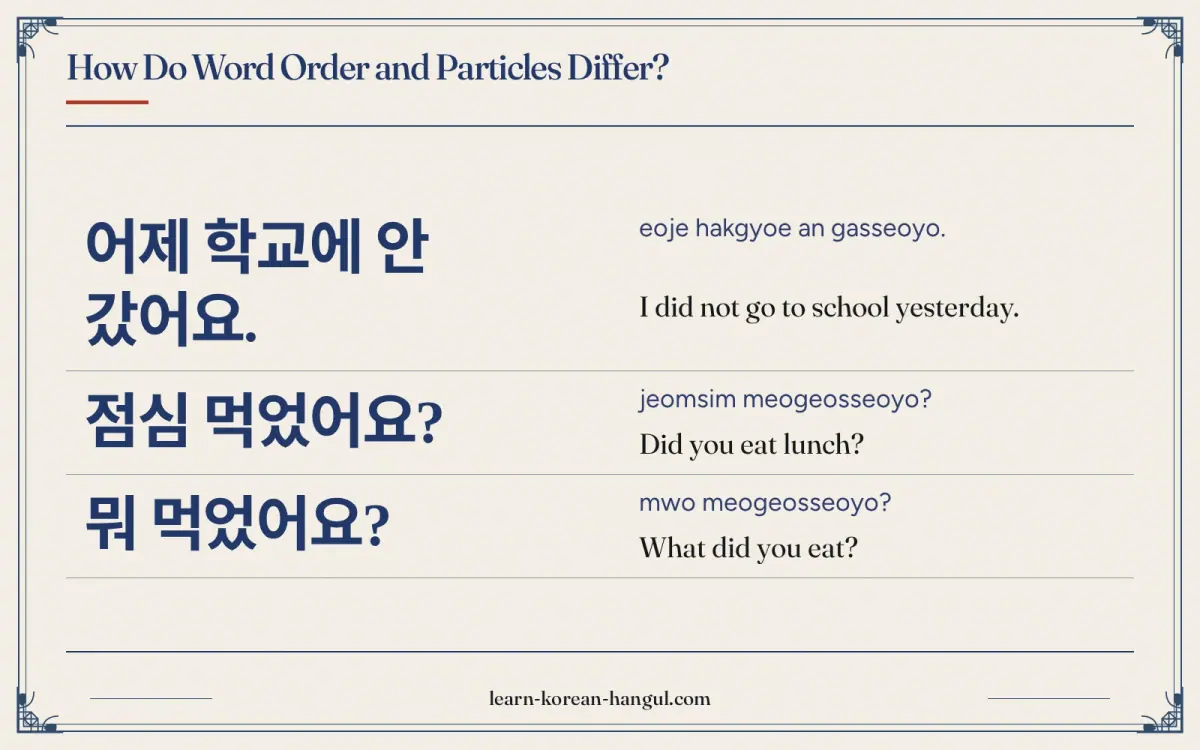
Negatives and questions are simpler in Korean than in English, because Korean adds no helper verb and moves no words. Compare three short sentences.
| English | Korean | Reading |
|---|---|---|
| I did not go to school yesterday. | 어제 학교에 안 갔어요. | eoje hakgyoe an gasseoyo |
| Did you eat lunch? | 점심 먹었어요? | jeomsim meogeosseoyo |
| What did you eat? | 뭐 먹었어요? | mwo meogeosseoyo |
어제 학교에 안 갔어요.
eoje hakgyoe an gasseoyo.
I did not go to school yesterday.
점심 먹었어요?
jeomsim meogeosseoyo?
Did you eat lunch?
뭐 먹었어요?
mwo meogeosseoyo?
What did you eat?
The first is said [어제 학꾜에 안 가써요]. Negation is a small word, 안, placed before the verb, with no "do" or "did". The second is a yes-or-no question, and it is the same words as the statement 점심 먹었어요 with a rising end. The third is a question with a question word. In English the word "what" moves to the front and "did" appears. In Korean 뭐 stays where the answer would go. Wh-questions do not end with a sharp rise: the stress falls on 뭐, and the end of the sentence often falls or rises and then falls, because a sharp final rise could turn 뭐 into "something".
How Do Sounds Differ?
Korean sounds differ from English in three ways that matter early: the consonant series, the final consonants and the sound changes between syllables.
A three-way consonant contrast. English separates voiced and voiceless pairs, such as b and p. Korean separates plain, tense and aspirated consonants, which differ in tension and breath, not in voicing. Three words show it.
| Word | Hangul | RR | Meaning | Starting sound |
|---|---|---|---|---|
| moon | 달 | dal | moon | plain |
| daughter | 딸 | ttal | daughter | tense |
| mask | 탈 | tal | mask | aspirated |
Final consonants that are not released. English lets you release a final consonant with a small puff, as in "cap". Korean stops the sound, and different letters collapse into seven final sounds. Three common words show the idea.
| Spelling | Spoken form | Meaning |
|---|---|---|
| 밖 | [박] | outside |
| 부엌 | [부억] | kitchen |
| 앞 | [압] | front |
Sound changes across syllables. Letters change their sound next to certain neighbours. The word 같이 ("together") is said [가치], and 한국말 ("the Korean language") is said [한궁말]. These changes follow rules, so they can be learned, and the batchim pronunciation lessons teach them.
Some English sounds are missing, too. Korean has no f, v or z, so English words are adapted: coffee becomes 커피 (keopi) and party becomes 파티 (pati). Korean rhythm is also different, since it is closer to even syllable timing than to English stress.
Winner on sounds: English, for an English speaker. The contrast and the final consonants need real ear training.
How Do Politeness Systems Differ?
Korean builds politeness into the verb, so you must choose a speech level in nearly every sentence, while English expresses politeness through words like "please" and "sir". The same idea, "eat", changes with the listener:
| Style | Korean | RR | When to use |
|---|---|---|---|
| Casual | 먹어 | meogeo | With close friends and younger people |
| Polite | 먹어요 | meogeoyo | The safe default with strangers and in daily life |
| Formal | 먹습니다 | meokseumnida | News, presentations and service settings |
| Honorific | 드세요 | deuseyo | Asking an older person to eat |
The spoken forms are [머거], [머거요], [먹씀니다] and [드세요]. The honorific form uses a different verb, 드시다, in place of 먹다.
Korean also avoids the word "you" with people you should respect. Instead of 당신 you use a name with 씨, a title such as 선생님, or no pronoun at all. The honorifics 씨 and 님 lesson explains the pattern, and the speech levels hub covers the full set.
Winner on politeness: English is easier for a beginner. Korean's system is regular once learned, but it asks for a decision every time you speak.
How Does Spelling Compare?
Korean spelling is much easier than English spelling, because each Hangul letter stands for one sound and the rules have few exceptions. English has words like "though", "through", "tough" and "cough" with the same letters and different sounds. A learner of Korean can read an unfamiliar word aloud after learning 24 basic letters, usually in a week or two.
Korean is not perfectly phonetic, though. The writing keeps the shape of each word root, and the pronunciation changes at the joins, as 같이 [가치] shows. That is a rules problem, not a memory problem. English has no such rules to learn, only lists.
Korean also has spacing rules. Words are separated by spaces, but particles and endings attach to the word before them. This differs from English, where each word stands apart, and it is one reason a Korean sentence can look like fewer, longer words.
Winner on spelling: Korean, clearly.
How Different Is the Vocabulary?
Korean vocabulary has three layers, and English has a similar layered history. Korean words are native Korean, Sino-Korean (from Chinese roots) or borrowed from English and other languages. A Sino-Korean word often sounds formal, and the native word sounds plain. The Sino-Korean vocabulary page shows how the layers work.
English loanwords are the part that helps an English speaker. Many are written in Hangul with Korean sounds:
| Hangul | RR | Meaning | Note |
|---|---|---|---|
| 커피 | keopi | coffee | Same word, Korean sound |
| 노트북 | noteubuk | laptop | "Notebook" means laptop |
| 에어컨 | eeokeon | air conditioner | Shortened from "air conditioner" |
| 셀카 | selka | selfie | A Korean-made short form |
| 핸드폰 | haendeupon | mobile phone | "Hand phone", a Korean-made word |
Words like these are sometimes called Konglish. They look like English but follow Korean rules, so a word can mean something different from the English word you expect. Listen before you guess.
Which Differences Matter Most for Learners?
Five differences cost English speakers the most time. They are listed here in the order most learners meet them.
- The verb comes last, and the ending carries a lot. Tense, politeness and mood all sit in the ending, so you must hear the end of a sentence to know what it says.
- Particles mark every role. Choosing 은/는 or 이/가 is the hardest early particle decision.
- No articles, and number is often unmarked. You must learn to let the context say what "a" and "the" say in English.
- Speech levels. You choose a level, and choosing wrong is noticed more than a grammar slip.
- Sounds and spacing. The three-way consonant contrast, the unreleased finals and the sound changes between syllables take months to settle.
The good news is that several things that trouble English learners are missing. Korean has no noun gender, no subject-verb agreement, and no articles. Irregular verbs exist, but they fall into seven groups with predictable rules, not a long list of one-off forms:
| Group | Dictionary form | Polite form |
|---|---|---|
| Regular | 먹다 (eat) | 먹어요 |
| ㅂ irregular | 춥다 (cold) | 추워요 |
| ㄷ irregular | 듣다 (listen) | 들어요 |
| ㅡ irregular | 바쁘다 (busy) | 바빠요 |
English irregular verbs such as "go, went, gone" have to be learned one by one. A Korean ㅂ verb like 춥다 follows the same rule as every other ㅂ verb.
Where Are Korean and English Alike?
The two languages are unrelated, but they share more than the tables suggest.
- Both mark time. Korean and English both have past, present and future forms, and both can talk about habits, plans and finished events.
- Both borrow heavily. English took much of its vocabulary from French and Latin, and Korean took much of its vocabulary from Chinese. Both languages therefore have a plain native layer and a more formal borrowed layer.
- Both have homophones. Korean 배 means "pear", "stomach" and "ship", and English "bat" has several meanings. Context decides in both.
- Both change with the listener. English shifts between "Hey" and "Good morning, sir". Korean does the same, but it writes the shift into the verb.
- Both have question words that carry the focus. In each language the question word receives the stress.
Seeing these shared features helps because they show that Korean is not an exotic exception. It is another human language with its own settings for the same dials.
How Should an English Speaker Study with These Differences in Mind?
Use the differences as a study order. This sequence puts the biggest differences first.
- Learn Hangul in a week. It removes the biggest barrier and makes every later step easier. The 7-day Hangul course is a short path.
- Learn the verb-last pattern with five short sentences. Say each one aloud until the verb at the end feels natural.
- Add particles one at a time. Start with 은/는 and 을/를, then add 이/가 and 에.
- Use 해요 style for everything at first. It is polite and safe, and it keeps you from juggling levels.
- Train your ear on the three-way contrast. Spend a few minutes a day on pairs such as 달, 딸 and 탈.
- Keep the sound rules for the second month. Once you can read, the changes at syllable joins are easier to see.
Is Korean Harder than English?
It depends who is learning. For a native English speaker, Korean is much harder than Spanish or French, because almost nothing is shared. The U.S. Foreign Service Institute (FSI) places Korean in Category IV, its hardest group for native English speakers, at about 88 weeks (2,200 class hours) of full-time training to reach professional working proficiency. Check the current figure on state.gov before quoting it.
For a native Korean speaker, English is also hard. Articles, plural endings, the difference between "r" and "l", and sounds such as "f" and "th" are all new, and English spelling has to be memorised word by word. Neither language is "easy", and each has its own hardest part.
Where Does This Comparison Fall Short?
The comparison is a map. Three limits apply.
- Individual learners vary. A learner who speaks Japanese will find Korean grammar easier than the table suggests, and a learner who speaks Spanish will find nothing special about English articles.
- Difficulty depends on the goal. Reading a menu is a week of work. Understanding fast spoken Korean is a long project.
- Tables simplify. Real speech mixes styles, drops particles and breaks the rules that this page lists.
Frequently Asked Questions
Is Korean Harder than English?
For a native English speaker, yes: the U.S. Foreign Service Institute places Korean in Category IV, its hardest group, at about 88 weeks (2,200 class hours) of full-time training. Check the current figure on state.gov. For a native Korean speaker, English is also hard, because of articles, plurals, spelling and sounds such as f and th.
Does Korean Have Articles?
No. Korean has no word for a, an or the. A bare noun such as 친구 can mean a friend, the friend or friends, and context decides. Learners usually find this a relief at first and then have to learn to hear the difference between a new topic and an already known one through the particles 이/가 and 은/는.
Why Is Korean Spelling Easier than English?
Each Hangul letter stands for one sound, and a learner can read a new word aloud after learning 24 basic letters. English spells the same sound many ways. Korean is not perfectly phonetic, because sounds change at syllable joins, as in 같이 [가치], but those changes follow rules that can be learned.
Which Has More Irregular Verbs, Korean or English?
English has a couple of hundred irregular verbs, each learned one by one, such as go, went, gone. Korean irregular verbs fall into seven groups (ㅂ, ㄷ, ㅅ, ㅎ, 르, ㄹ and ㅡ), and every verb in a group follows the same rule. Korean irregulars are therefore easier to predict, though they still take practice.
The Bottom Line
Korean language vs English is a contrast between a verb-final, particle-marked language with built-in politeness and a verb-in-the-middle language with articles and irregular spelling. For an English speaker, Korean is harder to speak and easier to spell. Start with Hangul, learn the verb-last pattern early, and treat particles and speech levels as habits to build, not as rules to memorise.