
Korean Consonants Flashcards: Study the 19 Cards
This is the full-set deck. Use it when you already know some letters and want one mixed session, or as a review after the three smaller decks. The lesson behind it is Korean consonants, where each letter has its own page. If you are new, start with the smaller basic Korean consonants flashcards and come back here.
How Do I Use These Flashcards?
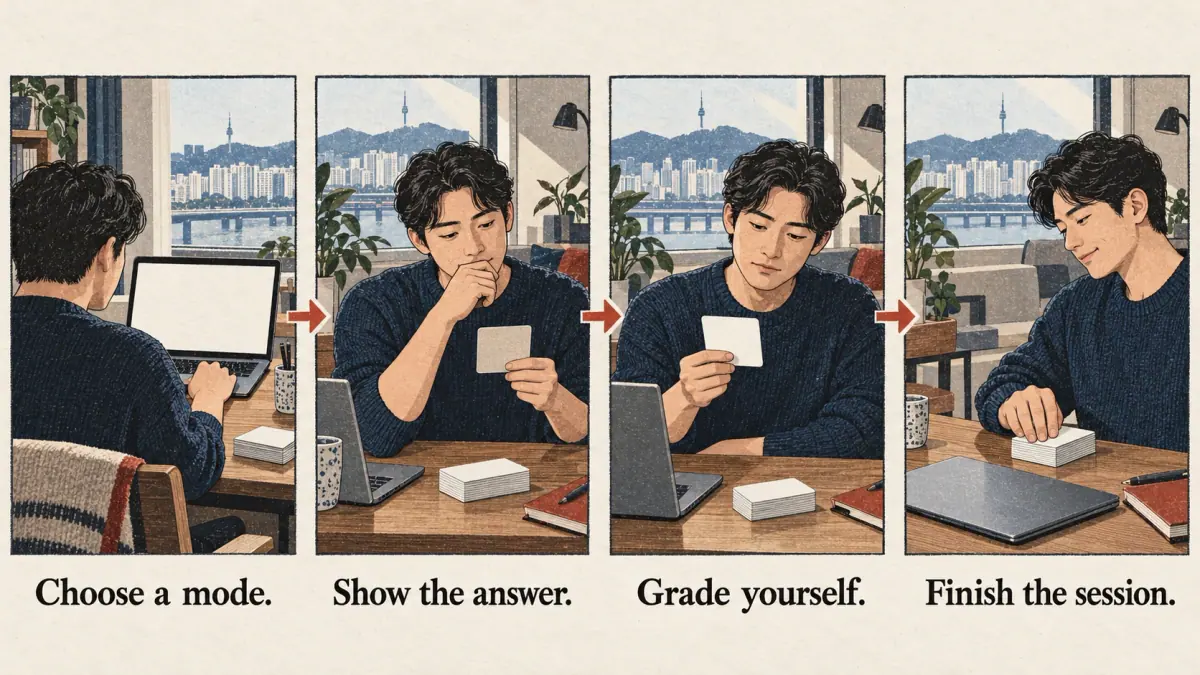
Use the deck above in four steps. It works with tap, click or keyboard, and nothing plays until you press an audio button.
- Choose a mode. Start with recognition (Hangul to meaning). Switch to recall (meaning to Hangul) or listening (audio to meaning) once recognition feels easy.
- Show the answer. Think of the answer first, then press Show answer (or Space). Turn on the romanization toggle only if you need it; the 19-card table below always shows it.
- Grade yourself. Press Got it if you answered correctly without help, or Not yet if you hesitated or guessed.
- Finish the session. A session holds up to 20 cards (you can set 10, 20 or 40). With 19 cards, one session fits the whole deck, but a first-time learner should split it across two days, using the default limit of 10 new cards a day.
What Do the Three Modes Do?
Recognition shows the Hangul and asks for the meaning, which trains reading. Recall shows the meaning and asks for the Hangul, which trains remembering; you may type the answer with your Hangul keyboard or just recall it in your head. Listening plays a clip and hides the letters, which trains the ear. Listening mode only uses a card once its audio is approved, and cards without approved audio are skipped in that mode with a note.
What Do Got It and Not yet Do?
Got it moves the card up one Leitner box, so it returns later. Not yet sends the card back to box 1, so it returns in the same session or within 10 minutes. The grades are your own judgement; the deck does not score you or claim fluency.
Deck Scope: What Is and Is Not Covered
The deck covers all 19 consonants: 10 basic letters (ㄱ ㄴ ㄷ ㄹ ㅁ ㅂ ㅅ ㅇ ㅈ ㅎ), 4 aspirated letters (ㅋ ㅌ ㅍ ㅊ) and 5 tense letters (ㄲ ㄸ ㅃ ㅆ ㅉ). Each card gives the letter name, a sound hint and one example word. Textbooks that count 14 basic consonants include the four aspirated letters in the basic set; this deck splits them to match the site lessons.
What Is Left out of This Deck?
Vowels are in the Hangul vowels flashcards. The way a final consonant sounds at the end of a syllable has its own deck, the Korean batchim flashcards. Letter names have a separate drill, and words that contrast plain, tense and aspirated sounds are in the minimal pairs deck.
All 19 Cards in One Table
All 19 cards appear below, grouped in deck order. The table is plain HTML, so you can read, search or print it without the deck.
| # | Hangul | Revised Romanization | Meaning | Note | Audio assetId |
|---|---|---|---|---|---|
| 1 | ㄱ | g / k | giyeok: g at the start of a word, k at the end of a syllable | Example: 고기 (gogi, meat). | au-pg-flashcards-consonants-1; slow: au-pg-flashcards-consonants-20 |
| 2 | ㄴ | n | nieun: n as in "no" | Example: 나무 (namu, tree). | au-pg-flashcards-consonants-2 |
| 3 | ㄷ | d / t | digeut: d at the start, t at the end of a syllable | Example: 다리 (dari, leg or bridge). | au-pg-flashcards-consonants-3 |
| 4 | ㄹ | r / l | rieul: a light flap r between vowels, l at the end of a syllable | Example: 라디오 (radio, radio). | au-pg-flashcards-consonants-4; slow: au-pg-flashcards-consonants-21 |
| 5 | ㅁ | m | mieum: m as in "mom" | Example: 모자 (moja, hat). | au-pg-flashcards-consonants-5 |
| 6 | ㅂ | b / p | bieup: b at the start, p at the end of a syllable | Example: 바지 (baji, trousers). | au-pg-flashcards-consonants-6 |
| 7 | ㅅ | s | siot: s, closer to sh before ㅣ | Example: 사과 (sagwa, apple). | au-pg-flashcards-consonants-7 |
| 8 | ㅇ | silent / ng | ieung: silent at the start of a syllable, ng at the end | Examples: 아이 (ai, child) and 강 (gang, river). | au-pg-flashcards-consonants-8; slow: au-pg-flashcards-consonants-22 |
| 9 | ㅈ | j | jieut: a soft j, with the tongue flat behind the teeth | Example: 주스 (juseu, juice). | au-pg-flashcards-consonants-9 |
| 10 | ㅎ | h | hieut: h as in "hat" | Example: 하나 (hana, one). | au-pg-flashcards-consonants-10 |
| 11 | ㅋ | k | kieuk: aspirated k, a k with a puff of air | Example: 커피 (keopi, coffee). | au-pg-flashcards-consonants-11 |
| 12 | ㅌ | t | tieut: aspirated t, a t with a puff of air | Example: 택시 (taeksi, taxi). | au-pg-flashcards-consonants-12 |
| 13 | ㅍ | p | pieup: aspirated p, a p with a puff of air | Example: 피자 (pija, pizza). | au-pg-flashcards-consonants-13 |
| 14 | ㅊ | ch | chieut: aspirated ch, a ch with a puff of air | Example: 치킨 (chikin, fried chicken). | au-pg-flashcards-consonants-14 |
| 15 | ㄲ | kk | ssanggiyeok: tense k, no puff of air and a tight throat | Example: 까치 (kkachi, magpie). | au-pg-flashcards-consonants-15 |
| 16 | ㄸ | tt | ssangdigeut: tense t, no puff of air | Example: 딸 (ttal, daughter). | au-pg-flashcards-consonants-16 |
| 17 | ㅃ | pp | ssangbieup: tense p, no puff of air | Example: 빵 (ppang, bread). | au-pg-flashcards-consonants-17 |
| 18 | ㅆ | ss | ssangsiot: tense s, a firm hiss | Example: 쌀 (ssal, uncooked rice). | au-pg-flashcards-consonants-18 |
| 19 | ㅉ | jj | ssangjieut: tense j, no puff of air | Example: 짜다 (jjada, to be salty). | au-pg-flashcards-consonants-19 |
How Do I Read the Table?
Hangul is the letter. Revised Romanization (RR) is a learning aid: when two forms are shown, the first is the sound before a vowel and the second is the sound at the end of a syllable. Meaning gives the letter name and a sound hint, the Note column gives an example word, and the last column lists the audio assetId. A second ID in a row marks a slow clip.
Usage Notes for These Cards
The 19 consonants fall into sound families. The plain letters are ㄱ ㄷ ㅂ ㅈ, the aspirated letters are ㅋ ㅌ ㅍ ㅊ, and the tense letters are ㄲ ㄸ ㅃ ㅉ. ㅅ and ㅆ form a plain and tense pair, and ㄴ ㅁ ㄹ ㅇ ㅎ stand outside those families as nasals, a liquid and a breathy sound.
Each tense letter is its plain letter written twice: ㄱ becomes ㄲ, ㄷ becomes ㄸ, ㅂ becomes ㅃ, ㅅ becomes ㅆ and ㅈ becomes ㅉ. Each aspirated letter adds a stroke to its plain letter: ㄱ becomes ㅋ, ㄷ becomes ㅌ and ㅈ becomes ㅊ. ㅂ becomes ㅍ too, but ㅍ is redrawn as a new shape, so learn it on its own.
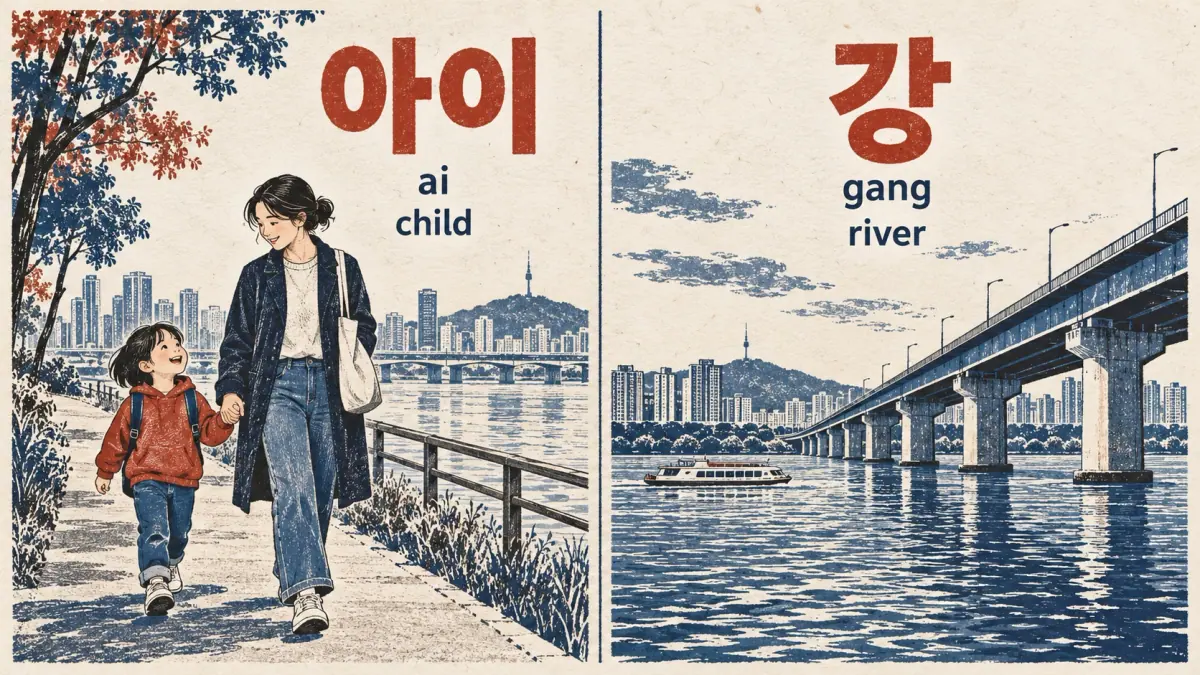
ㅇ does two jobs. At the start of a syllable it is silent, so 아이 (ai, child) is just a and i. At the end of a syllable it is ng, so 강 (gang, river) ends with a real nasal sound.
ㄹ covers both English r and l. Between vowels it is a light tap, as in 다리 (dari, leg), and at the end of a syllable it is an l sound, as in 물 (mul, water).
Which Sounds Do Not Match the Spelling?

ㄱ ㄷ ㅂ ㅈ sound softer between vowels and harder at the start of a phrase. 아기 (agi, baby) is close to "agi", while a lone 기 is closer to "ki". Revised Romanization shows g, d, b, j for these letters, so it hides the change.
At the end of a syllable the final sound of ㄱ ㅋ ㄲ is an unreleased k, as in 책 (chaek, book) and 부엌 (bueok, kitchen). This is called final sound neutralization, and the batchim deck drills it.
ㅅ sounds like "sh" before ㅣ, so 시 is closer to "shee" than to "see", even though Revised Romanization writes si.
What Mistakes Do Learners Make with Korean Consonants?

- Reading ㅇ as ng everywhere. At the start of a block it is silent, so 아이 is "a-i", not "nga-ngi".
- Treating ㅋ and ㄱ as the same sound. ㅋ carries a puff of air that you can feel on your palm.
- Adding a puff to the tense letters. ㄲ ㄸ ㅃ ㅆ ㅉ are tight and airless.
- Memorising romanization instead of shapes. Cover the RR column and read the Hangul first.
Mixed sets are the best test of these mistakes, so shuffle the deck once the three groups feel separate.
How Does the Review Schedule Work?
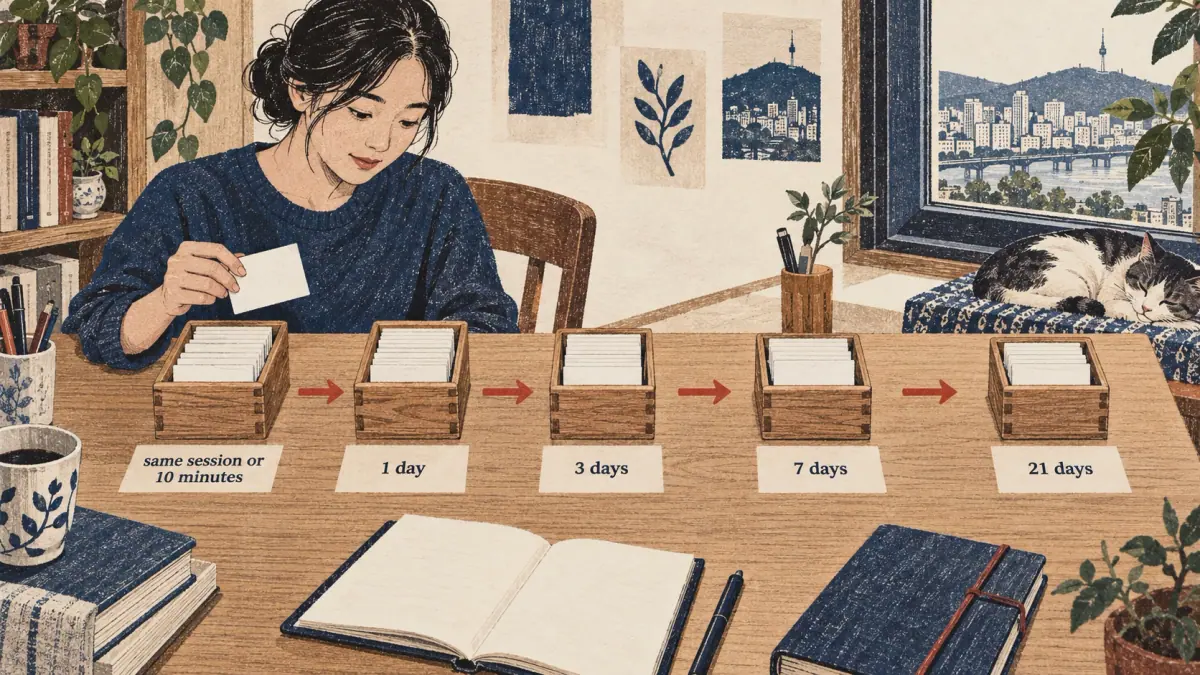
The deck uses a simplified Leitner system with five boxes. A new card starts in box 1. Each Got it moves it up one box, and each Not yet returns it to box 1. The box sets how long the card waits before it is due again.
| Box | Wait until the next review |
|---|---|
| 1 | same session or 10 minutes |
| 2 | 1 day |
| 3 | 3 days |
| 4 | 7 days |
| 5 | 21 days |
Each session shows due cards first, oldest due first, and then up to 10 new cards a day by default. A deck of 19 cards is introduced over two days at the default of 10 new cards a day, then the later boxes bring each card back at longer gaps. Progress is saved only in this browser, so clearing site data deletes it. Use the export button to save a small JSON file with card IDs, boxes and due dates, and import it on another device. No account is needed.
Cultural and Practical Context
King Sejong's scholars designed the consonants to show where the tongue and mouth sit, which is why the five base shapes ㄱ ㄴ ㅁ ㅅ ㅇ look like articulators. The alphabet was promulgated in 1446 in the Hunminjeongeum. The shapes you drill on these cards come from that design.
Limits of This Deck
This deck teaches letter recognition and a first sound, not the full sound-change rules that apply between syllables. Revised Romanization is only an approximation. All Korean text and example words are generated, and Min-ji Park reviewed and signed off the text and audio on 15 October 2026.
Next Steps after the Korean Consonants Flashcards
After this deck, move on to the basic Korean consonants flashcards if you want a smaller set, or to the vowel decks. Test yourself with the Korean consonants quiz, explore shapes in the interactive hangul alphabet, and see every deck in the Hangul flashcards list or the Korean flashcards hub.
Frequently Asked Questions
How Many Consonants Are in Hangul?
Hangul has 19 consonants: 14 basic letters (ㄱ ㄴ ㄷ ㄹ ㅁ ㅂ ㅅ ㅇ ㅈ ㅊ ㅋ ㅌ ㅍ ㅎ) and 5 tense letters made by doubling ㄱ ㄷ ㅂ ㅅ ㅈ. Together with 21 vowels they make the 40 letters of the alphabet. This deck teaches all 19 consonants with one example word each.
What Is the Difference between ㄱ, ㅋ and ㄲ?
All three are k-like sounds made at the back of the tongue. ㄱ is plain, with a light release. ㅋ is aspirated, with a strong puff of air. ㄲ is tense, with a tight throat and no puff. Revised Romanization writes them g or k, k and kk, so the audio matters more than the spelling.
Why Does ㅇ Have No Sound at the Start of a Syllable?
Hangul syllables are built as consonant, vowel and optional final, so a syllable that starts with a vowel needs a placeholder in the consonant slot. ㅇ fills it silently, which is why 아 is written with a circle. At the end of a syllable the same letter sounds like ng.
Do I Need to Learn the Consonant Names as Well as Their Sounds?
Learn the sounds first, because reading needs sounds. The names, such as 기역 for ㄱ, matter when you spell a word aloud or follow a textbook. This deck shows each name in the Meaning column, and a separate letter names deck drills them once you can read the letters.
Is My Progress Saved If I Close the Page?
Yes, in the same browser on the same device. Card boxes and due dates are stored locally and nothing is sent to a server. Clearing site data, using a private window or switching browsers removes them, so use the export button to keep a backup file that you can import later. No account is needed.