
Basic Korean Consonants Flashcards: Study the 10 Cards
Each card pairs one letter with its name, its sound and one example word. The letters follow the dictionary order of the basic consonants, so the order you learn them is also the order you will meet them when you look up words. The lesson behind these cards is basic Korean consonants, so read it first if a letter is new.
How Do I Use These Flashcards?

Use the deck above in four steps. It works with tap, click or keyboard, and nothing plays until you press an audio button.
- Choose a mode. Start with recognition (Hangul to meaning). Switch to recall (meaning to Hangul) or listening (audio to meaning) once recognition feels easy.
- Show the answer. Think of the answer first, then press Show answer (or Space). Turn on the romanization toggle only if you need it; the 10-card table below always shows it.
- Grade yourself. Press Got it if you answered correctly without help, or Not yet if you hesitated or guessed.
- Finish the session. A session holds up to 20 cards (you can set 10, 20 or 40). With 10 cards, one session covers the whole deck, and a second pass 10 minutes later is enough for the first day.
What Do the Three Modes Do?
Recognition shows the Hangul and asks for the meaning, which trains reading. Recall shows the meaning and asks for the Hangul, which trains remembering; you may type the answer with your Hangul keyboard or just recall it in your head. Listening plays a clip and hides the letters, which trains the ear. Listening mode only uses a card once its audio is approved, and cards without approved audio are skipped in that mode with a note.
What Do Got It and Not yet Do?
Got it moves the card up one Leitner box, so it returns later. Not yet sends the card back to box 1, so it returns in the same session or within 10 minutes. The grades are your own judgement; the deck does not score you or claim fluency.
Deck Scope: What Is and Is Not Covered
The deck covers the 10 consonants ㄱ ㄴ ㄷ ㄹ ㅁ ㅂ ㅅ ㅇ ㅈ ㅎ. The site lists 14 basic consonants in total, and these 10 are the ones that are neither aspirated nor tense. Each card gives the letter name (for example giyeok for ㄱ), the sound in Revised Romanization (RR) and one everyday word that starts with the letter.
What Is Left out of This Deck?
The four aspirated letters ㅋ ㅌ ㅍ ㅊ are in the Korean aspirated consonants flashcards, and the five tense letters ㄲ ㄸ ㅃ ㅆ ㅉ come after them. Vowels, syllable blocks and final consonants (batchim) have separate decks. If you want all 19 consonants in one session, use the Korean consonants flashcards.
All 10 Cards in One Table
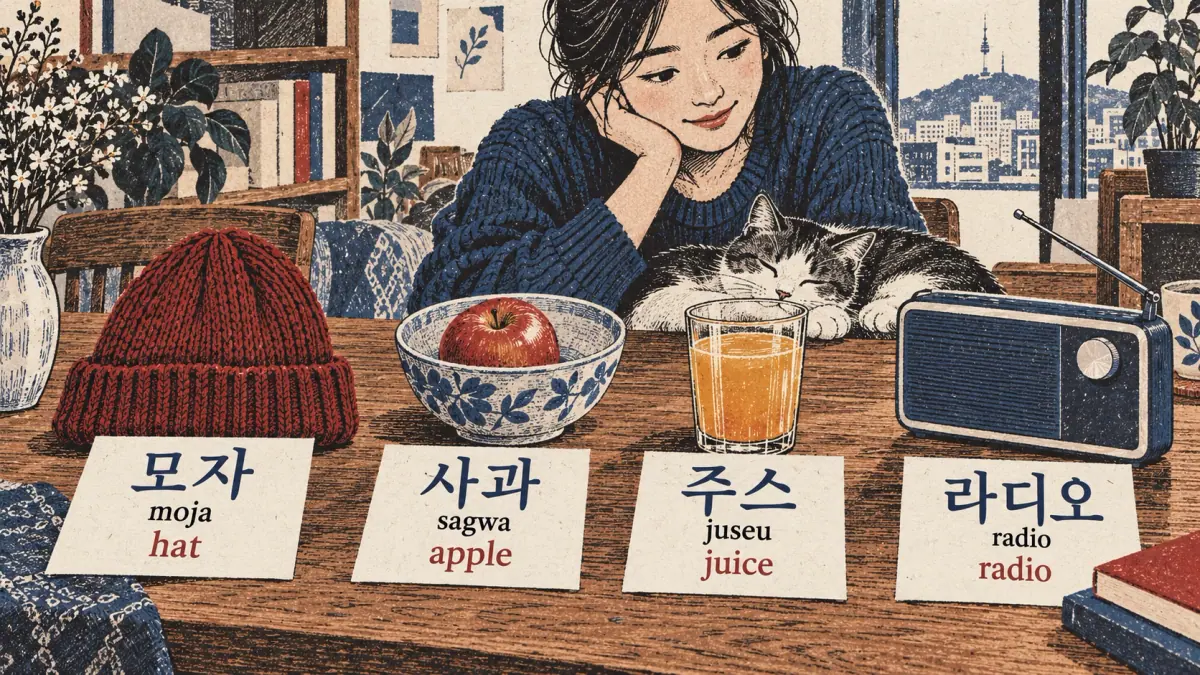
The table lists every card in the deck, in the same order as the deck above. It is plain HTML, so you can read it, search it or print it without running the deck.
| # | Hangul | Revised Romanization | Meaning | Note | Audio assetId |
|---|---|---|---|---|---|
| 1 | ㄱ | g / k | giyeok: g at the start of a word, k at the end of a syllable | Example: 고기 (gogi, meat). | au-pg-flashcards-basic-consonants-1; slow: au-pg-flashcards-basic-consonants-11 |
| 2 | ㄴ | n | nieun: n as in "no" | Example: 나무 (namu, tree). | au-pg-flashcards-basic-consonants-2 |
| 3 | ㄷ | d / t | digeut: d at the start, t at the end of a syllable | Example: 다리 (dari, leg or bridge). | au-pg-flashcards-basic-consonants-3 |
| 4 | ㄹ | r / l | rieul: a light flap r between vowels, l at the end of a syllable | Example: 라디오 (radio, radio). | au-pg-flashcards-basic-consonants-4; slow: au-pg-flashcards-basic-consonants-12 |
| 5 | ㅁ | m | mieum: m as in "mom" | Example: 모자 (moja, hat). | au-pg-flashcards-basic-consonants-5 |
| 6 | ㅂ | b / p | bieup: b at the start, p at the end of a syllable | Example: 바지 (baji, trousers). | au-pg-flashcards-basic-consonants-6 |
| 7 | ㅅ | s | siot: s, closer to sh before ㅣ | Example: 사과 (sagwa, apple). | au-pg-flashcards-basic-consonants-7 |
| 8 | ㅇ | silent / ng | ieung: silent at the start of a syllable, ng at the end | Examples: 아이 (ai, child) and 강 (gang, river). | au-pg-flashcards-basic-consonants-8 |
| 9 | ㅈ | j | jieut: a soft j, made with the tongue flat behind the teeth | Example: 주스 (juseu, juice). | au-pg-flashcards-basic-consonants-9 |
| 10 | ㅎ | h | hieut: h as in "hat" | Example: 하나 (hana, one). | au-pg-flashcards-basic-consonants-10 |
How Do I Read the Table?
Hangul is the letter. Revised Romanization (RR) is the official romanization system of South Korea, shown as a learning aid only: the first form is the sound before a vowel and the second is the sound at the end of a syllable. Meaning gives the letter name and a sound hint. The Note column gives an example word. The last column is the audio assetId for the normal-speed clip, and a second ID marks a slow clip for the hardest sounds. Audio never starts by itself.
Usage Notes for These Cards

The order ㄱ ㄴ ㄷ ㄹ ㅁ ㅂ ㅅ ㅇ ㅈ ㅎ is the dictionary order of these letters. A Korean dictionary lists all words that start with ㄱ first and words that start with ㅎ near the end of the consonant section, so the order on the cards doubles as a lookup skill.
Three letters are nasal sounds made through the nose: ㄴ (n), ㅁ (m) and ㅇ (ng at the end of a syllable). They keep their nasal sound at the end of a syllable, as in 산 (san, mountain), 밤 (bam, night) and 강 (gang, river). The letters ㄱ ㄷ ㅂ change more: they are k, t and p at the end of a syllable.
ㄷ is the base shape for the aspirated ㅌ, which is the same letter with one added stroke. When you reach the aspirated deck, you will recognise the shape family from this card.
ㅇ does two jobs. At the start of a syllable it is silent and only holds the place of a consonant, so 아 is just a. At the end of a syllable it sounds like the ng in English "song". Card 8 shows both jobs with the words 아이 (ai, child) and 강 (gang, river).
Which Sounds Do Not Match the Spelling?

ㄹ is one letter for two sounds. Between vowels it is a quick tongue tap, like the dd in American "ladder", as in 다리 (dari, leg). The r of loanwords such as 라디오 (radio) uses the same light tap, not a strong English r. At the end of a syllable it is an l sound, as in 물 (mul, water).
ㄱ, ㄷ, ㅂ and ㅈ sound softer between vowels and harder at the start of a phrase. For example 바보 (babo, fool) has a p-like ㅂ in the first syllable and a b-like ㅂ in the second, so it sounds close to "pabo". This is why Revised Romanization writes the same letter as g or k, d or t, b or p, and why you should trust the audio over the English letters.
ㅅ is s, but it turns closer to "sh" before ㅣ, so 시 sounds nearer to "shi" than to "see". ㅎ is dropped when a syllable-final ㅎ meets a vowel, so 좋아요 (joayo, it is good) is pronounced [조아요], "jo-a-yo". That is why this deck shows ㅎ with 하나 (hana, one), where it starts the word.
What Mistakes Do Learners Make with Basic Korean Consonants?
- Mixing up ㄷ and ㄹ. ㄷ is a flat top with a flat bottom corner, while ㄹ is a zigzag with three horizontal strokes.
- Saying ㅅ as an English s before ㅣ. Most speakers say "shi" for 시.
- Dropping the final ng of 강 and saying "ga". The ㅇ at the end of a syllable is a real sound.
- Reading ㅁ and ㅂ as the same shape. ㅁ is a closed box; ㅂ has two short strokes on top, like a bucket with a handle.
The next section shows how the review schedule brings the confusing letters back more often.
How Does the Review Schedule Work?

The deck uses a simplified Leitner system with five boxes. A new card starts in box 1. Each Got it moves it up one box, and each Not yet returns it to box 1. The box sets how long the card waits before it is due again.
| Box | Wait until the next review |
|---|---|
| 1 | same session or 10 minutes |
| 2 | 1 day |
| 3 | 3 days |
| 4 | 7 days |
| 5 | 21 days |
Each session shows due cards first, oldest due first, and then up to 10 new cards a day by default. A deck of 10 cards fits easily in one session, and a card that you mark Got it every time is shown on day 0, then about day 1, day 4, day 11 and day 32. Progress is saved only in this browser, so clearing site data deletes it. Use the export button to save a small JSON file with card IDs, boxes and due dates, and import it on another device. No account is needed.
Cultural and Practical Context
Korean dictionaries sort words by the same consonant sequence used on these cards, so a word that starts with ㅎ sits near the end of its section. Learning the cards in dictionary order is a small head start when you begin to look up words in a learner dictionary such as the NIKL Korean Learners' Dictionary.
Limits of This Deck
This deck teaches recognition of letters and a first sound for each, not full pronunciation. Revised Romanization is an approximation: it cannot show that ㄱ, ㄷ, ㅂ and ㅈ change sound by position. All Korean text and example words on the cards are generated, and Min-ji Park reviewed and signed off the text and audio on 15 October 2026. Listening mode is now available.
Next Steps after the Basic Korean Consonants Flashcards
When these cards feel easy, move on to the Korean aspirated consonants flashcards to keep the same routine with ㅋ ㅌ ㅍ ㅊ. If a letter still feels shaky, go back to the Korean consonants flashcards for all 19 letters. After a session, write the same letters by hand with the Korean consonants writing practice. The interactive hangul alphabet lets you explore the letters beyond a fixed deck, and the full list of decks is in the Hangul flashcards and the Korean flashcards hub.
Frequently Asked Questions
Which Consonants Are the Basic Ones in Korean?
Textbooks list 14 basic consonants. This deck uses 10 of them: ㄱ ㄴ ㄷ ㄹ ㅁ ㅂ ㅅ ㅇ ㅈ ㅎ. The other four, ㅋ ㅌ ㅍ ㅊ, are the aspirated letters and have their own deck. Together with the five tense letters ㄲ ㄸ ㅃ ㅆ ㅉ they make the full set of 19 consonants.
How Do I Tell ㅁ and ㅂ Apart When Reading?
ㅁ is a closed square with no gaps, and it sounds like English m. ㅂ looks like a square with two short vertical strokes rising from the top, and it sounds like b or p. A quick check is to look for the open top: only ㅂ has one. Say 마 (ma) and 바 (ba) aloud to feel the difference.
Is ㅇ a Consonant If It Is Silent?
Yes, ㅇ counts as a consonant letter. At the start of a syllable it is silent and acts as a placeholder, so 아 is pronounced a. At the end of a syllable it sounds like ng, as in 강 (gang). The name of the letter is ieung, and card 8 shows both of its jobs.
Should I Learn the Names Like 기역 Now or Just the Sounds?
Learn the sounds first, because reading needs sounds, not names. The names such as 기역 (giyeok) matter when you spell a word aloud or read a textbook. This deck shows each name in the Meaning column so you can meet it early, and the letter names deck drills them once you can read.
Is My Progress Saved If I Close the Page?
Yes, in the same browser on the same device. The deck saves card boxes and due dates locally and sends nothing to a server. Clearing site data, using a private window or switching browsers starts you from zero, so use the export button to keep a backup file.