
Take the Korean Consonants Quiz
Practice
아
Question 2 replay clip
물
Question 4 replay clip
지도
Question 6 replay clip
나무
Question 9 replay clip
바다
Question 13 replay clip
하나
Question 14 replay clip
차
Question 17 replay clip
사과
Question 19 replay clip
Practice · 20
Which letter is the aspirated partner of ㄱ?
Show answer
ㅋ
ㅋ is ㄱ plus a stroke and adds a puff of air; ㄲ is the tense partner.
What does ㅇ sound like at the start of a block?
Show answer
It is silent
A starting ㅇ only holds the place for a vowel: 아 is just "a".
Which consonant is named 시옷?
Show answer
ㅅ
시옷 (siot) is the name of ㅅ; 이응 is the name of ㅇ.
How is ㄹ pronounced in 물 (water)?
Show answer
l
At the end of a syllable ㄹ sounds like l; between vowels it is a quick tap.
Pick the tense consonant.
Show answer
ㅆ
ㅆ is the tense partner of ㅅ; ㅊ and ㅌ are aspirated, and ㅎ is a single letter with no tense partner.
Which letter makes the "j" sound in 지도 (map)?
Show answer
ㅈ
ㅈ (jieut) is the j sound; ㅊ would be ch, with a puff of air.
Counting the double letters, how many consonants does the Korean alphabet have?
Show answer
19
There are 14 basic consonants and 5 double consonants, which makes 19.
Which letter is named 미음?
Show answer
ㅁ
미음 (mieum) names ㅁ; the name ends with the letter's own sound, ㅁ.
Which letter makes the "n" sound in 나무 (tree)?
Show answer
ㄴ
ㄴ is n; ㅁ is m and ㄹ is a tap or l.
According to the traditional account, which letter's shape copies the mouth?
Show answer
ㅁ
The 1446 explanation (Hunminjeongeum Haerye) says ㅁ copies the mouth, ㄴ the tongue tip, ㅅ the teeth and ㅇ the throat.
Which pair is a plain letter and its aspirated partner?
Show answer
ㄷ and ㅌ
ㅌ is ㄷ plus a stroke with a puff of air; the other pairs are plain and tense.
Which consonant has no tense partner?
Show answer
ㅁ
Only ㄱ ㄷ ㅂ ㅅ ㅈ have tense partners (ㄲ ㄸ ㅃ ㅆ ㅉ); ㅁ does not.
How does ㅂ sound at the start of 바다 (sea)?
Show answer
A soft b, with little air
Plain ㅂ is soft and close to b; the strong puffed p is the aspirated ㅍ.
Which letter sounds like "h" in 하나 (one)?
Show answer
ㅎ
ㅎ (hieut) is h; ㅋ also has air but is a k sound.
디귿 is the name of which letter?
Show answer
ㄷ
디귿 (digeut) is ㄷ; 리을 (rieul) is ㄹ, which has an extra stroke.
Which letter looks like ㅈ with an extra stroke on top?
Show answer
ㅊ
ㅊ (ch) is ㅈ plus a stroke, which marks the added puff of air.
Which letter starts 차 (tea or car)?
Show answer
ㅊ
ㅊ is aspirated ch; plain ㅈ would give 자 (ja).
Which letter is the plain partner of both ㅌ and ㄸ?
Show answer
ㄷ
The triple is ㄷ (plain), ㅌ (aspirated) and ㄸ (tense).
Which letter makes the "s" sound in 사과 (apple)?
Show answer
ㅅ
ㅅ is s; before ㅣ it moves toward "sh", but Korean has no separate sh letter.
How many of the 19 consonants are tense?
Show answer
5
The tense letters are ㄲ ㄸ ㅃ ㅆ ㅉ, which is five.
Follow these steps. Each one tells you what you should see.
- Read the question and say any Korean text aloud once. You should see four choices.
- Pick one choice by click, tap or by pressing 1, 2, 3 or 4. The Check button turns active.
- Select Check. You see "Correct" or "Not quite", the right answer and a one-sentence reason. Select Next.
- After question 20, read the summary. It shows how many answers were correct in this session and links to the lesson and deck for the questions you missed.
Question order and choice order change every session, so a retake is never the same sequence. The quiz asks about sounds and names. It does not ask you to write letters by hand.
What Does the Korean Consonants Quiz Cover?

The quiz has 20 questions about the 19 consonants of the Korean alphabet. The letters are the 14 basic consonants plus the 5 double consonants ㄲ ㄸ ㅃ ㅆ ㅉ. Vowels, final consonants and whole words belong to other quizzes in the Hangul quiz collection.
| Question type | Count | Example of what is asked |
|---|---|---|
| Sound matching | 8 | Which letter makes the "j" sound in 지도? |
| Letter name or shape to letter | 4 | Which consonant is named 시옷? |
| Plain, aspirated or tense choice | 5 | Pick the tense consonant. |
| Counting and history | 3 | Counting the double letters, how many consonants does Hangul have? |
The questions follow the order of the lesson on Korean consonants. A learner who has finished that lesson and its flashcard deck should find most of them familiar.
How Is the Korean Consonants Quiz Scored?
The quiz gives one point for each of the 20 questions you answer correctly on the first try in the current session. At the end it shows a line such as "You answered 12 of 20 correctly in this session", and the same wording appears in the page data. There is no timer, no streak and no ranking, so you can slow down and say each answer aloud.
The count is not a CEFR level, a TOPIK level or a measure of fluency. It only shows what you recalled today. Your answers and score stay in your browser and disappear when you close the tab, unless you choose to save progress on your own device. Sound questions have one best answer; letter-name questions use the names from the National Institute of Korean Language (NIKL) standard, such as 기역 and 시옷.
What Should You Know about the 19 Consonants First?

The 14 basic consonants each have a name and a sound that changes a little by position. The table gives the NIKL standard names with Revised Romanization (RR), the sound at the start of a block and the sound at the end.
| Letter | Name | Start of a block | End of a block |
|---|---|---|---|
| ㄱ | 기역 (giyeok) | g | k |
| ㄴ | 니은 (nieun) | n | n |
| ㄷ | 디귿 (digeut) | d | t |
| ㄹ | 리을 (rieul) | r (quick tap) | l |
| ㅁ | 미음 (mieum) | m | m |
| ㅂ | 비읍 (bieup) | b | p |
| ㅅ | 시옷 (siot) | s | t |
| ㅇ | 이응 (ieung) | silent | ng |
| ㅈ | 지읒 (jieut) | j | t |
| ㅊ | 치읓 (chieut) | ch | t |
| ㅋ | 키읔 (kieuk) | k, with a puff | k |
| ㅌ | 티읕 (tieut) | t, with a puff | t |
| ㅍ | 피읖 (pieup) | p, with a puff | p |
| ㅎ | 히읗 (hieut) | h | t |
How Do Plain, Aspirated and Tense Consonants Differ?
Korean has a three-way contrast at four places of the mouth, and ㅅ has a two-way contrast (ㅅ and ㅆ). A plain consonant is soft. An aspirated consonant is the same sound with a strong puff of air. A tense consonant is the same sound with a tight throat and no puff. The aspirated letters are usually the plain letter plus one stroke, which is the design logic behind ㅋ, ㅌ, ㅍ and ㅊ.
| Place | Plain | Aspirated | Tense |
|---|---|---|---|
| back of tongue | ㄱ | ㅋ | ㄲ |
| tongue tip | ㄷ | ㅌ | ㄸ |
| lips | ㅂ | ㅍ | ㅃ |
| teeth and tongue (j) | ㅈ | ㅊ | ㅉ |
| hissing (s) | ㅅ | none | ㅆ |
Holding a hand in front of your mouth gives a quick test. You feel a clear puff for ㅋ, ㅌ, ㅍ and ㅊ, and almost none for the tense letters.
Which Letters Trick Beginners?
Two letters cause most misses. First, ㅇ is silent at the start of a block, so 아 sounds like "a", yet it sounds like "ng" at the end, as in 강 (gang). Second, ㄹ is a quick tap between vowels, like the middle of "butter" in American English, and an "l" at the end of a block, as in 물. The traditional account of the alphabet's design, in the 1446 explanation known as Hunminjeongeum Haerye, says the shapes of ㄱ ㄴ ㅁ ㅅ ㅇ copy the tongue root, the tongue tip, the mouth, the teeth and the throat. That story helps memory but is not tested for spelling.
Sample Questions with Answers

These six questions come from the quiz, with the answer and the reason for each. They also work as a no-JavaScript preview. Try to answer each one before you read the reason.
Sample Question 1 and Its Answer
Question: Which letter is the aspirated partner of ㄱ?
Choices: ㄲ; ㅋ; ㅎ; ㅇ.
Answer: ㅋ. Why: ㅋ is ㄱ plus a stroke and adds a puff of air; ㄲ is the tense partner.
Sample Question 2 and Its Answer
Question: What does ㅇ sound like at the start of a block?
Choices: It is silent; ng; g; h.
Answer: It is silent. Why: A starting ㅇ only holds the place for a vowel: 아 is just "a".
Sample Question 3 and Its Answer
Question: Which consonant is named 시옷?
Choices: ㅇ; ㅈ; ㅆ; ㅅ.
Answer: ㅅ. Why: 시옷 (siot) is the name of ㅅ; 이응 is the name of ㅇ.
Sample Question 4 and Its Answer
Question: How is ㄹ pronounced in 물 (water)?
Choices: n; d; l; m.
Answer: l. Why: At the end of a syllable ㄹ sounds like l; between vowels it is a quick tap.
Sample Question 5 and Its Answer
Question: Pick the tense consonant.
Choices: ㅊ; ㅆ; ㅌ; ㅎ.
Answer: ㅆ. Why: ㅆ is the tense partner of ㅅ; ㅊ and ㅌ are aspirated, and ㅎ is a single letter with no tense partner.
Sample Question 6 and Its Answer
Question: Which letter makes the "j" sound in 지도 (map)?
Choices: ㅈ; ㅊ; ㅅ; ㄱ.
Answer: ㅈ. Why: ㅈ (jieut) is the j sound; ㅊ would be ch, with a puff of air.
Tips before You Start
- Answer by sound first and by name second, because the quiz asks both kinds.
- If you miss a shape question, look for the stroke that differs, for example ㄷ and ㄹ or ㅂ and ㅁ.
- Say the sound aloud before you pick, and hold your hand in front of your mouth for aspirated and tense questions.
- Retake the quiz after a flashcard session to find which pairs are still confused.
Which Mistakes Does the Korean Consonants Quiz Catch?

Wrong answers on this quiz fall into four patterns. Each pattern points to a specific part of the lesson.
- Choosing ㅋ for plain ㄱ, because both can sound like k to English ears; listen for the puff of air.
- Reading ㅇ as "ng" at the start of a block, where it is silent.
- Mixing ㅅ and ㅈ, which look alike in some handwriting-style fonts.
- Calling ㅎ a double consonant; it is a single letter with no tense partner.
What Should You Study after the Quiz?
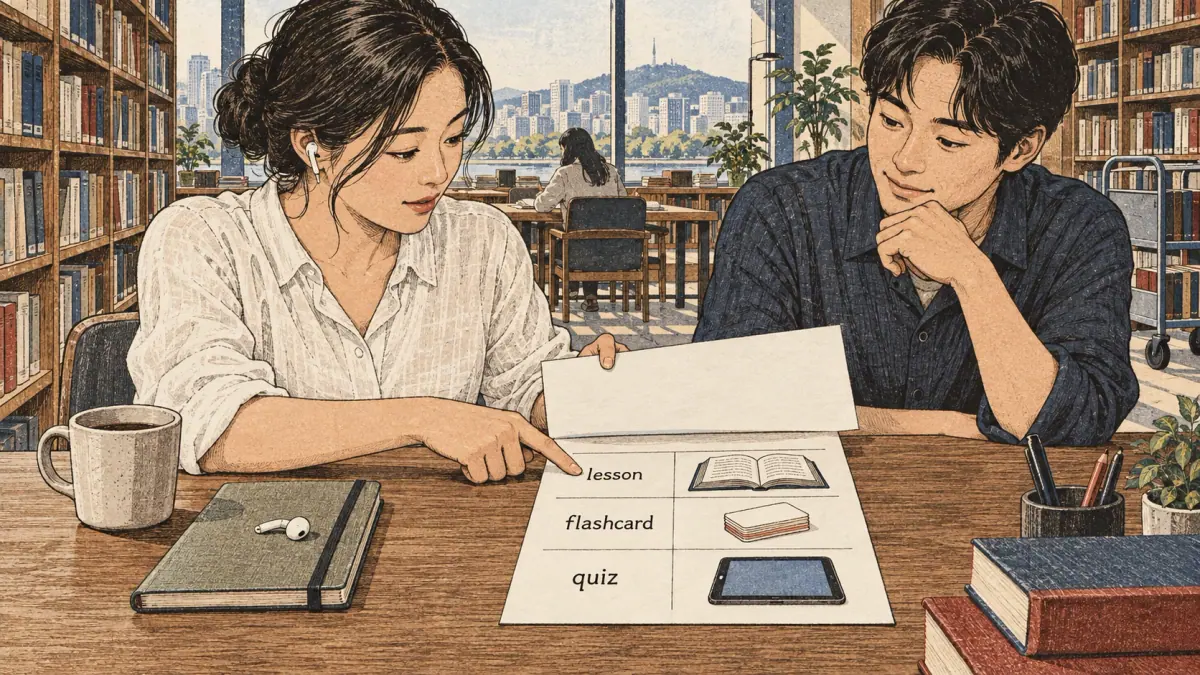
Review missed items with the Korean consonants flashcards and re-read the Korean consonants lesson. To hear and see each letter, open the interactive Hangul alphabet. Writing the letters by hand helps recall, so print the Hangul practice sheets. When you score well, move to the Hangul vowels quiz. Learners who want a broader check later can try the Korean level test.
Answer Key for Questions 7 to 20
Prefer to test yourself first? Take the quiz above, then check this table. The first six answers are in the sample questions.
| # | Question | Correct answer | Reason |
|---|---|---|---|
| 7 | Counting the double letters, how many consonants does the Korean alphabet have? | 19 | There are 14 basic consonants and 5 double consonants, which makes 19. |
| 8 | Which letter is named 미음? | ㅁ | 미음 (mieum) names ㅁ; the name ends with the letter's own sound, ㅁ. |
| 9 | Which letter makes the "n" sound in 나무 (tree)? | ㄴ | ㄴ is n; ㅁ is m and ㄹ is a tap or l. |
| 10 | According to the traditional account, which letter's shape copies the mouth? | ㅁ | The 1446 explanation (Hunminjeongeum Haerye) says ㅁ copies the mouth, ㄴ the tongue tip, ㅅ the teeth and ㅇ the throat. |
| 11 | Which pair is a plain letter and its aspirated partner? | ㄷ and ㅌ | ㅌ is ㄷ plus a stroke with a puff of air; the other pairs are plain and tense. |
| 12 | Which consonant has no tense partner? | ㅁ | Only ㄱ ㄷ ㅂ ㅅ ㅈ have tense partners (ㄲ ㄸ ㅃ ㅆ ㅉ); ㅁ does not. |
| 13 | How does ㅂ sound at the start of 바다 (sea)? | A soft b, with little air | Plain ㅂ is soft and close to b; the strong puffed p is the aspirated ㅍ. |
| 14 | Which letter sounds like "h" in 하나 (one)? | ㅎ | ㅎ (hieut) is h; ㅋ also has air but is a k sound. |
| 15 | 디귿 is the name of which letter? | ㄷ | 디귿 (digeut) is ㄷ; 리을 (rieul) is ㄹ, which has an extra stroke. |
| 16 | Which letter looks like ㅈ with an extra stroke on top? | ㅊ | ㅊ (ch) is ㅈ plus a stroke, which marks the added puff of air. |
| 17 | Which letter starts 차 (tea or car)? | ㅊ | ㅊ is aspirated ch; plain ㅈ would give 자 (ja). |
| 18 | Which letter is the plain partner of both ㅌ and ㄸ? | ㄷ | The triple is ㄷ (plain), ㅌ (aspirated) and ㄸ (tense). |
| 19 | Which letter makes the "s" sound in 사과 (apple)? | ㅅ | ㅅ is s; before ㅣ it moves toward "sh", but Korean has no separate sh letter. |
| 20 | How many of the 19 consonants are tense? | 5 | The tense letters are ㄲ ㄸ ㅃ ㅆ ㅉ, which is five. |
What Does This Quiz Not Do?
The quiz does not score your pronunciation, and no website can judge a spoken sound without a validated model. It also does not test handwriting. Letter names follow the NIKL standard; textbooks occasionally print older or alternative names. All Korean text in the questions and answers was generated and is waiting for review by a Korean reviewer.
Frequently Asked Questions
How many questions are in the consonants quiz?
The quiz has 20 questions. Each is multiple choice with four options, and each answer comes with a one-sentence reason. Question and option order are shuffled in every session. Most learners finish in about ten minutes, and there is no timer, so you can pause and think.
Does the quiz include audio questions?
Some questions have a replay button that plays the word or syllable in the question. Audio is optional and never starts by itself. Each clip is a generated recording approved by Min-ji Park on 15 October 2026. If a clip is missing, the button is hidden and the question still works as text.
What score means I know the consonants?
No score proves knowledge, because the count only shows what you recalled in one session. A useful rule is to repeat the quiz until you can explain the reason for each answer you get right. Then re-test after a day to see what stayed.
Are the letter names tested as well as the sounds?
Yes. Three questions give a letter name such as 시옷 or 디귿 and ask for the letter. Names follow the NIKL standard. Names matter less for reading than sounds do, but Korean teachers and dictionaries use them.
Is the quiz free?
Yes. The quiz is free, needs no account and runs in your browser on a phone, tablet or computer. Nothing you answer is uploaded to a server. If you choose to save progress, it is stored on your own device only, and you can delete it in the settings at any time.
Retake the Korean Consonants Quiz
Retake the korean consonants quiz a day after your first attempt and compare which questions change. Questions you answered correctly twice are ready to leave; the others belong in the next flashcard session. The sibling quiz on vowels is the logical next step, followed by the Korean double consonants quiz, which goes deeper on the tense letters.