
Happy Birthday in Korean Flashcards: Study the 23 Cards
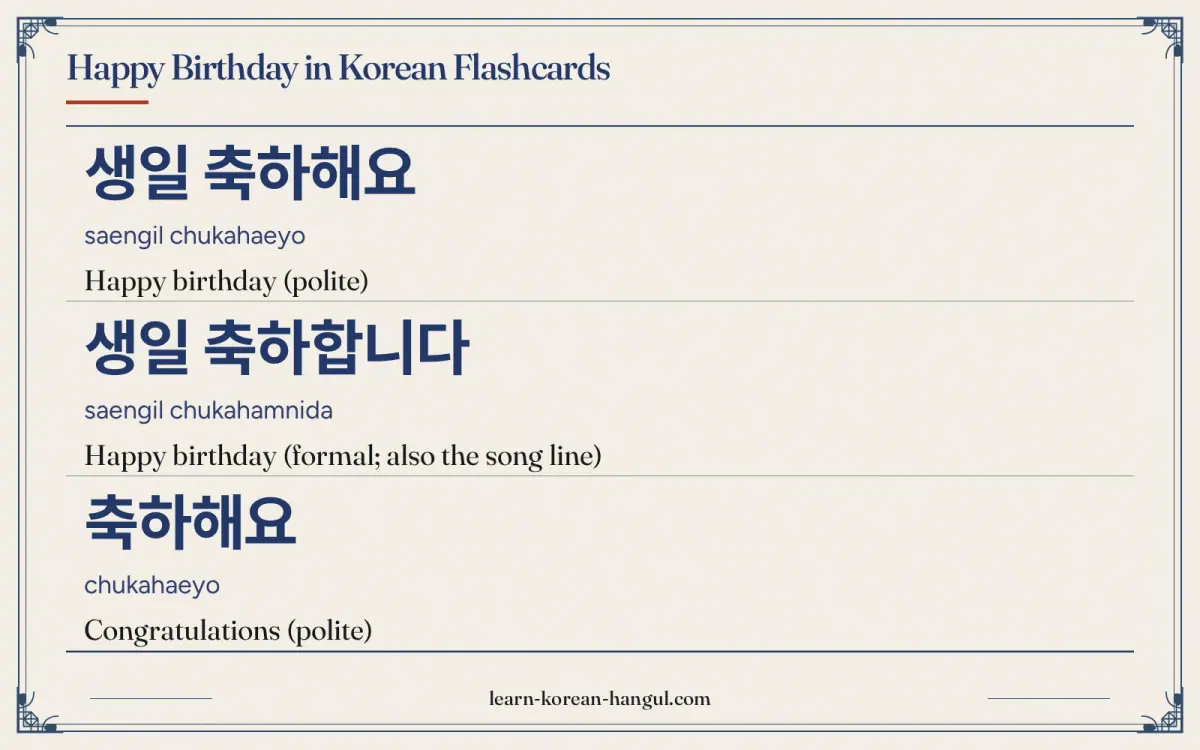
The same wish changes shape with the listener, so each card carries a politeness label. The lesson behind this deck is happy birthday in korean, so read it first if a card is new, and use the cards to make the right form come out without thinking.
How Do I Use These Flashcards?
Use the deck above in four steps. It works with tap, click or keyboard, and nothing plays until you press an audio button.
- Choose a mode. Start with recognition (Hangul to meaning). Switch to recall (meaning to Hangul) or listening (audio to meaning) once recognition feels easy.
- Show the answer. Think of the meaning and the politeness level first, then press Show answer (or Space). Say the phrase aloud before you reveal it, and ask who it is for: a friend, a parent or a boss. Turn on the romanization toggle only if you need it; the 23-card table below always shows it.
- Grade yourself. Press Got it if you answered correctly without help, or Not yet if you hesitated or guessed.
- Finish the session. A session holds up to 20 cards (you can set 10, 20 or 40). With 23 cards, a first-time learner can split the deck over 3 days, using the default limit of 10 new cards a day.
The Three Study Modes
Recognition shows the Hangul and asks for the meaning, which trains reading. Recall shows the meaning and asks for the Hangul, which trains remembering; you may type the answer with your Hangul keyboard or just recall it in your head. Listening plays a clip and hides the letters, which trains the ear. The pronunciation audio is generated with text-to-speech and a Korean teacher approves it before it is switched on. Listening mode only uses cards whose audio is approved, and cards without approved audio are skipped in that mode with a note.
Got It and Not Yet
Got it moves the card up one Leitner box, so it comes back later. Not yet sends the card back to box 1, so it returns in the same session or within 10 minutes. The grades are your own judgement; the deck does not score you or claim fluency.
Deck Scope: What Is and Is Not Covered
The deck covers congratulations, birthday, holiday and toast phrases in polite forms. It has the birthday wish in four registers (casual, polite, humble polite and formal), congratulations for graduation, a wedding, passing an exam and a promotion, the Lunar New Year, Chuseok and Christmas greetings, two toasts, and a few lines for giving a present and joining a party.
What Is Left out of This Deck?
The deck does not cover love declarations or thanks for everyday help. For love lines use the I love you in Korean flashcards, and for thanks and apologies use the polite Korean phrases flashcards. It also leaves out long speeches and written card messages.
All 23 Cards in One Table
All 23 cards appear below in deck order. The table is plain HTML, so you can use it as a drill without the deck: cover the Meaning column, say each phrase aloud, then uncover it.
| # | Hangul | Revised Romanization | Meaning | Note | Audio assetId |
|---|---|---|---|---|---|
| 1 | 생일 축하해요 | saengil chukahaeyo | Happy birthday (polite) | Polite 해요체 for peers and younger people. Said [생일 추카해요]. | au-pg-flashcards-celebration-phrases-flashcards-1; slow: au-pg-flashcards-celebration-phrases-flashcards-24 |
| 2 | 생일 축하합니다 | saengil chukahamnida | Happy birthday (formal; also the song line) | Formal 합쇼체; the line of the birthday song. | au-pg-flashcards-celebration-phrases-flashcards-2 |
| 3 | 축하해요 | chukahaeyo | Congratulations (polite) | Works for any good news among peers. | au-pg-flashcards-celebration-phrases-flashcards-3 |
| 4 | 정말 축하드려요 | jeongmal chukadeuryeoyo | Congratulations, really (humble polite) | 드리다 is the humble verb, so this fits elders and seniors. | au-pg-flashcards-celebration-phrases-flashcards-4 |
| 5 | 생일 축하드려요 | saengil chukadeuryeoyo | Happy birthday (to an elder) | For teachers and bosses; for parents and grandparents, 생신 축하드려요 is more respectful. | au-pg-flashcards-celebration-phrases-flashcards-5 |
| 6 | 생일 축하드립니다 | saengil chukadeurimnida | Happy birthday (formal, to an elder) | Formal and humble; fits cards and speeches. | au-pg-flashcards-celebration-phrases-flashcards-6 |
| 7 | 생일 축하해 | saengil chukahae | Happy birthday (casual) | Casual 반말; friends and younger people only. | au-pg-flashcards-celebration-phrases-flashcards-7 |
| 8 | 축하해 | chukahae | Congrats (casual) | Casual 반말; never to elders or strangers. | au-pg-flashcards-celebration-phrases-flashcards-8 |
| 9 | 축하드립니다 | chukadeurimnida | Congratulations (formal) | Weddings, promotions and graduations with older guests. | au-pg-flashcards-celebration-phrases-flashcards-9 |
| 10 | 졸업 축하해요 | joreop chukahaeyo | Congratulations on graduating | 졸업 is said [조럽]; add 드려요 for an elder. | au-pg-flashcards-celebration-phrases-flashcards-10 |
| 11 | 결혼 축하해요 | gyeolhon chukahaeyo | Congratulations on your wedding | 결혼 is often said [겨론] in fast speech, as the ㅎ weakens after ㄹ. | au-pg-flashcards-celebration-phrases-flashcards-11 |
| 12 | 합격 축하해요 | hapgyeok chukahaeyo | Congratulations on passing | 합격 is said [합껵]; ㄱ turns tense after ㅂ. | au-pg-flashcards-celebration-phrases-flashcards-12; slow: au-pg-flashcards-celebration-phrases-flashcards-25 |
| 13 | 승진 축하드려요 | seungjin chukadeuryeoyo | Congratulations on your promotion | Humble polite; for a boss or senior colleague. | au-pg-flashcards-celebration-phrases-flashcards-13 |
| 14 | 새해 복 많이 받으세요 | saehae bok mani badeuseyo | Happy New Year (lit. receive many blessings) | Honorific -(으)세요; said [새해 봉 마니 바드세요]. | au-pg-flashcards-celebration-phrases-flashcards-14; slow: au-pg-flashcards-celebration-phrases-flashcards-26 |
| 15 | 설날 잘 보내세요 | seollal jal bonaeseyo | Have a good Lunar New Year holiday | 설날 is said [설랄]; said just before the holiday, while 새해 복 많이 받으세요 is the greeting on the day. | au-pg-flashcards-celebration-phrases-flashcards-15 |
| 16 | 즐거운 추석 보내세요 | jeulgeoun chuseok bonaeseyo | Have a happy Chuseok | Wish for the autumn harvest holiday. | au-pg-flashcards-celebration-phrases-flashcards-16 |
| 17 | 메리 크리스마스 | meri keuriseumaseu | Merry Christmas | A loanword; also 즐거운 성탄절 보내세요. | au-pg-flashcards-celebration-phrases-flashcards-17 |
| 18 | 건배 | geonbae | Cheers | A general cheer when glasses meet. | au-pg-flashcards-celebration-phrases-flashcards-18 |
| 19 | 위하여 | wihayeo | To (us / you) | The toast leader says it and everyone repeats. | au-pg-flashcards-celebration-phrases-flashcards-19 |
| 20 | 미역국 드셨어요? | miyeokguk deusyeosseoyo | Did you have seaweed soup? | Honorific 드시다; a friendly birthday check. 미역국 is said [미역꾹]. | au-pg-flashcards-celebration-phrases-flashcards-20 |
| 21 | 선물이에요 | seonmurieyo | It is a gift (for you) | Said when handing over a present. | au-pg-flashcards-celebration-phrases-flashcards-21 |
| 22 | 파티에 와 주세요 | patie wa juseyo | Please come to the party | Polite invitation with -아/어 주세요. | au-pg-flashcards-celebration-phrases-flashcards-22 |
| 23 | 소원을 빌어 보세요 | sowoneul bireo boseyo | Make a wish | Said before blowing out the candles. | au-pg-flashcards-celebration-phrases-flashcards-23 |
Reading the Table
Hangul is the phrase. Revised Romanization (RR) is a learning aid, so try to read the Hangul before you look at it. RR follows the sound of the phrase, which is why 합격 is hapgyeok and 설날 is seollal. The Meaning column gives the English gloss with its politeness level, and the Note column gives a use or sound hint. The last column lists the audio assetId; a second ID marks a slow clip (0.8x) for the cards where the sound changes most.
Usage Notes for These Cards
Match the ending to the listener. Say 생일 축하해요 to peers and 생일 축하드려요 or 생일 축하드립니다 to elders. 드리다 is the humble verb for giving, and it lowers the speaker so the listener is raised, which is why it fits a respectful wish. Between close friends, drop 요 and say 생일 축하해.
New Year wishes are honorific. 새해 복 많이 받으세요 is a New Year greeting. 복 means blessings and 받다 means receive, so the line is a polite request that the other person receive many blessings. People use it from about 1 January through the Lunar New Year (설날), when it is the main greeting on the day itself; 설날 잘 보내세요 is the wish you give in the days before the holiday.
Toasts have a leader. 건배 is a general cheer that anyone can say as glasses meet. 위하여 is said by the toast leader, often with a phrase naming the group, and the rest repeat the line. You do not need to lead a toast; it is enough to repeat after the leader.
Pick the congratulation by occasion. 축하해요 works for most good news. For weddings and graduations with older guests, use the formal 축하드립니다 or 축하드려요, and use 축하해 with friends.
Which Sounds Do Not Match the Spelling?
축하해요 is said [추카해요]. The ㄱ at the end of 축 and the ㅎ of 하 merge into one ㅋ sound. This is aspiration. Revised Romanization writes the sound, so the RR is chukahaeyo.
설날 is said [설랄]. The ㄴ after ㄹ turns into ㄹ (liquidization). The RR is seollal.
합격 is said [합껵]. The ㄱ turns tense after the final ㅂ (tensification). RR does not mark this, so the RR stays hapgyeok.
What Mistakes Do Learners Make with Birthdays and Celebrations?
- Using 생일 축하해요 to an elder. Use 생일 축하드려요, because 드리다 shows respect.
- Saying 새해 복 많이 받아요 as a greeting. The honorific -(으)세요 is used: 새해 복 많이 받으세요.
- Raising a toast with 건배 before the leader says it at a formal dinner. Wait for the lead, then repeat.
- Using casual 축하해 to a teacher or boss. Add 요, or better 드려요.
The politeness level causes most slips, so give cards 5 and 6 extra passes in recall mode.
How Does the Review Schedule Work?
The deck uses a simplified Leitner system with five boxes. A new card starts in box 1. Each Got it moves it up one box, and each Not yet returns it to box 1. The box sets how long the card waits before it is due again.
| Box | Wait until the next review |
|---|---|
| 1 | same session or 10 minutes |
| 2 | 1 day |
| 3 | 3 days |
| 4 | 7 days |
| 5 | 21 days |
Each session shows due cards first, oldest due first, and then up to 10 new cards a day by default. A deck of 23 cards is introduced over 3 days at the default of 10 new cards a day, and the later boxes bring each card back at longer gaps. Progress is saved only in this browser, so clearing site data deletes it. Use the export button to save a small JSON file with card IDs, boxes and due dates, and import it on another device. No account is needed.
Cultural and Practical Context
Sharing seaweed soup (미역국) on a birthday is a long-standing custom that honors the mother who gave birth, and many Koreans eat it on their birthday. Seollal and Chuseok are the two big family holidays. At Seollal younger family members traditionally bow to elders and receive money in an envelope. Wishes are often given in the honorific form even among relatives, so a polite default is a good habit.
Limits of This Deck
The deck holds 23 cards and gives the main wish for each occasion, not every regional or written variant. The dates for the New Year greeting are approximate, and the remarks on the seaweed soup custom, the money envelope and toast etiquette are general. All Korean text is generated and was reviewed and signed off by Min-ji Park on 15 October 2026, and each audio clip is checked by a Korean teacher before publication.
Next Steps after This Deck
After these happy birthday in korean flashcards, move on to the kdrama korean phrases flashcards to keep the same routine. For more formal forms like 축하드립니다, the business korean phrases flashcards use the same routine at work. The Korean phrases flashcards page lists every phrase deck, and the Korean flashcards hub lists all topics.
Frequently Asked Questions
How Do I Say Happy Birthday to Someone Older?
Say 생일 축하드려요, or the more formal 생일 축하드립니다. 드리다 is the humble verb for giving, so it raises the listener. For parents and grandparents, swap 생일 for the honorific noun 생신 and say 생신 축하드려요. Keep 생일 축하해 for close friends.
When Can I Use 새해 복 많이 받으세요?
Use it from about 1 January (some people start in late December) through the Lunar New Year (설날), when it is the main greeting on the day. In the days before 설날, 설날 잘 보내세요 wishes someone a good holiday. 복 means blessings and 받다 means receive. The window is a matter of custom, not a fixed rule.
What Do I Say When Toasting?
Say 건배 as glasses meet. If someone leads the toast, they say 위하여 and the group repeats it. At a formal dinner, wait for the leader before you raise your glass, and follow the older guests.
What Is the Soup People Eat on Birthdays?
It is seaweed soup, 미역국. Koreans traditionally eat it on a birthday to honor the mother who gave birth, and you can ask a friendly 미역국 드셨어요? to check. The question uses the honorific 드시다, so it fits elders as well.
Is My Progress Saved If I Close the Page?
Yes, in the same browser on the same device. Card boxes and due dates are stored locally and nothing is sent to a server. Clearing site data, using a private window or switching browsers removes them, so use the export button to keep a backup file. No account is needed.