What Are the Most Useful Korean Airport Phrases to Learn First?
The most useful Korean airport phrases follow the order of a departure, so learn them in the order you will need them. Four lines cover the whole journey, and a small counter script covers most of the check-in.
| Step | Situation | Korean | Revised Romanization | Guide |
|---|---|---|---|---|
| 1 | In the taxi | 공항에 가 주세요 | gonghange ga juseyo | take me to the airport |
| 2 | At the counter | 체크인하고 싶어요 | chekeuinhago sipeoyo | check in at the airport |
| 3 | After security | 게이트가 어디예요? | geiteuga eodiyeyo | where is the gate |
| 4 | At baggage claim | 제 짐이 없어졌어요 | je jimi eopseojyeosseoyo | my luggage is lost |
Revised Romanization (the South Korean government standard of 2000) is shown only as a reading aid. Learn the Hangul first.
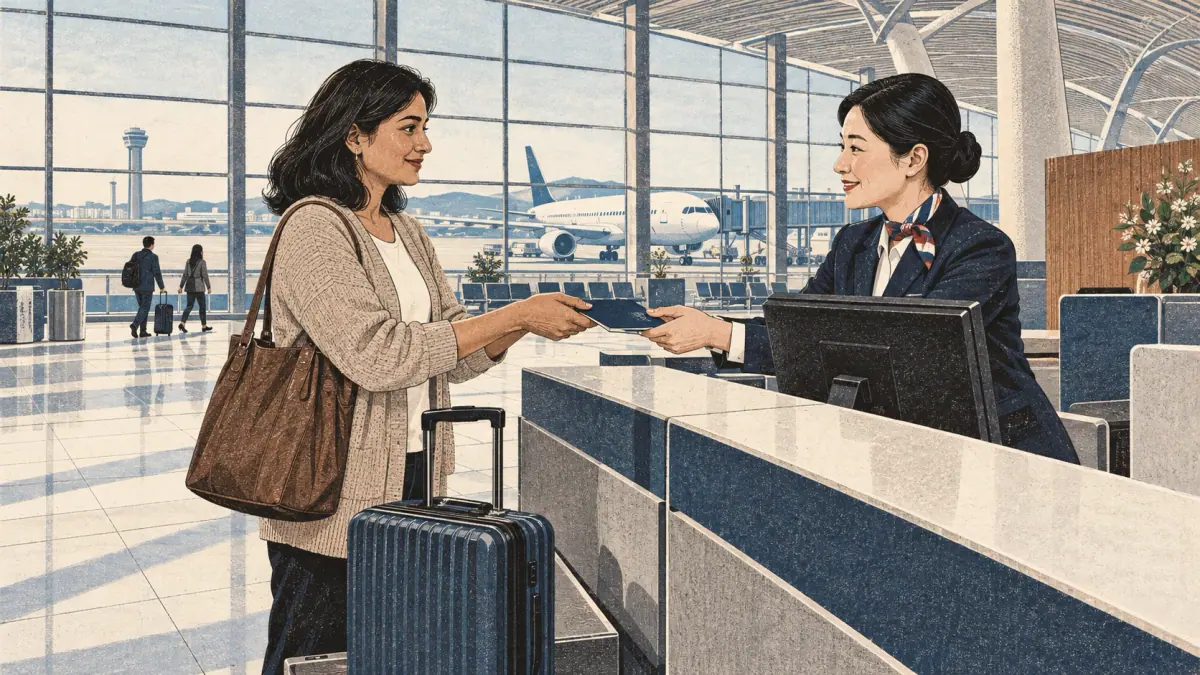
At the counter, three short lines do most of the work. Say them in this order, and hand over your passport with the first one.
- 체크인하고 싶어요. (chekeuinhago sipeoyo): "I would like to check in."
- 창가 자리로 주세요. (changga jariro juseyo): "A window seat, please."
- 짐은 한 개예요. (jimeun han gaeyeyo): "I have one bag."
For the gate, use 게이트 (geiteu), the English loanword that signs and staff use, or the formal word 탑승구 (tapseunggu, "boarding gate"). Do not ask for a 문 (mun, "door"), because 문 is not the word for an airport gate. Gate numbers are read with Sino-Korean numbers and the counter 번 (beon), so gate 12 is 십이 번 게이트. The page on Sino-Korean numbers teaches them. Signs at major airports usually show Korean and English, so the harder skill is listening to staff, and the guides below train it. With the order clear, the next question is which style to use.
How Do You Choose between Formal, Polite and Casual Korean Airport Phrases?
Use the polite style (해요체) for almost everything you say at an airport, and learn to recognise the formal style (합쇼체) that staff and announcements use. Staff usually speak formally to passengers, but you do not need to copy them. The page on Korean speech levels explains the three styles in depth.
| Situation | You say (polite) | You may hear (formal or polite) |
|---|---|---|
| Check-in | 체크인하고 싶어요 | 여권 좀 보여 주세요 (please show your passport) |
| Bags | 짐은 한 개예요 | 짐은 몇 개세요? (how many bags?) |
| Lost luggage | 제 짐이 없어졌어요 | 수하물 표 보여 주시겠어요? (may I see your baggage tag?) |
Two endings carry almost everything. -고 싶어요 means "I want to," and -(아/어) 주세요 means "please do it for me." Both are polite and warm, so you can use them with every staff member from the taxi driver to the gate agent. Casual 반말, such as 짐 잃어버렸어, is not right for staff or strangers. With the style chosen, the cards below list every guide.
All Korean Airport Phrases Guides
The list below has all four guides, each with its lead phrase and a short audio clip. The Korean travel phrases hub holds the other travel clusters, and the Korean phrases hub holds every situation.
Start Here
Check in at the Airport
The key phrase is 체크인하고 싶어요 (chekeuinhago sipeoyo), which means "I would like to check in."
Where Is the Gate
The key phrase is 게이트가 어디예요? (geiteuga eodiyeyo), which means "where is the gate?" It is the question to ask after security.
My Luggage Is Lost
The key phrase is 제 짐이 없어졌어요 (je jimi eopseojyeosseoyo), which means "my luggage is lost." It is the sentence for the baggage service desk.
Take Me to the Airport
The key phrase is 공항에 가 주세요 (gonghange ga juseyo), which means "please take me to the airport." It is the line for a taxi driver.
How Do You Practise Korean Airport Phrases?
Practise Korean airport phrases in journey order, out loud, with the audio on each card. Say the four lead lines in sequence: taxi, counter, gate, baggage claim. Then add the three-line counter script from the first section, and repeat the whole chain until it takes under a minute.
- Play each clip once without reading, and say what you heard.
- Play it again, and repeat it after the clip.
- Cover the Korean and say the line from the English meaning.
- Record yourself on a phone and compare with the clip.
The phrase flashcards drill the lines with audio. For a longer word list, see the page on Korean airport vocabulary, and for the single word, see airport in Korean. If you have not yet learned the basics, start with Korean greetings. Listening practice matters most here, because staff speak quickly and signs are bilingual.
What Mistakes Do Learners Make with Korean Airport Phrases?
Most mistakes with Korean airport phrases come from word choice and register, not from grammar.
| Mistake | Why it is a problem | Fix |
|---|---|---|
| Asking for the 문 | 문 means "door," not "gate" | Say 게이트 or 탑승구 |
| Using 반말, such as 짐 잃어버렸어 | Casual speech is rude to staff | Use 주세요 and 해요 endings |
| Saying 짐이 없어요 for a missing bag | It sounds like "I have no luggage" | Say 제 짐이 없어졌어요 (it has gone missing) |
| Reading 싶어요 letter by letter | The final ㅍ links to the vowel that follows | Say [시퍼요] |
| Memorising questions only | Staff answers are the hard part | Practise listening to replies |
A last point: 없어졌어요 means "has disappeared," and it fits a bag that did not arrive. For something you dropped or left behind, 잃어버렸어요 (ireobeoryeosseoyo, "I lost it") is the better verb. Use the right verb, and you can handle Korean airport phrases from the taxi to the gate.
Frequently Asked Questions
How do I check in at a Korean airport?
Walk to the airline counter, hand over your passport, and say 체크인하고 싶어요 (chekeuinhago sipeoyo), "I would like to check in." Staff will ask about bags. Reply 짐은 한 개예요 (jimeun han gaeyeyo), "I have one bag," and add 창가 자리로 주세요 if you want a window seat.
What is the word for boarding gate in Korean?
The everyday word is 게이트 (geiteu), borrowed from English, and the formal Korean word is 탑승구 (tapseunggu). Ask 게이트가 어디예요? (geiteuga eodiyeyo), "where is the gate?" Do not say 문 (mun, "door"), which is not used for airport gates. Gate numbers use Sino-Korean numbers, such as 십이 번.
How do I report lost luggage in Korean?
Go to the baggage service desk and say 제 짐이 없어졌어요 (je jimi eopseojyeosseoyo), "my luggage has gone missing." Show your baggage tag and passport. If the bag never appeared on the belt, 제 짐이 안 나왔어요 also works. Speak politely, because staff handle many such cases.
Which airport phrases should I memorise first?
Memorise four lines in this order: 공항에 가 주세요 for the taxi, 체크인하고 싶어요 at the counter, 게이트가 어디예요? after security, and 제 짐이 없어졌어요 if baggage goes missing. Add 여권 여기 있어요 (here is my passport), because staff ask for it first.