Countries in Korean Flashcards: Study the 30 Cards
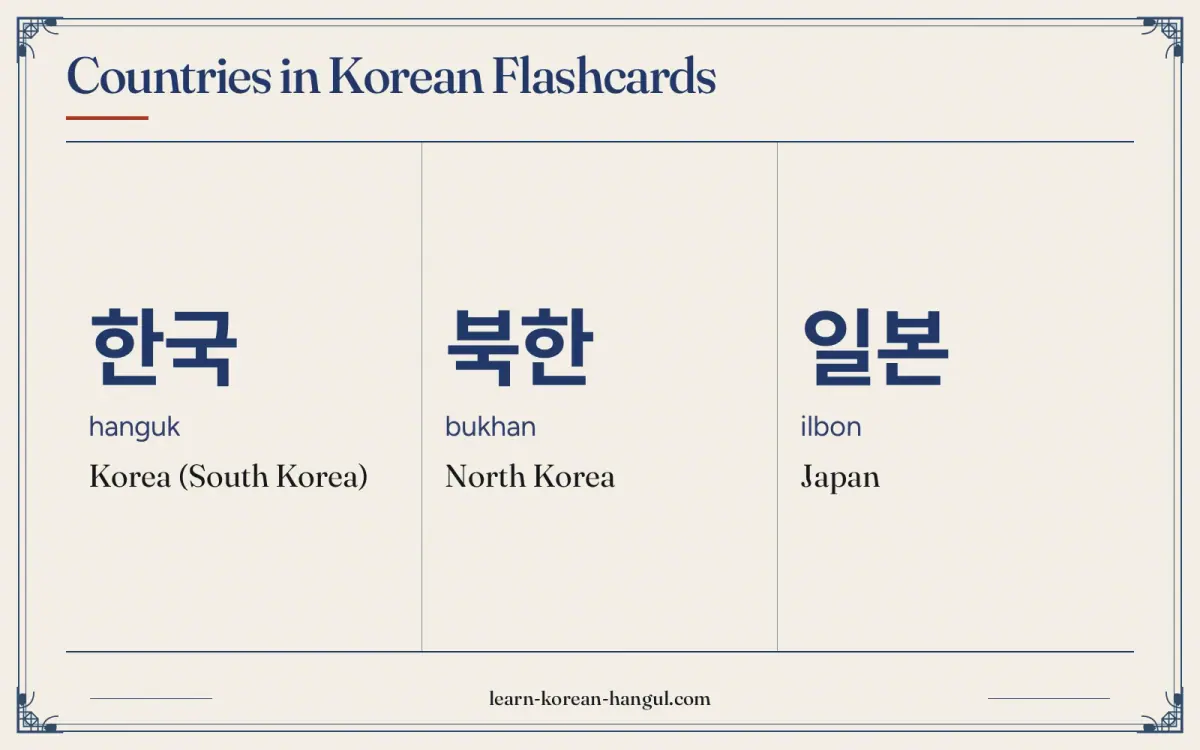
The cards start with the two Koreas and their neighbours (cards 1 to 4: 한국, 북한, 일본, 중국), then other countries around the world (5 to 21), the word 나라 (22), five language names (23 to 27) and three Korean cities (28 to 30). The country meanings come from the site's geography word list.
How Do I Use These Flashcards?
Use the deck above in four steps. It works with tap, click or keyboard, and nothing plays until you press an audio button.
- Choose a mode. Start with recognition (Hangul to meaning). Switch to recall (meaning to Hangul) or listening (audio to meaning) once recognition feels easy.
- Show the answer. Think of the answer first, then press Show answer (or Space). Turn on the romanization toggle only if you need it; the table below always shows it.
- Grade yourself. Press Got it if you answered correctly without help, or Not yet if you hesitated or guessed.
- Finish the session. A session holds up to 20 cards (you can set 10, 20 or 40). With 30 cards, a first-time learner should expect about 3 days at the default limit of 10 new cards a day, with review sessions on top.
The Three Study Modes
Recognition shows the Hangul and asks for the meaning, so with the first card it shows 한국 and you answer "Korea (South Korea)". Recall reverses this: it shows the meaning and asks for the Hangul, and you may type the answer with your Hangul keyboard or just say it in your head. Listening plays a clip and hides the letters, which trains the ear. Listening mode only uses a card once its audio is approved, and cards without approved audio are skipped in that mode with a note. Recall mode is a good test here, because it makes you produce the Hangul for a country you know in English.
Got It and Not Yet
Got it moves a card up one Leitner box, so it comes back later. Not yet sends the card back to box 1, so it returns in the same session or within 10 minutes. The grades are your own judgement; the deck does not score you or claim fluency.
Deck Scope: What Is and Is Not Covered
The deck covers country names, language names, three Korean cities and the pattern for nationality and language. Places you find in a town are in the city deck. The words and letters on these cards are explained in the countries in korean lesson, so read it first if a card is new.
What This Deck Leaves Out
Colors are in the Korean colors flashcards, and flower names have their own deck. Continents, landscape words such as 산 and 강, and further cities are in the geography lessons, not in these 30 cards.
All 30 Cards in One Table
All 30 cards appear below in deck order. The table is plain HTML, so you can use it as a drill without the deck: cover the Meaning column, read each word aloud, then uncover it.
| # | Hangul | Revised Romanization | Meaning | Note | Audio assetId |
|---|---|---|---|---|---|
| 1 | 한국 | hanguk | Korea (South Korea) | South Korea. The formal long name is 대한민국. | au-pg-flashcards-countries-1 |
| 2 | 북한 | bukhan | North Korea | North Korea; said [부칸]. | au-pg-flashcards-countries-2; slow: au-pg-flashcards-countries-31 |
| 3 | 일본 | ilbon | Japan | 일본에 여행 가요 (I am going on a trip to Japan). | au-pg-flashcards-countries-3 |
| 4 | 중국 | jungguk | China | 중국 is Sino-Korean (中國). | au-pg-flashcards-countries-4 |
| 5 | 미국 | miguk | USA, United States | 저는 미국에서 왔어요 (I came from the USA). | au-pg-flashcards-countries-5 |
| 6 | 영국 | yeongguk | United Kingdom | 영국은 비가 많이 와요 (It rains a lot in the UK). | au-pg-flashcards-countries-6 |
| 7 | 호주 | hoju | Australia | 저는 호주에서 왔어요 (I am from Australia). | au-pg-flashcards-countries-7 |
| 8 | 캐나다 | kaenada | Canada | An English loanword. | au-pg-flashcards-countries-8 |
| 9 | 독일 | dogil | Germany | Said [도길]. | au-pg-flashcards-countries-9; slow: au-pg-flashcards-countries-32 |
| 10 | 프랑스 | peurangseu | France | A loanword from the French name, France. | au-pg-flashcards-countries-10 |
| 11 | 이탈리아 | itallia | Italy | A loanword from the Italian name, Italia. | au-pg-flashcards-countries-11 |
| 12 | 스페인 | seupein | Spain | 스페인은 유럽에 있어요 (Spain is in Europe). | au-pg-flashcards-countries-12 |
| 13 | 러시아 | reosia | Russia | An English loanword. | au-pg-flashcards-countries-13 |
| 14 | 인도 | indo | India | 인도 사람 means an Indian person. | au-pg-flashcards-countries-14 |
| 15 | 베트남 | beteunam | Vietnam | 베트남 사람 means a Vietnamese person. | au-pg-flashcards-countries-15 |
| 16 | 태국 | taeguk | Thailand | 태국 사람 means a Thai person. | au-pg-flashcards-countries-16 |
| 17 | 필리핀 | pillipin | the Philippines | 필리핀 사람 means a Filipino person. | au-pg-flashcards-countries-17 |
| 18 | 방글라데시 | banggeulladesi | Bangladesh | 저는 방글라데시에서 왔어요 (I am from Bangladesh). | au-pg-flashcards-countries-18 |
| 19 | 대만 | daeman | Taiwan | 타이완 also appears; 대만 is the usual Korean name. | au-pg-flashcards-countries-19 |
| 20 | 멕시코 | meksiko | Mexico | 멕시코 음식을 먹어 봤어요 (I have tried Mexican food). | au-pg-flashcards-countries-20 |
| 21 | 브라질 | beurajil | Brazil | 브라질 사람 means a Brazilian person. | au-pg-flashcards-countries-21 |
| 22 | 나라 | nara | country | 어느 나라 사람이에요? (What country are you from?). | au-pg-flashcards-countries-22 |
| 23 | 한국어 | hangugeo | Korean (language) | Said [한구거]. | au-pg-flashcards-countries-23; slow: au-pg-flashcards-countries-33 |
| 24 | 일본어 | ilboneo | Japanese (language) | Country root plus 어. | au-pg-flashcards-countries-24 |
| 25 | 중국어 | junggugeo | Chinese (language) | Country root plus 어. | au-pg-flashcards-countries-25 |
| 26 | 영어 | yeongeo | English (language) | From 영국; the language is 영어, not 영국어. | au-pg-flashcards-countries-26 |
| 27 | 스페인어 | seupeineo | Spanish (language) | Country root plus 어. | au-pg-flashcards-countries-27 |
| 28 | 서울 | seoul | Seoul | 저는 서울에 살아요 (I live in Seoul). | au-pg-flashcards-countries-28 |
| 29 | 부산 | busan | Busan | 부산은 바다로 유명해요 (Busan is famous for its sea). | au-pg-flashcards-countries-29 |
| 30 | 제주도 | jejudo | Jeju Island | 제주도는 한국에서 가장 큰 섬이에요 (Jejudo is the biggest island in Korea). | au-pg-flashcards-countries-30 |
Reading the Table
Hangul is the word. Revised Romanization (RR) is a learning aid, so read the Hangul first. RR follows most sound changes between letters, but in nouns it keeps the h after ㄱ, ㄷ and ㅂ, which is why 북한 is written bukhan although it is said [부칸]. The Meaning column gives the English gloss, and the Note column gives an example or a sound hint. A second ID in the last column marks a slow clip.
Usage Notes for These Cards
A nationality is the country plus 사람. 한국 사람, 미국 사람 and 방글라데시 사람 mean a Korean, an American and a Bangladeshi person. In writing, the short form uses 인, as in 한국인.
A language is the country root plus 어. 한국어, 일본어 and 중국어 follow this pattern, with English being the exception: 영어, not 영국어.
Say where you are from with 에서 왔어요. 저는 방글라데시에서 왔어요 means I am from Bangladesh. To ask, say 어느 나라 사람이에요? (What country are you from?).
South Korea and North Korea have different everyday names. South Korea calls itself 한국 and North Korea 북한, while the formal long name of the South is 대한민국.
Where the names come from. Some names are Sino-Korean, including several outside Asia: 중국 (中國), 미국 (美國), 영국 (英國), 독일 (獨逸) and 호주 (濠洲). Many others are loanwords that copy the country's own name, as in 캐나다, 프랑스 and 이탈리아.
Which Sounds Do Not Match the Spelling?
북한 is said [부칸]: the ㄱ of 북 and the ㅎ merge into an aspirated ㅋ sound. Revised Romanization writes bukhan.
독일 is said [도길]: the final ㄱ of 독 moves to the empty onset of 일. Revised Romanization writes dogil.
한국어 is said [한구거]: the final ㄱ of 국 links to the empty onset of 어. Revised Romanization writes hangugeo.
What Mistakes Do Learners Make with Countries?
- Saying 한국에 왔어요 for I am from Korea. That means I came to Korea; use 한국에서 왔어요.
- Calling English 영국어. The language is 영어, which keeps only the first syllable of 영국.
- Adding 사람 to a language word. 한국어 is the language and 한국 사람 is the person.
- Using 북한 for the country you are visiting when you mean South Korea. 한국 is the everyday name for South Korea.
Most of these slips come from particles and word pairs that English does not have, so say each example aloud when you answer a card.
How Does the Review Schedule Work?
The deck uses a simplified Leitner system with five boxes. A new card starts in box 1. Each Got it moves it up one box, and each Not yet returns it to box 1. The box sets how long the card waits before it is due again.
| Box | Wait until the next review |
|---|---|
| 1 | same session or 10 minutes |
| 2 | 1 day |
| 3 | 3 days |
| 4 | 7 days |
| 5 | 21 days |
Each session shows due cards first, oldest due first, and then new cards up to the daily limit, which is 10 by default. A deck of 30 cards is introduced in about three days at the default of 10 new cards a day, and the later boxes bring each country back at longer gaps. Progress is saved only in this browser, so clearing site data deletes it. Use the export button to save a small JSON file with card IDs, boxes and due dates, and import it on another device. The file holds no personal data.
Cultural and Practical Context
South Koreans say 한국 for their country and 북한 for North Korea. North Korea itself uses different names such as 조선, which is worth knowing when you read news. Country names are among the first things you need in a self-introduction, because a Korean speaker will usually ask 어느 나라에서 왔어요?
Limits of This Deck
The deck holds 30 cards, a starting set rather than a list of every country. It does not include continents or flags. Some country names have more than one form in Korean: 대만 and 타이완 both appear for Taiwan, and the Korean name for Turkey has changed to 튀르키예 in official use, so check a current source for countries that changed names. The Korean text on this page is generated and was reviewed and signed off by Min-ji Park on 15 October 2026.
Next Steps after This Deck
This deck is one of the korean vocabulary flashcards on the site, so browse the full list if you want a different topic. When these cards feel easy, move on to korean colors flashcards to keep the same routine. For a related topic, try korean flower names flashcards. After a session, write the same words by hand with the korean nature vocabulary worksheet. All flashcard decks, including Hangul, vocabulary, phrases, grammar and TOPIK, are listed on the Korean flashcards hub.
Frequently Asked Questions
Why Is the Language of Britain 영어?
영어 takes only the first syllable of 영국 (英國, Britain) and adds 어 (語, language). So the language is 영어 and not 영국어. This is the one common exception to the country-root-plus-어 pattern.
How Do I Say I Am Bangladeshi?
저는 방글라데시 사람이에요. The country name plus 사람 gives the nationality, and 저는 ... 이에요 says I am. You can also say 저는 방글라데시에서 왔어요 (I am from Bangladesh).
Is 대만 the Same as 타이완?
Both appear in Korean for Taiwan, with 대만 the usual Korean name. 타이완 is a loanword that you may see in news and travel writing. If you learn one, learn 대만.
How Do I Ask What Country Someone Is From?
어느 나라 사람이에요? asks which country's person someone is. A common alternative is 어느 나라에서 왔어요? (What country did you come from?). Answer with the country plus 사람이에요 or 에서 왔어요.
Is My Progress Saved If I Close the Page?
Yes, in the same browser on the same device. Card boxes and due dates are stored locally and nothing is sent to a server. Clearing site data, using a private window or switching browsers removes them, so use the export button to keep a backup file. No account is needed.