
Korean Flower Names Flashcards: Study the 29 Cards
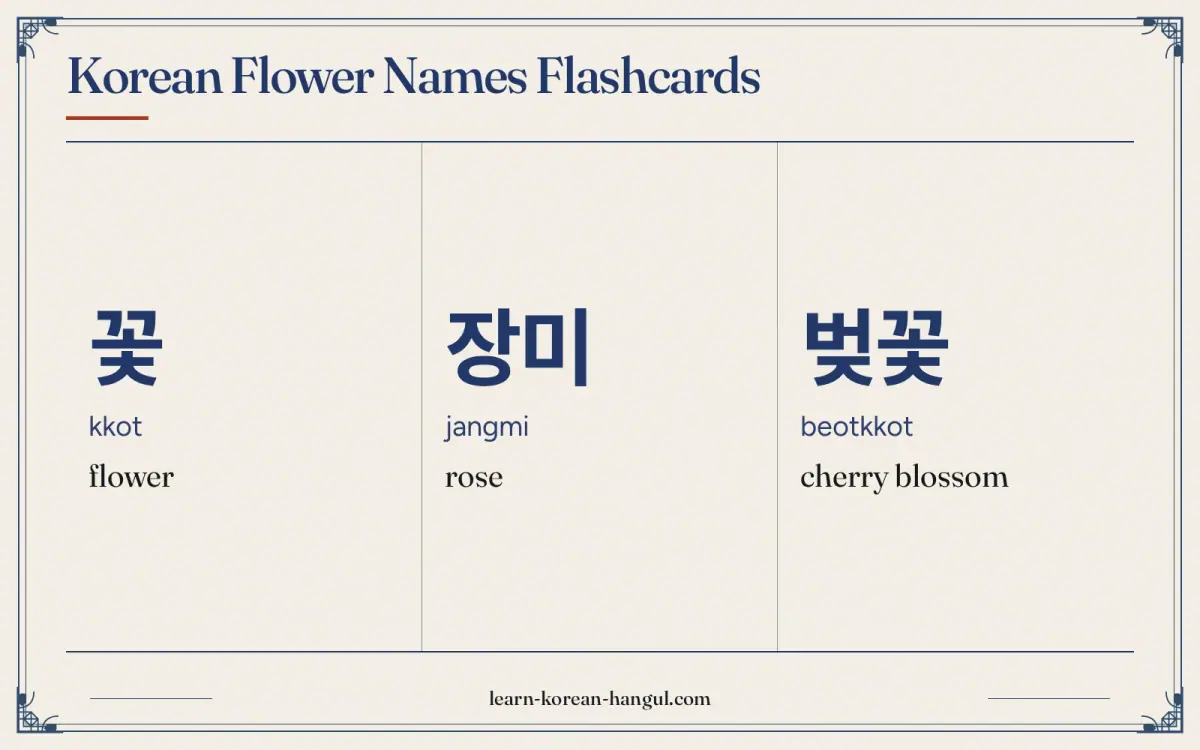
Each card shows the Hangul, the Revised Romanization (RR), the meaning and an audio button. The words come from the Korean plants and flowers lesson, which also has example sentences.
How Do I Use These Flashcards?
Use the deck above in four steps. It works with tap, click or keyboard, and nothing plays until you press an audio button.
- Choose a mode. Start with recognition (Hangul to meaning). Switch to recall (meaning to Hangul) or listening (audio to meaning) once recognition feels easy.
- Show the answer. Think of the answer first, then press Show answer (or Space). Say the word aloud before you reveal it. Turn on the romanization toggle only if you need it; the 29-card table below always shows it.
- Grade yourself. Press Got it if you answered correctly without help, or Not yet if you hesitated or guessed.
- Finish the session. A session holds up to 20 cards (you can set 10, 20 or 40). With 29 cards, a first-time learner can split the deck over three days, using the default limit of 10 new cards a day.
The Three Study Modes
Recognition shows the Hangul and asks for the meaning, which trains reading. Recall shows the meaning and asks for the Hangul, which trains remembering; you may type the answer with your Hangul keyboard or just recall it in your head. Listening plays a clip and hides the letters, which trains the ear. Listening mode only uses a card once its audio is approved, and cards without approved audio are skipped in that mode with a note.
Got It and Not Yet
Got it moves the card up one Leitner box, so it comes back later. Not yet sends the card back to box 1, so it returns in the same session or within 10 minutes. The grades are your own judgement; the deck does not score you or claim fluency.
Deck Scope: What Is and Is Not Covered
The deck covers 29 of the 35 words in the plants lesson: eight named flowers plus the general word 꽃, five named trees, forest and grass words, garden words and the parts of a plant. It follows the lesson's meanings and romanization exactly.
Which Plant Words Are Left out of This Deck?
The lesson words 사과나무, 가로수, 잡초, 이끼, 허브 and 가지 are not cards here. For more flower words see the flowers page.
All 29 Cards in One Table
All 29 cards appear below in deck order. The table is plain HTML, so you can use it as a drill without the deck: cover the Meaning column, say each word aloud, then uncover it.
| # | Hangul | Revised Romanization | Meaning | Note | Audio assetId |
|---|---|---|---|---|---|
| 1 | 꽃 | kkot | flower | Said [꼳] alone and [꼬치] before 이. | au-pg-flashcards-flower-names-1; slow: au-pg-flashcards-flower-names-30 |
| 2 | 장미 | jangmi | rose | A common gift flower. | au-pg-flashcards-flower-names-2 |
| 3 | 벚꽃 | beotkkot | cherry blossom | Said [벋꼳]. The sign of spring. | au-pg-flashcards-flower-names-3; slow: au-pg-flashcards-flower-names-31 |
| 4 | 무궁화 | mugunghwa | rose of Sharon (national flower) | Korea's national flower. | au-pg-flashcards-flower-names-4 |
| 5 | 진달래 | jindallae | azalea | Blooms on hills in early spring. | au-pg-flashcards-flower-names-5 |
| 6 | 개나리 | gaenari | forsythia | A yellow spring flower. | au-pg-flashcards-flower-names-6 |
| 7 | 국화 | gukhwa | chrysanthemum | An autumn flower. | au-pg-flashcards-flower-names-7 |
| 8 | 해바라기 | haebaragi | sunflower | Literally turns to face the sun. | au-pg-flashcards-flower-names-8 |
| 9 | 연꽃 | yeonkkot | lotus flower | Said [연꼳]. | au-pg-flashcards-flower-names-9 |
| 10 | 나무 | namu | tree; wood | Tree and the material wood share one word. | au-pg-flashcards-flower-names-10 |
| 11 | 소나무 | sonamu | pine tree | Symbol of long life. | au-pg-flashcards-flower-names-11 |
| 12 | 대나무 | daenamu | bamboo | The 대 means bamboo on its own. | au-pg-flashcards-flower-names-12 |
| 13 | 은행나무 | eunhaengnamu | ginkgo tree | Turns yellow in autumn. | au-pg-flashcards-flower-names-13 |
| 14 | 단풍나무 | danpungnamu | maple tree | Famous for red autumn leaves. | au-pg-flashcards-flower-names-14 |
| 15 | 버드나무 | beodeunamu | willow tree | Grows by rivers. | au-pg-flashcards-flower-names-15 |
| 16 | 숲 | sup | forest | Said [숩]; before 이 it is [수피]. | au-pg-flashcards-flower-names-16; slow: au-pg-flashcards-flower-names-33 |
| 17 | 풀 | pul | grass; weed | Everyday word for any green blades. | au-pg-flashcards-flower-names-17 |
| 18 | 잔디 | jandi | lawn grass | A common sign: 잔디에 들어가지 마세요. | au-pg-flashcards-flower-names-18 |
| 19 | 화분 | hwabun | flowerpot | For indoor and balcony plants. | au-pg-flashcards-flower-names-19 |
| 20 | 정원 | jeongwon | garden | A larger, planned garden. | au-pg-flashcards-flower-names-20 |
| 21 | 화단 | hwadan | flower bed | Often found outside apartment blocks. | au-pg-flashcards-flower-names-21 |
| 22 | 선인장 | seoninjang | cactus | Said [서닌장]. A popular easy houseplant. | au-pg-flashcards-flower-names-22 |
| 23 | 뿌리 | ppuri | root | Also used for origin, as in 뿌리 깊은. | au-pg-flashcards-flower-names-23 |
| 24 | 줄기 | julgi | stem; trunk | The main stalk of a plant. | au-pg-flashcards-flower-names-24 |
| 25 | 잎 | ip | leaf | Said [입]; before 이 it is [이피]. | au-pg-flashcards-flower-names-25; slow: au-pg-flashcards-flower-names-32 |
| 26 | 꽃잎 | kkonnip | petal | Said [꼰닙]. | au-pg-flashcards-flower-names-26 |
| 27 | 열매 | yeolmae | fruit; berry (of a plant) | Botanical fruit; 과일 is edible fruit. | au-pg-flashcards-flower-names-27 |
| 28 | 씨앗 | ssiat | seed | Said [씨앋]. Also 씨. | au-pg-flashcards-flower-names-28 |
| 29 | 싹 | ssak | sprout | The verb is 나다 (to come out). | au-pg-flashcards-flower-names-29 |
Reading the Table
Hangul is the word. Revised Romanization (RR) is a learning aid, so try to read the Hangul before you look at it. RR follows the spelling rules of the official system, not every sound change, so it can differ from what you hear. The Meaning column gives the English gloss, and the Note column gives a use or sound hint. The last column lists the audio assetId; a second ID marks a slow clip at 0.8 times the speed. Cards 2-9 are named flowers, from 장미 to 연꽃.
Usage Notes for These Cards
Flowers bloom with 피다. The flower is the subject: 꽃이 피어요 means The flowers bloom. Do not say 꽃을 피다, because the verb does not take an object.
나무 is tree and wood. 소나무 is a pine tree, and 나무 의자 is a wooden chair. Most tree names end in 나무: 소나무, 대나무, 은행나무, 단풍나무, 버드나무.
Count trees and flowers with their own words. Trees take 그루 (나무 한 그루) and flowers by the head take 송이 (장미 세 송이). Using 개 for them is understood but sounds off.
Spring flowers. 개나리 and 진달래 are known as early-spring flowers, and 벚꽃 is the cherry blossom that people go to see in spring.
꽃 builds more words. 꽃집 is a flower shop, 꽃다발 is a bouquet and 꽃말 is the meaning given to a flower. The base word 꽃 appears in each.
Which Sounds Do Not Match the Spelling?
Some of these words are said differently from how they are written. The table follows the standard pronunciation rules (표준 발음법) of the 국립국어원 (National Institute of Korean Language).
| Spelling | Sounds like | What changes |
|---|---|---|
| 꽃이 | [꼬치] | The final ㅊ moves to the next syllable before 이. |
| 벚꽃 | [벋꼳] | Both final consonants are said as [ㄷ]. |
| 꽃잎 | [꼰닙] | ㄴ is inserted before 잎, and the final ㅊ, said [ㄷ], becomes [ㄴ] before it. |
| 잎이 | [이피] | The final ㅍ moves to the next syllable. |
| 숲 | [숩] | The final ㅍ is said as [ㅂ] when alone. |
Final-consonant linking is the main habit. A flower on its own is [꼳], but the same flower with 이 is [꼬치]. Say it as one flowing word, not 꼳 + 이.
What Mistakes Do Learners Make with Flower and Plant Words?
- Saying 꽃이 열려요 for bloom. Flowers use 피다: 꽃이 피어요.
- Reading 꽃이 as [꽃이]. The standard sound is [꼬치].
- Missing the double meaning of 나무. It is tree and wood.
- Treating 열매 and 과일 as the same. 열매 is the fruit as part of the plant, 과일 is fruit as food.
- Counting trees with 개. Use 그루.
How Does the Review Schedule Work?
The deck uses a simplified Leitner system with five boxes. A new card starts in box 1. Each Got it moves it up one box, and each Not yet returns it to box 1. The box sets how long the card waits before it is due again.
| Box | Wait until the next review |
|---|---|
| 1 | same session or 10 minutes |
| 2 | 1 day |
| 3 | 3 days |
| 4 | 7 days |
| 5 | 21 days |
Each session shows due cards first, oldest due first, and then up to 10 new cards a day by default. A deck of 29 cards is introduced over three days at the default of 10 new cards a day, and the later boxes bring each card back at longer gaps. Progress is saved only in this browser, so clearing site data deletes it. Use the export button to save a small JSON file with card IDs, boxes and due dates, and import it on another device. No account is needed.
Cultural and Practical Context
Some plants carry meaning in Korea. The 무궁화 is widely regarded as the national flower, and a line of the national anthem mentions it. The 소나무 stands for long life and steadiness, and the 대나무 stands for integrity because it stays green in winter.
Limits of This Deck
The deck holds 29 words, so it gives only a handful of flowers and trees. It does not include every common flower. The cultural meanings are general. All Korean text is generated and was reviewed and signed off by Min-ji Park on 15 October 2026.
Next Steps after This Deck
The words and letters on these cards are explained in the Korean flower names lesson, so read it first if a card is new. This deck is one of the Korean vocabulary flashcards on the site, so browse the full list if you want a different topic. When these cards feel easy, move on to Countries in Korean flashcards to keep the same routine. If a word here still feels shaky, go back to Korean seasons flashcards for the earlier material. After a session, write the same words by hand with the Korean nature vocabulary worksheet. All flashcard decks, including Hangul, vocabulary, phrases, grammar and TOPIK, are listed on the Korean flashcards hub.
Frequently Asked Questions
Why Is 벚꽃 Spelled with 벚 and Not 벗?
The tree is 벚나무, and the compound keeps that stem. The word is said [벋꼳], so the spelling and the sound differ.
How Do I Ask What a Flower Is Called?
Say 이 꽃 이름이 뭐예요? It means What is the name of this flower?
What Is the National Flower of Korea?
The 무궁화 (rose of Sharon) is widely regarded as Korea's national flower. It appears in a line of the national anthem.
Is 풀 Only Grass?
On card 17 it is grass or a weed. The same sound also means paste or glue in other contexts, so the sentence decides.
Is My Progress Saved If I Close the Page?
Yes, in the same browser on the same device. Card boxes and due dates are stored locally and nothing is sent to a server. Clearing site data, using a private window or switching browsers removes them, so use the export button to keep a backup file. No account is needed.