Take the Body Parts in Korean Quiz
Practice
손
Question 1 replay clip
발
Question 2 replay clip
눈이 아파요
Question 4 replay clip
입
Question 5 replay clip
배가 고파요
Question 6 replay clip
강에 다리가 있어요
Question 8 replay clip
팔
Question 9 replay clip
귀
Question 10 replay clip
얼굴
Question 11 replay clip
허리가 아파요
Question 12 replay clip
무릎
Question 13 replay clip
발톱
Question 15 replay clip
Practice · 15
What does 손 (son) mean?
Show answer
hand
손 is the hand only. The arm is 팔 and the finger is 손가락.
What does 발 (bal) mean?
Show answer
foot
발 is the foot only, not the whole leg. The leg is 다리.
Which word means head?
Show answer
머리
머리 (meori) is the head. The same word also means hair, so context decides. 얼굴 is the face and 목 is the neck.
눈이 아파요 (nuni apayo) means "My ___ hurt." What is 눈 here?
Show answer
eyes
눈 means both eye and snow. With 아프다 (to hurt), the body part fits, so it is eyes.
What does 입 (ip) mean?
Show answer
mouth
입 is the mouth. Before the particle 이 it is said [이비], as in 입이.
배가 고파요 (baega gopayo) means "I am hungry." What does 배 mean here?
Show answer
belly
배 also means pear and ship, but 고프다 (to be hungry) points to the belly.
Which word means leg?
Show answer
다리
다리 is the leg. 팔 is the arm, 허리 the waist and 어깨 the shoulder.
강에 다리가 있어요 (gange dariga isseoyo) means "There is a ___ over the river." What is 다리 here?
Show answer
bridge
다리 is the leg and also a bridge. A river points to the bridge.
Which word means arm?
Show answer
팔
팔 (pal) is the arm. The same spelling is the number eight in Sino-Korean numbers.
What does 귀 (gwi) mean?
Show answer
ear
귀 is the ear. It is one syllable with a glide, said like gwi.
Which word means face, not the whole head?
Show answer
얼굴
얼굴 (eolgul) is the face. 머리 is the whole head, 이마 the forehead and 턱 the chin.
허리가 아파요 (heoriga apayo) means that your ___ hurts. Which part?
Show answer
lower back
허리 is the waist and lower back. People say it when the lower back hurts.
무릎 (mureup) is which joint?
Show answer
knee
무릎 is the knee. It is said [무릅], and before 이 it is [무르피].
Which word means neck or throat?
Show answer
목
목 (mok) covers both the neck and the throat. 몸 is the whole body and 등 is the back.
What is 발톱 (baltop)?
Show answer
toenail
발 (foot) plus 톱 gives toenail. A fingernail is 손톱, with 손 (hand) in place of 발.
Follow these steps. Each one tells you what you should see.
- Read the question and say any Korean text aloud once. You should see four choices.
- Pick one choice by click, tap or by pressing 1, 2, 3 or 4. The Check button turns active.
- Select Check. You see "Correct" or "Not quite", the right answer and a one-sentence reason. Select Next.
- After question 15, read the summary. It shows how many answers were correct in this session and links to the body parts lesson and the deck for the questions you missed.
Question order and choice order change every session, so a retake is never the same sequence. When a Korean word has more than one meaning, the question gives a short sentence so that only one answer fits.
What Does This Body Parts in Korean Quiz Cover?
The quiz has 15 questions. Six ask what a body word means, five ask you to pick the Korean word for an English meaning, and four use a short sentence to decide between meanings of the same spelling. The words come from the common set in the body parts lesson: 머리, 얼굴, 눈, 입, 귀, 손, 팔, 다리, 발, 목, 배, 허리, 무릎 and 발톱.
| Question type | Count | Example |
|---|---|---|
| What does this word mean? | 6 | What does 손 (son) mean? |
| Which Korean word means this? | 5 | Which word means head? |
| Sentence decides the meaning | 4 | 배가 고파요: what is 배 here? |
The lesson behind the quiz is korean body parts, which lists 45 words with Revised Romanization, audio and an example sentence for each. The quiz keeps to the 14 words you meet first.
How Is the Body Parts in Korean Quiz Scored?
The quiz gives one point for each of the 15 questions you answer correctly on the first try in the current session. At the end it shows a line such as "You answered 12 of 15 correctly in this session". There is no timer, no streak and no ranking, so you can slow down and say each answer aloud.
The count is not a CEFR level, a TOPIK level or a measure of fluency. It only shows what you recalled today. Your answers and score stay in your browser and disappear when you close the tab, unless you choose to save progress on your own device. Because several body words have more than one meaning, a miss on 눈, 배 or 다리 usually means you picked a valid meaning for the wrong sentence, not that you do not know the word.
Which Body Words Should You Know before You Start?
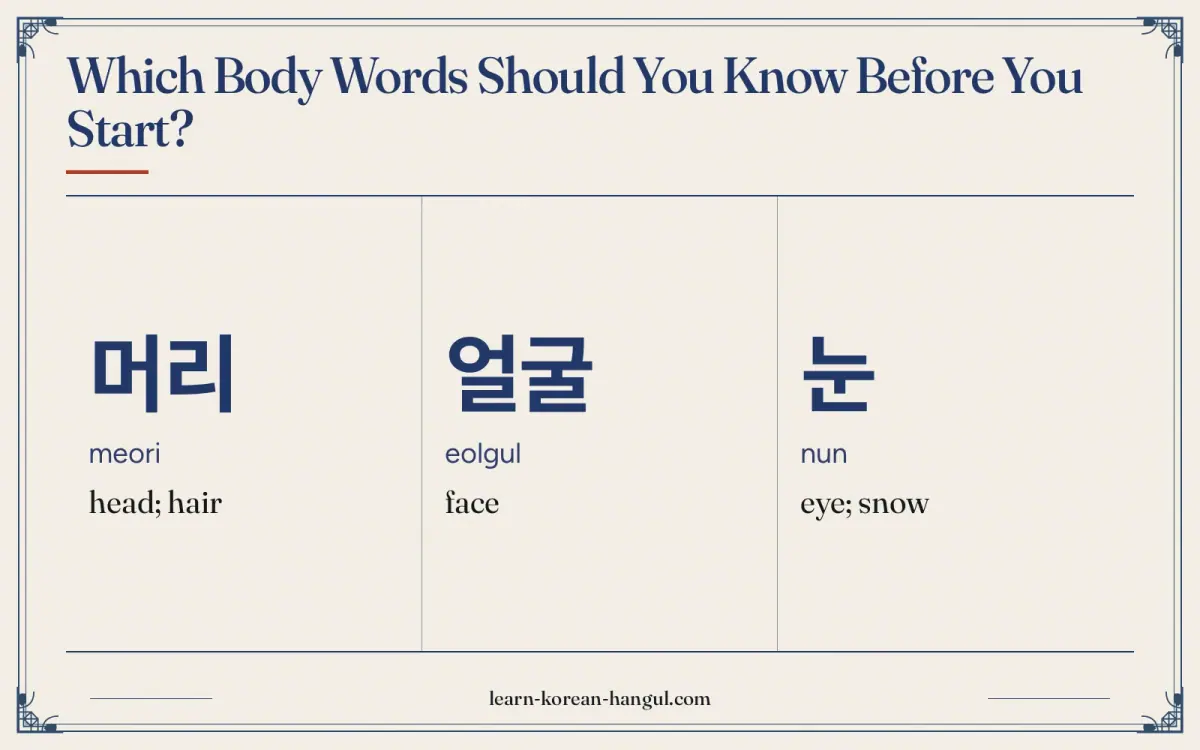
Body words fall into four areas. The table lists the ones the quiz uses, with Revised Romanization. Say each word aloud once before you begin.
| Area | Korean | Revised Romanization | Meaning |
|---|---|---|---|
| Head and face | 머리 | meori | head; hair |
| Head and face | 얼굴 | eolgul | face |
| Head and face | 눈 | nun | eye; snow |
| Head and face | 입 | ip | mouth |
| Head and face | 귀 | gwi | ear |
| Arms and hands | 팔 | pal | arm; the number eight |
| Arms and hands | 손 | son | hand |
| Legs and feet | 다리 | dari | leg; bridge |
| Legs and feet | 무릎 | mureup | knee |
| Legs and feet | 발 | bal | foot |
| Legs and feet | 발톱 | baltop | toenail |
| Torso | 목 | mok | neck; throat |
| Torso | 배 | bae | belly; pear; ship |
| Torso | 허리 | heori | waist; lower back |
Notice that 손 is the hand only and 발 is the foot only. The arm is 팔 and the leg is 다리. This is the most common source of mixed-up answers.
Which Spellings Have More than One Meaning?
Korean has many words that share a spelling. The sentence around the word decides which one you mean, just as in English "bat" or "row". Four body words work this way.
| Word | Meanings | Example that fixes the meaning |
|---|---|---|
| 눈 (nun) | eye; snow | 눈이 아파요 (nuni apayo): my eyes hurt |
| 배 (bae) | belly; pear; ship | 배가 고파요 (baega gopayo): I am hungry |
| 다리 (dari) | leg; bridge | 강에 다리가 있어요 (gange dariga isseoyo): there is a bridge over the river |
| 머리 (meori) | head; hair | 머리가 아파요 (meoriga apayo): I have a headache |
The particle after the noun does not help here, because 이 and 가 attach to every noun. The verb or the other nouns in the sentence do. A verb like 아프다 (apeuda, to hurt) points to a body part, and 고프다 (gopeuda, to be hungry) points to the belly.
Sample Questions with Answers
These six questions come from the quiz, with the answer and the reason for each. They also work as a no-JavaScript preview. Questions 3 and 4 show the same idea: one Korean spelling, two or more meanings.
Sample Question 1 and Its Answer
Question: What does 손 (son) mean?
Choices: arm; foot; hand; finger.
Answer: hand. Why: 손 is the hand only. The arm is 팔 and the finger is 손가락.
Sample Question 2 and Its Answer
Question: What does 발 (bal) mean?
Choices: foot; leg; hand; toenail.
Answer: foot. Why: 발 is the foot only, not the whole leg. The leg is 다리.
Sample Question 3 and Its Answer
Question: Which word means head?
Choices: 얼굴; 목; 머리; 가슴.
Answer: 머리. Why: 머리 (meori) is the head. The same word also means hair, so context decides. 얼굴 is the face and 목 is the neck.
Sample Question 4 and Its Answer
Question: 눈이 아파요 (nuni apayo) means "My ___ hurt." What is 눈 here?
Choices: eyes; snow; nose; ears.
Answer: eyes. Why: 눈 means both eye and snow. With 아프다 (to hurt), the body part fits, so it is eyes.
Sample Question 5 and Its Answer
Question: What does 입 (ip) mean?
Choices: lip; mouth; tongue; tooth.
Answer: mouth. Why: 입 is the mouth. Before the particle 이 it is said [이비], as in 입이.
Sample Question 6 and Its Answer
Question: 배가 고파요 (baega gopayo) means "I am hungry." What does 배 mean here?
Choices: pear; ship; back; belly.
Answer: belly. Why: 배 also means pear and ship, but 고프다 (to be hungry) points to the belly.
Tips before You Start
- Say each word aloud once before you choose. The sound often brings back the meaning faster than the spelling.
- Learn body words with a verb: 손을 씻다 (soneul ssitda, to wash hands), 눈을 감다 (nuneul gamda, to close the eyes), 입을 열다 (ibeul yeolda, to open the mouth).
- When a word has two meanings, look at the verb in the sentence before you look at the answers.
- Group the limbs in pairs: 손 and 팔, 발 and 다리. Ask yourself whether the question is about the end or the whole limb.
Which Mistakes Does the Body Parts in Korean Quiz Catch?
Four errors cover most misses.
- Mixing 다리 (leg) with 팔 (arm), because both are long limb words.
- Reading 손 as arm or 발 as leg. These two name the hand and foot only.
- Forgetting that 눈 means both eye and snow, and answering from the English word you saw first.
- Picking pear or ship for 배 when the sentence is about being hungry.
What Should You Study after the Quiz?
Drill the words with the korean body parts flashcards, and reread the korean body parts lesson for any area you missed. To practise reading the words quickly, try the korean reading practice tool. The next quiz in the sequence is the korean family members quiz. You can also return to the korean vocabulary quiz list, or take the korean level test for a wider check.
Answer Key for Questions 7 to 15
Prefer to test yourself first? Take the quiz above, then check this table. The first six answers are in the sample questions.
| # | Question | Correct answer | Reason |
|---|---|---|---|
| 7 | Which word means leg? | 다리 | 다리 is the leg. 팔 is the arm, 허리 the waist and 어깨 the shoulder. |
| 8 | 강에 다리가 있어요 (gange dariga isseoyo) means "There is a ___ over the river." What is 다리 here? | bridge | 다리 is the leg and also a bridge. A river points to the bridge. |
| 9 | Which word means arm? | 팔 | 팔 (pal) is the arm. The same spelling is the number eight in Sino-Korean numbers. |
| 10 | What does 귀 (gwi) mean? | ear | 귀 is the ear. It is one syllable with a glide, said like gwi. |
| 11 | Which word means face, not the whole head? | 얼굴 | 얼굴 (eolgul) is the face. 머리 is the whole head, 이마 the forehead and 턱 the chin. |
| 12 | 허리가 아파요 (heoriga apayo) means that your ___ hurts. Which part? | lower back | 허리 is the waist and lower back. People say it when the lower back hurts. |
| 13 | 무릎 (mureup) is which joint? | knee | 무릎 is the knee. It is said [무릅], and before 이 it is [무르피]. |
| 14 | Which word means neck or throat? | 목 | 목 (mok) covers both the neck and the throat. 몸 is the whole body and 등 is the back. |
| 15 | What is 발톱 (baltop)? | toenail | 발 (foot) plus 톱 gives toenail. A fingernail is 손톱, with 손 (hand) in place of 발. |
What Does This Quiz Not Do?
The quiz covers 14 common body words and does not test organs, bones, skin or medical vocabulary. It does not cover counters for body parts or idioms such as 손이 크다 (soni keuda, generous). Colloquial words may differ from the standard forms. All Korean text in the questions and answers was generated and is waiting for review by a Korean reviewer.
Frequently Asked Questions
Why does the quiz ask about words like 눈 and 배?
Because Korean uses many words with more than one meaning, and learners meet them in the first week. The quiz gives a short sentence so that only one meaning fits. Practising this early makes it easier to read signs, menus and conversation, where context always decides.
Does the quiz include 다리 as a bridge?
Yes. One question uses 강에 다리가 있어요 (there is a bridge over the river) to show that 다리 means both leg and bridge. Another asks for the leg with no sentence. Seeing both uses side by side is the quickest way to remember the pair.
Does the quiz use audio?
Most questions have a replay button for the Korean word or phrase. If a clip is missing, the replay button is hidden and the question still works as text.
Which body words are not in the quiz?
The quiz leaves out finger, toe, chest, back, skin, bone, blood and organs, to keep to the words you need first. Those appear in the full body parts lesson, which lists 45 words in five groups with audio and example sentences, and in the flashcard deck.
Is the quiz free?
Yes. The quiz is free, needs no account and runs in your browser on a phone, tablet or computer. Nothing you answer is uploaded to a server. If you choose to save progress, it is stored on your own device only, and you can delete it in the settings at any time.
Retake the Body Parts in Korean Quiz
Retake the body parts in korean quiz once you can say the four limb words (손, 팔, 발, 다리) without hesitation. The reason line for each question is also a mini-lesson, so reading it twice often helps more than a fast retake. When 눈, 배 and 다리 feel easy, move on to family words.