
Korean School Words Flashcards: Study the 28 Cards
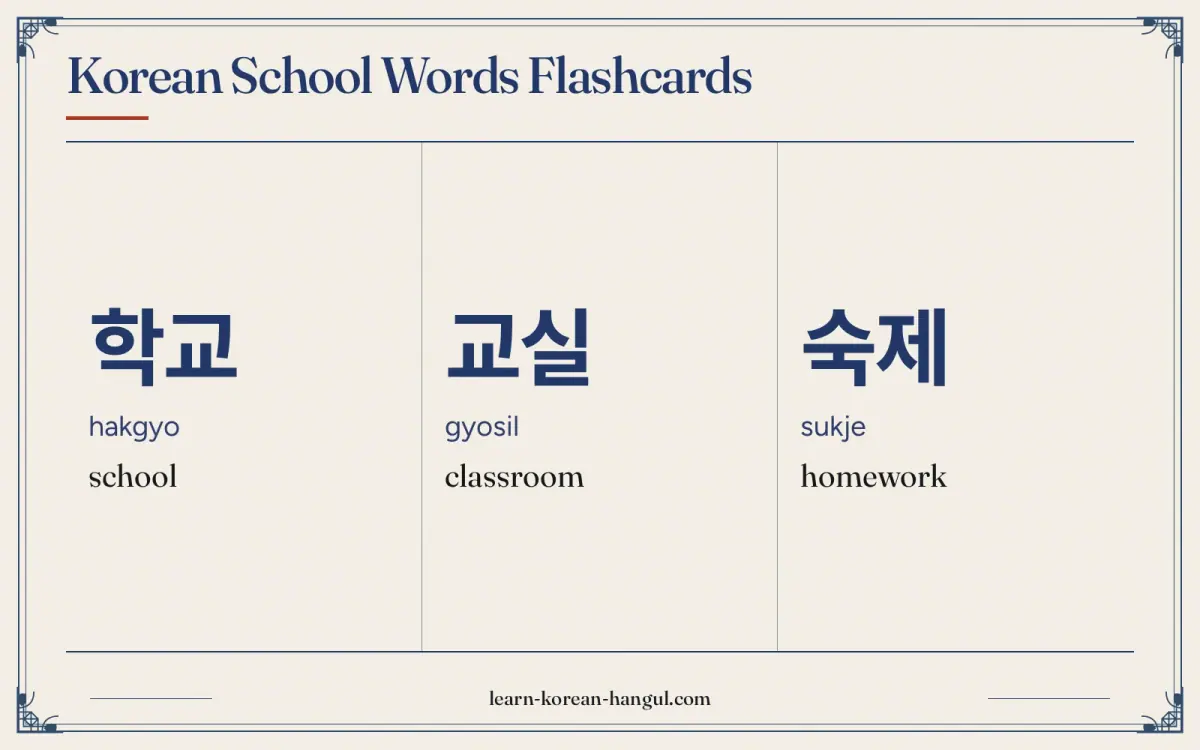
The school levels are built on 학교, so learn 학교 first and the rest follow. The words for things in a classroom come from the classroom and stationery lessons. The lesson behind the deck is korean school words, so read it first if a card is new.
How Do I Use These Flashcards?
Use the deck above in four steps. It works with tap, click or keyboard, and nothing plays until you press an audio button.
- Choose a mode. Start with recognition (Hangul to meaning). Switch to recall (meaning to Hangul) or listening (audio to meaning) once recognition feels easy.
- Show the answer. Think of the answer first, then press Show answer (or Space). Turn on the romanization toggle only if you need it; the 28-card table below always shows it.
- Grade yourself. Press Got it if you answered correctly without help, or Not yet if you hesitated or guessed.
- Finish the session. A session holds up to 20 cards (you can set 10, 20 or 40). With 28 cards, a first-time learner can split the deck over three days, using the default limit of 10 new cards a day.
The Three Study Modes
Recognition shows the Hangul and asks for the meaning, which trains reading. Recall shows the meaning and asks for the Hangul, which trains remembering; you may type the answer with your Hangul keyboard or just recall it in your head. Listening plays a clip and hides the letters, which trains the ear. Listening mode only uses a card once its audio is approved, and cards without approved audio are skipped in that mode with a note.
Got It and Not Yet
Got it moves the card up one Leitner box, so it comes back later. Not yet sends the card back to box 1, so it returns in the same session or within 10 minutes. The grades are your own judgement; the deck does not score you or claim fluency.
Deck Scope: What Is and Is Not Covered
The deck covers school and the levels of school (학교, 초등학교, 중학교, 고등학교, 대학교), things in the classroom (교실, 칠판, 책상, 의자), things in a school bag (책가방, 교과서, 공책, 연필, 볼펜, 지우개, 필통), people (학생, 선생님), and school life (반, 수업, 시간표, 숙제, 시험, 점수, 성적, 방학, 졸업, 쉬는 시간). Subjects are in the school-subjects deck.
What Is Left out of This Deck?
School subjects such as math and science are in the korean school subjects flashcards. Office and work words are in the korean business vocabulary flashcards, and hotel words are in the korean hotel vocabulary flashcards. The deck leaves out cram schools (학원) and school-year grades beyond a simple pattern.
All 28 Cards in One Table
All 28 cards appear below in deck order. The table is plain HTML, so you can use it as a drill without the deck: cover the Meaning column, read each Hangul word aloud, then uncover the meaning.
| # | Hangul | Revised Romanization | Meaning | Note | Audio assetId |
|---|---|---|---|---|---|
| 1 | 학교 | hakgyo | school | Said [학꾜]. The ㄱ after the closed ㄱ sound is tense. The base of the school-level words below. | au-pg-flashcards-school-vocabulary-1; slow: au-pg-flashcards-school-vocabulary-29 |
| 2 | 교실 | gyosil | classroom | 교 is teaching; 실 is room. | au-pg-flashcards-school-vocabulary-2 |
| 3 | 숙제 | sukje | homework | Verb: 하다 for doing it. | au-pg-flashcards-school-vocabulary-3 |
| 4 | 시험 | siheom | test; exam | You take it with 보다. | au-pg-flashcards-school-vocabulary-4 |
| 5 | 초등학교 | chodeunghakgyo | elementary school | The first stage of school. The next stages are 중학교 and 고등학교. | au-pg-flashcards-school-vocabulary-5 |
| 6 | 중학교 | junghakgyo | middle school | The stage after 초등학교. A student there is a 중학생. | au-pg-flashcards-school-vocabulary-6 |
| 7 | 고등학교 | godeunghakgyo | high school | The stage after 중학교. A student there is a 고등학생. | au-pg-flashcards-school-vocabulary-7 |
| 8 | 대학교 | daehakgyo | university | A university. 대학 alone can mean a college or a faculty. | au-pg-flashcards-school-vocabulary-8 |
| 9 | 칠판 | chilpan | blackboard | Used for whiteboards too. | au-pg-flashcards-school-vocabulary-9 |
| 10 | 책상 | chaeksang | desk | Said [책쌍]. | au-pg-flashcards-school-vocabulary-10; slow: au-pg-flashcards-school-vocabulary-31 |
| 11 | 의자 | uija | chair | Sit on it with 앉다. | au-pg-flashcards-school-vocabulary-11 |
| 12 | 책가방 | chaekgabang | school bag | Said [책까방]. | au-pg-flashcards-school-vocabulary-12 |
| 13 | 교과서 | gyogwaseo | textbook | 교과 is school subject. | au-pg-flashcards-school-vocabulary-13 |
| 14 | 공책 | gongchaek | notebook | Plain notebook for notes. | au-pg-flashcards-school-vocabulary-14 |
| 15 | 연필 | yeonpil | pencil | Sino-Korean: 연 is lead; 필 is brush. | au-pg-flashcards-school-vocabulary-15 |
| 16 | 볼펜 | bolpen | ballpoint pen | From ball + pen. | au-pg-flashcards-school-vocabulary-16 |
| 17 | 지우개 | jiugae | eraser | From 지우다, to erase. | au-pg-flashcards-school-vocabulary-17 |
| 18 | 필통 | piltong | pencil case | 필 is writing brush; 통 is tube. | au-pg-flashcards-school-vocabulary-18 |
| 19 | 학생 | haksaeng | student | Said [학쌩]. | au-pg-flashcards-school-vocabulary-19 |
| 20 | 선생님 | seonsaengnim | teacher | 님 is respectful; do not drop it. | au-pg-flashcards-school-vocabulary-20 |
| 21 | 반 | ban | class (group) | The group of students, not the lesson. | au-pg-flashcards-school-vocabulary-21 |
| 22 | 수업 | sueop | lesson; class | The lesson, not the group. | au-pg-flashcards-school-vocabulary-22 |
| 23 | 시간표 | siganpyo | timetable | 시간 is time; 표 is chart. | au-pg-flashcards-school-vocabulary-23 |
| 24 | 점수 | jeomsu | score | Said [점쑤]. | au-pg-flashcards-school-vocabulary-24 |
| 25 | 성적 | seongjeok | grades; results | Standard [성적]; [성쩍] is often heard. | au-pg-flashcards-school-vocabulary-25; slow: au-pg-flashcards-school-vocabulary-32 |
| 26 | 방학 | banghak | school vacation | A school or university break, as in 여름 방학 (summer break). Leave from work is 휴가. | au-pg-flashcards-school-vocabulary-26 |
| 27 | 졸업 | joreop | graduation | Said [조럽]: the ㄹ of 졸 links to the vowel of 업. 졸업하다 means to graduate. | au-pg-flashcards-school-vocabulary-27; slow: au-pg-flashcards-school-vocabulary-30 |
| 28 | 쉬는 시간 | swineun sigan | break time | 쉬다 is to rest. | au-pg-flashcards-school-vocabulary-28 |
Reading the Table
Hangul is the word. Revised Romanization (RR) is a learning aid, so try to read the Hangul before you look at it. RR follows the sound of the word, which is why some spellings change. The Meaning column gives the English gloss, and the Note column gives a hint about the parts of the word or its sound. The last column lists the audio assetId; a second ID marks a slow clip.
Usage Notes for These Cards
Levels are named by stage. 초등학교, 중학교 and 고등학교 are elementary, middle and high school. 대학교 is a university. In daily speech, people often say 초등학생, 중학생 and 고등학생 for the students.
Grades use Sino-Korean numbers. 삼 학년 means third year, and classes are 몇 반 (which class). A student can say 저는 일 학년이에요 (I am a first-year student).
Take an exam with 보다. 시험을 보다 means to take an exam: 내일 시험을 봐요 (I take an exam tomorrow). The verb 하다 is not used here.
Teachers are 선생님. 선생님 is the word for a teacher below university, and the ending 님 should stay. A university professor is usually 교수님.
Classes are 반 and lessons are 수업. 반 is the group of students and 수업 is the lesson. 이 학년 삼 반 means second year, class three.
Which Sounds Do Not Match the Spelling?
A few school words change sound when they are said.
- 학교 is said [학꾜]. The ㄱ of 교 is tense after the closed ㄱ sound of 학.
- 졸업 is said [조럽]. The final ㄹ of 졸 links forward, and the ㅂ of 업 links with the next sound when a particle follows.
- 학년 (school year) is said [항년]. The ㄱ before ㄴ is read as ㅇ; this is nasalization. 학년 is not a card, but it comes up in every grade phrase.
The pronunciations follow the 국립국어원 (National Institute of Korean Language) standard pronunciation rules (표준 발음법), and the romanization follows the Revised Romanization of Korean (2000).
What Mistakes Do Learners Make with School Words?
- Saying 시험을 하다 for "take an exam". Say 시험을 보다.
- Saying 세 학년. Grades take Sino-Korean numbers, so say 삼 학년.
- Saying 학교에 공부하다. Use 학교에서 공부하다, because 에서 marks where you do something.
- Mixing up 수업 (lesson) and 반 (class group).
- Mixing up 질문 (a question asked) and 문제 (a test question or a problem).
How Does the Review Schedule Work?
The deck uses a simplified Leitner system with five boxes. A new card starts in box 1. Each Got it moves it up one box, and each Not yet returns it to box 1. The box sets how long the card waits before it is due again.
| Box | Wait until the next review |
|---|---|
| 1 | same session or 10 minutes |
| 2 | 1 day |
| 3 | 3 days |
| 4 | 7 days |
| 5 | 21 days |
Each session shows due cards first, oldest due first, and then up to 10 new cards a day by default. A deck of 28 cards is introduced over three days at the default of 10 new cards a day, and the later boxes bring each card back at longer gaps. Progress is saved only in this browser, so clearing site data deletes it. Use the export button to save a small JSON file with card IDs, boxes and due dates, and import it on another device. No account is needed.
Cultural and Practical Context
The Korean school year starts in March, and private after-school 학원 classes are a familiar part of many students' weeks. A 담임 선생님 is the homeroom teacher who looks after one class for the year.
Limits of This Deck
The deck has 28 cards, so it teaches the core school words and leaves out most of the 70 words on the two classroom and stationery lesson pages. The 학원 and 교복 words are not cards. The remarks on the March start and on 학원 are general and not rules, and the school year can differ for some schools. All Korean text is generated and was reviewed and signed off by Min-ji Park on 15 October 2026. The audio is generated with text-to-speech and is checked by a Korean teacher before publication, and listening mode uses only cards whose clips are approved.
Next Steps after This Deck
Continue with the korean business vocabulary flashcards, or go back to the korean hotel vocabulary flashcards if a word here still feels shaky. Write the same words by hand with the korean school vocabulary worksheet. The korean vocabulary flashcards page lists every other deck, and the korean flashcards hub lists all topics.
Frequently Asked Questions
What Is the Difference between 대학 and 대학교?
대학교 is a university, and 대학 is a college or a faculty within a university. In daily speech people often shorten 대학교 to 대학, so the two can overlap. On a form or a sign, 대학교 is the safe word when you mean a whole university.
How Do I Say I Am a First-Year Student?
Say 저는 일 학년이에요. The number is Sino-Korean, and 학년 is the counter for school years. For the second year, say 이 학년, and for the third year, 삼 학년. The deck does not have a card for 학년, but it comes up in every grade phrase.
Is 선생님 Used for Professors?
Usually 교수님 is used for university professors, and 선생님 for teachers below university. 선생님 is also a polite title for other respected people, such as doctors, so it appears outside schools too. Keep the 님 in both words when you speak to the person.
What Is 반?
반 is a class group or a homeroom, as in 이 학년 삼 반 (second year, class three). It can also mean half, so context decides. Do not confuse it with 수업, the lesson itself. A student in 삼 반 shares a room with the same classmates all year.
Is My Progress Saved If I Close the Page?
Yes, in the same browser on the same device. Card boxes and due dates are stored locally and nothing is sent to a server. Clearing site data, using a private window or switching browsers removes them, so use the export button to keep a backup file. No account is needed.