
Key facts
- Scope: pets, farm animals, wild animals, sea creatures and the counter 마리. Animal sounds and animal meat names are in other decks.
Korean Animals Flashcards: Study the 29 Cards
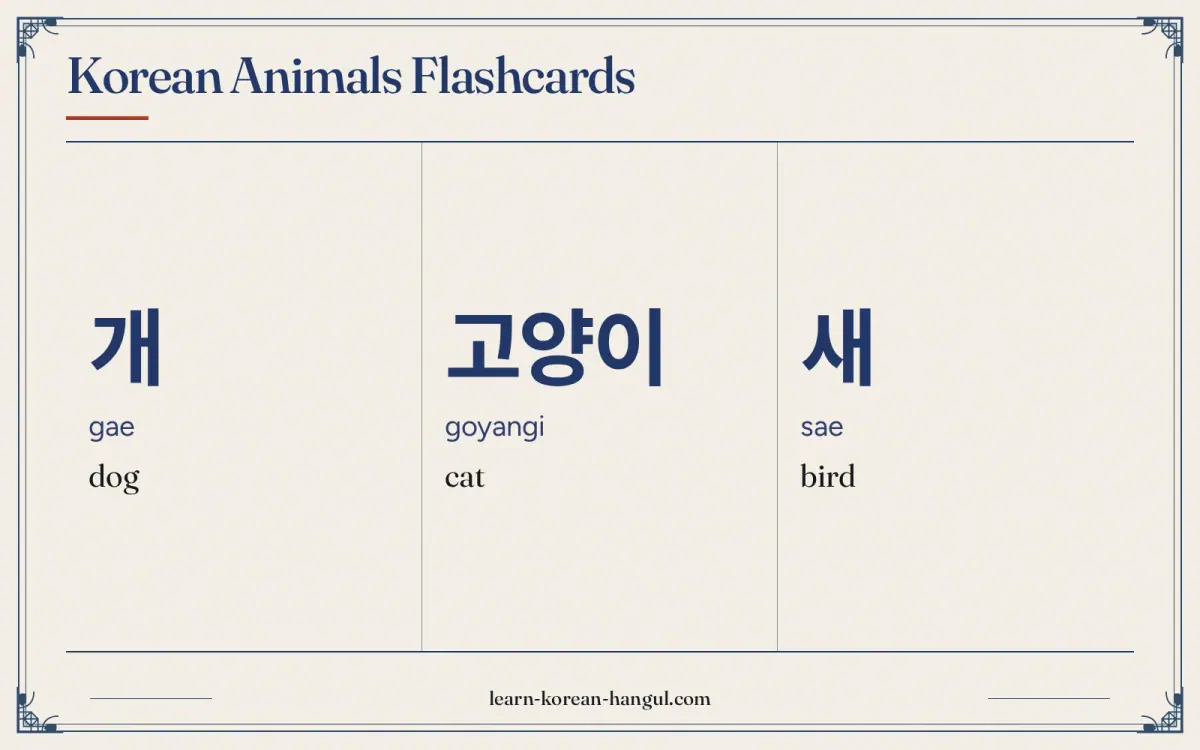
The cards start with the animals people meet every day (cards 1 to 7: 개, 고양이, 새, 물고기, 말, 소, 돼지), then birds and small animals, wild animals, reptiles and amphibians, insects, sea animals and general words. The last card is the counter 마리. Card meanings come from the site's animals word list.
How Do I Use These Flashcards?
Use the deck above in four steps. It works with tap, click or keyboard, and nothing plays until you press an audio button.
- Choose a mode. Start with recognition (Hangul to meaning). Switch to recall (meaning to Hangul) or listening (audio to meaning) once recognition feels easy.
- Show the answer. Think of the answer first, then press Show answer (or Space). Turn on the romanization toggle only if you need it; the table below always shows it.
- Grade yourself. Press Got it if you answered correctly without help, or Not yet if you hesitated or guessed.
- Finish the session. A session holds up to 20 cards (you can set 10, 20 or 40). With 29 cards, a first-time learner should expect about 3 days at the default limit of 10 new cards a day, with review sessions on top.
The Three Study Modes
Recognition shows the Hangul and asks for the meaning, so with the first card it shows 개 and you answer "dog". Recall reverses this: it shows the meaning and asks for the Hangul, and you may type the answer with your Hangul keyboard or just say it in your head. Listening plays a clip and hides the letters, which trains the ear. Listening mode only uses a card once its audio is approved, and cards without approved audio are skipped in that mode with a note. Recall mode works well here, because each English animal name has a short Hangul answer you can type.
Got It and Not Yet
Got it moves a card up one Leitner box, so it comes back later. Not yet sends the card back to box 1, so it returns in the same session or within 10 minutes. The grades are your own judgement; the deck does not score you or claim fluency.
Deck Scope: What Is and Is Not Covered
The deck covers pets, farm animals, wild animals, sea creatures and the counter 마리. Animal sounds are in the onomatopoeia deck, and animal meat names are in the ingredients deck. The words and letters on these cards are explained in the animals in korean lesson, so read it first if a card is new.
What This Deck Leaves Out
Animal sounds such as 멍멍 are word-sound words and belong to the onomatopoeia lessons. Meat and fish as food, such as 소고기 and 생선, are in the vocabulary lessons on ingredients. Weather is in the Korean weather flashcards deck if you want a different topic.
All 29 Cards in One Table
All 29 cards appear below in deck order. The table is plain HTML, so you can use it as a drill without the deck: cover the Meaning column, read each word aloud, then uncover it.
| # | Hangul | Revised Romanization | Meaning | Note | Audio assetId |
|---|---|---|---|---|---|
| 1 | 개 | gae | dog | 개 한 마리 (one dog). Do not confuse it with 게 (crab). | au-pg-flashcards-animals-1 |
| 2 | 고양이 | goyangi | cat | 고양이 두 마리 (two cats). | au-pg-flashcards-animals-2 |
| 3 | 새 | sae | bird | Also means new; context decides. | au-pg-flashcards-animals-3 |
| 4 | 물고기 | mulgogi | fish (animal) | A living fish; fish as food is 생선. | au-pg-flashcards-animals-4 |
| 5 | 말 | mal | horse | Also means speech; context decides. | au-pg-flashcards-animals-5 |
| 6 | 소 | so | cow | 소고기 is beef. | au-pg-flashcards-animals-6 |
| 7 | 돼지 | dwaeji | pig | 돼지고기 is pork. | au-pg-flashcards-animals-7 |
| 8 | 닭 | dak | chicken (animal) | Said [닥]; 닭이 is said [달기]. | au-pg-flashcards-animals-8; slow: au-pg-flashcards-animals-31 |
| 9 | 오리 | ori | duck | 오리가 헤엄쳐요 (The duck swims). | au-pg-flashcards-animals-9 |
| 10 | 강아지 | gangaji | puppy | 강아지를 키워요 (I have a puppy). | au-pg-flashcards-animals-10 |
| 11 | 토끼 | tokki | rabbit | 토끼가 귀여워요 (The rabbit is cute). | au-pg-flashcards-animals-11 |
| 12 | 쥐 | jwi | mouse | Rat or mouse; 생쥐 is specifically a mouse. | au-pg-flashcards-animals-12 |
| 13 | 호랑이 | horangi | tiger | 호랑이가 무서워요 (The tiger is scary). | au-pg-flashcards-animals-13 |
| 14 | 사자 | saja | lion | 사자가 무서워요 (The lion is scary). | au-pg-flashcards-animals-14 |
| 15 | 곰 | gom | bear | 곰이 커요 (The bear is big). | au-pg-flashcards-animals-15 |
| 16 | 코끼리 | kokkiri | elephant | 코끼리가 커요 (The elephant is big). | au-pg-flashcards-animals-16 |
| 17 | 원숭이 | wonsungi | monkey | 원숭이가 바나나를 먹어요 (The monkey eats a banana). | au-pg-flashcards-animals-17 |
| 18 | 뱀 | baem | snake | 뱀이 있어요 (There is a snake). | au-pg-flashcards-animals-18 |
| 19 | 용 | yong | dragon | A mythical creature. | au-pg-flashcards-animals-19 |
| 20 | 거북이 | geobugi | turtle | Said [거부기]. | au-pg-flashcards-animals-20; slow: au-pg-flashcards-animals-32 |
| 21 | 개구리 | gaeguri | frog | 개구리가 뛰어요 (The frog jumps). | au-pg-flashcards-animals-21 |
| 22 | 나비 | nabi | butterfly | 나비가 날아요 (The butterfly is flying). | au-pg-flashcards-animals-22 |
| 23 | 모기 | mogi | mosquito | 모기가 많아요 (There are many mosquitoes). | au-pg-flashcards-animals-23 |
| 24 | 고래 | gorae | whale | 고래는 바다에 살아요 (Whales live in the sea). | au-pg-flashcards-animals-24 |
| 25 | 돌고래 | dolgorae | dolphin | 돌고래가 똑똑해요 (Dolphins are smart). | au-pg-flashcards-animals-25 |
| 26 | 상어 | sangeo | shark | 상어가 무서워요 (Sharks are scary). | au-pg-flashcards-animals-26 |
| 27 | 동물 | dongmul | animal | 동물을 좋아해요 (I like animals). | au-pg-flashcards-animals-27 |
| 28 | 애완동물 | aewandongmul | pet | Older word; 반려동물 is the current word for companion animal. | au-pg-flashcards-animals-28 |
| 29 | 마리 | mari | counter for animals | Counter for animals: 고양이 두 마리 (two cats), 개 한 마리 (one dog). | au-pg-flashcards-animals-29 |
Reading the Table
Hangul is the word. Revised Romanization (RR) is a learning aid, so read the Hangul first. RR follows the pronunciation, so 닭 is written dak because it is said [닥], and 거북이 is written geobugi. It does not mark tensing. The Meaning column gives the English gloss, and the Note column gives an example or a sound hint. A second ID in the last column marks a slow clip.
Usage Notes for These Cards
Animals are counted with 마리. Use a native Korean number and 마리: 고양이 두 마리 (two cats), 개 한 마리 (one dog). Use 명 for people and 개 for objects.
Keeping a pet uses 키우다. 강아지를 키워요 means I have a puppy, where 강아지 is a young dog. People also use 강아지 affectionately for any small dog.
Fish as an animal and as food. The word for a living fish is 물고기, while fish as food is 생선: 물고기가 헤엄쳐요 (The fish swims).
Live animal and meat differ. 소 is the cow but 소고기 is beef, and 돼지 is the pig but 돼지고기 is pork. Adding 고기 (meat) turns the animal into food.
Homophones add confusion. 말 is also speech, 새 is also new, and 배 is also belly, ship and pear. Context decides, so learn each animal with a short phrase.
Which Sounds Do Not Match the Spelling?
닭 is said [닥]: the cluster ㄺ is read as ㄱ at the end of a word. With a particle, 닭이 is said [달기], with the ㄹ staying and the ㄱ moving to the next syllable.
거북이 is said [거부기]: the final ㄱ of 북 moves to the vowel of 이. Revised Romanization writes geobugi.
Most Seoul speakers today pronounce ㅐ and ㅔ the same, which is why 개 (dog) and 게 (crab) are easy to mix up when you only hear them.
What Mistakes Do Learners Make with Animals?
- Counting animals with 개. Use 마리 for animals and 개 for objects.
- Mixing up 개 (dog) and 게 (crab). The vowels ㅐ and ㅔ are close, so check the spelling.
- Using 물고기 on a restaurant menu. Fish dishes are 생선.
- Saying 소 for beef. The animal is 소, and the meat is 소고기.
Most of these errors come from sounds or counters that English does not have, so say the example phrase aloud when you answer a card.
How Does the Review Schedule Work?
The deck uses a simplified Leitner system with five boxes. A new card starts in box 1. Each Got it moves it up one box, and each Not yet returns it to box 1. The box sets how long the card waits before it is due again.
| Box | Wait until the next review |
|---|---|
| 1 | same session or 10 minutes |
| 2 | 1 day |
| 3 | 3 days |
| 4 | 7 days |
| 5 | 21 days |
Each session shows due cards first, oldest due first, and then new cards up to the daily limit, which is 10 by default. A deck of 29 cards is introduced in about three days at the default of 10 new cards a day, and the later boxes bring each animal back at longer gaps. Progress is saved only in this browser, so clearing site data deletes it. Use the export button to save a small JSON file with card IDs, boxes and due dates, and import it on another device. The file holds no personal data.
Cultural and Practical Context
Practise the ordinary animal words in groups, then compare similar words such as 개 and 강아지. Use the counter 마리 with the examples already shown on the cards. The dragon word 용 names a mythical creature in stories and pictures.
Limits of This Deck
The deck holds 29 cards, a starting set rather than a full animal dictionary. It has no insects beyond 나비 and 모기, and no birds beyond the general 새, 닭 and 오리. 거북이 is the everyday form of the animal, and 거북 also occurs. The Korean text on this page is generated and was reviewed and signed off by Min-ji Park on 15 October 2026.
Next Steps after This Deck
This deck is one of the korean vocabulary flashcards on the site, so browse the full list if you want a different topic. When these cards feel easy, move on to korean weather flashcards to keep the same routine. For a related topic, try korean cooking vocabulary flashcards. After a session, write the same words by hand with the korean nature vocabulary worksheet. To check what you recalled, take the korean animal quiz next. All flashcard decks, including Hangul, vocabulary, phrases, grammar and TOPIK, are listed on the Korean flashcards hub.
Frequently Asked Questions
Is 강아지 Different from 개?
강아지 is a puppy, a young dog, though people also use it affectionately for any small dog. 개 is the general word for dog. When you talk about owning a pet, 강아지를 키워요 is a natural thing to say.
How Do I Say Pet?
반려동물 is the current word for companion animal, and 애완동물 is an older word that still appears on this deck. Both name an animal kept at home. You will see 반려동물 more often in new signs, ads and news.
What Are 쥐 and 생쥐?
쥐 is the general word for rat or mouse, and 생쥐 is specifically a mouse. If you need to be precise, 생쥐 names the small house mouse.
Do Animals Take 명 or 마리?
Animals take 마리, and 명 is for people. Use a native Korean number with 마리: 고양이 두 마리 (two cats). Objects take 개, so a toy cat would be 한 개.
Is My Progress Saved If I Close the Page?
Yes, in the same browser on the same device. Card boxes and due dates are stored locally and nothing is sent to a server. Clearing site data, using a private window or switching browsers removes them, so use the export button to keep a backup file. No account is needed.