
Key facts
Korean Cooking Vocabulary at a Glance
This list has 40 words in five groups of eight. It follows how a cook works: you read the recipe and prepare the ingredients, you use tools and heat, you taste the result, you name the method and you measure the amounts. It belongs to Food and Drink, next to the restaurant and drinks lists. Every word has an example sentence, so the page doubles as a ready deck.
| Group | Words | Use |
|---|---|---|
| Cooking steps | 8 | Preparing, seasoning and cleaning up |
| Tools and heat | 8 | Naming kitchen tools and heat levels |
| Taste words | 8 | Describing flavour and texture |
| Cooking methods (as nouns) | 8 | Reading dish names |
| Recipes and measures | 8 | Reading amounts in a recipe |
All are nouns. Many add 하다 to make a verb, such as 준비하다 and 설거지하다. The next section picks the words to learn first.
Which Cooking Words Should You Learn First?
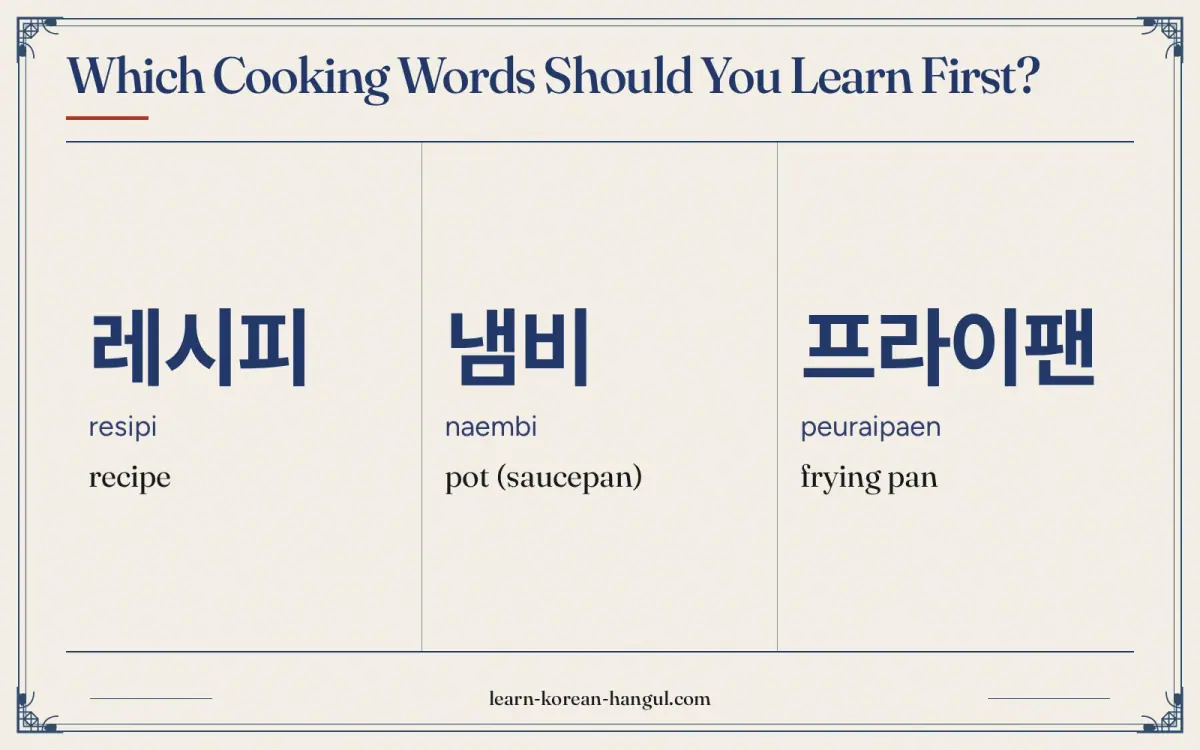
Learn 요리 (cooking), 레시피 (recipe), 재료 (ingredients), 맛 (taste) and 양념 (seasoning) first. They name the activity and the two things every cook handles, and they appear in every recipe heading. After that, add the tools and the method nouns, because the method nouns also read menus.
- Words to say. 요리, 맛, 간, 냄비, 칼. You use these when you cook with someone or talk about food.
- Words to recognise. 볶음, 찜, 구이, 조림, 무침, 튀김. You read these on menus and in recipe titles.
- Words to understand when spoken. 큰술, 작은술, 약간, 적당량. A cooking show or a family cook says these as quick instructions.
The Korean words for taste carry more meaning than their English glosses. 맛 is taste, but 간 is the seasoning level, and 손맛 is the cook's own touch. Learn these three with their notes and not just their translations. The single-word page on cooking in korean gives the lookup answer for 요리 and 요리하다.
Word · 8
- 1
레시피
resipi
recipe
- 2
냄비
naembi
pot (saucepan)
- 3
프라이팬
peuraipaen
frying pan
- 4
칼
kal
knife
- 5
도마
doma
cutting board
- 6
불
bul
fire; heat (of a stove)
- 7
그릇
geureut
bowl; dish; container
- 8
볶음
bokkeum
stir-fried dish
Cooking Steps
The first eight words follow the order of a cooking session: you choose a recipe, gather the ingredients, prepare them, season them and clean up at the end. They are nouns, and several add 하다 to become verbs, such as 준비하다 and 손질하다, which is how they appear in the example sentences.
| No. | Hangul | Revised Romanization | Meaning and note | Example sentence | Audio assetId |
|---|---|---|---|---|---|
| 1 | 요리 | yori | cooking; a cooked dish. 요리하다 is the verb "to cook". 요리사 is a chef. | 저는 요리를 좋아해요. (I like cooking.) | au-pg-vocabulary-food-cooking-1; example: au-pg-vocabulary-food-cooking-41 |
| 2 | 레시피 | resipi | recipe. A loanword. The Sino-Korean word 조리법 is used in books. | 레시피를 찾아요. (I look for a recipe.) | au-pg-vocabulary-food-cooking-2; example: au-pg-vocabulary-food-cooking-42 |
| 3 | 재료 | jaeryo | ingredients; materials. The things you need for a dish. Also used for building materials. | 재료를 준비해요. (I prepare the ingredients.) | au-pg-vocabulary-food-cooking-3; example: au-pg-vocabulary-food-cooking-43 |
| 4 | 준비 | junbi | preparation. 준비하다 means to prepare. 저녁 준비 is getting dinner ready. | 저녁 준비를 해요. (I prepare dinner.) | au-pg-vocabulary-food-cooking-4; example: au-pg-vocabulary-food-cooking-44 |
| 5 | 손질 | sonjil | trimming; cleaning and preparing. Cutting, washing and cleaning an ingredient before cooking, especially fish and vegetables. | 생선을 손질해요. (I clean and prepare the fish.) | au-pg-vocabulary-food-cooking-5; example: au-pg-vocabulary-food-cooking-45 |
| 6 | 양념 | yangnyeom | seasoning; sauce mix. The mix of soy sauce, garlic, chilli and other flavourings that goes on or in food. | 양념을 넣어요. (I add the seasoning.) | au-pg-vocabulary-food-cooking-6; example: au-pg-vocabulary-food-cooking-46 |
| 7 | 반죽 | banjuk | dough; batter. Used for dumplings, pancakes and noodles. 반죽하다 is to knead. | 반죽을 만들어요. (I make the dough.) | au-pg-vocabulary-food-cooking-7; example: au-pg-vocabulary-food-cooking-47 |
| 8 | 설거지 | seolgeoji | washing the dishes. 설거지하다 is the verb. Usually the last job after a meal. | 저녁 먹고 설거지를 해요. (After dinner I wash the dishes.) | au-pg-vocabulary-food-cooking-8; example: au-pg-vocabulary-food-cooking-48 |
Example Sentences
The sentences use two frames. The first is noun + 을/를 + 해요 (I do noun), as in 저녁 준비를 해요 and 설거지를 해요. The second is noun + 을/를 + verb, as in 재료를 준비해요 and 반죽을 만들어요. The same noun can sit in either frame: 준비를 해요 and 준비해요 mean the same, and the shorter one is more common in speech. Say each sentence aloud after the audio clip, and change the noun to make new ones.
How Do You Say Tools and Heat in Korean?
Kitchen tools are a mix of loanwords and older native words. The knife and the cutting board have been in Korean kitchens for generations, while the oven and the frying pan are loanwords from English. The word for heat is the plain noun 불, which also means fire.
| No. | Hangul | Revised Romanization | Meaning and note | Example sentence | Audio assetId |
|---|---|---|---|---|---|
| 9 | 냄비 | naembi | pot (saucepan). A pot with a lid and two handles. Used for ramyeon, soups and stews. | 냄비에 물을 끓여요. (I boil water in the pot.) | au-pg-vocabulary-food-cooking-9; example: au-pg-vocabulary-food-cooking-49 |
| 10 | 프라이팬 | peuraipaen | frying pan. A loanword: fry + pan. Shortened to 팬 in speech. | 프라이팬에 기름을 둘러요. (I coat the frying pan with oil.) | au-pg-vocabulary-food-cooking-10; example: au-pg-vocabulary-food-cooking-50 |
| 11 | 칼 | kal | knife. The general word. 식칼 is a kitchen knife. | 칼이 잘 들어요. (The knife cuts well.) | au-pg-vocabulary-food-cooking-11; example: au-pg-vocabulary-food-cooking-51 |
| 12 | 도마 | doma | cutting board. Used under the knife. Often made of wood. | 도마 위에서 채소를 썰어요. (I chop vegetables on the cutting board.) | au-pg-vocabulary-food-cooking-12; example: au-pg-vocabulary-food-cooking-52 |
| 13 | 가스레인지 | gaseureinji | gas stove. A loanword: gas + range. A stove with burners. | 가스레인지를 켜요. (I turn on the gas stove.) | au-pg-vocabulary-food-cooking-13; example: au-pg-vocabulary-food-cooking-53 |
| 14 | 불 | bul | fire; heat (of a stove). 센 불 is high heat and 약한 불 is low heat. Also the word for a light. | 불을 줄여요. (I lower the heat.) | au-pg-vocabulary-food-cooking-14; example: au-pg-vocabulary-food-cooking-54 |
| 15 | 오븐 | obeun | oven. A loanword. Home ovens are less common in Korea than stoves. | 오븐에 빵을 구워요. (I bake bread in the oven.) | au-pg-vocabulary-food-cooking-15; example: au-pg-vocabulary-food-cooking-55 |
| 16 | 그릇 | geureut | bowl; dish; container. The general word for tableware that holds food. Said [그륻] when it stands alone. | 그릇에 담아요. (I put it in a bowl.) | au-pg-vocabulary-food-cooking-16; example: au-pg-vocabulary-food-cooking-56 |
The word 불 does two jobs. As "fire" it appears in 불을 켜다 (switch on a light) and 불이 나다 (a fire breaks out). As "heat" it appears in a recipe: 센 불에서 볶아요 (stir-fry on high heat) and 약한 불로 끓여요 (simmer on low heat). In a recipe you will see 센 불, 중간 불 and 약한 불, which are high, medium and low heat. The verbs that match these tools, such as 끓이다, 볶다, 굽다 and 삶다, are covered on the common verbs page, so this list stays with the nouns.
Taste Words
Korean has a rich set of words for how food tastes and feels. The basic noun is 맛, taste, and many other words are built on it. This group also includes two ideas that are hard to translate: 간, the level of seasoning, and 손맛, the flavour that comes from a particular cook's hands.
| No. | Hangul | Revised Romanization | Meaning and note | Example sentence | Audio assetId |
|---|---|---|---|---|---|
| 17 | 맛 | mat | taste; flavour. Said [맏] alone. 맛있다 means delicious and 맛없다 means not tasty. | 맛이 좋아요. (The taste is good.) | au-pg-vocabulary-food-cooking-17; example: au-pg-vocabulary-food-cooking-57 |
| 18 | 간 | gan | seasoning level (mainly saltiness). 간이 맞다 means the seasoning is just right. 간을 보다 means to taste for seasoning. | 간이 맞아요. (The seasoning is just right.) | au-pg-vocabulary-food-cooking-18; example: au-pg-vocabulary-food-cooking-58 |
| 19 | 향 | hyang | aroma; scent. Used for coffee, tea, herbs and perfume. | 커피 향이 좋아요. (The coffee smells good.) | au-pg-vocabulary-food-cooking-19; example: au-pg-vocabulary-food-cooking-59 |
| 20 | 식감 | sikgam | texture (mouthfeel). Said [식깜]. Chewy, crispy and soft are all 식감. | 식감이 쫄깃해요. (The texture is chewy.) | au-pg-vocabulary-food-cooking-20; example: au-pg-vocabulary-food-cooking-60 |
| 21 | 단맛 | danmat | sweetness. 단 means sweet and 맛 means taste. Said [단맏]. | 단맛이 강해요. (The sweetness is strong.) | au-pg-vocabulary-food-cooking-21; example: au-pg-vocabulary-food-cooking-61 |
| 22 | 짠맛 | jjanmat | saltiness. 짜다 means to be salty. The tense ㅉ makes a sharp start. | 짠맛이 약해요. (The saltiness is mild.) | au-pg-vocabulary-food-cooking-22; example: au-pg-vocabulary-food-cooking-62 |
| 23 | 매운맛 | maeunmat | spicy taste. 맵다 means to be spicy. Said [매운맏]. | 매운맛을 좋아해요. (I like spicy flavours.) | au-pg-vocabulary-food-cooking-23; example: au-pg-vocabulary-food-cooking-63 |
| 24 | 손맛 | sonmat | hand taste (a cook's touch). 손 means hand. The flavour a particular cook gives, often said of a mother or grandmother. | 어머니의 손맛이에요. (It is my mother's special touch.) | au-pg-vocabulary-food-cooking-24; example: au-pg-vocabulary-food-cooking-64 |
What Does 손맛 Mean?
손맛 (hand taste) is the Korean idea that a dish tastes different depending on who made it, even from the same recipe. A person says 손맛이 좋다 about a cook whose food is always right. The word is a compliment, and it is used for home cooks and for restaurants that people trust. There is no single English word for it; "a cook's touch" comes closest. The related word 간 is more technical: it is the seasoning level, usually how salty a dish is, and a cook tastes the food with 간을 보다 before serving.
How Do You Say Cooking Methods (as nouns) in Korean?
Korean dish names are often built from an ingredient and a method noun. 생선구이 is fish + grilling, 갈비찜 is short rib + braising, and 오징어볶음 is squid + stir-frying. Learn these eight nouns and you can read a large part of a Korean menu. This list keeps to the nouns; the matching verbs are on a separate page.
| No. | Hangul | Revised Romanization | Meaning and note | Example sentence | Audio assetId |
|---|---|---|---|---|---|
| 25 | 볶음 | bokkeum | stir-fried dish. Said [보끔]. From the verb 볶다, to stir-fry. 김치볶음밥 is kimchi fried rice. | 오징어 볶음은 매워요. (Stir-fried squid is spicy.) | au-pg-vocabulary-food-cooking-25; example: au-pg-vocabulary-food-cooking-65 |
| 26 | 찜 | jjim | steamed or braised dish. From 찌다 (to steam). 갈비찜 is braised short ribs and 계란찜 is steamed egg. | 갈비찜을 먹어요. (I eat braised short ribs.) | au-pg-vocabulary-food-cooking-26; example: au-pg-vocabulary-food-cooking-66 |
| 27 | 구이 | gui | grilled dish. From 굽다 (to grill). 생선구이 is grilled fish and 삼겹살구이 is grilled pork belly. | 생선구이를 좋아해요. (I like grilled fish.) | au-pg-vocabulary-food-cooking-27; example: au-pg-vocabulary-food-cooking-67 |
| 28 | 조림 | jorim | braised-in-sauce dish. From 조리다 (to simmer down). Salty-sweet side dishes such as 감자조림. | 감자조림은 달아요. (The braised potatoes are sweet.) | au-pg-vocabulary-food-cooking-28; example: au-pg-vocabulary-food-cooking-68 |
| 29 | 무침 | muchim | seasoned dish (mixed by hand). From 무치다 (to toss with seasoning). A side dish of vegetables or fish. | 시금치 무침을 먹어요. (I eat seasoned spinach.) | au-pg-vocabulary-food-cooking-29; example: au-pg-vocabulary-food-cooking-69 |
| 30 | 튀김 | twigim | fried dish; tempura-style. From 튀기다 (to deep-fry). 새우튀김 is fried shrimp. | 새우튀김이 바삭해요. (The fried shrimp is crispy.) | au-pg-vocabulary-food-cooking-30; example: au-pg-vocabulary-food-cooking-70 |
| 31 | 전 | jeon | pan-fried pancake or patty. A thin fried cake of vegetables, fish or meat in batter. 김치전 is kimchi pancake. | 김치전을 부쳐요. (I pan-fry a kimchi pancake.) | au-pg-vocabulary-food-cooking-31; example: au-pg-vocabulary-food-cooking-71 |
| 32 | 절임 | jeorim | pickled food. From 절이다 (to brine). 오이 절임 is pickled cucumber. | 오이 절임을 만들어요. (I make pickled cucumber.) | au-pg-vocabulary-food-cooking-32; example: au-pg-vocabulary-food-cooking-72 |
Seven of the eight method nouns come from a verb: the verb stem plus -(으)ㅁ or -이 gives a noun. 볶다 gives 볶음, 굽다 gives 구이, 조리다 gives 조림 (조리 + ㅁ) and 튀기다 gives 튀김 (튀기 + ㅁ). The exception is 전, a Sino-Korean word with no verb behind it. When you meet an unfamiliar dish word that ends in ㅁ or 이, look for the verb it comes from. For the dish names themselves, see the Korean Dishes list.
Recipes and Measures
Korean recipes often use spoons and cups rather than grams, and they use a few vague amounts that cooks judge by eye. The measure words follow a number, and the number is a native Korean number that shortens before a counter. Here are the eight measure words you will meet in most recipes.
| No. | Hangul | Revised Romanization | Meaning and note | Example sentence | Audio assetId |
|---|---|---|---|---|---|
| 33 | 큰술 | keunsul | tablespoon. Literally "big spoon". 한 큰술, 두 큰술, 세 큰술. | 간장 두 큰술을 넣어요. (I add two tablespoons of soy sauce.) | au-pg-vocabulary-food-cooking-33; example: au-pg-vocabulary-food-cooking-73 |
| 34 | 작은술 | jageunsul | teaspoon. Literally "small spoon". Seen in recipes next to 큰술. | 소금 한 작은술을 넣어요. (I add one teaspoon of salt.) | au-pg-vocabulary-food-cooking-34; example: au-pg-vocabulary-food-cooking-74 |
| 35 | 컵 | keop | cup. A loanword. In recipes, 한 컵 is about 200 ml, but check the recipe, because spoons and cups vary. | 물 한 컵을 넣어요. (I add one cup of water.) | au-pg-vocabulary-food-cooking-35; example: au-pg-vocabulary-food-cooking-75 |
| 36 | 약간 | yakgan | a little; slightly. Said [약깐]. Put before the verb: 약간 넣어요. | 소금을 약간 넣어요. (I add a little salt.) | au-pg-vocabulary-food-cooking-36; example: au-pg-vocabulary-food-cooking-76 |
| 37 | 적당량 | jeokdangnyang | a suitable amount. Said [적땅냥]. Used when the amount is left to the cook. | 설탕은 적당량 넣어요. (Add a suitable amount of sugar.) | au-pg-vocabulary-food-cooking-37; example: au-pg-vocabulary-food-cooking-77 |
| 38 | 한 줌 | han jum | a handful. 줌 is the amount in one hand. 한 줌 of herbs, nuts or greens. | 파를 한 줌 넣어요. (I add a handful of green onion.) | au-pg-vocabulary-food-cooking-38; example: au-pg-vocabulary-food-cooking-78 |
| 39 | 한 꼬집 | han kkojip | a pinch. 꼬집 is a pinch with two fingers. Often 소금 한 꼬집. | 소금 한 꼬집을 넣어요. (I add a pinch of salt.) | au-pg-vocabulary-food-cooking-39; example: au-pg-vocabulary-food-cooking-79 |
| 40 | 분량 | bullyang | quantity; portion amount. Said [불량]. The amounts a recipe lists. | 분량을 잘 지켜요. (I keep to the amounts carefully.) | au-pg-vocabulary-food-cooking-40; example: au-pg-vocabulary-food-cooking-80 |
How Do You Read a Korean Recipe Line?
A recipe lists the item, then the amount, then the verb. The sample below shows three typical lines and how to say them.
| In the recipe | Spoken form | Meaning |
|---|---|---|
| 물 2컵 | 물 두 컵 | 2 cups of water |
| 간장 3큰술 | 간장 세 큰술 | 3 tablespoons of soy sauce |
| 소금 약간 | 소금 약간 | a little salt |
The digits in the recipe are read with native numbers: 한, 두, 세. Native numbers shorten before a counter, so 둘 becomes 두 and 셋 becomes 세. The table does not list 약간 with a number, because it is itself an amount. The food and drink counters page lists the counters that go with food.
How Do You Pronounce These Words?
Cooking words contain several sound changes, because many end in a consonant that meets another consonant or a vowel. Standard pronunciation follows the National Institute of Korean Language (국립국어원) rules, and the romanization follows the Revised Romanization of Korean, which records some sound changes and ignores others.
| Spelling | Sounds like | What changes |
|---|---|---|
| 식감 | [식깜] | After a final ㄱ, the ㄱ of 감 becomes tense [ㄲ]. |
| 약간 | [약깐] | After a final ㄱ, the ㄱ of 간 becomes tense [ㄲ]. |
| 적당량 | [적땅냥] | After ㄱ, ㄷ becomes tense [ㄸ], and ㄹ becomes [ㄴ] after ㅇ. |
| 볶음 | [보끔] | The final ㄲ links to the next vowel and stays tense. |
| 손맛 | [손맏] | A final ㅅ is said as [ㄷ] at the end of a word. |
| 매운맛 | [매운맏] | The same final ㅅ becomes [ㄷ]. |
The tense sounds in 식감, 약간 and 볶음 are the hardest. A tense consonant is said with a tight throat and no puff of air, so the second syllable should sound sharp and short. For 레시피 (resipi), say re-si-pi, with a short first vowel and an even rhythm.
Audio and Slow Playback
Every headword and every example sentence has its own audio. The five clips below replay the trickiest words slowly. Play one, repeat it aloud, then play it again and compare.
What Mistakes Do Learners Make with Cooking Words?
These five mistakes come up often with cooking words.
- Missing the second meaning of 요리. 요리 is the activity and also a cooked dish or a cuisine, so 중국 요리 is Chinese food. For the act of cooking, use 요리하다 or 요리를 해요.
- Confusing 간 and 맛. 맛 is the overall taste, and 간 is only the salt level. 맛이 없어요 says the food is not good, while 간이 싱거워요 says only that it needs more salt. Use 간 when you mean salt, as in 간을 봐요 (I taste it for seasoning).
- Translating 손맛 word for word. "Hand taste" in English sounds odd. Use it as a compliment: 손맛이 좋아요, or explain it as "a cook's special touch".
- Treating method nouns as standalone dishes. 구이 alone is grilled food. Add the ingredient to make a dish: 생선구이, 갈비구이.
- Putting a number before 약간. 약간 already means "a little", so it does not take 한 or 두. Say 소금 약간 or 소금 한 꼬집, not 소금 한 약간.
One habit helps with all five: learn each noun with the dish or the sentence that shows it.
Practice: Flashcards and Worksheet
Study in three steps. First, run the flashcard deck in recognition mode until you know each of the 40 words. Second, switch to listening mode and answer from the audio alone. Third, take the quiz. The deck covers all 40 words with audio, and your progress stays in your browser. The vocabulary flashcard decks page lists the other decks.
Practice · 85
- 01요리
Show answer
headword 1: cooking; a cooked dish
- 02저는 요리를 좋아해요.
Show answer
example sentence for 요리: I like cooking.
- 03레시피
Show answer
headword 2: recipe
- 04레시피를 찾아요.
Show answer
example sentence for 레시피: I look for a recipe.
- 05재료
Show answer
headword 3: ingredients; materials
- 06재료를 준비해요.
Show answer
example sentence for 재료: I prepare the ingredients.
- 07준비
Show answer
headword 4: preparation
- 08저녁 준비를 해요.
Show answer
example sentence for 준비: I prepare dinner.
- 09손질
Show answer
headword 5: trimming; cleaning and preparing
- 10생선을 손질해요.
Show answer
example sentence for 손질: I clean and prepare the fish.
- 11양념
Show answer
headword 6: seasoning; sauce mix
- 12양념을 넣어요.
Show answer
example sentence for 양념: I add the seasoning.
- 13반죽
Show answer
headword 7: dough; batter
- 14반죽을 만들어요.
Show answer
example sentence for 반죽: I make the dough.
- 15설거지
Show answer
headword 8: washing the dishes
- 16저녁 먹고 설거지를 해요.
Show answer
example sentence for 설거지: After dinner I wash the dishes.
- 17냄비
Show answer
headword 9: pot (saucepan)
- 18냄비에 물을 끓여요.
Show answer
example sentence for 냄비: I boil water in the pot.
- 19프라이팬
Show answer
headword 10: frying pan
- 20프라이팬에 기름을 둘러요.
Show answer
example sentence for 프라이팬: I coat the frying pan with oil.
- 21칼
Show answer
headword 11: knife
- 22칼이 잘 들어요.
Show answer
example sentence for 칼: The knife cuts well.
- 23도마
Show answer
headword 12: cutting board
- 24도마 위에서 채소를 썰어요.
Show answer
example sentence for 도마: I chop vegetables on the cutting board.
- 25가스레인지
Show answer
headword 13: gas stove
- 26가스레인지를 켜요.
Show answer
example sentence for 가스레인지: I turn on the gas stove.
- 27불
Show answer
headword 14: fire; heat (of a stove)
- 28불을 줄여요.
Show answer
example sentence for 불: I lower the heat.
- 29오븐
Show answer
headword 15: oven
- 30오븐에 빵을 구워요.
Show answer
example sentence for 오븐: I bake bread in the oven.
- 31그릇
Show answer
headword 16: bowl; dish; container
- 32그릇에 담아요.
Show answer
example sentence for 그릇: I put it in a bowl.
- 33맛
Show answer
headword 17: taste; flavour
- 34맛이 좋아요.
Show answer
example sentence for 맛: The taste is good.
- 35간
Show answer
headword 18: seasoning level (mainly saltiness)
- 36간이 맞아요.
Show answer
example sentence for 간: The seasoning is just right.
- 37향
Show answer
headword 19: aroma; scent
- 38커피 향이 좋아요.
Show answer
example sentence for 향: The coffee smells good.
- 39식감
Show answer
headword 20: texture (mouthfeel)
- 40식감이 쫄깃해요.
Show answer
example sentence for 식감: The texture is chewy.
- 41단맛
Show answer
headword 21: sweetness
- 42단맛이 강해요.
Show answer
example sentence for 단맛: The sweetness is strong.
- 43짠맛
Show answer
headword 22: saltiness
- 44짠맛이 약해요.
Show answer
example sentence for 짠맛: The saltiness is mild.
- 45매운맛
Show answer
headword 23: spicy taste
- 46매운맛을 좋아해요.
Show answer
example sentence for 매운맛: I like spicy flavours.
- 47손맛
Show answer
headword 24: hand taste (a cook's touch)
- 48어머니의 손맛이에요.
Show answer
example sentence for 손맛: It is my mother's special touch.
- 49볶음
Show answer
headword 25: stir-fried dish
- 50오징어 볶음은 매워요.
Show answer
example sentence for 볶음: Stir-fried squid is spicy.
- 51찜
Show answer
headword 26: steamed or braised dish
- 52갈비찜을 먹어요.
Show answer
example sentence for 찜: I eat braised short ribs.
- 53구이
Show answer
headword 27: grilled dish
- 54생선구이를 좋아해요.
Show answer
example sentence for 구이: I like grilled fish.
- 55조림
Show answer
headword 28: braised-in-sauce dish
- 56감자조림은 달아요.
Show answer
example sentence for 조림: The braised potatoes are sweet.
- 57무침
Show answer
headword 29: seasoned dish (mixed by hand)
- 58시금치 무침을 먹어요.
Show answer
example sentence for 무침: I eat seasoned spinach.
- 59튀김
Show answer
headword 30: fried dish; tempura-style
- 60새우튀김이 바삭해요.
Show answer
example sentence for 튀김: The fried shrimp is crispy.
- 61전
Show answer
headword 31: pan-fried pancake or patty
- 62김치전을 부쳐요.
Show answer
example sentence for 전: I pan-fry a kimchi pancake.
- 63절임
Show answer
headword 32: pickled food
- 64오이 절임을 만들어요.
Show answer
example sentence for 절임: I make pickled cucumber.
- 65큰술
Show answer
headword 33: tablespoon
- 66간장 두 큰술을 넣어요.
Show answer
example sentence for 큰술: I add two tablespoons of soy sauce.
- 67작은술
Show answer
headword 34: teaspoon
- 68소금 한 작은술을 넣어요.
Show answer
example sentence for 작은술: I add one teaspoon of salt.
- 69컵
Show answer
headword 35: cup
- 70물 한 컵을 넣어요.
Show answer
example sentence for 컵: I add one cup of water.
- 71약간
Show answer
headword 36: a little; slightly
- 72소금을 약간 넣어요.
Show answer
example sentence for 약간: I add a little salt.
- 73적당량
Show answer
headword 37: a suitable amount
- 74설탕은 적당량 넣어요.
Show answer
example sentence for 적당량: Add a suitable amount of sugar.
- 75한 줌
Show answer
headword 38: a handful
- 76파를 한 줌 넣어요.
Show answer
example sentence for 한 줌: I add a handful of green onion.
- 77한 꼬집
Show answer
headword 39: a pinch
- 78소금 한 꼬집을 넣어요.
Show answer
example sentence for 한 꼬집: I add a pinch of salt.
- 79분량
Show answer
headword 40: quantity; portion amount
- 80분량을 잘 지켜요.
Show answer
example sentence for 분량: I keep to the amounts carefully.
- 81레시피
Show answer
slow playback of headword 2: recipe
- 82식감
Show answer
slow playback of headword 20: texture (mouthfeel)
- 83손맛
Show answer
slow playback of headword 24: hand taste (a cook's touch)
- 84볶음
Show answer
slow playback of headword 25: stir-fried dish
- 85적당량
Show answer
slow playback of headword 37: a suitable amount
Practice · 5
What does 레시피 (resipi) mean?
Show answer
recipe
레시피 means recipe. Example: 레시피를 찾아요. (I look for a recipe.)
What does 냄비 (naembi) mean?
Show answer
pot (saucepan)
냄비 means pot (saucepan). Example: 냄비에 물을 끓여요. (I boil water in the pot.)
What does 손맛 (sonmat) mean?
Show answer
hand taste (a cook's touch)
손맛 means hand taste (a cook's touch). Example: 어머니의 손맛이에요. (It is my mother's special touch.)
What does 볶음 (bokkeum) mean?
Show answer
stir-fried dish
볶음 means stir-fried dish. Example: 오징어 볶음은 매워요. (Stir-fried squid is spicy.)
What does 큰술 (keunsul) mean?
Show answer
tablespoon
큰술 means tablespoon. Example: 간장 두 큰술을 넣어요. (I add two tablespoons of soy sauce.)
Korean Cooking Vocabulary Worksheet (PDF)
A printable worksheet for these words (word list, matching, writing practice, fill-in-the-blank exercises and answer key) is available in A4 and US Letter from the download card on this page. For practice, pick a Korean recipe and underline every noun from this list. Reading a real recipe is the best test of the whole page.
Where to Go Next
After this page, continue with At the Restaurant, which teaches the words for ordering and paying, or Korean Dishes to put the method nouns to work. For the verbs that go with these nouns, see common verbs. To move up a level, return to Food and Drink.
Frequently Asked Questions
How Do You Say Cooking in Korean?
Cooking is 요리 (yori). The verb is 요리하다 (yorihada), and the polite form is 요리해요 (I cook). 요리 also means a cooked dish, as in 중국 요리 (Chinese food). A cook or chef is 요리사 (yorisa). With 하다 as a separate verb, add the object particle 를 (used after a vowel): 요리를 해요 (I cook).
How Do You Pronounce 레시피 (resipi)?
Say re-si-pi, with three even syllables. The first vowel ㅔ is short, like the vowel in "bed". The ㅣ vowels in 시 and 피 are clear and bright. The ㅍ is aspirated, with a small puff of air. Press the audio button on this page for the normal and slow versions.
How Many Cooking Words Should I Learn First?
Five first: 요리, 레시피, 재료, 맛 and 양념. At five new words a day, the whole list of 40 takes eight days plus review. Add the method nouns next, since they help you read menus as well as recipes.
Where Can I Practise Cooking Words with Flashcards?
Use the vocabulary flashcard decks. The deck for this page holds all 40 words with Hangul, romanization and audio, and it offers recognition and listening modes. Your progress stays in your browser, so return daily and review the cards you missed.
Is the Romanization on This Page Official?
It follows the Revised Romanization of Korean, which South Korea adopted on 7 July 2000 and whose rules the National Institute of Korean Language (국립국어원) publishes. It is a learning aid and does not mark every sound change, so rely on the Hangul and the audio.
Is There a Printable Worksheet for Cooking Words?
A printable worksheet for these words (word list, matching, writing practice, fill-in-the-blank exercises and answer key) is available in A4 and US Letter from the download card on this page. For practice, copy the tables on this page by hand or use the flashcard deck, which carries the same 40 words.