Korean Idioms at a Glance
An idiom is a phrase you cannot work out from its parts. In English, 'break a leg' has nothing to do with legs. Korean works the same way. 눈이 높다 (nuni nopda) is literally 'the eyes are high', but it means 'picky' or 'has high standards'. You can't translate it word by word, so you learn it as one unit.
Most Korean idioms are a short clause: a noun, a particle and a verb or adjective. Because the last word is a real predicate, the idiom conjugates. 눈이 높다 becomes 눈이 높아요 in polite speech and 눈이 높았어요 in the past. The words inside it stay fixed. You can't swap 눈 (eyes) for 시력 (eyesight) and keep the meaning.
| Group | Idioms | What it covers |
|---|---|---|
| Body-part idioms | 8 | Personality: generous, picky, bold, discreet |
| Animal idioms | 8 | Size, quiet, denial and narrow views |
| Food idioms | 8 | Easy tasks, failure, weddings and tiredness |
| Idioms about feelings | 8 | Jealousy, worry, guilt, fear and anger |
| Idioms about work and money | 8 | Busy days, quitting, teamwork and spending |
Idioms, Proverbs and Four-Character Idioms
Korean has three kinds of fixed expressions, and learners often mix them up. The table shows how they differ.
| Kind | Korean name | Shape | Example | How you use it |
|---|---|---|---|---|
| Idiom | 관용어 (gwanyongeo) | short phrase with a verb or adjective | 발이 넓다 (well-connected) | inside your own sentence, conjugated |
| Proverb | 속담 (sokdam) | a full saying with a lesson | 시작이 반이다 (well begun is half done) | quoted as a whole, often to comment |
| Four-character idiom | 사자성어 (sajaseongeo) | four Sino-Korean syllables | 일석이조 (two birds with one stone) | as a noun, often with 이다 or 하다 |
An idiom describes. A proverb teaches. A four-character idiom packs an idea into four syllables taken from Chinese characters (Hanja). The other two kinds have their own lists: Korean proverbs and Korean four character idioms.
This page belongs to Korean Word Types. Two deeper lists go further: Korean body part idioms (30 idioms with the hand, foot, eye, ear, mouth, face, heart and liver) and Korean animal idioms (30 idioms with tigers, dogs, frogs, cats and cows).
Which Korean Idioms Should You Learn First?
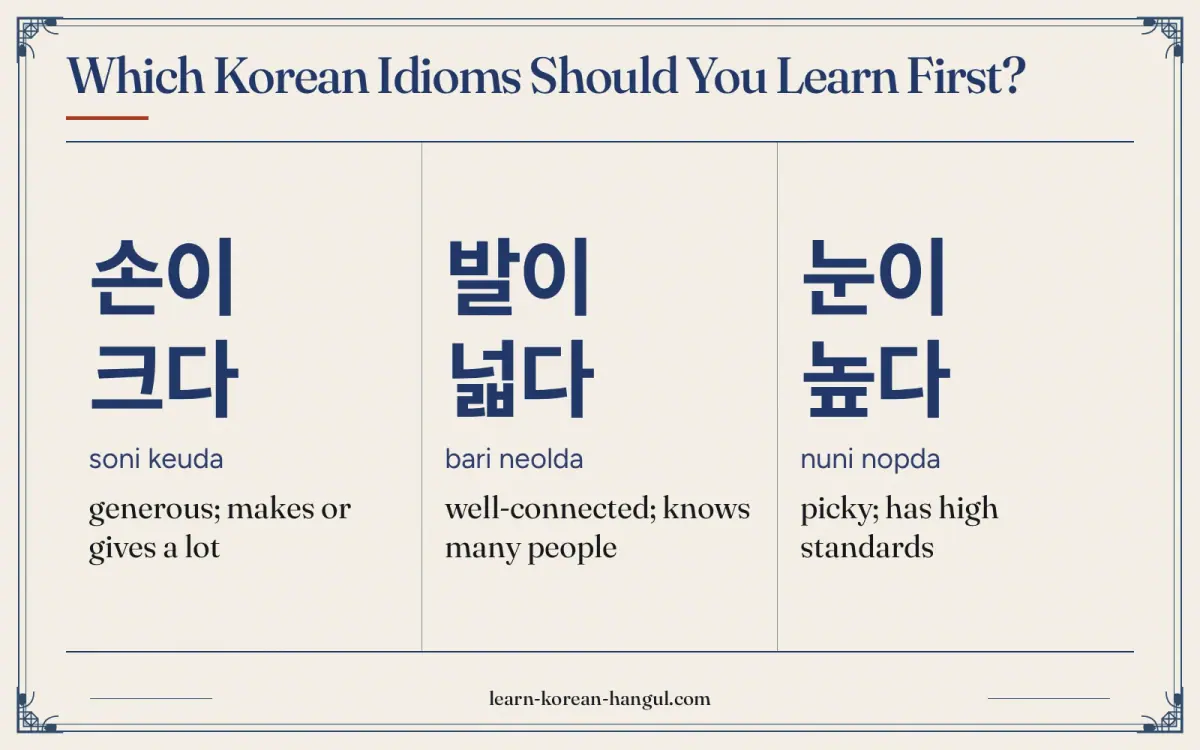
Learn idioms in the order you are likely to need them. Most daily conversation is about people, so personality idioms come first. Next come the ones for everyday situations, like an easy task, a busy week or a failed exam. Save the old-fashioned and critical idioms for recognition.
- Say first. 손이 크다, 발이 넓다, 눈이 높다, 귀가 얇다, 입이 무겁다, 식은 죽 먹기.
- Use often. 눈코 뜰 새 없다, 파김치가 되다, 미역국을 먹다, 바가지를 쓰다, 속이 타다.
- Recognise, use with care. 얼굴이 두껍다, 입이 가볍다, 국수를 먹다, 깨가 쏟아지다.
The scene below is a family dinner where each numbered person or object shows one idiom. Tap a number to hear it.
Word · 10
- 1
손이 크다
soni keuda
generous; makes or gives a lot
- 2
발이 넓다
bari neolda
well-connected; knows many people
- 3
눈이 높다
nuni nopda
picky; has high standards
- 4
귀가 얇다
gwiga yalda
easily persuaded; gullible
- 5
입이 무겁다
ibi mugeopda
keeps secrets; discreet
- 6
간이 크다
gani keuda
bold; daring
- 7
식은 죽 먹기
sigeun juk meokgi
a piece of cake; very easy
- 8
그림의 떡
geurimui tteok
something you want but can't have
- 9
파김치가 되다
pagimchiga doeda
to be worn out
- 10
배가 아프다
baega apeuda
to be jealous
Body-Part Idioms
Body parts carry the most Korean idioms. Each part has a job. The hand (손) is about giving and working, the foot (발) about going places and the eyes (눈) about judging. The mouth (입) is about speaking, the ears (귀) about listening and the liver (간) about courage. A big hand gives a lot, a wide foot meets many people and high eyes look down on ordinary choices. The full set of body words is on body parts.
| No. | Hangul | Revised Romanization | Literally | Meaning and note | Example sentence | Audio assetId |
|---|---|---|---|---|---|---|
| 1 | 손이 크다 | soni keuda | the hand is big | generous; makes or gives a lot. Everyday. Often about someone who cooks or serves far more food than needed. | 우리 어머니는 손이 커서 음식을 항상 많이 만들어요. (My mother is generous and always makes lots of food.) | au-pg-vocabulary-word-types-idioms-1; example: au-pg-vocabulary-word-types-idioms-41 |
| 2 | 발이 넓다 | bari neolda [바리 널따] | the foot is wide | well-connected; knows many people. Everyday and positive. The 'foot' has walked to many places and met many people. | 민수 씨는 발이 넓어서 아는 사람이 많아요. (Minsu is well-connected, so he knows lots of people.) | au-pg-vocabulary-word-types-idioms-2; example: au-pg-vocabulary-word-types-idioms-42 |
| 3 | 눈이 높다 | nuni nopda [누니 놉따] | the eyes are high | picky; has high standards. Everyday. Used for taste in partners, shopping and jobs. Mildly teasing. | 언니는 눈이 높아서 아직 남자 친구가 없어요. (My older sister is picky, so she still has no boyfriend.) | au-pg-vocabulary-word-types-idioms-3; example: au-pg-vocabulary-word-types-idioms-43 |
| 4 | 귀가 얇다 | gwiga yalda [귀가 얄따] | the ears are thin | easily persuaded; gullible. Everyday. People often say it about themselves with a laugh. | 저는 귀가 얇아서 광고를 보면 다 사고 싶어요. (I'm easily persuaded, so when I see an ad I want to buy everything.) | au-pg-vocabulary-word-types-idioms-4; example: au-pg-vocabulary-word-types-idioms-44 |
| 5 | 입이 무겁다 | ibi mugeopda [이비 무겁따] | the mouth is heavy | keeps secrets; discreet. Everyday and a real compliment. The opposite is 입이 가볍다. | 지수 씨는 입이 무거워요. 비밀을 꼭 지켜요. (Jisu is discreet. She always keeps secrets.) | au-pg-vocabulary-word-types-idioms-5; example: au-pg-vocabulary-word-types-idioms-45 |
| 6 | 입이 가볍다 | ibi gabyeopda [이비 가볍따] | the mouth is light | can't keep a secret. Everyday but critical, so say it about a situation rather than to the person's face. | 동생은 입이 가벼워서 비밀을 금방 말해요. (My younger sibling can't keep a secret and tells it right away.) | au-pg-vocabulary-word-types-idioms-6; example: au-pg-vocabulary-word-types-idioms-46 |
| 7 | 간이 크다 | gani keuda | the liver is big | bold; daring. Everyday. Can praise courage or point to recklessness. The liver is the seat of courage in Korean idioms. | 혼자 세계 여행을 가요? 간이 정말 커요! (You're travelling the world alone? You're really bold!) | au-pg-vocabulary-word-types-idioms-7; example: au-pg-vocabulary-word-types-idioms-47 |
| 8 | 얼굴이 두껍다 | eolguri dukkeopda [얼구리 두껍따] | the face is thick | shameless; thick-skinned. Casual and critical. In English 'thick-skinned' can be praise, but this idiom is not. | 그 사람은 얼굴이 두꺼워서 매일 돈을 빌려요. (That person is shameless and borrows money every day.) | au-pg-vocabulary-word-types-idioms-8; example: au-pg-vocabulary-word-types-idioms-48 |
Example Sentences
Most of the eight sentences follow one frame: person + 은/는 + idiom + a reason or result. 은/는 is the topic particle. It marks the person you're describing. Play each sentence, say it aloud, then swap in someone you know.
우리 어머니는 손이 커서 음식을 항상 많이 만들어요.
uri eomeonineun soni keoseo eumsigeul hangsang mani mandeureoyo
My mother is generous and always makes lots of food.
언니는 눈이 높아서 아직 남자 친구가 없어요.
eonnineun nuni nopaseo ajik namja chinguga eopseoyo
My older sister is picky, so she still has no boyfriend.
Notice the pairs. 입이 무겁다 and 입이 가볍다 are opposites, and so are 간이 크다 and 간이 콩알만 해지다 in the feelings group. Learning idioms in pairs halves the work.
How Do You Say Animal Idioms in Korean?
Animal idioms use small creatures to talk about size, quiet and cunning. A frog in a well has never seen the sky, so it stands for a narrow mind. A cat's forehead is tiny, so it stands for a small space. These idioms are vivid and slightly playful. Friends use them, and so do news headlines.
| No. | Hangul | Revised Romanization | Literally | Meaning and note | Example sentence | Audio assetId |
|---|---|---|---|---|---|---|
| 9 | 우물 안 개구리 | umul an gaeguri | a frog inside a well | someone with a narrow view of the world. Everyday. Some dictionaries file it as a proverb. Often said about yourself after travel or study abroad. | 저는 우물 안 개구리였어요. 세상은 정말 넓어요. (I was a frog in a well. The world is really big.) | au-pg-vocabulary-word-types-idioms-9; example: au-pg-vocabulary-word-types-idioms-49 |
| 10 | 고양이 이마만 하다 | goyangi imaman hada | as big as a cat's forehead | tiny (of a space). Casual and humorous. Used for small rooms, yards and plots of land. | 우리 집 마당은 고양이 이마만 해요. (Our yard is tiny.) | au-pg-vocabulary-word-types-idioms-10; example: au-pg-vocabulary-word-types-idioms-50 |
| 11 | 쥐 죽은 듯이 | jwi jugeun deusi [쥐 주근 드시] | as if a mouse had died | dead quiet. Everyday. Goes before a verb or adjective, usually 조용하다 (to be quiet). | 시험 시간에 교실이 쥐 죽은 듯이 조용해요. (During the exam the classroom is dead quiet.) | au-pg-vocabulary-word-types-idioms-11; example: au-pg-vocabulary-word-types-idioms-51 |
| 12 | 새 발의 피 | sae barui pi [새 바릐 피], also [새 바레 피] | blood from a bird's foot | a drop in the bucket. Everyday. Says an amount is tiny compared with something else. | 이 돈은 집값에 비하면 새 발의 피예요. (Compared with house prices, this money is a drop in the bucket.) | au-pg-vocabulary-word-types-idioms-12; example: au-pg-vocabulary-word-types-idioms-52 |
| 13 | 닭살이 돋다 | daksari dotda [닥싸리 돋따] | chicken skin rises | get goosebumps; cringe. Casual. Used for cold or fear, and for cheesy, lovey-dovey talk. | 그 영화의 대사를 듣고 닭살이 돋았어요. (I cringed when I heard that line in the film.) | au-pg-vocabulary-word-types-idioms-13; example: au-pg-vocabulary-word-types-idioms-53 |
| 14 | 파리를 날리다 | parireul nallida | to make flies fly | business is dead; no customers. Everyday. Pictures a shopkeeper waving away flies because nobody comes in. | 손님이 없어서 가게가 파리를 날려요. (There are no customers, so the shop is dead.) | au-pg-vocabulary-word-types-idioms-14; example: au-pg-vocabulary-word-types-idioms-54 |
| 15 | 오리발을 내밀다 | oribareul naemilda [오리바를 내밀다] | to hold out a duck's foot | to play dumb; deny it. Casual. Short for the saying 닭 잡아먹고 오리발 내민다: someone eats a stolen chicken, then holds out a duck's foot as if that was all they had. | 동생이 케이크를 먹고 오리발을 내밀어요. (My younger sibling ate the cake and is playing dumb.) | au-pg-vocabulary-word-types-idioms-15; example: au-pg-vocabulary-word-types-idioms-55 |
| 16 | 병아리 눈물만큼 | byeongari nunmulmankeum | as much as a chick's tear | a tiny amount. Casual and humorous. Common in complaints about pay rises. | 월급이 병아리 눈물만큼 올랐어요. (My salary went up by a tiny amount.) | au-pg-vocabulary-word-types-idioms-16; example: au-pg-vocabulary-word-types-idioms-56 |
Food Idioms
Food idioms come from everyday Korean meals: porridge (죽), rice cake (떡), noodles (국수), seaweed soup (미역국) and kimchi. Several are about ease and difficulty. 식은 죽 먹기 and 누워서 떡 먹기 both mean 'very easy', while 그림의 떡 is food you can see but never eat.
| No. | Hangul | Revised Romanization | Literally | Meaning and note | Example sentence | Audio assetId |
|---|---|---|---|---|---|---|
| 17 | 식은 죽 먹기 | sigeun juk meokgi [시근 죽 먹끼] | eating cold porridge | a piece of cake; very easy. Everyday. Cold porridge goes down with no effort. | 이 문제는 저한테 식은 죽 먹기예요. (This problem is a piece of cake for me.) | au-pg-vocabulary-word-types-idioms-17; example: au-pg-vocabulary-word-types-idioms-57 |
| 18 | 누워서 떡 먹기 | nuwoseo tteok meokgi [누워서 떡 먹끼] | eating rice cake lying down | very easy. Everyday. Same meaning as 식은 죽 먹기; use either. | 한국어 인사는 이제 누워서 떡 먹기예요. (Korean greetings are a breeze for me now.) | au-pg-vocabulary-word-types-idioms-18; example: au-pg-vocabulary-word-types-idioms-58 |
| 19 | 그림의 떡 | geurimui tteok [그리믜 떡], also [그리메 떡] | a rice cake in a picture | something you want but can't have. Everyday. Close to 'pie in the sky'. | 비싼 차는 저한테 그림의 떡이에요. (An expensive car is out of my reach.) | au-pg-vocabulary-word-types-idioms-19; example: au-pg-vocabulary-word-types-idioms-59 |
| 20 | 국수를 먹다 | guksureul meokda [국쑤를 먹따] | to eat noodles | to have a wedding. Heard more from older speakers. Guests were served noodles at weddings, so 'When do we eat noodles?' means 'When are you getting married?' | 두 사람, 언제 국수 먹여 줄 거예요? (You two, when are you getting married?) | au-pg-vocabulary-word-types-idioms-20; example: au-pg-vocabulary-word-types-idioms-60 |
| 21 | 미역국을 먹다 | miyeokgugeul meokda [미역꾸글 먹따] | to eat seaweed soup | to fail an exam. Everyday and joking. A common explanation is that slippery seaweed suggests sliding out of a test, and many students avoid the soup before exams. | 형은 운전면허 시험에서 미역국을 먹었어요. (My older brother failed his driving test.) | au-pg-vocabulary-word-types-idioms-21; example: au-pg-vocabulary-word-types-idioms-61 |
| 22 | 깨가 쏟아지다 | kkaega ssodajida [깨가 쏘다지다] | sesame seeds pour out | to be blissfully happy (a couple). Everyday, a little old-fashioned. Said of newlyweds and loving couples. | 형 부부는 요즘 깨가 쏟아져요. (My brother and his wife are blissfully happy these days.) | au-pg-vocabulary-word-types-idioms-22; example: au-pg-vocabulary-word-types-idioms-62 |
| 23 | 김칫국부터 마시다 | gimchitgukbuteo masida [김치꾹뿌터 마시다] | to drink the kimchi soup first | to count your chickens before they hatch. Everyday. Short for a longer proverb about drinking the soup before anyone has offered you the rice cake. | 벌써 김칫국부터 마셔요? 결과는 아직 몰라요. (Counting your chickens already? We don't know the result yet.) | au-pg-vocabulary-word-types-idioms-23; example: au-pg-vocabulary-word-types-idioms-63 |
| 24 | 파김치가 되다 | pagimchiga doeda | to become green-onion kimchi | to be worn out. Everyday. Green onions go limp in kimchi, just like a tired body. | 하루 종일 이사해서 파김치가 됐어요. (I moved house all day and I'm completely worn out.) | au-pg-vocabulary-word-types-idioms-24; example: au-pg-vocabulary-word-types-idioms-64 |
이 문제는 저한테 식은 죽 먹기예요.
i munjeneun jeohante sigeun juk meokgiyeyo
This problem is a piece of cake for me.
The seaweed-soup idiom has a cultural side. Koreans eat 미역국 on birthdays, so a birthday soup and a failed exam share one dish. The idiom only means failure when an exam, test or interview is in the sentence.
How Do You Say Idioms about Feelings in Korean?
Korean often places feelings inside the body. Jealousy sits in the stomach (배), worry burns in the insides (속), fear shrinks the liver (간) and anger climbs to the top of the head (머리끝). Learn the body part and the feeling comes with it.
| No. | Hangul | Revised Romanization | Literally | Meaning and note | Example sentence | Audio assetId |
|---|---|---|---|---|---|---|
| 25 | 배가 아프다 | baega apeuda | the stomach hurts | to be jealous. Casual. Context decides: it can also mean a real stomach ache. | 친구가 새 차를 사서 솔직히 배가 아파요. (My friend bought a new car and, honestly, I'm jealous.) | au-pg-vocabulary-word-types-idioms-25; example: au-pg-vocabulary-word-types-idioms-65 |
| 26 | 속이 타다 | sogi tada [소기 타다] | the insides burn | to be worried sick. Everyday. Used while you wait for news. | 아이가 아직 집에 안 와서 속이 타요. (My child isn't home yet and I'm worried sick.) | au-pg-vocabulary-word-types-idioms-26; example: au-pg-vocabulary-word-types-idioms-66 |
| 27 | 마음이 무겁다 | maeumi mugeopda [마으미 무겁따] | the heart is heavy | to feel heavy-hearted. Everyday and also common in writing. | 친구에게 거짓말을 해서 마음이 무거워요. (I lied to my friend, so I feel heavy-hearted.) | au-pg-vocabulary-word-types-idioms-27; example: au-pg-vocabulary-word-types-idioms-67 |
| 28 | 가슴이 뜨끔하다 | gaseumi tteukkeumhada [가스미 뜨끔하다] | the chest stings | to feel a pang of guilt. Everyday. The sting comes when someone mentions what you did. | 거짓말을 한 게 생각나서 가슴이 뜨끔했어요. (I remembered my lie and felt a pang of guilt.) | au-pg-vocabulary-word-types-idioms-28; example: au-pg-vocabulary-word-types-idioms-68 |
| 29 | 간이 콩알만 해지다 | gani kongalman haejida [가니 콩알만 해지다] | the liver shrinks to a bean | to be scared stiff. Casual. The opposite of 간이 크다 (bold). | 천둥소리에 간이 콩알만 해졌어요. (The thunder scared me stiff.) | au-pg-vocabulary-word-types-idioms-29; example: au-pg-vocabulary-word-types-idioms-69 |
| 30 | 코가 납작해지다 | koga napjakaejida [코가 납짜캐지다] | the nose becomes flat | to be humbled; lose face. Everyday. Said when a proud person is beaten. | 시합에서 져서 코가 납작해졌어요. (We lost the match and were humbled.) | au-pg-vocabulary-word-types-idioms-30; example: au-pg-vocabulary-word-types-idioms-70 |
| 31 | 화가 머리끝까지 나다 | hwaga meorikkeutkkaji nada [화가 머리끋까지 나다] | anger rises to the top of the head | to be furious. Everyday. Stronger than plain 화가 나다 (to get angry). | 동생이 제 노트북을 망가뜨려서 화가 머리끝까지 났어요. (My younger sibling broke my laptop and I was furious.) | au-pg-vocabulary-word-types-idioms-31; example: au-pg-vocabulary-word-types-idioms-71 |
| 32 | 눈에 넣어도 아프지 않다 | nune neoeodo apeuji anta [누네 너어도 아프지 안타] | it wouldn't hurt even if put in your eye | to adore; dote on. Everyday. The classic phrase for grandparents and grandchildren. | 할머니는 손주가 눈에 넣어도 아프지 않아요. (Grandma absolutely dotes on her grandchild.) | au-pg-vocabulary-word-types-idioms-32; example: au-pg-vocabulary-word-types-idioms-72 |
Idioms about Work and Money
Work idioms again use hands, feet, heads and eyes. Taking your hand off (손을 떼다) is quitting, pulling your foot out (발을 빼다) is backing away and putting heads together (머리를 맞대다) is teamwork. Several match English idioms almost word for word, which makes them easy to remember.
| No. | Hangul | Revised Romanization | Literally | Meaning and note | Example sentence | Audio assetId |
|---|---|---|---|---|---|---|
| 33 | 손을 떼다 | soneul tteda [소늘 떼다] | to take your hand off | to quit; wash your hands of. Everyday and common in the news about business. | 형은 작년에 그 사업에서 손을 뗐어요. (My older brother pulled out of that business last year.) | au-pg-vocabulary-word-types-idioms-33; example: au-pg-vocabulary-word-types-idioms-73 |
| 34 | 발을 빼다 | bareul ppaeda [바를 빼다] | to pull your foot out | to back out of something. Everyday. Often about risky deals or groups. | 위험해 보여서 그 투자에서 발을 뺐어요. (It looked risky, so I backed out of that investment.) | au-pg-vocabulary-word-types-idioms-34; example: au-pg-vocabulary-word-types-idioms-74 |
| 35 | 손이 모자라다 | soni mojarada | hands are short | to be short-handed. Everyday. 손 here means working hands, as in English 'farm hands'. | 주말에는 손님이 많아서 손이 모자라요. (We're short-handed at weekends because there are so many customers.) | au-pg-vocabulary-word-types-idioms-35; example: au-pg-vocabulary-word-types-idioms-75 |
| 36 | 머리를 맞대다 | meorireul matdaeda [머리를 맏때다] | to put heads together | to put your heads together. Everyday and in the news. The same image as in English. | 팀원들이 머리를 맞대고 방법을 찾았어요. (The team put their heads together and found a way.) | au-pg-vocabulary-word-types-idioms-36; example: au-pg-vocabulary-word-types-idioms-76 |
| 37 | 눈코 뜰 새 없다 | nunko tteul sae eopda [눈코 뜰쌔 업따] | no time to open eyes and nose | extremely busy. Everyday. 새 is a short form of 사이 (time, gap). | 요즘 회사 일 때문에 눈코 뜰 새 없어요. (These days I'm run off my feet with work.) | au-pg-vocabulary-word-types-idioms-37; example: au-pg-vocabulary-word-types-idioms-77 |
| 38 | 바가지를 쓰다 | bagajireul sseuda | to wear a gourd bowl | to get ripped off. Everyday. The person who overcharges 'puts the bowl on' you: 바가지를 씌우다. | 관광지 식당에서 바가지를 썼어요. (I got ripped off at a restaurant in a tourist spot.) | au-pg-vocabulary-word-types-idioms-38; example: au-pg-vocabulary-word-types-idioms-78 |
| 39 | 허리띠를 졸라매다 | heorittireul jollamaeda | to tighten the belt | to tighten your belt; cut spending. Everyday and in economic news. The same image as in English. | 이번 달부터 허리띠를 졸라맬 거예요. (From this month I'm going to tighten my belt.) | au-pg-vocabulary-word-types-idioms-39; example: au-pg-vocabulary-word-types-idioms-79 |
| 40 | 돈을 물 쓰듯 하다 | doneul mul sseudeut hada [도늘 물 쓰드타다] | to use money as you use water | to spend money like water. Everyday and critical. The same image as in English. | 동생은 월급을 받으면 돈을 물 쓰듯 해요. (When my sibling gets paid, the money goes like water.) | au-pg-vocabulary-word-types-idioms-40; example: au-pg-vocabulary-word-types-idioms-80 |
Which Idioms Are Everyday and Which Are Old-Fashioned?
Most idioms on this page are alive in daily speech, dramas and webtoons. A few sound old-fashioned, and a few are fine with friends but rude to someone's face. The labels below are editorial guidance, not dictionary labels.
| Use | Idioms | Advice |
|---|---|---|
| Everyday, neutral | 손이 크다, 발이 넓다, 눈이 높다, 식은 죽 먹기, 눈코 뜰 새 없다, 머리를 맞대다 | Safe with anyone in polite speech |
| Everyday, teasing | 귀가 얇다, 미역국을 먹다, 고양이 이마만 하다, 병아리 눈물만큼 | Fine with friends; often said about yourself |
| Critical | 입이 가볍다, 얼굴이 두껍다, 우물 안 개구리, 돈을 물 쓰듯 하다 | Avoid about a senior or to someone's face |
| Heard more from older speakers | 국수를 먹다, 깨가 쏟아지다 | Understood by all; younger people use them less |
| Common in the news | 손을 떼다, 발을 빼다, 허리띠를 졸라매다 | Fine in writing as well as speech |
How Idioms Change Their Endings
The last word of an idiom is a normal verb or adjective, so it takes every ending. 눈코 뜰 새 없다 becomes 눈코 뜰 새 없어요 (polite present), and 미역국을 먹다 becomes 미역국을 먹었어요 (polite past). Before a noun, an adjective idiom uses its modifier form: 손이 큰 사람 (a generous person), 발이 넓은 친구 (a well-connected friend). The particle inside the idiom does not change. Say 손이 커요, not 손은 커요, unless you are contrasting one person with another.
How Do You Pronounce These Idioms?
Idioms are short phrases, so the sound rules that join words matter. The Standard Pronunciation Rules (표준 발음법) of the National Institute of Korean Language (국립국어원) are the reference. The romanization follows the Revised Romanization of Korean. It writes each spaced word separately and does not show tensing caused by a neighbouring sound.
- Linking. A final consonant moves to a following vowel: 손이 [소니], 발이 [바리], 입이 [이비]. That is why the romanization reads soni, bari and ibi.
- Double final consonants. In 넓다 and 얇다 the cluster ㄼ is said as ㄹ, and the next ㄷ becomes tense: [널따], [얄따]. Before a vowel both letters are heard: 넓어요 [널버요].
- Tensing after a stop. After ㄱ, ㄷ or ㅂ, a plain consonant becomes tense: 높다 [놉따], 먹기 [먹끼], 국수 [국쑤].
- ㅎ and aspiration. In 않다 the ㅎ joins the ㄷ to give [안타]. The romanization writes anta because Revised Romanization shows this change in verbs and adjectives.
- The possessive 의. In 새 발의 피 and 그림의 떡 the standard sound is [의], and [에] is also allowed. Most people say [에].
Audio and Slow Playback
Each idiom and sentence has its own clip. The clips below replay five longer idioms slowly. Play one, repeat it in chunks, then say the whole phrase.
What Mistakes Do Learners Make with Korean Idioms?
Five mistakes come up often.
- Translating word by word. 배가 아파요 can mean 'I'm jealous' or 'My stomach hurts'. Read the whole situation before you decide.
- Swapping a word inside the idiom. 발이 넓다 works, but 다리가 넓다 (the leg is wide) means nothing. Keep the exact nouns.
- Changing the particle. The idiom is 눈이 높다, with 이. Saying 눈을 높다 is ungrammatical, because 높다 is an adjective and takes no object.
- Using a critical idiom on a senior. Calling your manager 얼굴이 두꺼운 사람 (a shameless person) is rude even in polite speech.
- Mixing up opposites. 입이 무겁다 (discreet) is praise, but 입이 가볍다 (can't keep a secret) is criticism. Changing one word flips the judgement.
Tip: When you meet a new idiom, write down its literal picture first. The picture is what makes it stick.
Practice: Flashcards and Worksheet
Run the deck below in recognition mode until each idiom brings up its meaning, then switch to listening mode. The deck holds all 40 idioms with audio, and your progress stays in your browser. Other topic decks are listed on the vocabulary flashcard decks page.
Practice · 40
- 01손이 크다
Show answer
soni keuda
generous; makes or gives a lot
- 02발이 넓다
Show answer
bari neolda
well-connected; knows many people
- 03눈이 높다
Show answer
nuni nopda
picky; has high standards
- 04귀가 얇다
Show answer
gwiga yalda
easily persuaded; gullible
- 05입이 무겁다
Show answer
ibi mugeopda
keeps secrets; discreet
- 06입이 가볍다
Show answer
ibi gabyeopda
can't keep a secret
- 07간이 크다
Show answer
gani keuda
bold; daring
- 08얼굴이 두껍다
Show answer
eolguri dukkeopda
shameless; thick-skinned
- 09우물 안 개구리
Show answer
umul an gaeguri
someone with a narrow view of the world
- 10고양이 이마만 하다
Show answer
goyangi imaman hada
tiny (of a space)
- 11쥐 죽은 듯이
Show answer
jwi jugeun deusi
dead quiet
- 12새 발의 피
Show answer
sae barui pi
a drop in the bucket
- 13닭살이 돋다
Show answer
daksari dotda
get goosebumps; cringe
- 14파리를 날리다
Show answer
parireul nallida
business is dead; no customers
- 15오리발을 내밀다
Show answer
oribareul naemilda
to play dumb; deny it
- 16병아리 눈물만큼
Show answer
byeongari nunmulmankeum
a tiny amount
- 17식은 죽 먹기
Show answer
sigeun juk meokgi
a piece of cake; very easy
- 18누워서 떡 먹기
Show answer
nuwoseo tteok meokgi
very easy
- 19그림의 떡
Show answer
geurimui tteok
something you want but can't have
- 20국수를 먹다
Show answer
guksureul meokda
to have a wedding
- 21미역국을 먹다
Show answer
miyeokgugeul meokda
to fail an exam
- 22깨가 쏟아지다
Show answer
kkaega ssodajida
to be blissfully happy (a couple)
- 23김칫국부터 마시다
Show answer
gimchitgukbuteo masida
to count your chickens before they hatch
- 24파김치가 되다
Show answer
pagimchiga doeda
to be worn out
- 25배가 아프다
Show answer
baega apeuda
to be jealous
- 26속이 타다
Show answer
sogi tada
to be worried sick
- 27마음이 무겁다
Show answer
maeumi mugeopda
to feel heavy-hearted
- 28가슴이 뜨끔하다
Show answer
gaseumi tteukkeumhada
to feel a pang of guilt
- 29간이 콩알만 해지다
Show answer
gani kongalman haejida
to be scared stiff
- 30코가 납작해지다
Show answer
koga napjakaejida
to be humbled; lose face
- 31화가 머리끝까지 나다
Show answer
hwaga meorikkeutkkaji nada
to be furious
- 32눈에 넣어도 아프지 않다
Show answer
nune neoeodo apeuji anta
to adore; dote on
- 33손을 떼다
Show answer
soneul tteda
to quit; wash your hands of
- 34발을 빼다
Show answer
bareul ppaeda
to back out of something
- 35손이 모자라다
Show answer
soni mojarada
to be short-handed
- 36머리를 맞대다
Show answer
meorireul matdaeda
to put your heads together
- 37눈코 뜰 새 없다
Show answer
nunko tteul sae eopda
extremely busy
- 38바가지를 쓰다
Show answer
bagajireul sseuda
to get ripped off
- 39허리띠를 졸라매다
Show answer
heorittireul jollamaeda
to tighten your belt; cut spending
- 40돈을 물 쓰듯 하다
Show answer
doneul mul sseudeut hada
to spend money like water
Practice · 5
What does 발이 넓다 (bari neolda) mean?
Show answer
to be well-connected
발이 넓다 means someone knows many people. Example: 민수 씨는 발이 넓어서 아는 사람이 많아요.
Your friend can't keep a secret. Which idiom fits?
Show answer
입이 가볍다
입이 가볍다 (the mouth is light) means someone can't keep a secret. 입이 무겁다 is the opposite.
Which idiom means 'very easy'?
Show answer
식은 죽 먹기
식은 죽 먹기 (eating cold porridge) means a piece of cake. 그림의 떡 is something you can't have.
A student says 시험에서 미역국을 먹었어요. What happened?
Show answer
They failed the exam.
미역국을 먹다 (to eat seaweed soup) means to fail an exam.
Which idiom means 'to be scared stiff'?
Show answer
간이 콩알만 해지다
간이 콩알만 해지다 (the liver shrinks to a bean) means to be terrified. 간이 크다 means bold.
Korean Idioms Worksheet (PDF)
A printable worksheet for these words (word list, matching, writing practice, fill-in-the-blank exercises and answer key) is available in A4 and US Letter from the download card on this page. For practice, pick five people you know, write one idiom from this page for each, and say each sentence aloud in the polite style.
Where to Go Next
Idioms sit between single words and full sayings. Move up to whole sayings with Korean proverbs, or try the compact Hanja-based expressions in Korean four character idioms. For lighter material, Korean onomatopoeia covers sound words such as 멍멍 and 딩동. To see every kind of Korean vocabulary, return to Korean Word Types. For more of the two biggest groups, open Korean body part idioms and Korean animal idioms, with 30 idioms each.
Frequently Asked Questions
What Is the Korean Word for Idiom?
An idiom is 관용어 (gwanyongeo) or 관용구 (gwanyonggu) in Korean. Both words name a fixed phrase whose meaning is not the sum of its words, such as 발이 넓다 (bari neolda), literally 'the foot is wide' but meaning 'well-connected'. A proverb is a different thing, 속담 (sokdam), and a four-character idiom is 사자성어 (sajaseongeo).
How Do You Say Generous in Korean?
The idiom is 손이 크다 (soni keuda), literally 'the hand is big'. It describes someone who cooks, buys or gives far more than needed, as in 우리 어머니는 손이 커요 (My mother is generous). The plain adjective for generous in character is 너그럽다 (neogeureopda).
How Do You Pronounce 발이 넓다 (bari neolda)?
Say it [바리 널따]. The ㄹ of 발 moves to the next syllable, so 발이 sounds like 바리. In 넓다 the cluster ㄼ is said as ㄹ, and the ㄷ after it becomes tense, so you hear 널따. The romanization bari neolda does not show that tensing, so follow the audio.
Which Korean Idioms Should I Learn First?
Start with idioms you can use about people you know: 손이 크다 (generous), 발이 넓다 (well-connected), 눈이 높다 (picky), 귀가 얇다 (easily persuaded) and 입이 무겁다 (keeps secrets). Then add 식은 죽 먹기 (very easy) and 눈코 뜰 새 없다 (very busy), which come up in daily conversation.
Can I Use Korean Idioms with Older People or at Work?
Most idioms on this page are fine in polite speech when you end them in the polite style, such as 손이 커요. Be careful with critical ones, such as 얼굴이 두껍다 (shameless) and 입이 가볍다 (can't keep a secret). Do not say them about a senior, and do not use them in formal writing.
Is the Romanization on This Page Official?
It follows the Revised Romanization of Korean, which South Korea adopted on 7 July 2000 and whose rules the National Institute of Korean Language (국립국어원) publishes. Each word is romanized on its own, so sound changes across a space are not shown. The bracketed spoken forms and the audio show how the phrase really sounds.