
Korean Four Character Idioms at a Glance
A four-character idiom squeezes a whole idea into four syllables. Each syllable is a Sino-Korean word, which is a word based on a Chinese character (Hanja). Read them one by one and you get the literal meaning. 작심삼일 is 作 (make) 心 (heart, resolve) 三 (three) 日 (day), 'a resolve that lasts three days'. The real meaning is a New Year's resolution that collapses almost at once.
Many of these idioms came to Korea from Classical Chinese, and some come from old stories. Those story idioms are called 고사성어 (gosaseongeo). Koreans use the idioms in everyday speech, in the news and in essays. In a sentence, an idiom behaves like a noun. It takes the copula 이다 (to be), a particle, or 하다 to become a verb.
| Group | Idioms | What it covers |
|---|---|---|
| Everyday idioms (일석이조) | 8 | Idioms you hear in daily conversation |
| Idioms about people and character | 8 | Personality, friendship and agreement |
| Idioms about effort and time | 8 | Hard work, progress and giving up |
| Idioms from stories | 8 | Story idioms with a short origin note |
| Idioms for TOPIK and news reading | 8 | Idioms common in articles and essays |
How to Read a Four-Character Idiom
Break the idiom into two pairs. Most idioms are two halves that mirror each other: 東問 / 西答 (asked east / answered west), 同苦 / 同樂 (same pain / same joy), 外柔 / 內剛 (soft outside / strong inside). If you know one half, the other is often its opposite or its echo.
| Idiom | Pair 1 | Pair 2 | Pattern |
|---|---|---|---|
| 동문서답 (東問西答) | 동문: asked about the east | 서답: answered about the west | opposites |
| 동고동락 (同苦同樂) | 동고: the same pain | 동락: the same joy | echo with 同 |
| 외유내강 (外柔內剛) | 외유: soft outside | 내강: strong inside | opposites |
| 인산인해 (人山人海) | 인산: a mountain of people | 인해: a sea of people | echo with 人 |
Learning a few characters pays off quickly. The Sino-Korean words page explains how Hanja-based syllables build Korean vocabulary.
This page belongs to Korean Word Types. Two deeper lists go further: common Korean four character idioms (30 everyday 사자성어 with Hanja) and Korean four character idioms with stories (30 고사성어 with their origin tales).
Which Four-Character Idioms Should You Learn First?
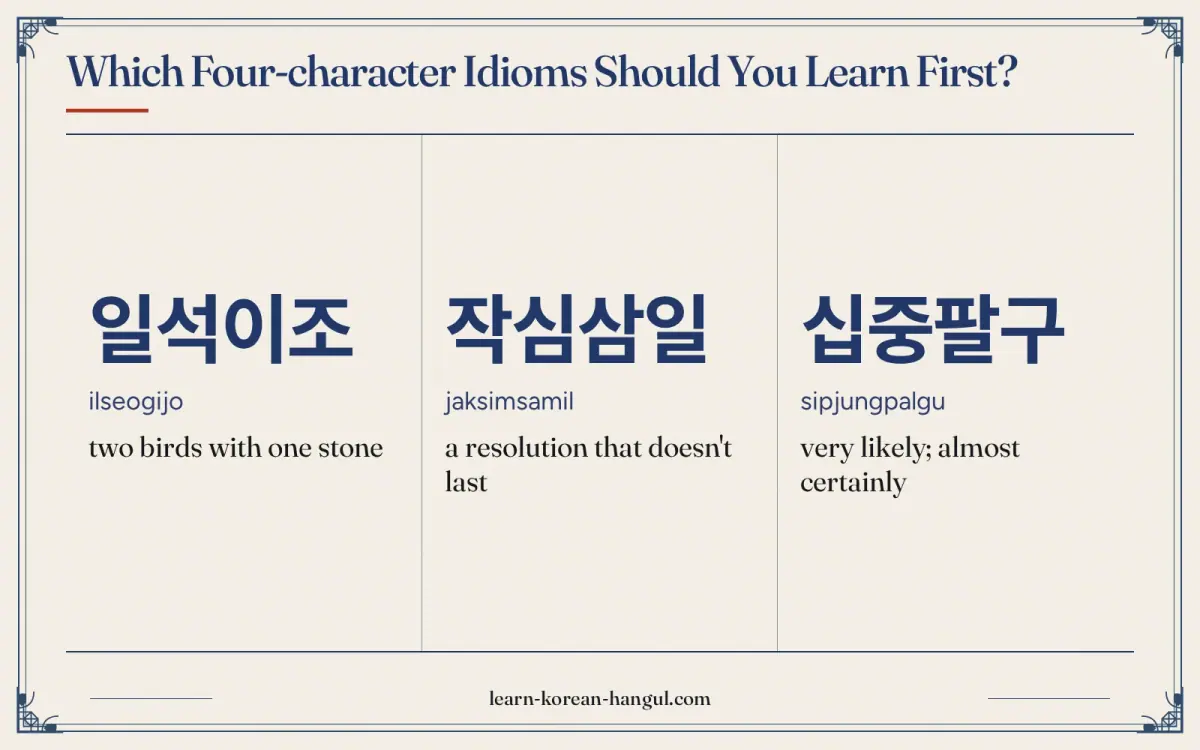
Start with the idioms that come up in daily conversation, because you will hear them in dramas and on the street. Then learn the character idioms, which help you describe people. Leave the story idioms for later, since they make most sense once you know the story behind them.
- Say first. 일석이조, 작심삼일, 십중팔구, 인산인해, 설상가상, 금시초문.
- Use often. 동문서답, 이심전심, 우유부단, 죽마고우, 일취월장, 시행착오, 전화위복.
- Recognise in reading. 각주구검, 와신상담, 형설지공, 표리부동, 과유불급.
The scene below is a busy town square where each numbered person or object shows one idiom. Tap a number to hear it.
Word · 10
- 1
일석이조
ilseogijo
two birds with one stone
- 2
작심삼일
jaksimsamil
a resolution that doesn't last
- 3
십중팔구
sipjungpalgu
very likely; almost certainly
- 4
동문서답
dongmunseodap
an answer that misses the question
- 5
인산인해
insaninhae
a huge crowd
- 6
이심전심
isimjeonsim
understanding each other without words
- 7
설상가상
seolsanggasang
to make matters worse
- 8
죽마고우
jungmagou
a childhood friend
- 9
칠전팔기
chiljeonpalgi
never giving up
- 10
오비이락
obiirak
a coincidence that looks like the cause
Everyday Idioms (일석이조)
These eight idioms are the most common in everyday talk. Most of them take the copula 이다 straight away: 일석이조예요 after a vowel, 작심삼일이에요 after a consonant. A few take a particle and work as an adverb, such as 설상가상으로 (to make matters worse).
| No. | Hangul | Hanja | Revised Romanization | Literally | Meaning and note | Example sentence | Audio assetId |
|---|---|---|---|---|---|---|---|
| 1 | 일석이조 | 一石二鳥 | ilseogijo [일써기조] | one stone, two birds | two birds with one stone. Heard daily. The native proverb 꿩 먹고 알 먹고 means the same. | 운동하면서 영어 팟캐스트를 들어요. 일석이조예요. (I listen to English podcasts while I work out. Two birds with one stone.) | au-pg-vocabulary-word-types-four-character-idioms-1; example: au-pg-vocabulary-word-types-four-character-idioms-41 |
| 2 | 작심삼일 | 作心三日 | jaksimsamil [작씸사밀] | a firm resolve lasts three days | a resolution that doesn't last. Heard daily, especially in January. | 올해도 다이어트가 작심삼일이었어요. (My diet resolution fizzled out again this year.) | au-pg-vocabulary-word-types-four-character-idioms-2; example: au-pg-vocabulary-word-types-four-character-idioms-42 |
| 3 | 십중팔구 | 十中八九 | sipjungpalgu [십쭝팔구] | eight or nine out of ten | very likely; almost certainly. Heard daily. Works like an adverb before a verb. | 이렇게 구름이 많으면 십중팔구 비가 와요. (With this many clouds, it'll almost certainly rain.) | au-pg-vocabulary-word-types-four-character-idioms-3; example: au-pg-vocabulary-word-types-four-character-idioms-43 |
| 4 | 동문서답 | 東問西答 | dongmunseodap | asked about the east, answers about the west | an answer that misses the question. Heard daily. Usually with 하다: 동문서답을 하다. | 제 질문에 동생이 동문서답을 했어요. (My younger sibling gave an answer that had nothing to do with my question.) | au-pg-vocabulary-word-types-four-character-idioms-4; example: au-pg-vocabulary-word-types-four-character-idioms-44 |
| 5 | 인산인해 | 人山人海 | insaninhae [인사닌해] | mountains of people, seas of people | a huge crowd. Heard daily for festivals, sales and holiday traffic. | 주말 명동은 인산인해예요. (Myeongdong at the weekend is packed with people.) | au-pg-vocabulary-word-types-four-character-idioms-5; example: au-pg-vocabulary-word-types-four-character-idioms-45 |
| 6 | 이심전심 | 以心傳心 | isimjeonsim | passing heart to heart | understanding each other without words. Common in speech and writing. Warm and positive. | 엄마는 제 마음을 금방 알아요. 이심전심이에요. (Mum knows how I feel straight away. We understand each other without words.) | au-pg-vocabulary-word-types-four-character-idioms-6; example: au-pg-vocabulary-word-types-four-character-idioms-46 |
| 7 | 설상가상 | 雪上加霜 | seolsanggasang [설쌍가상] | frost on top of snow | to make matters worse. Heard daily. Usually 설상가상으로 at the start of a clause. | 길을 잃었어요. 설상가상으로 비까지 왔어요. (I got lost. To make matters worse, it started to rain.) | au-pg-vocabulary-word-types-four-character-idioms-7; example: au-pg-vocabulary-word-types-four-character-idioms-47 |
| 8 | 자업자득 | 自業自得 | jaeopjadeuk [자업짜득] | your own deeds, your own result | you reap what you sow. Common. Critical, so it can sound harsh about someone else. | 밤새 게임을 해서 시험을 망쳤어요. 자업자득이에요. (I gamed all night and ruined my exam. I only have myself to blame.) | au-pg-vocabulary-word-types-four-character-idioms-8; example: au-pg-vocabulary-word-types-four-character-idioms-48 |
Example Sentences
Each sentence describes a situation first, then names it with the idiom. Play each one, say it aloud, then think of a moment in your own week that fits.
운동하면서 영어 팟캐스트를 들어요. 일석이조예요.
undonghamyeonseo yeongeo patkaeseuteureul deureoyo. ilseogijoyeyo.
I listen to English podcasts while I work out. Two birds with one stone.
올해도 다이어트가 작심삼일이었어요.
olhaedo daieoteuga jaksimsamirieosseoyo.
My diet resolution fizzled out again this year.
주말 명동은 인산인해예요.
jumal myeongdongeun insaninhaeyeyo.
Myeongdong at the weekend is packed with people.
The copula changes with the last syllable. 일석이조 ends in a vowel, so it takes 예요. 작심삼일 ends in the consonant ㄹ, so it takes 이에요 and, in the past, 이었어요.
How Do You Say Idioms about People and Character in Korean?
Character idioms are handy for describing people in a single word. Some are compliments (팔방미인, 외유내강), some are criticism (안하무인, 표리부동) and some describe a relationship (죽마고우, 동고동락). Several turn into adjectives or verbs with 하다: 우유부단하다 (to be indecisive), 동고동락하다 (to go through thick and thin together).
| No. | Hangul | Hanja | Revised Romanization | Literally | Meaning and note | Example sentence | Audio assetId |
|---|---|---|---|---|---|---|---|
| 9 | 우유부단 | 優柔不斷 | uyubudan | soft and gentle, not cutting | indecisive. Heard daily. Usually as the adjective 우유부단하다. | 저는 우유부단해서 메뉴를 못 골라요. (I'm so indecisive that I can't choose from the menu.) | au-pg-vocabulary-word-types-four-character-idioms-9; example: au-pg-vocabulary-word-types-four-character-idioms-49 |
| 10 | 팔방미인 | 八方美人 | palbangmiin | a beauty from all eight directions | an all-rounder; good at everything. Common and positive in Korean, unlike the Japanese use of the same characters. | 제 친구는 노래도 잘하고 요리도 잘해요. 정말 팔방미인이에요. (My friend sings well and cooks well too. A real all-rounder.) | au-pg-vocabulary-word-types-four-character-idioms-10; example: au-pg-vocabulary-word-types-four-character-idioms-50 |
| 11 | 외유내강 | 外柔內剛 | oeyunaegang | soft outside, strong inside | gentle on the outside, tough on the inside. Common and positive. Often said about a quiet person with a strong will. | 선생님은 조용하지만 외유내강이에요. (My teacher is quiet, but gentle outside and strong inside.) | au-pg-vocabulary-word-types-four-character-idioms-11; example: au-pg-vocabulary-word-types-four-character-idioms-51 |
| 12 | 안하무인 | 眼下無人 | anhamuin | nobody below the eyes | arrogant; treating others as nothing. Common and very critical. | 그 손님은 직원에게 반말을 하고 안하무인이었어요. (That customer talked down to the staff and was utterly arrogant.) | au-pg-vocabulary-word-types-four-character-idioms-12; example: au-pg-vocabulary-word-types-four-character-idioms-52 |
| 13 | 표리부동 | 表裏不同 | pyoribudong | outside and inside are not the same | two-faced. Common in writing. Usually as the adjective 표리부동하다. | 앞에서는 웃고 뒤에서는 욕해요. 표리부동한 사람이에요. (Smiles to your face, curses behind your back. A two-faced person.) | au-pg-vocabulary-word-types-four-character-idioms-13; example: au-pg-vocabulary-word-types-four-character-idioms-53 |
| 14 | 죽마고우 | 竹馬故友 | jungmagou [중마고우] | an old friend from bamboo-horse days | a childhood friend. Common and warm. Children once rode bamboo sticks as toy horses. | 민호와 저는 죽마고우예요. (Minho and I are childhood friends.) | au-pg-vocabulary-word-types-four-character-idioms-14; example: au-pg-vocabulary-word-types-four-character-idioms-54 |
| 15 | 동고동락 | 同苦同樂 | donggodongnak [동고동낙] | the same pains, the same joys | to go through thick and thin together. Common. Usually as the verb 동고동락하다. | 우리는 십 년 동안 동고동락했어요. (We've been through thick and thin together for ten years.) | au-pg-vocabulary-word-types-four-character-idioms-15; example: au-pg-vocabulary-word-types-four-character-idioms-55 |
| 16 | 이구동성 | 異口同聲 | igudongseong | different mouths, the same voice | with one voice; unanimously. Common. Usually 이구동성으로 before a verb of speaking. | 학생들이 이구동성으로 대답했어요. (The students answered with one voice.) | au-pg-vocabulary-word-types-four-character-idioms-16; example: au-pg-vocabulary-word-types-four-character-idioms-56 |
Idioms about Effort and Time
Effort idioms are favourites in speeches, school posters and success stories. They praise patience and steady work. Numbers are common here. 칠전팔기 is 'seven falls, eight rises', and 일사천리 runs a thousand li (an old unit of distance) in one rush.
| No. | Hangul | Hanja | Revised Romanization | Literally | Meaning and note | Example sentence | Audio assetId |
|---|---|---|---|---|---|---|---|
| 17 | 대기만성 | 大器晩成 | daegimanseong | a great vessel is finished late | a late bloomer. Common and encouraging. | 그 배우는 마흔 살에 유명해졌어요. 대기만성이에요. (That actor became famous at forty. A true late bloomer.) | au-pg-vocabulary-word-types-four-character-idioms-17; example: au-pg-vocabulary-word-types-four-character-idioms-57 |
| 18 | 유비무환 | 有備無患 | yubimuhwan | be prepared and there is no trouble | better safe than sorry. Common in speech, safety posters and the news. | 유비무환이에요. 우산을 챙기세요. (Better safe than sorry. Take an umbrella.) | au-pg-vocabulary-word-types-four-character-idioms-18; example: au-pg-vocabulary-word-types-four-character-idioms-58 |
| 19 | 주경야독 | 晝耕夜讀 | jugyeongyadok | plough by day, read by night | working by day and studying by night. Common in writing and in success stories. | 그는 주경야독으로 대학을 졸업했어요. (He graduated from university by working by day and studying at night.) | au-pg-vocabulary-word-types-four-character-idioms-19; example: au-pg-vocabulary-word-types-four-character-idioms-59 |
| 20 | 일취월장 | 日就月將 | ilchwiwoljang [일취월짱] | progress by day, advance by month | rapid progress. Common. Often praise for a learner: 실력이 일취월장하다. | 한국어 실력이 일취월장했어요. (Your Korean has come on in leaps and bounds.) | au-pg-vocabulary-word-types-four-character-idioms-20; example: au-pg-vocabulary-word-types-four-character-idioms-60 |
| 21 | 고진감래 | 苦盡甘來 | gojingamnae [고진감내] | bitterness ends, sweetness comes | after hardship comes happiness. Common. The Sino-Korean twin of 고생 끝에 낙이 온다. | 삼 년 동안 고생했어요. 드디어 합격했어요. 고진감래예요. (I struggled for three years. I've finally passed. After hardship comes happiness.) | au-pg-vocabulary-word-types-four-character-idioms-21; example: au-pg-vocabulary-word-types-four-character-idioms-61 |
| 22 | 칠전팔기 | 七顚八起 | chiljeonpalgi [칠쩐팔기] | fall seven times, rise eight | never giving up. Common. Used in sports and success stories. | 그는 칠전팔기 끝에 꿈을 이뤘어요. (After falling and rising again and again, he achieved his dream.) | au-pg-vocabulary-word-types-four-character-idioms-22; example: au-pg-vocabulary-word-types-four-character-idioms-62 |
| 23 | 일사천리 | 一瀉千里 | ilsacheolli [일싸철리] | one rush flows a thousand li | quickly and without a hitch. Common. Usually 일사천리로 before a verb. | 회의가 일사천리로 끝났어요. (The meeting wrapped up quickly and smoothly.) | au-pg-vocabulary-word-types-four-character-idioms-23; example: au-pg-vocabulary-word-types-four-character-idioms-63 |
| 24 | 자포자기 | 自暴自棄 | japojagi | harming yourself, abandoning yourself | giving up on yourself. Common. Usually as the verb 자포자기하다. | 시험에 떨어졌어요. 하지만 자포자기는 안 해요. (I failed the exam. But I won't give up on myself.) | au-pg-vocabulary-word-types-four-character-idioms-24; example: au-pg-vocabulary-word-types-four-character-idioms-64 |
How Do You Say Idioms from Stories in Korean?
Story idioms, or 고사성어, each sum up an old tale, mostly from Chinese history and classics. The note beside each one gives the core of the story in one sentence. Once you know the story, the four syllables make sense and are easy to remember. The full tales, with the book each one comes from, are on Korean four character idioms with stories.
| No. | Hangul | Hanja | Revised Romanization | Literally | Meaning and note | Example sentence | Audio assetId |
|---|---|---|---|---|---|---|---|
| 25 | 새옹지마 | 塞翁之馬 | saeongjima | the old frontier man's horse | good and bad luck can turn into each other. Common. From a Chinese tale: an old man's horse runs away, returns with another horse, and the luck keeps flipping. | 회사를 그만뒀어요. 그 덕분에 더 좋은 일을 찾았어요. 인생은 새옹지마예요. (I quit my company. Thanks to that, I found a better job. Life's ups and downs are hard to predict.) | au-pg-vocabulary-word-types-four-character-idioms-25; example: au-pg-vocabulary-word-types-four-character-idioms-65 |
| 26 | 오비이락 | 烏飛梨落 | obiirak | the crow flies and a pear falls | a coincidence that looks like the cause. Common. The crow takes off just as the pear drops, so it gets the blame. | 제가 컴퓨터를 만졌어요. 그 순간 화면이 꺼졌어요. 정말 오비이락이에요. (I touched the computer and the screen went off at that very moment. Pure coincidence, honestly.) | au-pg-vocabulary-word-types-four-character-idioms-26; example: au-pg-vocabulary-word-types-four-character-idioms-66 |
| 27 | 어부지리 | 漁夫之利 | eobujiri | the fisherman's profit | a third party profits from a quarrel. Common in sports and politics. A clam and a bird fight, and a fisherman catches both. | 두 팀이 싸우는 동안 우리 팀이 어부지리로 이겼어요. (While the two teams fought each other, our team won as the lucky third party.) | au-pg-vocabulary-word-types-four-character-idioms-27; example: au-pg-vocabulary-word-types-four-character-idioms-67 |
| 28 | 사면초가 | 四面楚歌 | samyeonchoga | songs of Chu on all four sides | surrounded with no way out. Common. A general hears his enemies singing his own homeland's songs on every side. | 모두 저를 비판해요. 사면초가예요. (Everyone is criticising me. I'm surrounded on all sides.) | au-pg-vocabulary-word-types-four-character-idioms-28; example: au-pg-vocabulary-word-types-four-character-idioms-68 |
| 29 | 각주구검 | 刻舟求劍 | gakjugugeom [각쭈구검] | mark the boat, look for the sword | stubbornly using an outdated method. Common in writing. A man drops his sword from a moving boat, marks the boat, and searches there after it moves. | 옛날 방법만 고집하면 각주구검이에요. (Insisting only on old methods is like marking the boat to find the sword.) | au-pg-vocabulary-word-types-four-character-idioms-29; example: au-pg-vocabulary-word-types-four-character-idioms-69 |
| 30 | 와신상담 | 臥薪嘗膽 | wasinsangdam | lie on firewood, taste bile | enduring hardship to reach a goal. Common in sports news. Two rival kings kept themselves uncomfortable so they would never forget a defeat. | 그 팀은 일 년 동안 와신상담했어요. (That team endured a hard year to get its revenge.) | au-pg-vocabulary-word-types-four-character-idioms-30; example: au-pg-vocabulary-word-types-four-character-idioms-70 |
| 31 | 형설지공 | 螢雪之功 | hyeongseoljigong [형설찌공] | the merit of fireflies and snow | studying hard despite poverty. Common in writing. Poor scholars read by the light of fireflies and of moonlight on snow. | 형설지공으로 공부해서 의사가 됐어요. (He studied through hardship and became a doctor.) | au-pg-vocabulary-word-types-four-character-idioms-31; example: au-pg-vocabulary-word-types-four-character-idioms-71 |
| 32 | 우공이산 | 愚公移山 | ugongisan | the foolish old man moves the mountain | persistence can move mountains. Common in writing. An old man starts digging away a mountain, and his family carries on after him. | 우공이산이에요. 매일 한 단어씩 외워요. (Persistence moves mountains. I memorise one word a day.) | au-pg-vocabulary-word-types-four-character-idioms-32; example: au-pg-vocabulary-word-types-four-character-idioms-72 |
Idioms for TOPIK and News Reading
These idioms are common in Korean newspapers, essays and intermediate textbooks. TOPIK II reading uses that kind of text. This page does not say that any of these idioms has appeared on a particular test. The official TOPIK website, topik.go.kr, publishes past papers, and those are the best place to see real exam texts.
| No. | Hangul | Hanja | Revised Romanization | Literally | Meaning and note | Example sentence | Audio assetId |
|---|---|---|---|---|---|---|---|
| 33 | 금시초문 | 今始初聞 | geumsichomun | hearing it now for the first time | news to me. Heard daily. | 그 이야기는 금시초문이에요. (That's the first I've heard of it.) | au-pg-vocabulary-word-types-four-character-idioms-33; example: au-pg-vocabulary-word-types-four-character-idioms-73 |
| 34 | 시행착오 | 試行錯誤 | sihaengchago | trying and making errors | trial and error. Very common in speech, news and essays. | 처음에는 많은 시행착오를 겪었어요. (At first I went through a lot of trial and error.) | au-pg-vocabulary-word-types-four-character-idioms-34; example: au-pg-vocabulary-word-types-four-character-idioms-74 |
| 35 | 우왕좌왕 | 右往左往 | uwangjwawang | going right, going left | running around in confusion. Common. Usually as the verb 우왕좌왕하다. | 갑자기 불이 났어요. 사람들이 우왕좌왕했어요. (A fire suddenly broke out. People ran around in confusion.) | au-pg-vocabulary-word-types-four-character-idioms-35; example: au-pg-vocabulary-word-types-four-character-idioms-75 |
| 36 | 전화위복 | 轉禍爲福 | jeonhwawibok | turning misfortune into fortune | a blessing in disguise. Very common. Usually 전화위복이 되다. | 그 실패가 전화위복이 됐어요. (That failure turned out to be a blessing in disguise.) | au-pg-vocabulary-word-types-four-character-idioms-36; example: au-pg-vocabulary-word-types-four-character-idioms-76 |
| 37 | 다다익선 | 多多益善 | dadaikseon [다다익썬] | the more there are, the better | the more, the better. Common. | 친구는 다다익선이에요. (With friends, the more the better.) | au-pg-vocabulary-word-types-four-character-idioms-37; example: au-pg-vocabulary-word-types-four-character-idioms-77 |
| 38 | 과유불급 | 過猶不及 | gwayubulgeup | too much is like too little | too much is as bad as too little. Common in writing and advice. | 운동도 과유불급이에요. 너무 많이 하면 다쳐요. (Exercise too: too much is as bad as too little. Overdo it and you'll get hurt.) | au-pg-vocabulary-word-types-four-character-idioms-38; example: au-pg-vocabulary-word-types-four-character-idioms-78 |
| 39 | 이열치열 | 以熱治熱 | iyeolchiyeol | treat heat with heat | fight heat with heat. Heard daily in summer, when people eat hot soup to beat the heat. | 여름에 삼계탕을 먹어요. 이열치열이에요. (In summer we eat hot ginseng chicken soup. Fighting heat with heat.) | au-pg-vocabulary-word-types-four-character-idioms-39; example: au-pg-vocabulary-word-types-four-character-idioms-79 |
| 40 | 동상이몽 | 同床異夢 | dongsangimong | the same bed, different dreams | sharing a plan but wanting different things. Common in the news about partners, couples and politics. | 두 사람은 같은 회사에서 일하지만 동상이몽이에요. (The two work at the same company, but they want different things.) | au-pg-vocabulary-word-types-four-character-idioms-40; example: au-pg-vocabulary-word-types-four-character-idioms-80 |
Which Idioms Are Said Aloud and Which Are Written?
Four-character idioms sound a little more educated than everyday words, but many are fully at home in conversation. The labels below are editorial guidance, not dictionary labels.
| Use | Idioms | Advice |
|---|---|---|
| Heard daily | 일석이조, 작심삼일, 십중팔구, 인산인해, 설상가상, 금시초문, 이열치열 | Use freely with anyone |
| Common in speech and writing | 동문서답, 이심전심, 우유부단, 죽마고우, 일취월장, 시행착오, 전화위복 | Natural in conversation and the news |
| Mostly written | 표리부동, 각주구검, 와신상담, 형설지공, 우공이산 | Recognise first; common in essays and editorials |
| Critical, use with care | 안하무인, 표리부동, 자업자득 | Avoid about a senior or to someone's face |
How Idioms Fit into a Sentence
A four-character idiom is a noun, so it fits into a sentence in three ways.
| Pattern | Example | Meaning |
|---|---|---|
| idiom + 이다 | 일석이조예요 / 작심삼일이에요 | It's two birds with one stone. / It didn't last. |
| idiom + 하다 | 동고동락했어요 / 우유부단해요 | We went through it together. / He's indecisive. |
| idiom + 으로/로 | 설상가상으로 / 일사천리로 | To make matters worse / smoothly |
Not every idiom can take 하다. 일석이조하다 is not used, while 동고동락하다 is a normal verb. Learn the pattern with each idiom.
How Do You Pronounce These Idioms?
Four-character idioms are single words, so all sound changes inside them apply. The Standard Pronunciation Rules (표준 발음법) of the National Institute of Korean Language (국립국어원) are the reference. The romanization follows the Revised Romanization of Korean. It shows linking and nasal changes inside a word but does not show tensing.
- Tensing after a stop. After final ㄱ or ㅂ, a plain consonant becomes tense: 작심 [작씸], 십중 [십쭝], 각주 [각쭈], 익선 [익썬].
- Tensing after ㄹ in Sino-Korean words. ㄹ makes only a following ㄷ, ㅅ or ㅈ tense: 설상 [설쌍], 일사 [일싸], 월장 [월짱], 설지 [설찌]. Before ㄱ there is no tensing: 불급 [불급].
- Nasal assimilation. A stop before ㅁ or ㄴ becomes a nasal: 죽마 [중마]. ㄹ after ㅁ or ㅇ becomes ㄴ: 감래 [감내], 동락 [동낙]. The romanization shows these: jungmagou, gojingamnae, donggodongnak.
- ㄴ and ㄹ. ㄴ before ㄹ becomes ㄹ: 천리 [철리]. The romanization writes ilsacheolli.
- Linking. A final consonant moves to a following vowel: 인산인해 [인사닌해], 작심삼일 [작씸사밀].
Audio and Slow Playback
Each idiom and sentence has its own clip. The clips below replay five idioms with sound changes slowly. Play one, repeat it syllable by syllable, then say it at normal speed.
What Mistakes Do Learners Make with Four-Character Idioms?
Five mistakes come up often.
- Using the wrong copula. 일석이조 ends in a vowel, so it is 일석이조예요. 작심삼일 ends in a consonant, so it is 작심삼일이에요.
- Adding 하다 to every idiom. 동고동락하다 and 우유부단하다 are real words, but 일석이조하다 and 인산인해하다 are not. Check each idiom's pattern.
- Reading syllables as native Korean words. The 이 in 일석이조 is 二 (two), not the native word 이 (this). The 일 in 작심삼일 is 日 (day), while the 일 in 일석이조 is 一 (one).
- Assuming Chinese or Japanese meanings carry over. 팔방미인 is praise in Korean, but the same characters can be criticism in Japanese. Learn the Korean use.
- Overusing them. One idiom in a paragraph sounds educated. Several in a row sounds stiff, especially in casual speech.
Tip: Write the Hanja under each syllable when you first learn an idiom. Even if you forget the characters later, the literal picture stays.
Practice: Flashcards and Worksheet
Run the deck below in recognition mode until each idiom brings up its meaning, then switch to listening mode. The deck holds all 40 idioms with audio, and your progress stays in your browser. Other topic decks are listed on the vocabulary flashcard decks page.
Practice · 40
- 01일석이조
Show answer
ilseogijo
two birds with one stone
- 02작심삼일
Show answer
jaksimsamil
a resolution that doesn't last
- 03십중팔구
Show answer
sipjungpalgu
very likely; almost certainly
- 04동문서답
Show answer
dongmunseodap
an answer that misses the question
- 05인산인해
Show answer
insaninhae
a huge crowd
- 06이심전심
Show answer
isimjeonsim
understanding each other without words
- 07설상가상
Show answer
seolsanggasang
to make matters worse
- 08자업자득
Show answer
jaeopjadeuk
you reap what you sow
- 09우유부단
Show answer
uyubudan
indecisive
- 10팔방미인
Show answer
palbangmiin
an all-rounder; good at everything
- 11외유내강
Show answer
oeyunaegang
gentle on the outside, tough on the inside
- 12안하무인
Show answer
anhamuin
arrogant; treating others as nothing
- 13표리부동
Show answer
pyoribudong
two-faced
- 14죽마고우
Show answer
jungmagou
a childhood friend
- 15동고동락
Show answer
donggodongnak
to go through thick and thin together
- 16이구동성
Show answer
igudongseong
with one voice; unanimously
- 17대기만성
Show answer
daegimanseong
a late bloomer
- 18유비무환
Show answer
yubimuhwan
better safe than sorry
- 19주경야독
Show answer
jugyeongyadok
working by day and studying by night
- 20일취월장
Show answer
ilchwiwoljang
rapid progress
- 21고진감래
Show answer
gojingamnae
after hardship comes happiness
- 22칠전팔기
Show answer
chiljeonpalgi
never giving up
- 23일사천리
Show answer
ilsacheolli
quickly and without a hitch
- 24자포자기
Show answer
japojagi
giving up on yourself
- 25새옹지마
Show answer
saeongjima
good and bad luck can turn into each other
- 26오비이락
Show answer
obiirak
a coincidence that looks like the cause
- 27어부지리
Show answer
eobujiri
a third party profits from a quarrel
- 28사면초가
Show answer
samyeonchoga
surrounded with no way out
- 29각주구검
Show answer
gakjugugeom
stubbornly using an outdated method
- 30와신상담
Show answer
wasinsangdam
enduring hardship to reach a goal
- 31형설지공
Show answer
hyeongseoljigong
studying hard despite poverty
- 32우공이산
Show answer
ugongisan
persistence can move mountains
- 33금시초문
Show answer
geumsichomun
news to me
- 34시행착오
Show answer
sihaengchago
trial and error
- 35우왕좌왕
Show answer
uwangjwawang
running around in confusion
- 36전화위복
Show answer
jeonhwawibok
a blessing in disguise
- 37다다익선
Show answer
dadaikseon
the more, the better
- 38과유불급
Show answer
gwayubulgeup
too much is as bad as too little
- 39이열치열
Show answer
iyeolchiyeol
fight heat with heat
- 40동상이몽
Show answer
dongsangimong
sharing a plan but wanting different things
Practice · 5
What does 작심삼일 (jaksimsamil) mean?
Show answer
a resolution that doesn't last
작심삼일 (作心三日): a firm resolve that lasts only three days.
Which idiom means 'two birds with one stone'?
Show answer
일석이조
일석이조 (一石二鳥): one stone, two birds.
The festival is packed with people. Which idiom fits?
Show answer
인산인해
인산인해 (人山人海): mountains and seas of people, a huge crowd.
In 새옹지마, what does the story teach?
Show answer
Good and bad luck can turn into each other.
The old man's luck keeps flipping, so you can't judge an event as good or bad too soon.
Which idiom describes a late bloomer?
Show answer
대기만성
대기만성 (大器晩成): a great vessel takes a long time to finish.
Korean Four Character Idioms Worksheet (PDF)
A printable worksheet for these words (word list, matching, writing practice, fill-in-the-blank exercises and answer key) is available in A4 and US Letter from the download card on this page. For practice, pick five idioms, write the Hanja and the literal meaning of each syllable, and make one sentence with each.
Where to Go Next
Four-character idioms often have native Korean twins. 일석이조 matches the proverb 꿩 먹고 알 먹고, and 고진감래 matches 고생 끝에 낙이 온다. Compare them in Korean proverbs. For shorter phrases built from body parts and food, see Korean idioms. To learn how Hanja syllables form everyday words, read Sino-Korean words, and return to Korean Word Types for every kind of Korean vocabulary. For 30 idioms in daily use, grouped by situation, open common Korean four character idioms; for the tales behind story idioms, open Korean four character idioms with stories.
Frequently Asked Questions
What Are Four-Character Idioms Called in Korean?
They are called 사자성어 (sajaseongeo), literally 'four-character set phrases'. Ones that come from an old story are also called 고사성어 (gosaseongeo). Each syllable stands for one Chinese character (Hanja), so 일석이조 is written 一石二鳥 and means 'one stone, two birds'.
How Do You Say Two Birds with One Stone in Korean?
Say 일석이조 (ilseogijo), from 一石二鳥: one stone, two birds. In speech, add the polite copula: 일석이조예요. The native Korean proverb 꿩 먹고 알 먹고 (eat the pheasant and its eggs) means the same thing and is just as common.
How Do You Pronounce 작심삼일 (jaksimsamil)?
Say it [작씸사밀]. After the final ㄱ of 작, the ㅅ of 심 becomes tense, so you hear 씸. The ㅁ of 삼 then links to the vowel of 일, giving 사밀. The romanization jaksimsamil does not show the tensing, so follow the audio.
Do I Need to Know Hanja to Learn Four-Character Idioms?
No. You can learn them as Korean words with Hangul and audio, and most Koreans use them without writing the characters. Knowing a few common characters helps you guess new idioms, though. For example, 일 (一, one), 이 (二, two), 삼 (三, three) and 인 (人, person) appear in many idioms on this page.
Are Four-Character Idioms Used in TOPIK?
Four-character idioms appear in intermediate and advanced Korean reading, including news and essays, which is the kind of text TOPIK II uses. This page does not claim that any idiom is on a particular test. Past papers are published on the official TOPIK website, topik.go.kr, so check those to see real examples.
Is the Romanization on This Page Official?
It follows the Revised Romanization of Korean, which South Korea adopted on 7 July 2000 and whose rules the National Institute of Korean Language (국립국어원) publishes. Each idiom is one word, so sound changes inside it, such as [중마고우] for 죽마고우, appear in the romanization (jungmagou). Tensing does not.