
Korean Hotel Vocabulary Flashcards: Study the 26 Cards
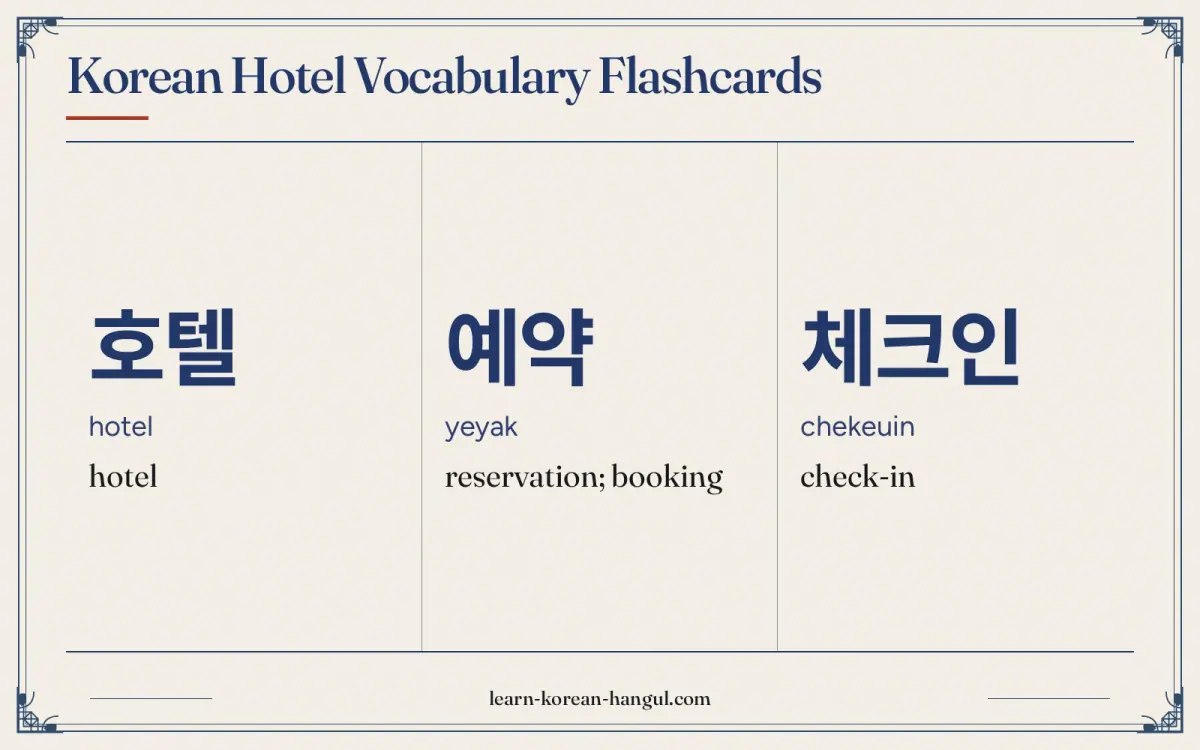
Say each word aloud before you press Show answer. Every card has a short note that explains how the word is used or why it sounds different from its spelling.
How Do I Use These Flashcards?
Use the deck above in four steps. It works with tap, click or keyboard, and nothing plays until you press an audio button.
- Choose a mode. Start with recognition (Hangul to meaning). Switch to recall (meaning to Hangul) or listening (audio to meaning) once recognition feels easy.
- Show the answer. Think of the answer first, then press Show answer (or Space). Turn on the romanization toggle only if you need it; the 26-card table below always shows it.
- Grade yourself. Press Got it if you answered correctly without help, or Not yet if you hesitated or guessed.
- Finish the session. A session holds up to 20 cards (you can set 10, 20 or 40). With 26 cards, a first-time learner can split the deck over 3 days, using the default limit of 10 new cards a day.
What Do the Three Modes Do?
Recognition shows the Hangul and asks for the meaning, which trains reading. Recall shows the meaning and asks for the Hangul, which trains remembering; you may type the answer with your Hangul keyboard or just recall it in your head. Listening plays a clip and hides the letters, which trains the ear. Listening mode only uses a card once its audio is approved, and cards without approved audio are skipped in that mode with a note.
What Do Got It and Not yet Do?
Got it moves the card up one Leitner box, so it comes back later. Not yet sends the card back to box 1, so it returns in the same session or within 10 minutes. The grades are your own judgement; the deck does not score you or claim fluency.
Deck Scope: What Is and Is Not Covered
The deck covers words for booking, checking in and using a hotel room. Flights and airports are in the korean travel vocabulary flashcards. The topic lesson is hotel in korean.
What Is Left out of This Deck?
The deck has 26 cards for booking and staying, and it does not cover complaints, directions around the hotel or full conversations. Prices and policies such as cancellation windows vary by hotel, so read the booking page. All Korean text is generated, and Min-ji Park reviewed and signed off the text and audio on 15 October 2026.
All 26 Cards in One Table
All 26 cards appear below in deck order. The table is plain HTML, so you can use it as a drill without the deck: cover the Meaning column, read each word aloud, then uncover the meaning.
| # | Hangul | Revised Romanization | Meaning | Note | Audio assetId |
|---|---|---|---|---|---|
| 1 | 호텔 | hotel | hotel | A loanword from English. Ranges from business hotels to luxury ones. | au-pg-flashcards-hotel-vocabulary-1 |
| 2 | 예약 | yeyak | reservation; booking | 예약하다 is the verb: to book. Used for hotels, restaurants and tickets. | au-pg-flashcards-hotel-vocabulary-2 |
| 3 | 체크인 | chekeuin | check-in | A loanword. 체크인하다 means to check in. | au-pg-flashcards-hotel-vocabulary-3 |
| 4 | 체크아웃 | chekeuaut | check-out | A loanword. 체크아웃하다 means to check out. | au-pg-flashcards-hotel-vocabulary-4 |
| 5 | 숙소 | sukso | accommodation; lodging | The general word for the place where you stay, whatever the type. | au-pg-flashcards-hotel-vocabulary-5 |
| 6 | 모텔 | motel | motel (short-stay city hotel) | A loanword. In Korea a basic city lodging, not a roadside motor inn. | au-pg-flashcards-hotel-vocabulary-6 |
| 7 | 게스트하우스 | geseuteuhauseu | guesthouse | A loanword for a small, budget place with shared spaces. Popular with solo travellers. | au-pg-flashcards-hotel-vocabulary-7 |
| 8 | 펜션 | pensyeon | pension (holiday cottage) | A loanword. A small holiday house or cottage for families and groups, often in the countryside or by the sea. | au-pg-flashcards-hotel-vocabulary-8 |
| 9 | 객실 | gaeksil | guest room | Said [객씰]. The formal word for a hotel room. 방 is the everyday word. | au-pg-flashcards-hotel-vocabulary-9; slow: au-pg-flashcards-hotel-vocabulary-27 |
| 10 | 싱글룸 | singgeullum | single room | From English "single room". One person, one bed. | au-pg-flashcards-hotel-vocabulary-10 |
| 11 | 더블룸 | deobeullum | double room | From English "double room". One large bed for two. | au-pg-flashcards-hotel-vocabulary-11 |
| 12 | 트윈룸 | teuwinrum | twin room | From English "twin room". Two separate beds. | au-pg-flashcards-hotel-vocabulary-12 |
| 13 | 온돌방 | ondolbang | ondol room (heated floor) | Said [온돌빵]. A room with floor heating where guests sleep on bedding laid on the floor. | au-pg-flashcards-hotel-vocabulary-13; slow: au-pg-flashcards-hotel-vocabulary-28 |
| 14 | 침대 | chimdae | bed | The piece of furniture. Single, double and twin rooms differ in the beds. | au-pg-flashcards-hotel-vocabulary-14 |
| 15 | 욕실 | yoksil | bathroom (with bath or shower) | Said [욕씰]. The room for washing. A toilet room alone is 화장실. | au-pg-flashcards-hotel-vocabulary-15; slow: au-pg-flashcards-hotel-vocabulary-29 |
| 16 | 조식 | josik | breakfast (hotel) | The word for the hotel breakfast on booking pages. The everyday word is 아침. | au-pg-flashcards-hotel-vocabulary-16 |
| 17 | 와이파이 | waipai | Wi-Fi | A loanword. Staff will give you the network name and the password. | au-pg-flashcards-hotel-vocabulary-17 |
| 18 | 수건 | sugeon | towel | Towels are usually supplied. Ask for more at the front desk. | au-pg-flashcards-hotel-vocabulary-18 |
| 19 | 에어컨 | eeokeon | air conditioner | A loanword. Each room has its own controller. | au-pg-flashcards-hotel-vocabulary-19 |
| 20 | 열쇠 | yeolsoe | key | The word for a key. In hotels this is usually a card. | au-pg-flashcards-hotel-vocabulary-20 |
| 21 | 여권 | yeogwon | passport | The staff may scan or photocopy it at check-in. | au-pg-flashcards-hotel-vocabulary-21 |
| 22 | 프런트 | peureonteu | front desk | A loanword. Staff there answer questions and hold luggage. | au-pg-flashcards-hotel-vocabulary-22 |
| 23 | 숙박 | sukbak | overnight stay; lodging | Said [숙빡]. Appears in booking totals and tax lines. | au-pg-flashcards-hotel-vocabulary-23; slow: au-pg-flashcards-hotel-vocabulary-30 |
| 24 | 청소 | cheongso | cleaning | 청소하다 means to clean. A housekeeping request. | au-pg-flashcards-hotel-vocabulary-24 |
| 25 | 칫솔 | chitsol | toothbrush | Said [치쏠], also [칟쏠]: the ㅅ of 칫 makes the next ㅅ tense. | au-pg-flashcards-hotel-vocabulary-25; slow: au-pg-flashcards-hotel-vocabulary-31 |
| 26 | 취소 | chwiso | cancellation | 취소하다 means to cancel. Many rates list a cancellation deadline. | au-pg-flashcards-hotel-vocabulary-26 |
How Do I Read the Table?
Hangul is the word. Revised Romanization (RR) is a learning aid, so try to read the Hangul before you look at it. RR follows the sound of the word, which is why some spellings change. The Meaning column gives the English gloss, and the Note column gives a use or sound hint. The last column lists the audio assetId; a second ID marked slow is a slower clip for the 5 cards whose sound differs from their spelling.
Usage Notes for These Cards
At the front desk. Say you have a booking with 예약했는데요 (I made a reservation).
Counting nights and days. Trip length is counted in nights and days: 이 박 삼 일 means two nights and three days, with 박 as the counter for nights.
Floors and rooms. Floors take Sino-Korean numbers with 층, and rooms take 호: 삼 층 삼백일 호 (3rd floor, room 301).
Asking for extras. Ask with 더 주세요: 수건 좀 더 주세요 (Could I have more towels?).
Breakfast. 조식 포함 means breakfast included. 조식 is the formal hotel word, while 아침 식사 is everyday talk.
Which Sounds Do Not Match the Spelling?
칫솔 is said [치쏠], and [칟쏠] is also allowed: the ㅅ written at the end of 칫 makes the next ㅅ tense. RR still writes the spelled ㅅ as t: chitsol.
객실 is said [객씰]: ㅅ after a ㄱ final is tensified.
금연 (no smoking) is said [그면]: the final ㅁ of 금 links to the vowel of 연.
These forms follow the 국립국어원 standard pronunciation rules (표준 발음법).
What Mistakes Do Learners Make with Hotel Vocabulary?
- Counting nights with 밤. Use 박, as in 이 박.
- Using native numbers for floors. 세 층 is wrong; say 삼 층.
- Using 호텔 for any lodging. Guesthouses are 게스트하우스 and motels are 모텔, a different category in Korea.
How Does the Review Schedule Work?
The deck uses a simplified Leitner system with five boxes. A new card starts in box 1. Each Got it moves it up one box, and each Not yet returns it to box 1. The box sets how long the card waits before it is due again.
| Box | Wait until the next review |
|---|---|
| 1 | same session or 10 minutes |
| 2 | 1 day |
| 3 | 3 days |
| 4 | 7 days |
| 5 | 21 days |
Each session shows due cards first, oldest due first, and then up to 10 new cards a day by default. Progress is saved only in this browser, so clearing site data deletes it. Use the export button to save a small JSON file with card IDs, boxes and due dates, and import it on another device. No account is needed.
Cultural and Practical Context
A 모텔 in Korea is a different kind of lodging from a motel in many countries, and travellers often choose 게스트하우스, 한옥 stays or 온돌방 rooms for a more local feel.
Next Steps after This Deck
The words and letters on these cards are explained in the korean hotel vocabulary lesson, so read it first if a card is new. This deck is one of the korean vocabulary flashcards on the site, so browse the full list if you want a different topic. When these cards feel easy, move on to korean school words flashcards to keep the same routine. If a word here still feels shaky, go back to korean travel vocabulary flashcards for the earlier material. After a session, write the same words by hand with the korean places vocabulary worksheet. All flashcard decks, including Hangul, vocabulary, phrases, grammar and TOPIK, are listed on the korean flashcards hub.
Frequently Asked Questions
What Is 온돌방?
An 온돌방 is a room where you sleep on a bedding mat on a heated floor. Many hotels and guesthouses offer one as a more traditional alternative to a bed room.
How Do I Ask for Late Checkout?
Ask 체크아웃을 늦게 해도 돼요? It means May I check out late? The 체크아웃 card gives you the noun, and 늦게 means late.
What Is 보증금?
보증금 is a refundable deposit. It is not one of the 26 cards, but you may see it on booking pages together with the 취소 card.
What Does 프런트 Mean?
프런트 means the front desk. 프런트 is the standard spelling of the loanword, but you will often see 프론트 on signs and booking sites. Both are read the same way by staff, so either will be understood at check-in.
Is My Progress Saved If I Close the Page?
Yes, in the same browser on the same device. Card boxes and due dates are stored locally and nothing is sent to a server. Clearing site data, using a private window or switching browsers removes them, so use the export button to keep a backup file. No account is needed.