Korean Travel Vocabulary Flashcards: Study the 29 Cards
A trip abroad starts at the airport, and most of its signs use Sino-Korean words that are easy to recognise once you have met them. The lesson behind this deck is Korean travel vocabulary, so read it first if a card is new.
How Do I Use These Flashcards?
Use the deck above in four steps. It works with tap, click or keyboard, and nothing plays until you press an audio button.
- Choose a mode. Start with recognition (Hangul to meaning). Switch to recall (meaning to Hangul) or listening (audio to meaning) once recognition feels easy.
- Show the answer. Think of the answer first, then press Show answer (or Space). Say the word aloud before you reveal it, and for ticket cards try it inside a request such as 왕복표 한 장 주세요. Turn on the romanization toggle only if you need it; the 29-card table below always shows it.
- Grade yourself. Press Got it if you answered correctly without help, or Not yet if you hesitated or guessed.
- Finish the session. A session holds up to 20 cards (you can set 10, 20 or 40). With 29 cards, a first-time learner can split the deck over three days, using the default limit of 10 new cards a day.
The Three Study Modes
Recognition shows the Hangul and asks for the meaning, which trains reading. Recall shows the meaning and asks for the Hangul, which trains remembering; you may type the answer with your Hangul keyboard or just recall it in your head. Listening plays a clip and hides the letters, which trains the ear. Listening mode only uses a card once its audio is approved, and cards without approved audio are skipped in that mode with a note.
Got It and Not Yet
Got it moves a card up one Leitner box, so it comes back later. Not yet sends the card back to box 1, so it returns in the same session or within 10 minutes. The grades are your own judgement; the deck does not score you or claim fluency.
Deck Scope: What Is and Is Not Covered
The deck covers 29 words along the path of a journey: documents and bags (cards 1 to 9), boarding and flight status (10 to 17), border control and money (18 to 22), the trip itself (23 to 24) and seats and bookings (25 to 29). Nouns are given in their basic form, and you add 이에요 or 을/를 to use them in a sentence.
What Is Left out of This Deck?
Hotel words, such as check-in at the front desk and room types, are in the Korean hotel vocabulary flashcards. Buses, subways and taxis are in the Korean transportation vocabulary flashcards. Longer lists, such as insurance, embassy and immigration forms, stay on the Korean travel vocabulary lesson page.
All 29 Cards in One Table
All 29 cards appear below in deck order. The table is plain HTML, so you can use it as a drill without the deck: cover the Meaning column, say each entry aloud, then uncover it.
| # | Hangul | Revised Romanization | Meaning | Note | Audio assetId |
|---|---|---|---|---|---|
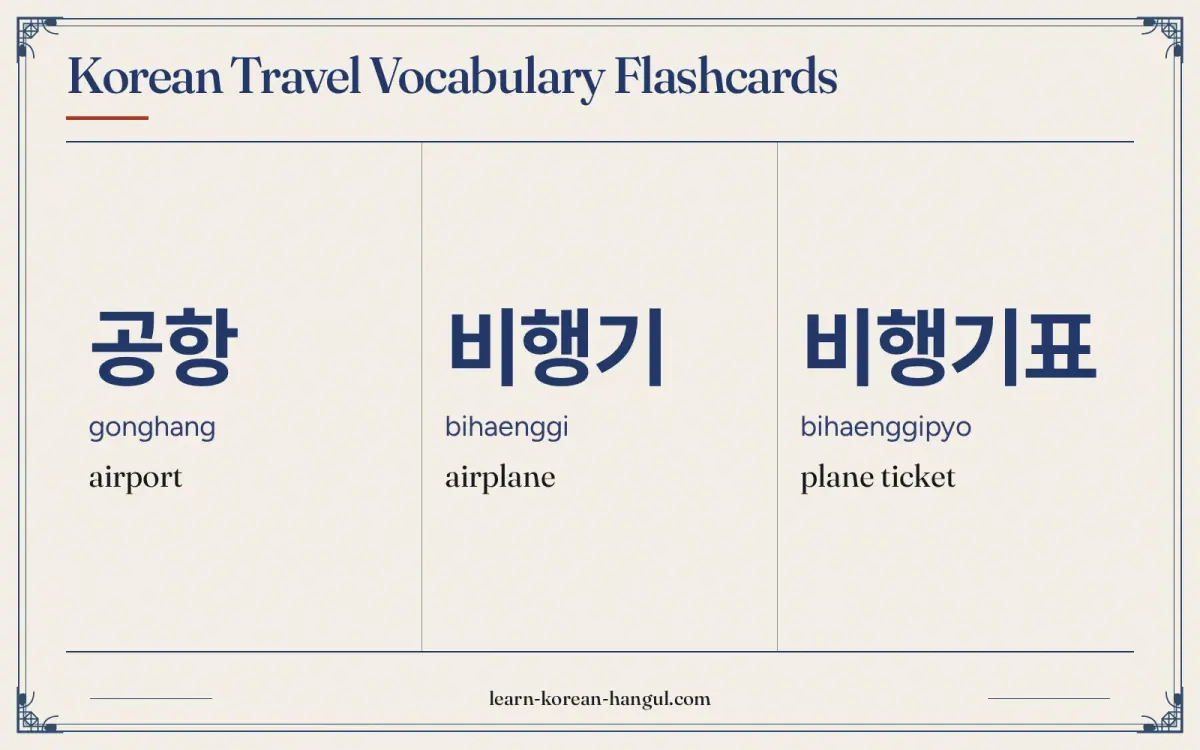
| 1 | 공항 | gonghang | airport | 공 is air and 항 is port; said as written. | au-pg-flashcards-travel-vocabulary-1 |
| 2 | 비행기 | bihaenggi | airplane | 비행기를 타요 means I take a plane. | au-pg-flashcards-travel-vocabulary-2 |
| 3 | 비행기표 | bihaenggipyo | plane ticket | Everyday word; the formal word is 항공권. | au-pg-flashcards-travel-vocabulary-3 |
| 4 | 여권 | yeogwon | passport | Said [여꿘]; the ㄱ of 권 is pronounced tense. | au-pg-flashcards-travel-vocabulary-4; slow: au-pg-flashcards-travel-vocabulary-30 |
| 5 | 비자 | bija | visa | Loanword for visa. | au-pg-flashcards-travel-vocabulary-5 |
| 6 | 짐 | jim | luggage | All your luggage, not one bag; 짐을 부치다 is to check bags. | au-pg-flashcards-travel-vocabulary-6 |
| 7 | 가방 | gabang | bag | The everyday word for a bag. | au-pg-flashcards-travel-vocabulary-7 |
| 8 | 캐리어 | kaerieo | wheeled suitcase | From the English carrier. | au-pg-flashcards-travel-vocabulary-8 |
| 9 | 수하물 | suhamul | baggage (airline term) | The airline word on signs; checked bags are 위탁 수하물. Speech often says 짐. | au-pg-flashcards-travel-vocabulary-9 |
| 10 | 탑승권 | tapseunggwon | boarding pass | Said [탑씅꿘]; the ㅅ and the ㄱ are pronounced tense. | au-pg-flashcards-travel-vocabulary-10; slow: au-pg-flashcards-travel-vocabulary-31 |
| 11 | 탑승구 | tapseunggu | boarding gate | Said [탑씅구]. | au-pg-flashcards-travel-vocabulary-11 |
| 12 | 탑승 | tapseung | boarding | Said [탑씅]; ㅅ after a ㅂ final is tensified. | au-pg-flashcards-travel-vocabulary-12 |
| 13 | 체크인 | chekeuin | check-in | Loanword; also used at hotels. | au-pg-flashcards-travel-vocabulary-13 |
| 14 | 출발 | chulbal | departure | The opposite of 도착. | au-pg-flashcards-travel-vocabulary-14 |
| 15 | 도착 | dochak | arrival | Printed beside 출발 on the board. | au-pg-flashcards-travel-vocabulary-15 |
| 16 | 지연 | jiyeon | delay | Shown on the board when a flight is late. | au-pg-flashcards-travel-vocabulary-16 |
| 17 | 직항 | jikhang | direct flight | Said [지캉]; ㄱ and ㅎ merge into ㅋ. RR keeps the h in nouns: jikhang. | au-pg-flashcards-travel-vocabulary-17; slow: au-pg-flashcards-travel-vocabulary-32 |
| 18 | 출국 | chulguk | leaving the country | The opposite of 입국. | au-pg-flashcards-travel-vocabulary-18 |
| 19 | 입국 | ipguk | entering the country | Said [입꾹]; ㄱ after a ㅂ final is tensified. | au-pg-flashcards-travel-vocabulary-19 |
| 20 | 세관 | segwan | customs | Where goods are declared. | au-pg-flashcards-travel-vocabulary-20 |
| 21 | 면세점 | myeonsejeom | duty-free shop | 면세 means tax-free. | au-pg-flashcards-travel-vocabulary-21 |
| 22 | 환전 | hwanjeon | currency exchange | Changing money; 환 means exchange. | au-pg-flashcards-travel-vocabulary-22 |
| 23 | 여행 | yeohaeng | travel | Go on a trip with 여행을 가요. | au-pg-flashcards-travel-vocabulary-23 |
| 24 | 관광 | gwangwang | tourism | Also sightseeing; answers 방문 목적이 뭐예요? | au-pg-flashcards-travel-vocabulary-24 |
| 25 | 통로 | tongno | aisle | Said [통노]; an aisle seat is 통로 쪽 자리. | au-pg-flashcards-travel-vocabulary-25 |
| 26 | 창가 | changga | window side | Said [창까]. 창가 자리 is a window seat. | au-pg-flashcards-travel-vocabulary-26 |
| 27 | 예약 | yeyak | reservation | Add 하다 for the verb: 예약했어요. | au-pg-flashcards-travel-vocabulary-27 |
| 28 | 편도 | pyeondo | one-way | The opposite of 왕복. | au-pg-flashcards-travel-vocabulary-28 |
| 29 | 왕복 | wangbok | round trip | 왕복표 한 장 주세요 (One round-trip ticket, please). | au-pg-flashcards-travel-vocabulary-29 |
Reading the Table
Hangul is the word. Revised Romanization (RR) is a learning aid, so read the Hangul first and check RR afterwards. RR follows the sound of the word, which is why 통로 is written tongno even though the spelling has ㄹ. The Meaning column gives the English gloss, and the Note column gives a use or sound hint. The last column lists the audio assetId; a second ID marks a slow clip. Cards 4, 10 and 17 have slow clips because their tense or merged sounds are easy to miss.
Usage Notes for These Cards
Check a bag with 짐을 부치다. The verb 부치다 means to send or check in, and it is the word for baggage: 짐을 부치고 싶어요 (I want to check my bag).
Show your passport with 여권을 보여 주세요. At the desk the officer says 여권을 보여 주세요 (Please show your passport). You can answer 여기 있어요 (Here it is).
Say the purpose of your visit with 관광이에요. The officer asks 방문 목적이 뭐예요? (What is the purpose of your visit?), and you answer 관광이에요 (It is sightseeing).
왕복 is round trip and 편도 is one way. Ask for the ticket you need: 왕복표 한 장 주세요 (One round-trip ticket, please) or 편도로 주세요 (One way, please).
Tickets are counted with 장. The counter 장 is for flat things such as tickets and sheets, and the number before it is a native Korean one: 비행기표 두 장 (two plane tickets).
You ride a plane with 타다. 비행기를 타요 means I take a plane. For a trip, say 여행을 가요 (I go on a trip).
Which Sounds Do Not Match the Spelling?
직항 is said [지캉]. The final ㄱ of 직 meets the ㅎ of 항, and the two merge into aspirated ㅋ. Say ji-kang. The romanization still writes the h (jikhang), because Revised Romanization keeps ㅎ in nouns.
통로 is said [통노]. After the final ㅇ of 통, the ㄹ of 로 is read as ㄴ.
탑승 is said [탑씅]. The ㅅ after the final ㅂ of 탑 is pronounced as tense ㅆ. The same happens in 탑승권 [탑씅꿘] and 탑승구 [탑씅구].
입국 is said [입꾹] and 여권 is said [여꿘]. In 입국 the ㄱ after a ㅂ final is pronounced tense. In 여권 the ㄱ of 권 is also pronounced tense, a fixed pronunciation of the word.
창가 is said [창까]. The ㄱ of 가 is tense in this compound, so a window seat, 창가 자리, sounds like chang-kka ja-ri.
What Mistakes Do Learners Make with Travel and Airport Words?
- Saying 짐을 보내다 for checking bags. Say 짐을 부치다.
- Using 비행기를 올라가다 for boarding. Say 비행기를 타다.
- Mixing up 편도 and 왕복. 편도 is one way, and 왕복 is a round trip.
- Mixing up 출국 and 입국. 출국 is leaving the country, and 입국 is entering it.
The tense and aspirated sounds cause most of the listening slips, so use listening mode for cards 4, 10, 17, 19 and 26.
How Does the Review Schedule Work?
The deck uses a simplified Leitner system with five boxes. A new card starts in box 1. Each Got it moves it up one box, and each Not yet returns it to box 1. The box sets how long the card waits before it is due again.
| Box | Wait until the next review |
|---|---|
| 1 | same session or 10 minutes |
| 2 | 1 day |
| 3 | 3 days |
| 4 | 7 days |
| 5 | 21 days |
Each session shows due cards first, oldest due first, and then up to 10 new cards a day by default. A deck of 29 cards is introduced over three days at the default of 10 new cards a day, and the later boxes bring each card back at longer gaps. Progress is saved only in this browser, so clearing site data deletes it. Use the export button to save a small JSON file with card IDs, boxes and due dates, and import it on another device. No account is needed.
Cultural and Practical Context
Incheon International Airport is Korea's main international hub, and its large duty-free areas make 면세점 a regular part of leaving the country. Signs there usually show Korean, English and other languages together, but the Korean words on this deck are the ones announcements and desks use.
Limits of This Deck
The deck holds 29 cards and teaches single words, so it does not cover full conversations at the desk. The Incheon remark is general. All Korean text is generated and was reviewed and signed off by Min-ji Park on 15 October 2026. The audio is generated with text-to-speech and is checked by a Korean teacher before publication, and listening mode uses only cards whose clips are approved.
Next Steps after This Deck
After this deck, move on to the Korean hotel vocabulary flashcards for the next stop on a trip. Go back to the Korean transportation vocabulary flashcards if buses and subways still feel shaky, and write the words by hand with the Korean places vocabulary worksheet. The Korean travel vocabulary lesson holds the longer word list, the Korean vocabulary flashcards page lists every other deck, and the Korean flashcards hub lists all topics.
Frequently Asked Questions
What Is the Difference between 비행기표 and 항공권?
비행기표 is the everyday word for a plane ticket, and 항공권 is the formal word you see on booking sites and airline counters. Both mean the same thing. In speech you can say 비행기표를 샀어요 (I bought a plane ticket), while a form is more likely to say 항공권.
Is 비자 a Korean Word?
It is a loanword from the English word visa, romanized as bija. The official Sino-Korean term is 사증, which you may see on government forms, but everyday talk uses 비자, as in 비자가 필요해요 (I need a visa).
What Does 출국 Mean?
출국 means leaving a country, and 입국 means entering one. You pass 출국 심사 (departure inspection) on the way out and 입국 심사 (immigration inspection) on the way in. The two words differ only in their first syllable, so say them slowly.
How Do I Ask for a Window Seat?
Say 창가 자리 주세요 (A window seat, please). For an aisle seat say 통로 쪽 자리 주세요. The word 자리 means seat or place, and 주세요 is the polite request for please give me.
Is My Progress Saved If I Close the Page?
Yes, in the same browser on the same device. Card boxes and due dates are stored locally and nothing is sent to a server. Clearing site data, using a private window or switching browsers removes them, so use the export button to keep a backup file. No account is needed.