Korean Hotel Vocabulary at a Glance
This list has 35 words in five groups of seven. The groups follow a stay: pick the type of lodging, book, check in, choose a room and ask for what you need. It sits in Places and Travel, after Korean Directions Vocabulary, and it supplies the nouns for the sentences on the hotel phrases page.
| Group | Words | Use |
|---|---|---|
| Types of lodging | 7 | Choosing where to stay |
| Booking | 7 | Reserving and paying |
| Check-in and check-out | 7 | Arriving and leaving |
| Room types | 7 | Rooms, beds and bathrooms |
| Facilities and requests | 7 | What you ask for during a stay |
Most entries are nouns or loanwords. The verbs you need, such as 예약하다 (to book) and 체크인하다 (to check in), are made by adding 하다 to the noun. For the single query on its own, see hotel in korean. The next section says where to start.
Which Hotel Words Should You Learn First?
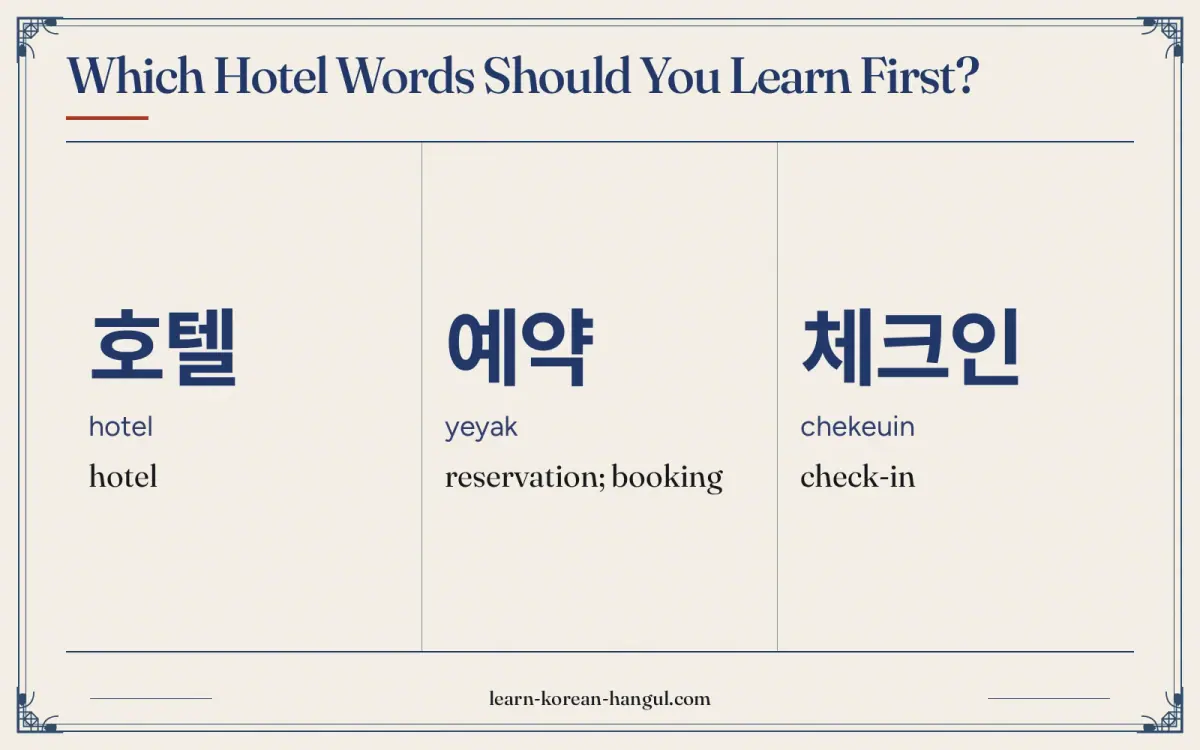
Learn 예약 (reservation), 체크인 (check-in), 체크아웃 (check-out), 객실 (guest room) and 조식 (breakfast) first. With these five you can confirm a booking, ask for a room and find out when breakfast is served. Add 수건 (towel) and 와이파이 (Wi-Fi) for the first night.
- Words to say at the front desk. 예약, 체크인, 체크아웃, 여권, 열쇠.
- Words to read on a booking page. 숙박, 일박, 보증금, 취소, 조식.
- Words to use in a request. 수건, 에어컨, 와이파이, 청소, 소음.
Start by checking which type of lodging you are booking. Korea has several, and the English name often hides a different meaning. The first group and the table below explain the differences.
Word · 8
- 1
호텔
hotel
hotel
- 2
예약
yeyak
reservation; booking
- 3
체크인
chekeuin
check-in
- 4
프런트
peureonteu
front desk
- 5
카드키
kadeuki
key card
- 6
침대
chimdae
bed
- 7
수건
sugeon
towel
- 8
에어컨
eeokeon
air conditioner
Types of Lodging
Korean lodging comes in more types than a hotel, and the names do not always match English. These seven words name the places you can book.
| No. | Hangul | Revised Romanization | Meaning and note | Example sentence | Audio assetId |
|---|---|---|---|---|---|
| 1 | 호텔 | hotel | hotel. A loanword from English. Ranges from business hotels to luxury ones. | 서울에서 호텔을 예약했어요. (I booked a hotel in Seoul.) | au-pg-vocabulary-places-hotel-1; example: au-pg-vocabulary-places-hotel-2 |
| 2 | 숙소 | sukso | accommodation; lodging. The general word for the place where you stay, whatever the type. | 숙소가 어디예요? (Where is your accommodation?) | au-pg-vocabulary-places-hotel-3; example: au-pg-vocabulary-places-hotel-4 |
| 3 | 모텔 | motel | motel (short-stay city hotel). A loanword. In Korea a basic city lodging, not a roadside motor inn. | 모텔은 가격이 싸요. (The motel is cheap.) | au-pg-vocabulary-places-hotel-5; example: au-pg-vocabulary-places-hotel-6 |
| 4 | 게스트하우스 | geseuteuhauseu | guesthouse. A loanword for a small, budget place with shared spaces. Popular with solo travellers. | 게스트하우스에서 친구를 만났어요. (I met a friend at the guesthouse.) | au-pg-vocabulary-places-hotel-7; example: au-pg-vocabulary-places-hotel-8 |
| 5 | 펜션 | pensyeon | pension (holiday cottage). A loanword. A small holiday house or cottage for families and groups, often in the countryside or by the sea. | 가족과 펜션에 갔어요. (I went to a pension with my family.) | au-pg-vocabulary-places-hotel-9; example: au-pg-vocabulary-places-hotel-10 |
| 6 | 한옥 스테이 | hanok seutei | hanok stay. 한옥 is a traditional Korean house. 스테이 is from English "stay". Said [하녹 스테이]. | 한옥 스테이를 예약하고 싶어요. (I want to book a hanok stay.) | au-pg-vocabulary-places-hotel-11; example: au-pg-vocabulary-places-hotel-12 |
| 7 | 리조트 | rijoteu | resort. A loanword. A large leisure property, often by the sea or in the mountains. | 리조트에서 이틀 묵어요. (I stay two nights at the resort.) | au-pg-vocabulary-places-hotel-13; example: au-pg-vocabulary-places-hotel-14 |
Korean uses its own word for each type. A 모텔 is a plain city lodging with a private room, and quality varies; check reviews before you book. A 펜션 is a self-catering house, not a bed-and-breakfast. The 한옥 stay is a traditional house with an ondol floor. The table in the extras section compares them side by side.
Booking
These seven words appear on every booking page and in every confirmation email. The first three are the ones you say; the rest you read.
| No. | Hangul | Revised Romanization | Meaning and note | Example sentence | Audio assetId |
|---|---|---|---|---|---|
| 8 | 예약 | yeyak | reservation; booking. 예약하다 is the verb: to book. Used for hotels, restaurants and tickets. | 호텔을 예약했어요. (I booked a hotel.) | au-pg-vocabulary-places-hotel-15; example: au-pg-vocabulary-places-hotel-16 |
| 9 | 예약 번호 | yeyak beonho | reservation number. 번호 means number. The code you show at check-in. | 예약 번호가 뭐예요? (What is the reservation number?) | au-pg-vocabulary-places-hotel-17; example: au-pg-vocabulary-places-hotel-18 |
| 10 | 숙박 | sukbak | overnight stay; lodging. Said [숙빡]. Appears in booking totals and tax lines. | 숙박은 3박이에요. (The stay is three nights.) | au-pg-vocabulary-places-hotel-19; example: au-pg-vocabulary-places-hotel-20 |
| 11 | 일박 | ilbak | one night. Usually said [일빡]. 박 counts nights. 이 박 삼 일 means two nights, three days. | 일박에 얼마예요? (How much is it for one night?) | au-pg-vocabulary-places-hotel-21; example: au-pg-vocabulary-places-hotel-22 |
| 12 | 취소 | chwiso | cancellation. 취소하다 means to cancel. Many rates list a cancellation deadline. | 예약을 취소하고 싶어요. (I want to cancel my reservation.) | au-pg-vocabulary-places-hotel-23; example: au-pg-vocabulary-places-hotel-24 |
| 13 | 보증금 | bojeunggeum | deposit; security deposit. A sum held against damage or extra charges. It is normally returned at check-out. | 보증금이 있어요. (There is a deposit.) | au-pg-vocabulary-places-hotel-25; example: au-pg-vocabulary-places-hotel-26 |
| 14 | 할인 | harin | discount. Said [하린]. Seen on booking sites during sales. | 주중에는 할인이 있어요. (There is a discount on weekdays.) | au-pg-vocabulary-places-hotel-27; example: au-pg-vocabulary-places-hotel-28 |
The counting pattern 이 박 삼 일 (two nights, three days) is how Koreans state the length of a trip. The nights come first, then the days. A one-night stay is 일 박 이 일, and a three-night stay is 삼 박 사 일. Read the numbers with Sino-Korean numerals.
Check-in and Check-Out
These words are what you say at the front desk on arrival and on departure. The first two are English loanwords and the others are everyday nouns.
| No. | Hangul | Revised Romanization | Meaning and note | Example sentence | Audio assetId |
|---|---|---|---|---|---|
| 15 | 체크인 | chekeuin | check-in. A loanword. 체크인하다 means to check in. | 체크인은 몇 시예요? (What time is check-in?) | au-pg-vocabulary-places-hotel-29; example: au-pg-vocabulary-places-hotel-30 |
| 16 | 체크아웃 | chekeuaut | check-out. A loanword. 체크아웃하다 means to check out. | 체크아웃은 열한 시예요. (Check-out is at eleven.) | au-pg-vocabulary-places-hotel-31; example: au-pg-vocabulary-places-hotel-32 |
| 17 | 프런트 | peureonteu | front desk. A loanword. Staff there answer questions and hold luggage. | 프런트에 물어보세요. (Please ask at the front desk.) | au-pg-vocabulary-places-hotel-33; example: au-pg-vocabulary-places-hotel-34 |
| 18 | 열쇠 | yeolsoe | key. The word for a key. In hotels this is usually a card. | 열쇠를 잃어버렸어요. (I lost my key.) | au-pg-vocabulary-places-hotel-35; example: au-pg-vocabulary-places-hotel-36 |
| 19 | 카드키 | kadeuki | key card. 카드 is card and 키 is key. Opens the door and often switches on the room power. | 카드키를 한 장 더 주세요. (Please give me one more key card.) | au-pg-vocabulary-places-hotel-37; example: au-pg-vocabulary-places-hotel-38 |
| 20 | 여권 | yeogwon | passport. The staff may scan or photocopy it at check-in. | 여권을 보여 주세요. (Please show your passport.) | au-pg-vocabulary-places-hotel-39; example: au-pg-vocabulary-places-hotel-40 |
| 21 | 신분증 | sinbunjeung | ID card. Residents use it instead of a passport. | 신분증이 필요해요. (An ID card is needed.) | au-pg-vocabulary-places-hotel-41; example: au-pg-vocabulary-places-hotel-42 |
Notice the two ways of saying key: 열쇠 is the older word and 카드키 is the modern hotel word. The phrase 체크인은 몇 시예요? is worth saying aloud, because the front-desk answer will be a time. A time is read with native Korean numbers for hours and Sino-Korean for minutes, as in 열한 시 (eleven o'clock).
Room Types
Room names in Korean are mostly English loanwords with Korean spelling, plus the uniquely Korean ondol room. The seven words below cover the choices on a booking page.
| No. | Hangul | Revised Romanization | Meaning and note | Example sentence | Audio assetId |
|---|---|---|---|---|---|
| 22 | 객실 | gaeksil | guest room. Said [객씰]. The formal word for a hotel room. 방 is the everyday word. | 객실이 깨끗해요. (The guest room is clean.) | au-pg-vocabulary-places-hotel-43; example: au-pg-vocabulary-places-hotel-44 |
| 23 | 싱글룸 | singgeullum | single room. From English "single room". One person, one bed. | 싱글룸을 예약했어요. (I booked a single room.) | au-pg-vocabulary-places-hotel-45; example: au-pg-vocabulary-places-hotel-46 |
| 24 | 더블룸 | deobeullum | double room. From English "double room". One large bed for two. | 더블룸은 침대가 하나예요. (The double room has one bed.) | au-pg-vocabulary-places-hotel-47; example: au-pg-vocabulary-places-hotel-48 |
| 25 | 트윈룸 | teuwinrum | twin room. From English "twin room". Two separate beds. | 트윈룸으로 주세요. (A twin room, please.) | au-pg-vocabulary-places-hotel-49; example: au-pg-vocabulary-places-hotel-50 |
| 26 | 온돌방 | ondolbang | ondol room (heated floor). Said [온돌빵]. A room with floor heating where guests sleep on bedding laid on the floor. | 온돌방이 따뜻해요. (The ondol room is warm.) | au-pg-vocabulary-places-hotel-51; example: au-pg-vocabulary-places-hotel-52 |
| 27 | 침대 | chimdae | bed. The piece of furniture. Single, double and twin rooms differ in the beds. | 침대가 커요. (The bed is big.) | au-pg-vocabulary-places-hotel-53; example: au-pg-vocabulary-places-hotel-54 |
| 28 | 욕실 | yoksil | bathroom (with bath or shower). Said [욕씰]. The room for washing. A toilet room alone is 화장실. | 욕실이 방 안에 있어요. (The bathroom is inside the room.) | au-pg-vocabulary-places-hotel-55; example: au-pg-vocabulary-places-hotel-56 |
The 싱글룸, 더블룸 and 트윈룸 trio is the quickest way to state your needs: 트윈룸으로 주세요 (a twin room, please). The 온돌방 is a different kind of room. It has underfloor heating, and guests sleep on a mat laid on the floor, not in a bed. Check the listing, because some rooms offer both a bed and an ondol floor.
Facilities and Requests
The last group names the things you ask for or complain about. The first three are amenities and the last four are the nouns of a problem or a service request.
| No. | Hangul | Revised Romanization | Meaning and note | Example sentence | Audio assetId |
|---|---|---|---|---|---|
| 29 | 조식 | josik | breakfast (hotel). The word for the hotel breakfast on booking pages. The everyday word is 아침. | 조식은 몇 시부터예요? (From what time is breakfast?) | au-pg-vocabulary-places-hotel-57; example: au-pg-vocabulary-places-hotel-58 |
| 30 | 와이파이 | waipai | Wi-Fi. A loanword. Staff will give you the network name and the password. | 와이파이 비밀번호가 뭐예요? (What is the Wi-Fi password?) | au-pg-vocabulary-places-hotel-59; example: au-pg-vocabulary-places-hotel-60 |
| 31 | 수건 | sugeon | towel. Towels are usually supplied. Ask for more at the front desk. | 수건 더 주세요. (Please give me more towels.) | au-pg-vocabulary-places-hotel-61; example: au-pg-vocabulary-places-hotel-62 |
| 32 | 에어컨 | eeokeon | air conditioner. A loanword. Each room has its own controller. | 에어컨이 안 켜져요. (The air conditioner does not turn on.) | au-pg-vocabulary-places-hotel-63; example: au-pg-vocabulary-places-hotel-64 |
| 33 | 소음 | soeum | noise. A complaint noun. 소음이 심해요 means the noise is severe. | 옆방 소음이 심해요. (The noise from the next room is severe.) | au-pg-vocabulary-places-hotel-65; example: au-pg-vocabulary-places-hotel-66 |
| 34 | 고장 | gojang | breakdown; fault. 고장 나다 means to break down. 고장 났어요 is the past tense. | 에어컨이 고장 났어요. (The air conditioner has broken down.) | au-pg-vocabulary-places-hotel-67; example: au-pg-vocabulary-places-hotel-68 |
| 35 | 청소 | cheongso | cleaning. 청소하다 means to clean. A housekeeping request. | 방을 청소해 주세요. (Please clean the room.) | au-pg-vocabulary-places-hotel-69; example: au-pg-vocabulary-places-hotel-70 |
Notice the two frames in the examples. The request frame is noun + (더) + 주세요 (please give me [more]) or verb + 해 주세요 (please do). The problem frame is noun + 이/가 + 고장 났어요 (the noun has broken). The request forms come from 주다 (줘요) and 하다 (해요).
What Is the Difference between a 호텔, 모텔 and 펜션?
The English word does not always match the Korean one. The table compares the common types, and the notes below the table explain the most important cases.
| Type | Korean | What it usually is | Good for |
|---|---|---|---|
| Hotel | 호텔 | Full-service hotel with a front desk | Most visitors |
| Motel | 모텔 | Basic city lodging with a private room | A cheap overnight stay |
| Guesthouse | 게스트하우스 | Budget place with shared spaces | Solo travellers |
| Pension | 펜션 | A house or cottage for a group | Families and groups |
| Hanok stay | 한옥 스테이 | A traditional Korean house | A cultural experience |
| Bathhouse | 찜질방 | A large public bath with sleeping areas | A low-cost night in a pinch |
A 모텔 is not the same as an American roadside motel. In Korea it is usually a basic city lodging with a private room, and quality varies, so read the reviews before you book. A 찜질방 is not a hotel at all. It is a public bath with common sleeping areas, and some guests stay overnight. For the bath on its own, see the Around the City list.
What Do You Say at Check-In?
A check-in follows a short script. The sentences use the words on this page, plus the basic verbs 하다 and 주다.
| Step | You say | Meaning |
|---|---|---|
| Say you have a booking | 예약했어요. | I have made a reservation. |
| Give the name or number | 예약 번호는 이 이 삼 사예요. | The reservation number is 2234. |
| Ask the time | 체크아웃은 몇 시예요? | What time is check-out? |
| Ask about breakfast | 조식은 몇 시부터예요? | From what time is breakfast? |
| Ask for something | 수건 더 주세요. | Please give me more towels. |
The first line uses 예약하다 in the past tense, 예약했어요. The number in the second line is read digit by digit. The last line uses the pattern noun + 더 + 주세요. For more sentences, see the hotel phrases page and the travel phrases section.
How Do You Report a Problem Politely?
Korean hotel staff expect a soft, specific request. Name the problem noun, then say it has broken or ask for the fix. Three frames cover most cases.
- Something is broken. 에어컨이 고장 났어요. (The air conditioner has broken down.)
- Something is too loud. 옆방 소음이 심해요. (The noise from the next room is severe.)
- Something is needed. 방을 청소해 주세요. (Please clean the room.)
The polite ending -요 is enough in a hotel. Adding 죄송하지만 (sorry, but) at the start softens a request: 죄송하지만 수건 더 주세요. Keep the sentence short, name the room, and point to the problem if the words fail. A complaint is easier to handle when you state the room number: 삼백오 호입니다 means this is room 305.
How Do You Pronounce Korean Hotel Words?
Hotel words contain several sound changes that the spelling hides. The Revised Romanization of Korean records the spelling and ignores many of these changes. The standard pronunciation rules published by the National Institute of Korean Language (국립국어원) give the spoken form.
| Spelling | Sounds like | What changes |
|---|---|---|
| 숙박 | [숙빡] | After a final ㄱ, the ㅂ of 박 becomes tense [ㅃ]. |
| 일박 | [일빡] | After the final ㄹ, the ㅂ of 박 is usually said tense [ㅃ] in this word. |
| 객실 | [객씰] | After a final ㄱ, the ㅅ of 실 becomes tense [ㅆ]. |
| 욕실 | [욕씰] | After a final ㄱ, the ㅅ of 실 becomes tense [ㅆ]. |
| 온돌방 | [온돌빵] | The ㅂ of 방 becomes tense [ㅃ] in this compound. |
| 한옥 스테이 | [하녹 스테이] | The final ㄴ of 한 links to the vowel of 옥. |
The tense sounds in 숙박, 객실 and 욕실 are the most common slip. Say the second consonant tight, with no puff of air. The Hangul does not show the change, so use the audio as your guide.
Audio and Slow Playback
Each headword and each example sentence has its own audio clip. The clips below replay the trickiest words at a slower pace. Play one, repeat it aloud, then play it again and compare.
What Mistakes Do Learners Make with Hotel Words?
These five mistakes come up most when learners book a Korean stay.
- Booking a 모텔 and expecting a roadside motel. In Korea it is a basic city lodging. Read the reviews.
- Reading 이 박 삼 일 as three nights. It means two nights and three days. The first number counts nights.
- Looking for 방 on a booking page. Booking pages and hotel signs use the formal 객실. 방 is the everyday word you say at the desk.
- Expecting a bed in an 온돌방. The room has a heated floor and bedding on the floor. Check the listing.
- Saying 열쇠 for a card. A hotel door usually opens with a 카드키.
If you remember only one, remember that nights come before days, because it changes how long you pay for.
Practice: Flashcards and Worksheet
Study in three steps. First, run the flashcard deck in recognition mode until you know each of the 35 words. Second, switch to listening mode and answer from the audio alone. Third, take the quiz. The deck covers all 35 words with audio, and your progress stays in your browser. The vocabulary flashcard decks page lists the other decks.
Practice · 75
- 01호텔
Show answer
headword 1: hotel
- 02서울에서 호텔을 예약했어요.
Show answer
example sentence for 호텔: I booked a hotel in Seoul.
- 03숙소
Show answer
headword 2: accommodation; lodging
- 04숙소가 어디예요?
Show answer
example sentence for 숙소: Where is your accommodation?
- 05모텔
Show answer
headword 3: motel (short-stay city hotel)
- 06모텔은 가격이 싸요.
Show answer
example sentence for 모텔: The motel is cheap.
- 07게스트하우스
Show answer
headword 4: guesthouse
- 08게스트하우스에서 친구를 만났어요.
Show answer
example sentence for 게스트하우스: I met a friend at the guesthouse.
- 09펜션
Show answer
headword 5: pension (holiday cottage)
- 10가족과 펜션에 갔어요.
Show answer
example sentence for 펜션: I went to a pension with my family.
- 11한옥 스테이
Show answer
headword 6: hanok stay
- 12한옥 스테이를 예약하고 싶어요.
Show answer
example sentence for 한옥 스테이: I want to book a hanok stay.
- 13리조트
Show answer
headword 7: resort
- 14리조트에서 이틀 묵어요.
Show answer
example sentence for 리조트: I stay two nights at the resort.
- 15예약
Show answer
headword 8: reservation; booking
- 16호텔을 예약했어요.
Show answer
example sentence for 예약: I booked a hotel.
- 17예약 번호
Show answer
headword 9: reservation number
- 18예약 번호가 뭐예요?
Show answer
example sentence for 예약 번호: What is the reservation number?
- 19숙박
Show answer
headword 10: overnight stay; lodging
- 20숙박은 3박이에요.
Show answer
example sentence for 숙박: The stay is three nights.
- 21일박
Show answer
headword 11: one night
- 22일박에 얼마예요?
Show answer
example sentence for 일박: How much is it for one night?
- 23취소
Show answer
headword 12: cancellation
- 24예약을 취소하고 싶어요.
Show answer
example sentence for 취소: I want to cancel my reservation.
- 25보증금
Show answer
headword 13: deposit; security deposit
- 26보증금이 있어요.
Show answer
example sentence for 보증금: There is a deposit.
- 27할인
Show answer
headword 14: discount
- 28주중에는 할인이 있어요.
Show answer
example sentence for 할인: There is a discount on weekdays.
- 29체크인
Show answer
headword 15: check-in
- 30체크인은 몇 시예요?
Show answer
example sentence for 체크인: What time is check-in?
- 31체크아웃
Show answer
headword 16: check-out
- 32체크아웃은 열한 시예요.
Show answer
example sentence for 체크아웃: Check-out is at eleven.
- 33프런트
Show answer
headword 17: front desk
- 34프런트에 물어보세요.
Show answer
example sentence for 프런트: Please ask at the front desk.
- 35열쇠
Show answer
headword 18: key
- 36열쇠를 잃어버렸어요.
Show answer
example sentence for 열쇠: I lost my key.
- 37카드키
Show answer
headword 19: key card
- 38카드키를 한 장 더 주세요.
Show answer
example sentence for 카드키: Please give me one more key card.
- 39여권
Show answer
headword 20: passport
- 40여권을 보여 주세요.
Show answer
example sentence for 여권: Please show your passport.
- 41신분증
Show answer
headword 21: ID card
- 42신분증이 필요해요.
Show answer
example sentence for 신분증: An ID card is needed.
- 43객실
Show answer
headword 22: guest room
- 44객실이 깨끗해요.
Show answer
example sentence for 객실: The guest room is clean.
- 45싱글룸
Show answer
headword 23: single room
- 46싱글룸을 예약했어요.
Show answer
example sentence for 싱글룸: I booked a single room.
- 47더블룸
Show answer
headword 24: double room
- 48더블룸은 침대가 하나예요.
Show answer
example sentence for 더블룸: The double room has one bed.
- 49트윈룸
Show answer
headword 25: twin room
- 50트윈룸으로 주세요.
Show answer
example sentence for 트윈룸: A twin room, please.
- 51온돌방
Show answer
headword 26: ondol room (heated floor)
- 52온돌방이 따뜻해요.
Show answer
example sentence for 온돌방: The ondol room is warm.
- 53침대
Show answer
headword 27: bed
- 54침대가 커요.
Show answer
example sentence for 침대: The bed is big.
- 55욕실
Show answer
headword 28: bathroom (with bath or shower)
- 56욕실이 방 안에 있어요.
Show answer
example sentence for 욕실: The bathroom is inside the room.
- 57조식
Show answer
headword 29: breakfast (hotel)
- 58조식은 몇 시부터예요?
Show answer
example sentence for 조식: From what time is breakfast?
- 59와이파이
Show answer
headword 30: Wi-Fi
- 60와이파이 비밀번호가 뭐예요?
Show answer
example sentence for 와이파이: What is the Wi-Fi password?
- 61수건
Show answer
headword 31: towel
- 62수건 더 주세요.
Show answer
example sentence for 수건: Please give me more towels.
- 63에어컨
Show answer
headword 32: air conditioner
- 64에어컨이 안 켜져요.
Show answer
example sentence for 에어컨: The air conditioner does not turn on.
- 65소음
Show answer
headword 33: noise
- 66옆방 소음이 심해요.
Show answer
example sentence for 소음: The noise from the next room is severe.
- 67고장
Show answer
headword 34: breakdown; fault
- 68에어컨이 고장 났어요.
Show answer
example sentence for 고장: The air conditioner has broken down.
- 69청소
Show answer
headword 35: cleaning
- 70방을 청소해 주세요.
Show answer
example sentence for 청소: Please clean the room.
- 71숙박
Show answer
slow playback of 숙박
- 72객실
Show answer
slow playback of 객실
- 73온돌방
Show answer
slow playback of 온돌방
- 74체크아웃
Show answer
slow playback of 체크아웃
- 75보증금
Show answer
slow playback of 보증금
Practice · 5
What does 예약 (yeyak) mean?
Show answer
reservation; booking
예약 means reservation; booking. Example: 호텔을 예약했어요. (I booked a hotel.)
What does 체크아웃 (chekeuaut) mean?
Show answer
check-out
체크아웃 means check-out. Example: 체크아웃은 열한 시예요. (Check-out is at eleven.)
What does 온돌방 (ondolbang) mean?
Show answer
ondol room (heated floor)
온돌방 means ondol room (heated floor). Example: 온돌방이 따뜻해요. (The ondol room is warm.)
What does 조식 (josik) mean?
Show answer
breakfast (hotel)
조식 means breakfast (hotel). Example: 조식은 몇 시부터예요? (From what time is breakfast?)
What does 보증금 (bojeunggeum) mean?
Show answer
deposit; security deposit
보증금 means deposit; security deposit. Example: 보증금이 있어요. (There is a deposit.)
Korean Hotel Vocabulary Worksheet (PDF)
A printable worksheet for these words (word list, matching, writing practice, fill-in-the-blank exercises and answer key) is available in A4 and US Letter from the download card on this page. For practice, copy the 35 words by hand and write the meaning next to each. Write a three-line check-in script with your own name and dates.
Where to Go Next
After this page, continue with hotel phrases for the full sentences, or Travel and Airport for the words you need before you arrive. For finding the hotel, see Korean Directions Vocabulary. For the single query on its own, see hotel in korean. To move up a level, return to Places and Travel.
Frequently Asked Questions
How Do You Say Hotel in Korean?
Hotel is 호텔 (hotel). It is a loanword from English and is written in Hangul as 호텔. Say ho-tel, with a short [o] and an [l] sound at the end. In a sentence: 호텔을 예약했어요 (I booked a hotel).
How Do You Say Reservation in Korean?
Reservation is 예약 (yeyak). The verb is 예약하다, and the polite past tense is 예약했어요 (I have booked), which is also the first thing you say at check-in. To ask the number, say 예약 번호가 뭐예요? Use 예약 for hotels, restaurants and tickets.
How Do You Say Check-in in Korean?
Check-in is 체크인 (chekeuin), a loanword. To ask the time, say 체크인은 몇 시예요? The check-out is 체크아웃 (chekeuaut). Both are written in Hangul and used in everyday speech, and both become verbs with 하다, as in 체크인했어요 (I have checked in).
How Do You Pronounce 호텔?
Say ho-tel. The first syllable has the vowel [o], and the second syllable has [te] followed by a light [l] at the end. There is no sound change. Play the 호텔 clip in the lodging table, and compare it with 모텔, which differs only in the first consonant.
What Is an 온돌방?
An 온돌방 (ondolbang) is a room with underfloor heating, where guests sleep on bedding laid on the floor. It is a traditional Korean style of room. If you prefer a bed, choose a 싱글룸, 더블룸 or 트윈룸, or check whether the listing offers both.
Is the Romanization on This Page Official?
It follows the Revised Romanization of Korean, which South Korea adopted on 7 July 2000 and whose rules the National Institute of Korean Language (국립국어원) publishes. It is a learning aid and does not mark every sound change, so rely on the Hangul and the audio.