Korean Shopping Vocabulary Flashcards: Study the 29 Cards
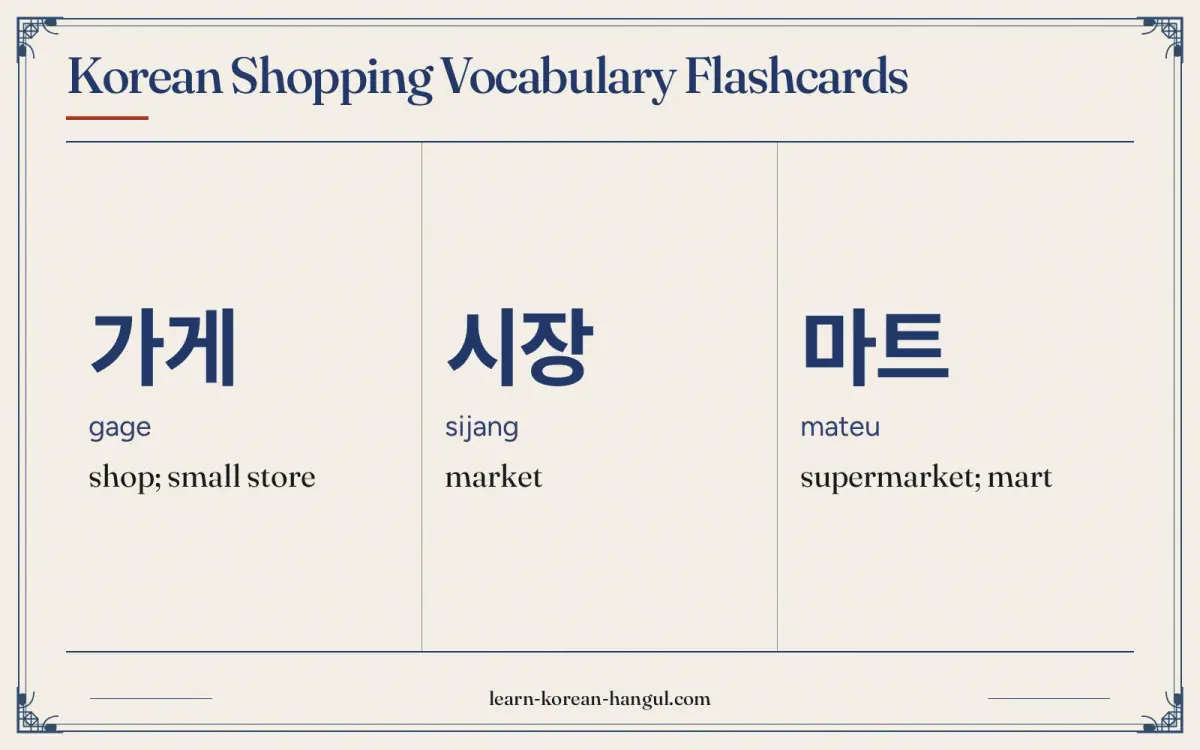
Many of these words are Sino-Korean or loanwords, and the table marks which. Read the Hangul first, then check the Note column for the origin and an example sentence. The lesson behind the deck is korean shopping vocabulary, so read it first if a card is new.
How Do I Use These Flashcards?
Use the deck above in four steps. It works with tap, click or keyboard, and nothing plays until you press an audio button.
- Choose a mode. Start with recognition (Hangul to meaning). Switch to recall (meaning to Hangul) or listening (audio to meaning) once recognition feels easy.
- Show the answer. Think of the answer first, then press Show answer (or Space). Turn on the romanization toggle only if you need it; the 29-card table below always shows it.
- Grade yourself. Press Got it if you answered correctly without help, or Not yet if you hesitated or guessed.
- Finish the session. A session holds up to 20 cards (you can set 10, 20 or 40). With 29 cards, a first-time learner can split the deck over three days, using the default limit of 10 new cards a day.
The Three Study Modes
Recognition shows the Hangul and asks for the meaning, which trains reading. Recall shows the meaning and asks for the Hangul, which trains remembering; you may type the answer with your Hangul keyboard or just recall it in your head. Listening plays a clip and hides the letters, which trains the ear. Listening mode only uses a card once its audio is approved, and cards without approved audio are skipped in that mode with a note.
Got It and Not Yet
Got it moves the card up one Leitner box, so it comes back later. Not yet sends the card back to box 1, so it returns in the same session or within 10 minutes. The grades are your own judgement; the deck does not score you or claim fluency.
Deck Scope: What Is and Is Not Covered
The deck covers shop types (가게, 시장, 마트, 백화점, 편의점, 쇼핑몰), the people in a shop (손님, 점원, 주인), price and discount words (가격, 값, 세일, 할인, 쿠폰, 무료), paying words (계산, 결제, 카드, 현금, 거스름돈, 영수증) and returns (환불, 교환, 품절). Banking and card terms such as accounts and transfers are in the money deck.
What Is Left out of This Deck?
Banking, loans and accounts are in the korean money vocabulary flashcards, and everyday habits are in the korean daily routine flashcards. The deck leaves out clothing, food items and sizes beyond 사이즈, and it does not teach the full bargaining phrases that the lesson page covers.
All 29 Cards in One Table
All 29 cards appear below in deck order. The table is plain HTML, so you can use it as a drill without the deck: cover the Meaning column, read each Hangul word aloud, then uncover the meaning.
| # | Hangul | Revised Romanization | Meaning | Note | Audio assetId |
|---|---|---|---|---|---|
| 1 | 가게 | gage | shop; small store | Native Korean word. Example: 가게가 일곱 시에 닫아요. (The shop closes at seven) | au-pg-flashcards-shopping-vocabulary-1 |
| 2 | 시장 | sijang | market | Sino-Korean word. Example: 시장에서 채소를 사요. (I buy vegetables at the market) | au-pg-flashcards-shopping-vocabulary-2 |
| 3 | 마트 | mateu | supermarket; mart | Loanword. Example: 마트에서 우유를 사요. (I buy milk at the supermarket) | au-pg-flashcards-shopping-vocabulary-3 |
| 4 | 백화점 | baekhwajeom | department store | Sino-Korean word. Example: 백화점은 열 시에 열어요. (The department store opens at ten) | au-pg-flashcards-shopping-vocabulary-4; slow: au-pg-flashcards-shopping-vocabulary-31 |
| 5 | 편의점 | pyeonuijeom | convenience store | Sino-Korean word. Example: 편의점이 집 앞에 있어요. (There is a convenience store in front of my house) | au-pg-flashcards-shopping-vocabulary-5 |
| 6 | 쇼핑몰 | syopingmol | shopping mall | Loanword. Example: 주말에 쇼핑몰에 가요. (I go to the shopping mall on weekends) | au-pg-flashcards-shopping-vocabulary-6 |
| 7 | 손님 | sonnim | customer; guest | Native Korean word. Example: 손님이 많아요. (There are many customers) | au-pg-flashcards-shopping-vocabulary-7 |
| 8 | 점원 | jeomwon | shop assistant | Sino-Korean word. Example: 점원이 친절해요. (The shop assistant is kind) | au-pg-flashcards-shopping-vocabulary-8 |
| 9 | 주인 | juin | owner | Sino-Korean word. Example: 가게 주인은 할머니예요. (The owner of the shop is an elderly woman) | au-pg-flashcards-shopping-vocabulary-9 |
| 10 | 가격 | gagyeok | price | Sino-Korean word. Example: 가격이 얼마예요? (What is the price?) | au-pg-flashcards-shopping-vocabulary-10 |
| 11 | 값 | gap | price; cost | Native Korean word. Example: 값이 싸요. (The price is cheap) | au-pg-flashcards-shopping-vocabulary-11; slow: au-pg-flashcards-shopping-vocabulary-30 |
| 12 | 세일 | seil | sale | Loanword. Example: 이번 주에 세일해요. (There is a sale this week) | au-pg-flashcards-shopping-vocabulary-12 |
| 13 | 할인 | harin | discount | Sino-Korean word. Example: 학생은 할인이 돼요. (Students get a discount) | au-pg-flashcards-shopping-vocabulary-13 |
| 14 | 쿠폰 | kupon | coupon | Loanword. Example: 쿠폰을 사용해요. (I use a coupon) | au-pg-flashcards-shopping-vocabulary-14 |
| 15 | 포인트 | pointeu | points | Loanword. Example: 포인트가 쌓여요. (Points build up) | au-pg-flashcards-shopping-vocabulary-15 |
| 16 | 무료 | muryo | free of charge | Sino-Korean word. Example: 배송은 무료예요. (Delivery is free) | au-pg-flashcards-shopping-vocabulary-16 |
| 17 | 계산 | gyesan | payment; adding up | Sino-Korean word. Example: 계산은 저기에서 해요. (You pay over there) | au-pg-flashcards-shopping-vocabulary-17 |
| 18 | 계산대 | gyesandae | checkout counter | Sino-Korean word. Example: 계산대 앞에 줄이 있어요. (There is a line in front of the checkout) | au-pg-flashcards-shopping-vocabulary-18 |
| 19 | 결제 | gyeolje | payment | Sino-Korean word. Example: 결제는 카드로 해요. (I pay by card) | au-pg-flashcards-shopping-vocabulary-19 |
| 20 | 카드 | kadeu | card | Loanword. Example: 카드로 계산할게요. (I will pay by card) | au-pg-flashcards-shopping-vocabulary-20 |
| 21 | 현금 | hyeongeum | cash | Sino-Korean word. Example: 현금만 받아요. (We take cash only) | au-pg-flashcards-shopping-vocabulary-21 |
| 22 | 거스름돈 | geoseureumdon | change (money returned) | Native Korean word. Example: 거스름돈을 받았어요. (I received my change) | au-pg-flashcards-shopping-vocabulary-22; slow: au-pg-flashcards-shopping-vocabulary-33 |
| 23 | 봉투 | bongtu | envelope; bag | Sino-Korean word. Example: 봉투 필요하세요? (Do you need a bag?) | au-pg-flashcards-shopping-vocabulary-23 |
| 24 | 영수증 | yeongsujeung | receipt | Sino-Korean word. Example: 영수증 주세요. (Please give me the receipt) | au-pg-flashcards-shopping-vocabulary-24; slow: au-pg-flashcards-shopping-vocabulary-32 |
| 25 | 환불 | hwanbul | refund | Sino-Korean word. Example: 환불하고 싶어요. (I would like a refund) | au-pg-flashcards-shopping-vocabulary-25 |
| 26 | 교환 | gyohwan | exchange | Sino-Korean word. Example: 사이즈를 교환하고 싶어요. (I would like to exchange the size) | au-pg-flashcards-shopping-vocabulary-26 |
| 27 | 사이즈 | saijeu | size | Loanword. Example: 사이즈가 커요. (The size is big) | au-pg-flashcards-shopping-vocabulary-27 |
| 28 | 품절 | pumjeol | sold out | Sino-Korean word. Example: 이 색은 품절이에요. (This color is sold out) | au-pg-flashcards-shopping-vocabulary-28 |
| 29 | 쇼핑 | syoping | shopping | Loanword. Example: 주말에 쇼핑해요. (I go shopping on weekends) | au-pg-flashcards-shopping-vocabulary-29 |
Reading the Table
Hangul is the word. Revised Romanization (RR) is a learning aid, so try to read the Hangul before you look at it. RR follows the sound of the word, which is why some spellings change. The Meaning column gives the English gloss, and the Note column shows where each word comes from (native, Sino-Korean or loanword) and gives a short example sentence from the lesson. The last column lists the audio assetId; a second ID marks a slow clip.
Usage Notes for These Cards
Prices use Sino-Korean numbers with 원. 오천 원이에요 means "It is 5,000 won". Ask the price with 얼마예요?, and read the number with Sino-Korean digits.
Ask for a bag with 봉투 주세요. 봉투 주세요 (Please give me a bag) works in shops that charge for bags. The same pattern, noun plus 주세요, works for 영수증 주세요 (Please give me a receipt).
Bargaining depends on the place. Asking for a discount with 깎아 주세요 (Please give me a discount) is normal in a 시장 but not in a 마트 or 백화점, where prices are fixed.
Pay by a method with 로 or 으로. The particle marks the means: 카드로 계산할게요 (I will pay by card) and 현금으로 낼게요 (I will pay in cash).
Try clothes on with 입어 보다. 입어 보다 means to try clothes on and 신어 보다 to try shoes on: 이거 입어 봐도 돼요? (May I try this on?). 사이즈 is the word for the size.
Which Sounds Do Not Match the Spelling?
A few shopping words do not sound the way they are spelled.
- 값이 is said [갑씨]. The ㅅ of 값 moves to the next syllable and is tensified, and the ㅂ stays.
- 백화점 is said [배콰점]. The ㄱ of 백 and the ㅎ of 화 merge into an aspirated ㅋ.
- 깎다 (to cut; here, to knock down a price) is said [깍따]. The final ㄲ is read as ㄱ and the ㄷ after it is tensified. You will meet it in 깎아 주세요, which is the form you say.
The pronunciations follow the 국립국어원 (National Institute of Korean Language) standard pronunciation rules (표준 발음법), and the romanization follows the Revised Romanization of Korean (2000).
What Mistakes Do Learners Make with Shopping Words?
- Saying 돈을 계산해 주세요. Say just 계산해 주세요 (Please ring it up).
- Using 싸다 (cheap) about people. 싸다 describes prices and goods, not people.
- Confusing 값 and 가격. Both mean price, but 값 is a bit more colloquial.
- Using 교환 and 환불 as if they were the same. 교환 is an exchange for another item, and 환불 is a refund of money.
How Does the Review Schedule Work?
The deck uses a simplified Leitner system with five boxes. A new card starts in box 1. Each Got it moves it up one box, and each Not yet returns it to box 1. The box sets how long the card waits before it is due again.
| Box | Wait until the next review |
|---|---|
| 1 | same session or 10 minutes |
| 2 | 1 day |
| 3 | 3 days |
| 4 | 7 days |
| 5 | 21 days |
Each session shows due cards first, oldest due first, and then up to 10 new cards a day by default. A deck of 29 cards is introduced over three days at the default of 10 new cards a day, and the later boxes bring each card back at longer gaps. Progress is saved only in this browser, so clearing site data deletes it. Use the export button to save a small JSON file with card IDs, boxes and due dates, and import it on another device. No account is needed.
Cultural and Practical Context
Traditional 시장 markets and convenience stores are everyday shopping places in Korea, and in large markets a small amount of bargaining is part of the experience. In a 마트 or 백화점, prices are fixed, and a discount appears as a 세일 or 할인 sign instead.
Limits of This Deck
The deck has 29 cards, so it picks the most common shopping words and leaves out about half of the lesson list. It teaches single words rather than full shop dialogues, and the example sentences in the table come from the lesson page. The notes about bargaining and bag charges are general customs, not rules, and they vary by shop. All Korean text is generated and was reviewed and signed off by Min-ji Park on 15 October 2026. The audio is generated with text-to-speech and is checked by a Korean teacher before publication, and listening mode uses only cards whose clips are approved.
Next Steps after This Deck
Continue with the korean money vocabulary flashcards, or go back to the korean daily routine flashcards if a word here still feels shaky. Write the same words by hand with the korean daily life vocabulary worksheet. The korean vocabulary flashcards page lists every other deck, and the korean flashcards hub lists all topics.
Frequently Asked Questions
How Do I Ask for a Plastic Bag?
Say 봉투 주세요. Many shops charge a small fee for a bag, so you may be asked whether you need one. The shop assistant often asks 봉투 필요하세요?, and you can answer yes or no. The same noun plus 주세요 pattern works for a receipt.
Is 세일 the Same as 할인?
Both mean a price reduction. 세일 usually names a sale period, while 할인 names the reduction itself, as in 십 퍼센트 할인 (10 percent off). Shops use both on signs, and learners can treat them as close partners. Coupons are 쿠폰, which is another way to get a lower price.
How Do I Say Too Expensive?
Say 너무 비싸요 (It is too expensive). 비싸다 means expensive and 싸다 means cheap, and both describe prices or goods, not people. In a traditional 시장, you can follow with 깎아 주세요 (Please give me a discount), but not in a 마트 or 백화점.
What Is 거스름돈?
It is the change you get back after you pay. 잔돈 is small change in coins, which appears in the lesson but not on this deck. At the counter, a clerk may say 거스름돈 여기 있습니다, and you can check the amount before you leave the checkout.
Is My Progress Saved If I Close the Page?
Yes, in the same browser on the same device. Card boxes and due dates are stored locally and nothing is sent to a server. Clearing site data, using a private window or switching browsers removes them, so use the export button to keep a backup file. No account is needed.