Korean Seasons Flashcards: Study the 25 Cards
Each season has its own sign, fruit or snack, so the cards are easier to remember when you link a word to a picture of the season. The lesson behind the deck is seasons in korean, so read it first if a card is new.
How Do I Use These Flashcards?
Use the deck above in four steps. It works with tap, click or keyboard, and nothing plays until you press an audio button.
- Choose a mode. Start with recognition (Hangul to meaning). Switch to recall (meaning to Hangul) or listening (audio to meaning) once recognition feels easy.
- Show the answer. Think of the answer first, then press Show answer (or Space). Turn on the romanization toggle only if you need it; the 25-card table below always shows it.
- Grade yourself. Press Got it if you answered correctly without help, or Not yet if you hesitated or guessed.
- Finish the session. A session holds up to 20 cards (you can set 10, 20 or 40). With 25 cards, a first-time learner can split the deck over three days, using the default limit of 10 new cards a day.
The Three Study Modes
Recognition shows the Hangul and asks for the meaning, which trains reading. Recall shows the meaning and asks for the Hangul, which trains remembering; you may type the answer with your Hangul keyboard or just recall it in your head. Listening plays a clip and hides the letters, which trains the ear. Listening mode only uses a card once its audio is approved, and cards without approved audio are skipped in that mode with a note.
Got It and Not Yet
Got it moves the card up one Leitner box, so it comes back later. Not yet sends the card back to box 1, so it returns in the same session or within 10 minutes. The grades are your own judgement; the deck does not score you or claim fluency.
Deck Scope: What Is and Is Not Covered
The deck covers the four seasons (봄, 여름, 가을, 겨울) and the words 계절 and 사계절. It also covers the signs of each season (벚꽃, 장마, 단풍, 눈, 첫눈, 무더위), seasonal foods (딸기, 수박, 감, 호떡, 팥죽, 빙수) and seasonal clothes (반팔, 긴팔, 샌들, 패딩, 목도리, 장갑), plus the word 환절기 for the change of seasons. Day-to-day weather terms are in the weather deck.
What Is Left out of This Deck?
Rain, wind, temperature and forecasts are in the korean weather flashcards, and flowers are in the korean flower names flashcards. The deck leaves out the solar terms (절기), which are on the lesson page, and it does not teach months or dates, which have their own deck.
All 25 Cards in One Table
All 25 cards appear below in deck order. The table is plain HTML, so you can use it as a drill without the deck: cover the Meaning column, read each Hangul word aloud, then uncover the meaning.
| # | Hangul | Revised Romanization | Meaning | Note | Audio assetId |
|---|---|---|---|---|---|
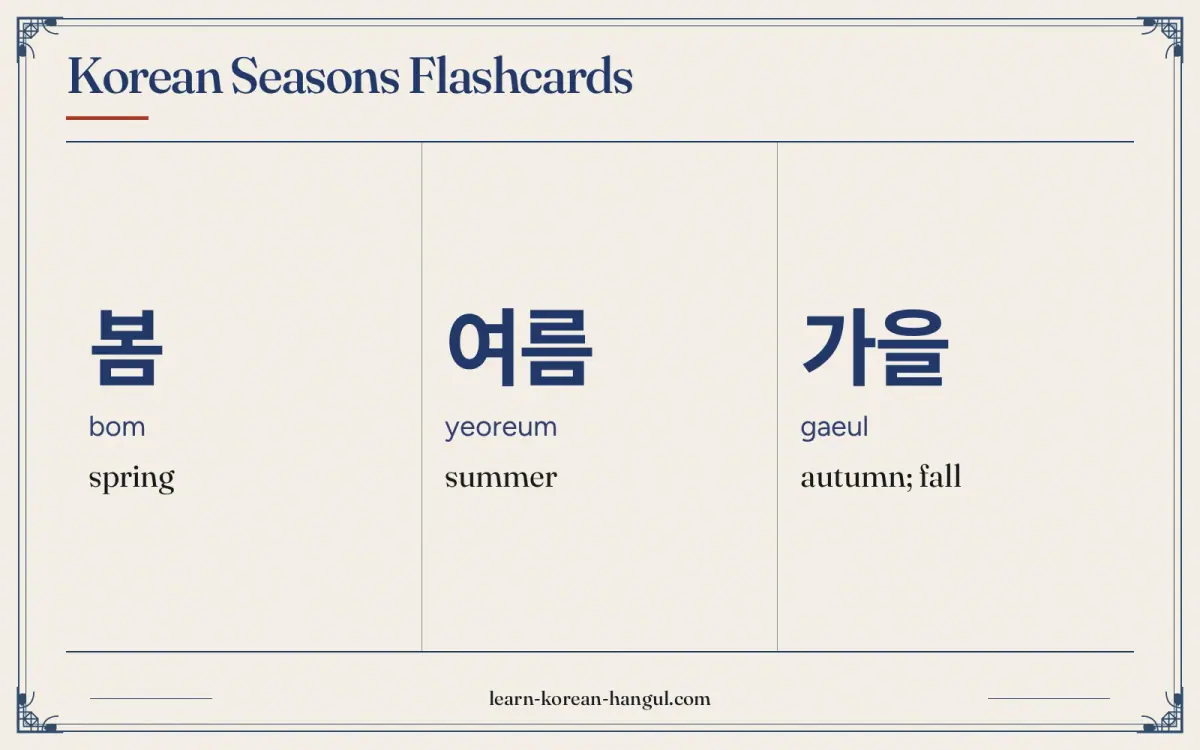
| 1 | 봄 | bom | spring | With 에 it means in spring. | au-pg-flashcards-seasons-1 |
| 2 | 여름 | yeoreum | summer | Said [여름] with a clear ㄹ; do not drop the second syllable. | au-pg-flashcards-seasons-2 |
| 3 | 가을 | gaeul | autumn; fall | Often paired with 하늘 (sky) in set expressions. | au-pg-flashcards-seasons-3 |
| 4 | 겨울 | gyeoul | winter | Not 거울 (mirror), which has a different first vowel. | au-pg-flashcards-seasons-4 |
| 5 | 사계절 | sagyejeol | four seasons | 사 is four. The 계 may be said [게], so [사게절] is also heard. | au-pg-flashcards-seasons-5; slow: au-pg-flashcards-seasons-29 |
| 6 | 계절 | gyejeol | season | The general word; it can name any of the four. | au-pg-flashcards-seasons-6 |
| 7 | 벚꽃 | beotkkot | cherry blossom | Said [벋꼳]. The sign of spring; 꽃 is flower. | au-pg-flashcards-seasons-7; slow: au-pg-flashcards-seasons-26 |
| 8 | 장마 | jangma | rainy season (early summer monsoon) | A spell of rain, not a fifth season. | au-pg-flashcards-seasons-8 |
| 9 | 단풍 | danpung | autumn leaves | Leaves turning red and yellow. | au-pg-flashcards-seasons-9 |
| 10 | 눈 | nun | snow | Same spelling as 눈 (eye); context decides. | au-pg-flashcards-seasons-10 |
| 11 | 첫눈 | cheonnun | first snow | Said [천눈]. 첫 means first. | au-pg-flashcards-seasons-11; slow: au-pg-flashcards-seasons-27 |
| 12 | 무더위 | mudeowi | sultry heat | Hot and humid summer weather. | au-pg-flashcards-seasons-12 |
| 13 | 딸기 | ttalgi | strawberry | A spring fruit in Korea. | au-pg-flashcards-seasons-13 |
| 14 | 수박 | subak | watermelon | A summer fruit. | au-pg-flashcards-seasons-14 |
| 15 | 감 | gam | persimmon | An autumn fruit. Also a syllable in 감기 (a cold). | au-pg-flashcards-seasons-15 |
| 16 | 호떡 | hotteok | hotteok (sweet filled pancake) | A winter street snack. | au-pg-flashcards-seasons-16 |
| 17 | 팥죽 | patjuk | red bean porridge | Said [팓쭉]. Eaten on 동지 (winter solstice). | au-pg-flashcards-seasons-17; slow: au-pg-flashcards-seasons-28 |
| 18 | 빙수 | bingsu | shaved ice dessert | Popular in hot weather. | au-pg-flashcards-seasons-18 |
| 19 | 반팔 | banpal | short sleeves | Literally half arm. | au-pg-flashcards-seasons-19 |
| 20 | 긴팔 | ginpal | long sleeves | Literally long arm. | au-pg-flashcards-seasons-20 |
| 21 | 샌들 | saendeul | sandals | Loanword. | au-pg-flashcards-seasons-21 |
| 22 | 패딩 | paeding | padded jacket | Loanword for a puffy winter coat. | au-pg-flashcards-seasons-22 |
| 23 | 목도리 | mokdori | scarf | Said [목또리]. 목 is neck. | au-pg-flashcards-seasons-23 |
| 24 | 장갑 | janggap | gloves | Used with 끼다 (to put on something that fits closely, such as gloves or a ring). | au-pg-flashcards-seasons-24 |
| 25 | 환절기 | hwanjeolgi | change of seasons | The shaky weeks between seasons. | au-pg-flashcards-seasons-25 |
Reading the Table
Hangul is the word. Revised Romanization (RR) is a learning aid, so try to read the Hangul before you look at it. RR follows the sound of the word, which is why some spellings change. The Meaning column gives the English gloss, and the Note column explains how the word is built or said, and which season it belongs to. The last column lists the audio assetId; a second ID marks a slow clip.
Usage Notes for These Cards
Seasons take 에 for "in". 봄에 꽃이 피어요 (Flowers bloom in spring). The pattern is season plus 에 plus a noun and a verb. When the season is the topic, use 은 or 는: 여름은 더워요 (Summer is hot).
Ask about preference. 좋아하는 계절이 뭐예요? (What is your favourite season?) is the usual question. Answer with 저는 가을을 좋아해요 (I like autumn).
방학 and 휴가 are different breaks. 방학 is the school or university break, while 휴가 is leave or vacation from work. You will hear 여름 방학 for students and 여름 휴가 for workers.
단풍 and 낙엽 are not the same. 단풍 means colourful autumn leaves and 낙엽 means fallen leaves: 단풍 구경을 가요 (We go to see autumn leaves).
A spring outing. 벚꽃 구경 (cherry blossom viewing) is a spring outing: 벚꽃 구경 가요. 첫눈, the first snow, has its own word because people mark the day.
Which Sounds Do Not Match the Spelling?
Several season words change sound when they are said, and some endings hide a final consonant.
- 벚꽃 is said [벋꼳]. The final ㅈ of 벚 is read as ㄷ, and 꽃 ends in a ㄷ sound too, so neither final is heard as spelled.
- 첫눈 is said [천눈]. The ㅅ of 첫 becomes ㄷ, and the ㄷ turns into ㄴ before the ㄴ of 눈.
- 팥죽 is said [팓쭉]. The ㅌ of 팥 is read as a closed ㄷ, and the ㅈ after it becomes tense ㅉ.
- 목도리 is said [목또리]. The ㄷ after the final ㄱ of 목 becomes tense ㄸ, the same rule as in 팥죽.
The pronunciations follow the 국립국어원 (National Institute of Korean Language) standard pronunciation rules (표준 발음법), and the romanization follows the Revised Romanization of Korean (2000).
What Mistakes Do Learners Make with Season Words?
- Mixing up 방학 and 휴가. 방학 is for school, and 휴가 is for work.
- Pronouncing 꽃 with a final ㅊ. It ends in a ㄷ sound, and 꽃이 is said [꼬치].
- Using 낙엽 for the season. 가을 is autumn, and 낙엽 only means fallen leaves.
- Mixing up 겨울 (winter) and 거울 (mirror). They differ by one vowel.
- Treating 장마 as a fifth season. It is a spell of rain inside the summer.
How Does the Review Schedule Work?
The deck uses a simplified Leitner system with five boxes. A new card starts in box 1. Each Got it moves it up one box, and each Not yet returns it to box 1. The box sets how long the card waits before it is due again.
| Box | Wait until the next review |
|---|---|
| 1 | same session or 10 minutes |
| 2 | 1 day |
| 3 | 3 days |
| 4 | 7 days |
| 5 | 21 days |
Each session shows due cards first, oldest due first, and then up to 10 new cards a day by default. A deck of 25 cards is introduced over three days at the default of 10 new cards a day, and the later boxes bring each card back at longer gaps. Progress is saved only in this browser, so clearing site data deletes it. Use the export button to save a small JSON file with card IDs, boxes and due dates, and import it on another device. No account is needed.
Cultural and Practical Context
Seasonal events such as cherry blossom viewing in spring and leaf viewing in autumn are well-loved outings, and the first snow of the year is a romantic motif in songs and dramas. Many families also link foods to the calendar, such as 팥죽 on the winter solstice.
Limits of This Deck
The deck has 25 cards, so it leaves out five lesson words: 절기 and the solar terms 입춘, 하지, 입추 and 동지. It teaches single words and not weather forecasts. The remarks on customs are general. The timing of 장마 varies by year and region, so the deck does not give dates. All Korean text is generated and was reviewed and signed off by Min-ji Park on 15 October 2026. The audio is generated with text-to-speech and is checked by a Korean teacher before publication, and listening mode uses only cards whose clips are approved.
Next Steps after This Deck
Continue with the korean flower names flashcards, or go back to the korean weather flashcards if a word here still feels shaky. Write the same words by hand with the korean nature vocabulary worksheet. The korean vocabulary flashcards page lists every other deck, and the korean flashcards hub lists all topics.
Frequently Asked Questions
Is 장마 a Season?
No. 장마 is the early-summer rainy period, a spell of rain inside the summer and not a fifth season. The word is common in the weather news. The four seasons are 봄, 여름, 가을 and 겨울, and 장마 sits inside 여름 in most years.
What Is 사계절?
It means the four seasons. The word is often used when people describe Korea's climate, as in 한국은 사계절이 있어요 (Korea has four seasons). 사 is four, and 계절 is season, so the word is easy to build when you know the other cards.
Do I Say 봄이 오다?
Yes. 봄이 오다 means that spring comes, and the same verb works for other seasons, as in 겨울이 오다 (winter comes). The season takes the subject marker 이 or 가 because it is the thing that comes, and the verb 오다 is the plain word for coming or arriving.
How Do I Say Last Summer or This Summer?
Use 지난여름 for last summer and 올여름 for this summer. Both are single words and do not take a space. The same pattern works for other seasons, as in 올겨울 (this winter). These forms are not cards, but they use words that are.
Is My Progress Saved If I Close the Page?
Yes, in the same browser on the same device. Card boxes and due dates are stored locally and nothing is sent to a server. Clearing site data, using a private window or switching browsers removes them, so use the export button to keep a backup file. No account is needed.