
Korean Weather Flashcards: Study the 29 Cards
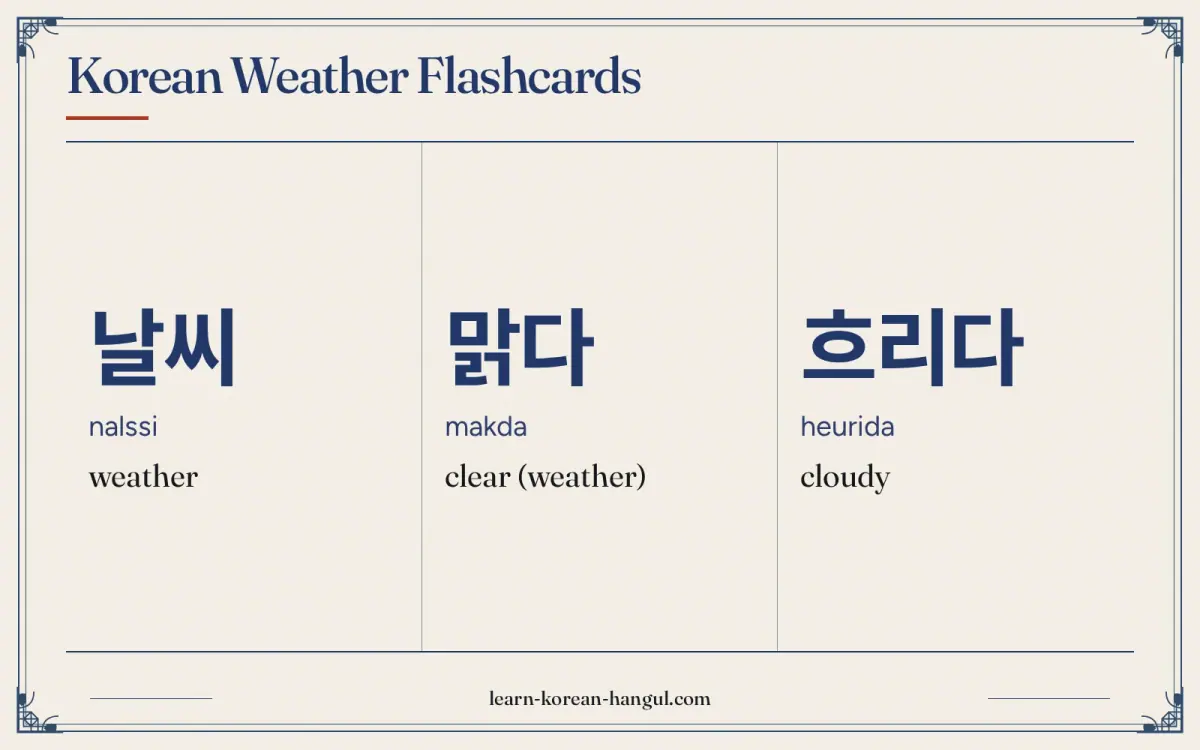
Weather is the classic opener in Korean small talk, and a forecast uses a small, steady set of words. The lesson behind this deck is Korean weather vocabulary, so read it first if a card is new.
How Do I Use These Flashcards?
Use the deck above in four steps. It works with tap, click or keyboard, and nothing plays until you press an audio button.
- Choose a mode. Start with recognition (Hangul to meaning). Switch to recall (meaning to Hangul) or listening (audio to meaning) once recognition feels easy.
- Show the answer. Think of the answer first, then press Show answer (or Space). Say the word aloud before you reveal it, and try a short sentence for the weather cards, such as 비가 와요. Turn on the romanization toggle only if you need it; the 29-card table below always shows it.
- Grade yourself. Press Got it if you answered correctly without help, or Not yet if you hesitated or guessed.
- Finish the session. A session holds up to 20 cards (you can set 10, 20 or 40). With 29 cards, a first-time learner can split the deck over three days, using the default limit of 10 new cards a day.
The Three Study Modes
Recognition shows the Hangul and asks for the meaning, which trains reading. Recall shows the meaning and asks for the Hangul, which trains remembering; you may type the answer with your Hangul keyboard or just recall it in your head. Listening plays a clip and hides the letters, which trains the ear. Listening mode only uses a card once its audio is approved, and cards without approved audio are skipped in that mode with a note.
Got It and Not Yet
Got it moves a card up one Leitner box, so it comes back later. Not yet sends the card back to box 1, so it returns in the same session or within 10 minutes. The grades are your own judgement; the deck does not score you or claim fluency.
Deck Scope: What Is and Is Not Covered
The deck covers 29 words in four groups: general weather words (날씨, 하늘, 해), precipitation and storms (비, 눈, 번개, 천둥, 태풍, 장마, 소나기, 무지개), the adjectives that describe a day (맑다, 흐리다, 덥다, 춥다, 따뜻하다, 시원하다, 습하다, 건조하다) and temperature and air-quality words (기온, 온도, 영하, 영상, 미세먼지, 황사). Verbs and adjectives appear in their dictionary form, ending in -다.
What Is Left out of This Deck?
The four seasons and seasonal events are in the Korean seasons flashcards. Animals and plants are in the Korean animals flashcards. Warnings, advisories and the longer list of weather terms are left to the Korean weather vocabulary lesson.
All 29 Cards in One Table
All 29 cards appear below in deck order. The table is plain HTML, so you can use it as a drill without the deck: cover the Meaning column, say each entry aloud, then uncover it.
| # | Hangul | Revised Romanization | Meaning | Note | Audio assetId |
|---|---|---|---|---|---|
| 1 | 날씨 | nalssi | weather | The general word; 날씨가 좋아요 means the weather is nice. | au-pg-flashcards-weather-1 |
| 2 | 맑다 | makda | clear (weather) | Said [막따]; 맑은 is said [말근]. | au-pg-flashcards-weather-2; slow: au-pg-flashcards-weather-30 |
| 3 | 흐리다 | heurida | cloudy | 날씨가 흐려요 means it is cloudy. | au-pg-flashcards-weather-3 |
| 4 | 비 | bi | rain | Pairs with 오다: 비가 와요. | au-pg-flashcards-weather-4 |
| 5 | 눈 | nun | snow | Same spelling as eye; 눈이 와요 means it snows. | au-pg-flashcards-weather-5 |
| 6 | 바람 | baram | wind | Pairs with 불다: 바람이 불어요. | au-pg-flashcards-weather-6 |
| 7 | 구름 | gureum | cloud | 구름이 많아요 means there are many clouds. | au-pg-flashcards-weather-7 |
| 8 | 안개 | angae | fog | 안개가 끼어요 means fog settles in. | au-pg-flashcards-weather-8 |
| 9 | 하늘 | haneul | sky | Also heaven in some set phrases. | au-pg-flashcards-weather-9 |
| 10 | 해 | hae | sun | Also means year; context decides. | au-pg-flashcards-weather-10 |
| 11 | 번개 | beongae | lightning | 번개가 쳐요 means lightning strikes. | au-pg-flashcards-weather-11 |
| 12 | 천둥 | cheondung | thunder | Often followed by 소리 (sound). | au-pg-flashcards-weather-12 |
| 13 | 태풍 | taepung | typhoon | Mostly in late summer. | au-pg-flashcards-weather-13 |
| 14 | 장마 | jangma | rainy season (monsoon) | Long summer rains; 장마철 is the season itself. | au-pg-flashcards-weather-14 |
| 15 | 소나기 | sonagi | sudden shower | Short, heavy and over quickly. | au-pg-flashcards-weather-15 |
| 16 | 무지개 | mujigae | rainbow | Appears after rain. | au-pg-flashcards-weather-16 |
| 17 | 우산 | usan | umbrella | Used with 쓰다: 우산을 써요. | au-pg-flashcards-weather-17; slow: au-pg-flashcards-weather-31 |
| 18 | 덥다 | deopda | hot (weather) | ㅂ-irregular: 더워요. | au-pg-flashcards-weather-18 |
| 19 | 춥다 | chupda | cold (weather) | ㅂ-irregular: 추워요. | au-pg-flashcards-weather-19 |
| 20 | 따뜻하다 | ttatteutada | warm | Said [따뜨타다]; the final ㅅ is read as ㄷ, which merges with ㅎ into ㅌ. | au-pg-flashcards-weather-20; slow: au-pg-flashcards-weather-32 |
| 21 | 시원하다 | siwonhada | cool, refreshing | Pleasantly cool; 춥다 is unpleasantly cold. | au-pg-flashcards-weather-21 |
| 22 | 습하다 | seupada | humid | Said [스파다]; ㅂ and ㅎ merge into ㅍ. | au-pg-flashcards-weather-22 |
| 23 | 건조하다 | geonjohada | dry | Used for air and skin. | au-pg-flashcards-weather-23 |
| 24 | 기온 | gion | air temperature | The word on weather reports. | au-pg-flashcards-weather-24 |
| 25 | 온도 | ondo | temperature | General word for any degree of heat. | au-pg-flashcards-weather-25 |
| 26 | 영하 | yeongha | below zero | Said before the number: 영하 오 도. | au-pg-flashcards-weather-26 |
| 27 | 영상 | yeongsang | above zero | Forecast term; also means video. | au-pg-flashcards-weather-27 |
| 28 | 미세먼지 | misemeonji | fine dust | Tiny particles in the air; very common in forecasts. | au-pg-flashcards-weather-28 |
| 29 | 황사 | hwangsa | yellow dust | Sand carried by wind, mostly in spring. | au-pg-flashcards-weather-29 |
Reading the Table
Hangul is the word. Revised Romanization (RR) is a learning aid, so read the Hangul first and check RR afterwards. RR for verbs and adjectives matches the verb dictionary on this site, so 덥다 is deopda. The Meaning column gives the English gloss, and the Note column gives a use or sound hint. The last column lists the audio assetId; a second ID marks a slow clip. Cards 2, 17 and 20 have slow clips because their final consonants change the sound.
Usage Notes for These Cards
Rain and snow use 오다, but wind uses 불다. The weather word is the subject and takes 이/가: 비가 와요 (It rains), 눈이 와요 (It snows), 바람이 불어요 (The wind blows). The verb 오다 means to come, so rain and snow literally come.
덥다 and 춥다 are ㅂ-irregular. The ㅂ turns into 우 before a vowel ending: 더워요 (It is hot) and 추워요 (It is cold). The dictionary forms are 덥다 and 춥다.
Say the weather is nice with 날씨가 좋아요 and ask about it with 날씨가 어때요? The question means How is the weather? The answer can be 맑아요 (It is clear) or 흐려요 (It is cloudy).
An umbrella is used with 쓰다. You hold an umbrella over your head, so the verb is 쓰다, the one for hats and glasses: 우산을 써요 (I use an umbrella).
Temperatures use 영하 and 영상, plus the counter 도. Say the sign first and then the number: 영하 오 도 (minus five degrees). Ask the temperature with 기온이 몇 도예요?
Which Sounds Do Not Match the Spelling?
맑다 is said [막따]. The cluster ㄺ is read as ㄱ before ㄷ, and the ㄷ becomes tense ㄸ. Before a vowel the full cluster appears, so 맑은 is said [말근].
따뜻하다 is said [따뜨타다]. The final ㅅ of 뜻 is pronounced as ㄷ, and it merges with the ㅎ of 하 into aspirated ㅌ.
습하다 is said [스파다]. The final ㅂ of 습 merges with the ㅎ of 하 into aspirated ㅍ.
What Mistakes Do Learners Make with Weather Words?
- Saying 비를 와요. Rain is the subject, so say 비가 와요.
- Using 입다 for an umbrella. Say 우산을 써요; 입다 is for clothes.
- Writing 덥어요 or 춥어요. The ㅂ-irregular forms are 더워요 and 추워요.
- Mixing up 눈 (snow) and 눈 (eye). The sentence tells you which one, as in 눈이 와요 (It snows) and 눈이 아파요 (My eyes hurt).
The ㅂ-irregular verbs cause most of the slips, so give cards 18 and 19 extra passes in recall mode.
How Does the Review Schedule Work?
The deck uses a simplified Leitner system with five boxes. A new card starts in box 1. Each Got it moves it up one box, and each Not yet returns it to box 1. The box sets how long the card waits before it is due again.
| Box | Wait until the next review |
|---|---|
| 1 | same session or 10 minutes |
| 2 | 1 day |
| 3 | 3 days |
| 4 | 7 days |
| 5 | 21 days |
Each session shows due cards first, oldest due first, and then up to 10 new cards a day by default. A deck of 29 cards is introduced over three days at the default of 10 new cards a day, and the later boxes bring each card back at longer gaps. Progress is saved only in this browser, so clearing site data deletes it. Use the export button to save a small JSON file with card IDs, boxes and due dates, and import it on another device. No account is needed.
Cultural and Practical Context
Fine dust (미세먼지) and yellow dust (황사) are part of Korean weather talk, and many people check a daily air-quality report alongside the forecast. A mask and an umbrella are common items to carry on a bad day.
Limits of This Deck
The deck holds 29 cards and shows each word on its own, so it does not teach the weather verbs in all their forms. 영상 is shown only as the forecast term for above zero. The fine-dust remark is general. All Korean text is generated and was reviewed and signed off by Min-ji Park on 15 October 2026. The audio is generated with text-to-speech and is checked by a Korean teacher before publication, and listening mode uses only cards whose clips are approved.
Next Steps after This Deck
After this deck, move on to the Korean seasons flashcards to keep the same routine. If a word here still feels shaky, go back to the Korean animals flashcards for earlier material, and write the words by hand with the Korean nature vocabulary worksheet. The Korean weather vocabulary lesson holds the longer list, the Korean vocabulary flashcards page lists every other deck, and the Korean flashcards hub lists all topics.
Frequently Asked Questions
Is 비가 내리다 Correct?
Yes. 비가 내리다 means rain falls, and it is slightly more written than 비가 오다. News reports and weather forecasts often say 비가 내리겠습니다 (It will rain). In everyday speech, 비가 와요 is the more natural choice.
What Is the Difference between 시원하다 and 춥다?
시원하다 means pleasantly cool, such as a breeze on a hot day or a cold drink. 춥다 means cold in an unpleasant way. A cool autumn morning can be 시원해요, but a freezing winter day is 추워요.
How Do I Say It Is Cloudy?
Say 흐려요 (It is cloudy) or 날씨가 흐려요 (The weather is cloudy). If you want to say there are many clouds, say 구름이 많아요. The noun form 흐림 is what you see on a forecast chart.
How Do I Ask the Temperature?
Ask 기온이 몇 도예요? (What is the temperature?). Answer with the number and the counter 도, such as 이십이 도예요 (It is 22 degrees). Below zero, put 영하 first: 영하 오 도예요 (It is minus 5 degrees).
Is My Progress Saved If I Close the Page?
Yes, in the same browser on the same device. Card boxes and due dates are stored locally and nothing is sent to a server. Clearing site data, using a private window or switching browsers removes them, so use the export button to keep a backup file. No account is needed.