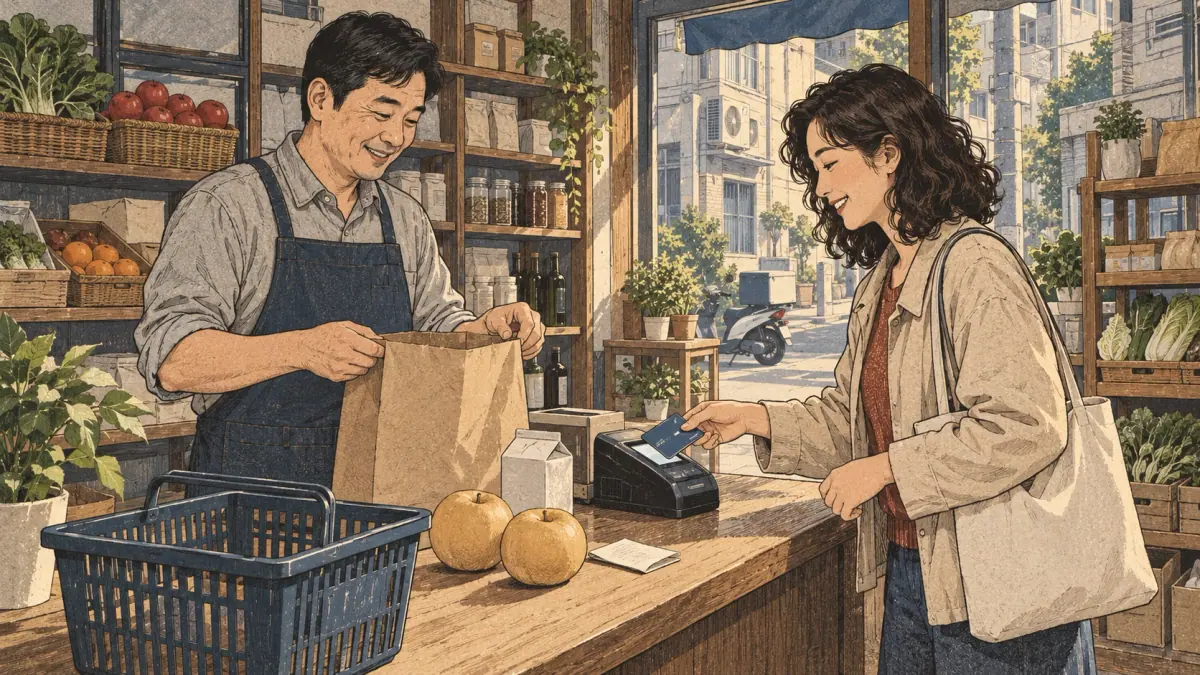
Korean Shopping Vocabulary at a Glance
Shopping in Korea mixes old and new places: a neighborhood 시장 (market), a big 백화점 (department store), the 24-hour 편의점 (convenience store) and online shops that deliver the next day. Most of the words you need are nouns, and you can use them with only three tiny frames: the noun alone, the noun plus 주세요 (please give me), and the noun plus 얼마예요? (how much is it?). This page teaches those nouns in the order you meet them in a real trip.
By origin, the 45 words are 5 native Korean, 28 Sino-Korean (built from Chinese-derived syllables), 10 loanwords and 2 mixed. The high Sino-Korean share is typical of commerce: syllables such as 품 (goods) in 반품 and 품절 recur across many shop words. The groups are:
| Group | Words | Examples |
|---|---|---|
| Shops and stores | 10 | 가게, 시장, 마트, 백화점 |
| Prices and discounts | 10 | 가격, 값, 세일, 할인 |
| Paying | 9 | 계산, 계산대, 결제, 카드 |
| Returns and receipts | 8 | 영수증, 환불, 교환, 반품 |
| Online shopping | 8 | 온라인, 쇼핑, 장바구니, 주문 |
Two details are worth knowing now. First, payment words such as 현금, 할인 and 영수증 are Sino-Korean, while 카드, 쿠폰 and 포인트 come from English. Second, the words for price, 가격 and 값, mean almost the same thing, and the price section shows when each is used. This list sits inside Daily Life, where you can find the related topics.
Which Shopping Words Should You Learn First?
Start with five words that you will use on your first shopping trip: 봉투, 카드, 현금, 할인 and 영수증. Press play, then the slow button, and say each one aloud.
봉투 (bongtu) means envelope or bag. The same word means an envelope for a letter and a bag at the till. At a shop, 봉투 필요하세요? means "Do you need a bag?" because many stores charge for bags. For a letter, say 편지 봉투. Example: 봉투 필요하세요? (Do you need a bag?)
카드 (kadeu) means card. It is a loanword, and it covers any card: a credit card, a debit card or a membership card. The sound is ka-deu, two syllables: keep the final ㅡ instead of saying English "card". Example: 카드로 계산할게요. (I will pay by card.)
현금 (hyeongeum) means cash. 현금만 받아요 (we take cash only) is a sign you may see at a market stall. Its pair is 카드, and a cashier may ask 카드세요, 현금이세요? (Card or cash?). Example: 현금만 받아요. (We take cash only.)
할인 (harin) means discount. It is the general word, seen on price tags and in app banners, often with a percentage, as in 20% 할인. In speech the ㄹ moves onto the next syllable, so it sounds like [하린]. Example: 학생은 할인이 돼요. (Students get a discount.)
영수증 (yeongsujeung) means receipt. You need it for returns and expense claims. Cashiers often ask 영수증 드릴까요? (Would you like the receipt?), and you can answer 네, 주세요 or 아니요, 괜찮아요. Example: 영수증 주세요. (Please give me the receipt.)
Shops and Stores
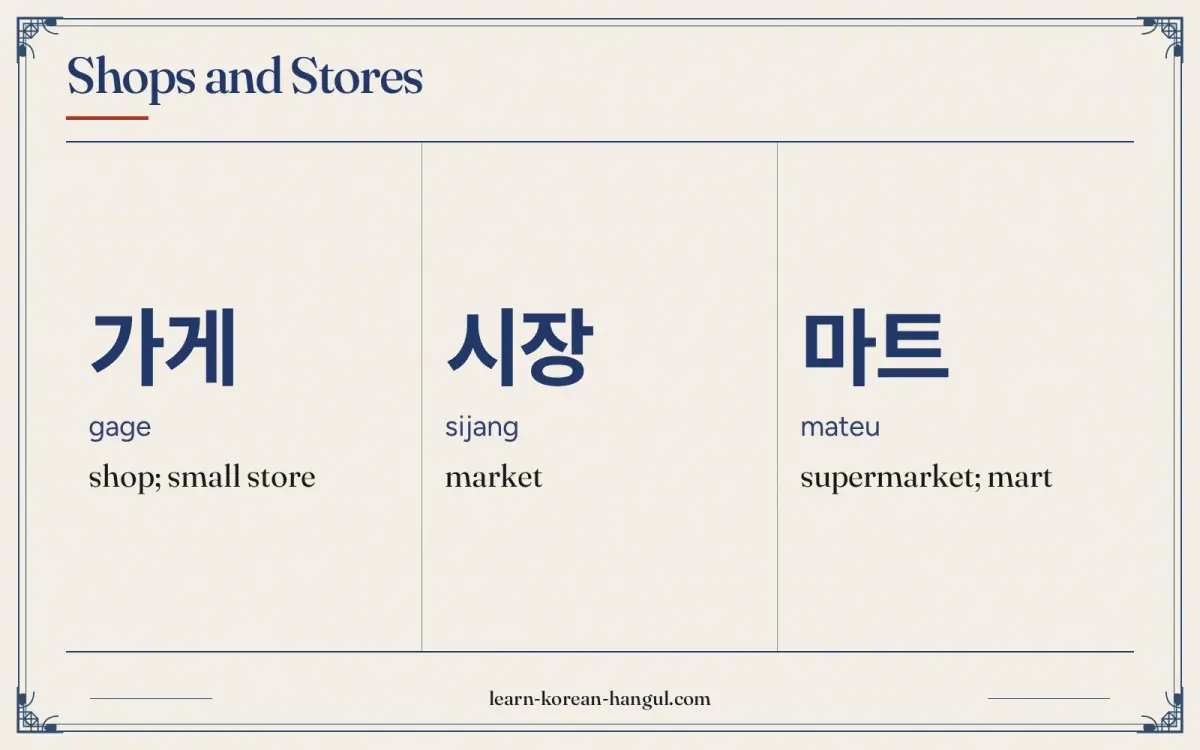
This group names the places and the people. Korean has several words for a shop, and they differ in size and feel, so the table gives the plain meaning and the notes give the difference.
| No. | Hangul | Revised Romanization | Meaning | Origin | Example sentence | Audio assetId |
|---|---|---|---|---|---|---|
| 1 | 가게 | gage | shop; small store | native | 가게가 일곱 시에 문을 닫아요. (gagega ilgop sie muneul dadayo; The shop closes at seven.) | au-pg-vocabulary-daily-life-shopping-1; example: au-pg-vocabulary-daily-life-shopping-101 |
| 2 | 시장 | sijang | market | Sino-Korean | 시장에서 채소를 사요. (sijangeseo chaesoreul sayo; I buy vegetables at the market.) | au-pg-vocabulary-daily-life-shopping-2; example: au-pg-vocabulary-daily-life-shopping-102 |
| 3 | 마트 | mateu | supermarket; mart | loanword | 마트에서 우유를 사요. (mateueseo uyureul sayo; I buy milk at the supermarket.) | au-pg-vocabulary-daily-life-shopping-3; example: au-pg-vocabulary-daily-life-shopping-103 |
| 4 | 백화점 | baekhwajeom | department store | Sino-Korean | 백화점은 열 시에 열어요. (baekhwajeomeun yeol sie yeoreoyo; The department store opens at ten.) | au-pg-vocabulary-daily-life-shopping-4; example: au-pg-vocabulary-daily-life-shopping-104 |
| 5 | 편의점 | pyeonuijeom | convenience store | Sino-Korean | 편의점이 집 앞에 있어요. (pyeonuijeomi jip ape isseoyo; There is a convenience store in front of my house.) | au-pg-vocabulary-daily-life-shopping-5; example: au-pg-vocabulary-daily-life-shopping-105 |
| 6 | 쇼핑몰 | syopingmol | shopping mall | loanword | 주말에 쇼핑몰에 가요. (jumare syopingmore gayo; I go to the shopping mall on weekends.) | au-pg-vocabulary-daily-life-shopping-6; example: au-pg-vocabulary-daily-life-shopping-106 |
| 7 | 매장 | maejang | store; shop floor | Sino-Korean | 이 매장은 옷을 팔아요. (i maejangeun oseul parayo; This store sells clothes.) | au-pg-vocabulary-daily-life-shopping-7; example: au-pg-vocabulary-daily-life-shopping-107 |
| 8 | 손님 | sonnim | customer; guest | native | 손님이 많아요. (sonnimi manayo; There are many customers.) | au-pg-vocabulary-daily-life-shopping-8; example: au-pg-vocabulary-daily-life-shopping-108 |
| 9 | 점원 | jeomwon | shop assistant | Sino-Korean | 점원이 친절해요. (jeomwoni chinjeolhaeyo; The shop assistant is kind.) | au-pg-vocabulary-daily-life-shopping-9; example: au-pg-vocabulary-daily-life-shopping-109 |
| 10 | 주인 | juin | owner | Sino-Korean | 가게 주인은 할머니예요. (gage juineun halmeoniyeyo; The owner of the shop is an elderly woman.) | au-pg-vocabulary-daily-life-shopping-10; example: au-pg-vocabulary-daily-life-shopping-110 |
- 가게 is the everyday word for a small shop, such as a corner store or a stall. 마트 is bigger and sells groceries, and 백화점 sells many brands in one building.
- 매장 is the word in company language: a brand's 매장 is one of its stores, and 매장 안내 is the floor guide. 손님 also means a guest at your home, so the context tells you which one is meant.
- For deeper lists, see Korean Supermarket Vocabulary, Korean Convenience Store Vocabulary and Korean Traditional Market Vocabulary.
Example Sentences
Three sentence frames cover most shopping. Say the noun plus 주세요 to ask for something: 영수증 주세요 (Please give me the receipt) and 봉투 주세요 (A bag, please). Say the noun plus 얼마예요? to ask a price: 이거 얼마예요? (How much is this?). Say the noun plus 있어요? to ask whether a shop has it: 큰 사이즈 있어요? (Do you have a bigger size?). Add a number from prices and money to understand the answer. For whole phrases for the till and the fitting room, open shopping phrases; the single-word page shopping in korean covers the word 쇼핑 by itself.
How Do You Say Prices and Discounts in Korean?
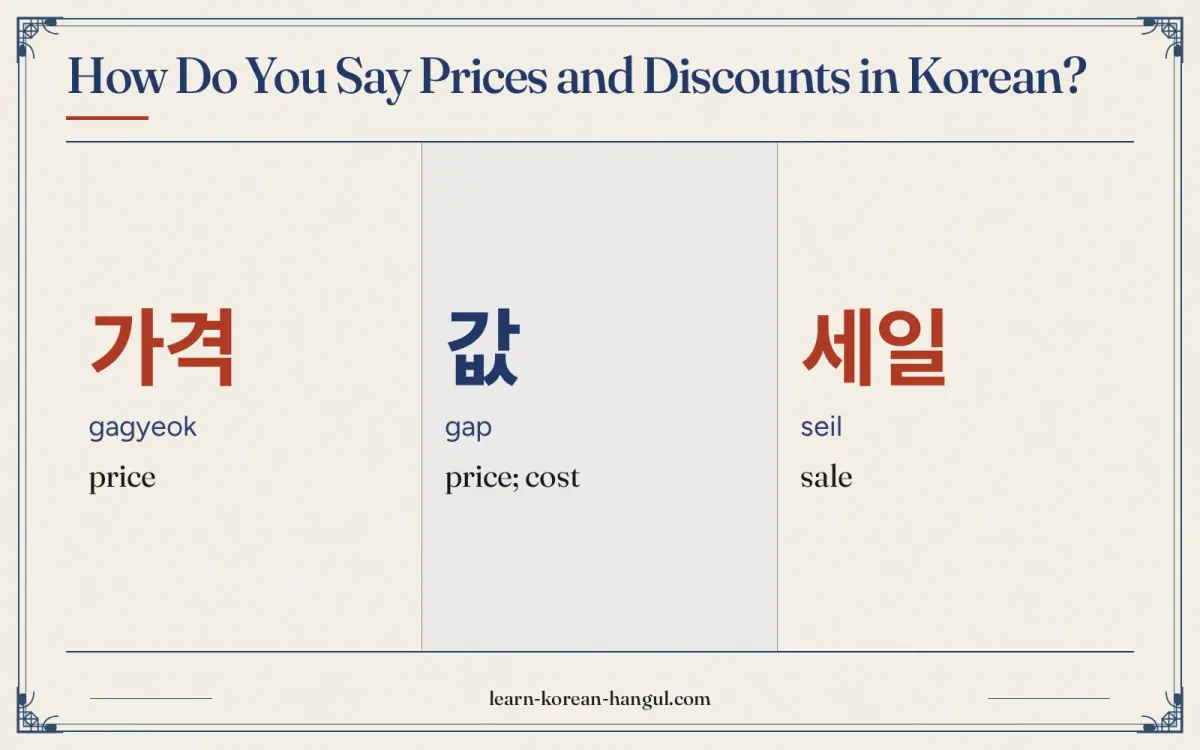
Signs and tags use short nouns, not full sentences. Knowing these ten words lets you read most price boards.
| No. | Hangul | Revised Romanization | Meaning | Origin | Example sentence | Audio assetId |
|---|---|---|---|---|---|---|
| 11 | 가격 | gagyeok | price | Sino-Korean | 가격이 얼마예요? (gagyeogi eolmayeyo; What is the price?) | au-pg-vocabulary-daily-life-shopping-11; example: au-pg-vocabulary-daily-life-shopping-111 |
| 12 | 값 | gap | price; cost | native | 값이 싸요. (gapsi ssayo; The price is cheap.) | au-pg-vocabulary-daily-life-shopping-12; example: au-pg-vocabulary-daily-life-shopping-112 |
| 13 | 세일 | seil | sale | loanword | 이번 주에 세일해요. (ibeon jue seilhaeyo; There is a sale this week.) | au-pg-vocabulary-daily-life-shopping-13; example: au-pg-vocabulary-daily-life-shopping-113 |
| 14 | 할인 | harin | discount | Sino-Korean | 학생은 할인이 돼요. (haksaengeun harini dwaeyo; Students get a discount.) | au-pg-vocabulary-daily-life-shopping-14; example: au-pg-vocabulary-daily-life-shopping-114 |
| 15 | 행사 | haengsa | event; promotion | Sino-Korean | 오늘은 할인 행사를 해요. (oneureun harin haengsareul haeyo; There is a discount event today.) | au-pg-vocabulary-daily-life-shopping-15; example: au-pg-vocabulary-daily-life-shopping-115 |
| 16 | 원 플러스 원 | won peulleoseu won | buy one, get one free | loanword | 원 플러스 원 행사 중이에요. (won peulleoseu won haengsa jungieyo; A buy-one-get-one offer is on.) | au-pg-vocabulary-daily-life-shopping-16; example: au-pg-vocabulary-daily-life-shopping-116 |
| 17 | 쿠폰 | kupon | coupon | loanword | 쿠폰을 사용해요. (kuponeul sayonghaeyo; I use a coupon.) | au-pg-vocabulary-daily-life-shopping-17; example: au-pg-vocabulary-daily-life-shopping-117 |
| 18 | 포인트 | pointeu | points | loanword | 포인트가 쌓여요. (pointeuga ssayeoyo; Points build up.) | au-pg-vocabulary-daily-life-shopping-18; example: au-pg-vocabulary-daily-life-shopping-118 |
| 19 | 무료 | muryo | free of charge | Sino-Korean | 배송은 무료예요. (baesongeun muryoyeyo; Delivery is free.) | au-pg-vocabulary-daily-life-shopping-19; example: au-pg-vocabulary-daily-life-shopping-119 |
| 20 | 특가 | teukga | special price | Sino-Korean | 오늘만 특가예요. (oneulman teukgayeyo; It is a special price today only.) | au-pg-vocabulary-daily-life-shopping-20; example: au-pg-vocabulary-daily-life-shopping-120 |
- 가격 is the neutral word, used in speech and on labels and notices. 값 is the native word and often joins another noun: 책값 (the price of a book), 밥값 (the cost of a meal).
- 세일, 할인 and 행사 overlap. 세일 is the English-based word on big signs, 할인 is a lowering of the price, and 행사 is the whole promotion event.
- At convenience stores, the signs 1+1 and 2+1 are read 원 플러스 원 and 투 플러스 원: buy one and get one free, or buy two and get one free.
Paying
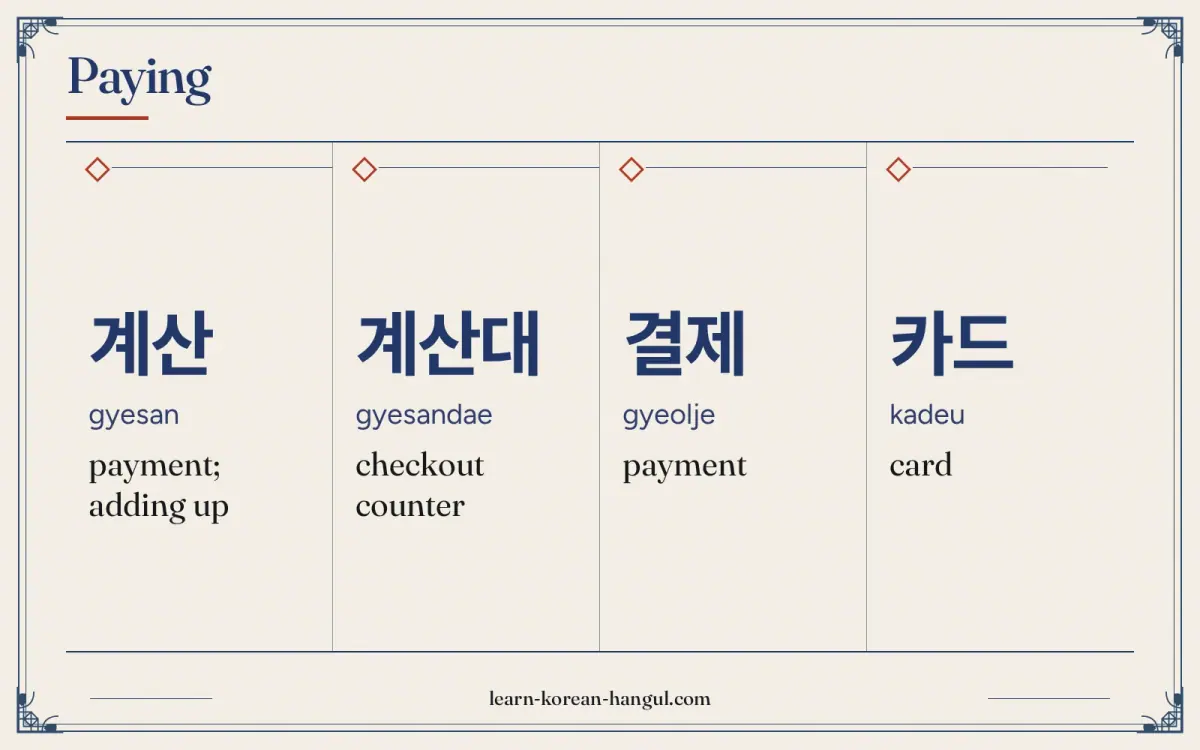
Paying has its own small group of words: the place, the method and what comes back to you.
| No. | Hangul | Revised Romanization | Meaning | Origin | Example sentence | Audio assetId |
|---|---|---|---|---|---|---|
| 21 | 계산 | gyesan | payment; adding up | Sino-Korean | 계산은 저기에서 해요. (gyesaneun jeogieseo haeyo; You pay over there.) | au-pg-vocabulary-daily-life-shopping-21; example: au-pg-vocabulary-daily-life-shopping-121 |
| 22 | 계산대 | gyesandae | checkout counter | Sino-Korean | 계산대 앞에 줄이 있어요. (gyesandae ape juri isseoyo; There is a line in front of the checkout.) | au-pg-vocabulary-daily-life-shopping-22; example: au-pg-vocabulary-daily-life-shopping-122 |
| 23 | 결제 | gyeolje | payment | Sino-Korean | 결제는 카드로 해요. (gyeoljeneun kadeuro haeyo; I pay by card.) | au-pg-vocabulary-daily-life-shopping-23; example: au-pg-vocabulary-daily-life-shopping-123 |
| 24 | 카드 | kadeu | card | loanword | 카드로 계산할게요. (kadeuro gyesanhalgeyo; I will pay by card.) | au-pg-vocabulary-daily-life-shopping-24; example: au-pg-vocabulary-daily-life-shopping-124 |
| 25 | 현금 | hyeongeum | cash | Sino-Korean | 현금만 받아요. (hyeongeumman badayo; We take cash only.) | au-pg-vocabulary-daily-life-shopping-25; example: au-pg-vocabulary-daily-life-shopping-125 |
| 26 | 신용카드 | sinyongkadeu | credit card | mixed | 신용카드를 써요. (sinyongkadeureul sseoyo; I use a credit card.) | au-pg-vocabulary-daily-life-shopping-26; example: au-pg-vocabulary-daily-life-shopping-126 |
| 27 | 거스름돈 | geoseureumdon | change (money returned) | native | 거스름돈을 받았어요. (geoseureumdoneul badasseoyo; I received my change.) | au-pg-vocabulary-daily-life-shopping-27; example: au-pg-vocabulary-daily-life-shopping-127 |
| 28 | 잔돈 | jandon | small change | native | 잔돈이 없어요. (jandoni eopseoyo; I have no small change.) | au-pg-vocabulary-daily-life-shopping-28; example: au-pg-vocabulary-daily-life-shopping-128 |
| 29 | 봉투 | bongtu | envelope; bag | Sino-Korean | 봉투 필요하세요? (bongtu piryohaseyo; Do you need a bag?) | au-pg-vocabulary-daily-life-shopping-29; example: au-pg-vocabulary-daily-life-shopping-129 |
- 계산 and 결제 both mean paying, but 계산 is what you say aloud at the till (계산해 주세요, please ring it up), and 결제 appears on screens and apps.
- The particle 로 after a method means "by": 카드로 (by card), 현금으로 (in cash). It is a small word with a big use.
- 거스름돈 is the money handed back to you after paying. 잔돈 is small coins and notes, and in casual speech it also means the change you get back: 잔돈 여기 있어요 (Here is your change).
How Do You Say Returns and Receipts in Korean?
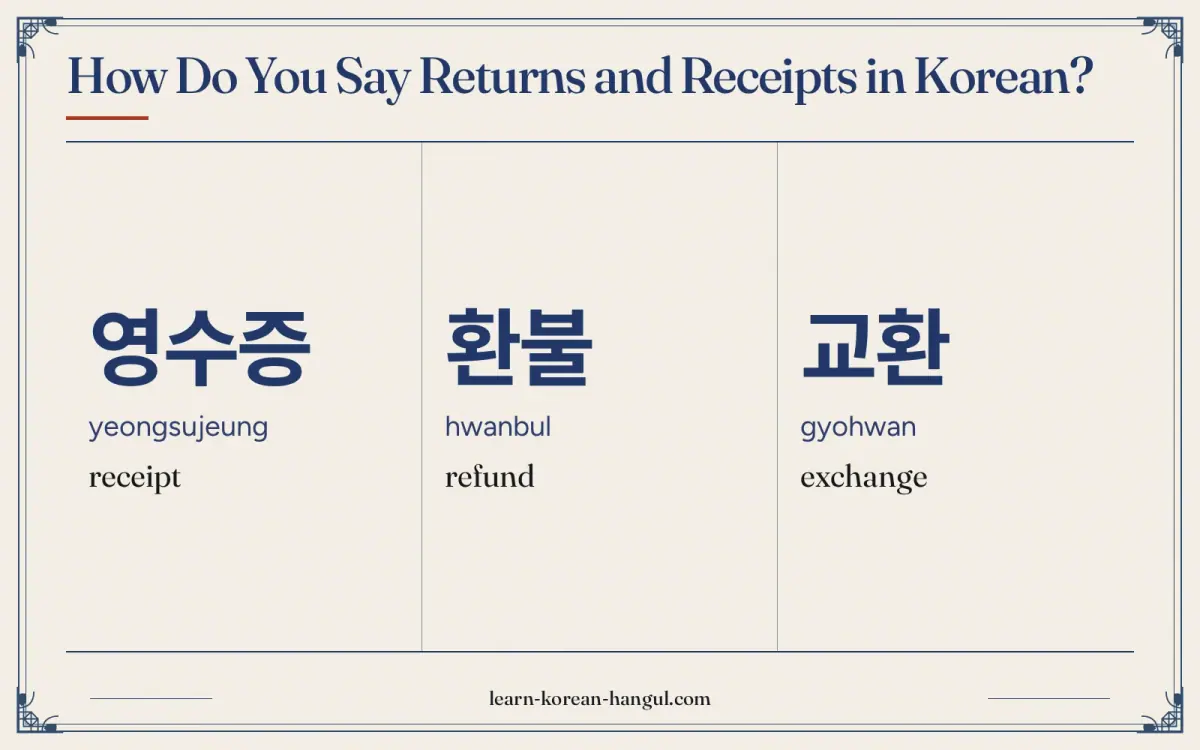
When something does not fit or does not work, four words matter: 영수증, 환불, 교환 and 반품. They are easy to mix up, so the notes separate them.
| No. | Hangul | Revised Romanization | Meaning | Origin | Example sentence | Audio assetId |
|---|---|---|---|---|---|---|
| 30 | 영수증 | yeongsujeung | receipt | Sino-Korean | 영수증 주세요. (yeongsujeung juseyo; Please give me the receipt.) | au-pg-vocabulary-daily-life-shopping-30; example: au-pg-vocabulary-daily-life-shopping-130 |
| 31 | 환불 | hwanbul | refund | Sino-Korean | 환불하고 싶어요. (hwanbulhago sipeoyo; I would like a refund.) | au-pg-vocabulary-daily-life-shopping-31; example: au-pg-vocabulary-daily-life-shopping-131 |
| 32 | 교환 | gyohwan | exchange | Sino-Korean | 사이즈를 교환하고 싶어요. (saijeureul gyohwanhago sipeoyo; I would like to exchange it for another size.) | au-pg-vocabulary-daily-life-shopping-32; example: au-pg-vocabulary-daily-life-shopping-132 |
| 33 | 반품 | banpum | returning goods | Sino-Korean | 반품은 일주일 안에 돼요. (banpumeun iljuil ane dwaeyo; Returns are possible within a week.) | au-pg-vocabulary-daily-life-shopping-33; example: au-pg-vocabulary-daily-life-shopping-133 |
| 34 | 사이즈 | saijeu | size | loanword | 사이즈가 커요. (saijeuga keoyo; The size is big.) | au-pg-vocabulary-daily-life-shopping-34; example: au-pg-vocabulary-daily-life-shopping-134 |
| 35 | 품절 | pumjeol | sold out | Sino-Korean | 이 색은 품절이에요. (i saegeun pumjeorieyo; This color is sold out.) | au-pg-vocabulary-daily-life-shopping-35; example: au-pg-vocabulary-daily-life-shopping-135 |
| 36 | 재고 | jaego | stock; inventory | Sino-Korean | 재고가 있어요? (jaegoga isseoyo; Do you have it in stock?) | au-pg-vocabulary-daily-life-shopping-36; example: au-pg-vocabulary-daily-life-shopping-136 |
| 37 | 구매 | gumae | purchase | Sino-Korean | 구매 날짜가 영수증에 있어요. (gumae naljjaga yeongsujeunge isseoyo; The purchase date is on the receipt.) | au-pg-vocabulary-daily-life-shopping-37; example: au-pg-vocabulary-daily-life-shopping-137 |
- 환불 means getting your money back. 교환 means swapping for another item. 반품 is the act of sending goods back, and it is the word on online return forms.
- 사이즈 is the usual word for clothes and shoes sizes. 크기 (keugi) is the general word for how big something is.
- 품절 is the written word on signs and websites. In speech, staff often say 다 팔렸어요 (it has all sold).
Online Shopping
Online shopping has its own vocabulary, and a few words come from English. These eight appear on most Korean shopping apps.
| No. | Hangul | Revised Romanization | Meaning | Origin | Example sentence | Audio assetId |
|---|---|---|---|---|---|---|
| 38 | 온라인 | ollain | online | loanword | 온라인으로 옷을 사요. (ollaineuro oseul sayo; I buy clothes online.) | au-pg-vocabulary-daily-life-shopping-38; example: au-pg-vocabulary-daily-life-shopping-138 |
| 39 | 쇼핑 | syoping | shopping | loanword | 주말에 쇼핑해요. (jumare syopinghaeyo; I go shopping on weekends.) | au-pg-vocabulary-daily-life-shopping-39; example: au-pg-vocabulary-daily-life-shopping-139 |
| 40 | 장바구니 | jangbaguni | shopping basket | mixed | 장바구니에 넣었어요. (jangbagunie neoeosseoyo; I put it in the basket.) | au-pg-vocabulary-daily-life-shopping-40; example: au-pg-vocabulary-daily-life-shopping-140 |
| 41 | 주문 | jumun | order | Sino-Korean | 어제 주문했어요. (eoje jumunhaesseoyo; I ordered yesterday.) | au-pg-vocabulary-daily-life-shopping-41; example: au-pg-vocabulary-daily-life-shopping-141 |
| 42 | 배송 | baesong | delivery | Sino-Korean | 배송은 이틀 걸려요. (baesongeun iteul geollyeoyo; Delivery takes two days.) | au-pg-vocabulary-daily-life-shopping-42; example: au-pg-vocabulary-daily-life-shopping-142 |
| 43 | 택배 | taekbae | parcel delivery | Sino-Korean | 택배가 왔어요. (taekbaega wasseoyo; A parcel has arrived.) | au-pg-vocabulary-daily-life-shopping-43; example: au-pg-vocabulary-daily-life-shopping-143 |
| 44 | 배송비 | baesongbi | shipping fee | Sino-Korean | 배송비는 삼천 원이에요. (baesongbineun samcheon wonieyo; The shipping fee is 3,000 won.) | au-pg-vocabulary-daily-life-shopping-44; example: au-pg-vocabulary-daily-life-shopping-144 |
| 45 | 후기 | hugi | review (written after use) | Sino-Korean | 후기를 읽고 샀어요. (hugireul ilgo sasseoyo; I read the reviews and bought it.) | au-pg-vocabulary-daily-life-shopping-45; example: au-pg-vocabulary-daily-life-shopping-145 |
- 장바구니 means a shopping basket both in a real shop and on a website. The word joins 장 (market), 바구니 (basket).
- 배송 is the process of sending goods and 택배 is the courier service or the parcel itself. A parcel at your door is 택배, and tracking its progress is 배송 조회.
- 후기 is a review based on your own experience of a product or place. The loanword 리뷰 is also common, especially for app and delivery ratings, and 사용 후기 means a user review.
How Do You Pronounce These Words?
Most shopping words are said as written, but five show sound changes that learners often miss. The rules come from the Standard Pronunciation Rules (표준 발음법) published by the National Institute of Korean Language (국립국어원).
| Word | Romanization | Said | Rule |
|---|---|---|---|
| 백화점 | baekhwajeom | [배콰점] | ㄱ and ㅎ join into one aspirated sound ㅋ |
| 할인 | harin | [하린] | final ㄹ moves onto the empty ㅇ of the next syllable |
| 택배 | taekbae | [택빼] | ㅂ after ㄱ becomes tense |
| 값 | gap | [갑] | the final cluster ㅂㅅ is said as ㅂ |
| 결제 | gyeolje | [결쩨] | in Sino-Korean words, ㅈ after ㄹ becomes tense (Article 26) |
Revised Romanization is the official romanization system of South Korea, announced on 7 July 2000. It follows most sound changes, such as liaison in 할인 (harin), but it does not show tensing caused by a neighbouring sound, so it is only a learning aid. Always read the Hangul as well.
Audio and Slow Playback
Each headword and each example sentence has its own audio clip, and the 5 words in the first-words section also have a slow clip at 0.8 times the speed. Nothing plays until you press a button. Listen once, repeat aloud, and only then check the romanization.
What Mistakes Do Learners Make with Shopping Words?
- Mixing up 환불, 교환 and 반품. Say 환불 for money back, 교환 for a swap and 반품 for sending an item back.
- Reading 봉투 only as "envelope". At a till it means a bag, and you hear it in the question 봉투 필요하세요?
- Using 쇼핑 alone as a verb. Add 하다: 쇼핑해요 (I go shopping), or say 쇼핑하러 가요 (I am going shopping).
- Saying 카드 as one syllable, like English "card". The Korean word is ka-deu, with a light ㄷ and a flat ㅡ.
- Forgetting 로 with the payment method. Say 카드로 (by card) or 현금으로 (in cash), not 카드를 for "by card".
Practice: Flashcards and Worksheet
Drill these 45 words with the vocabulary flashcard decks: each card shows the Hangul on one side and the meaning on the other, so you can test recall instead of recognition. Print a labelling sheet from the vocabulary worksheets and write the Korean word for each numbered object in the scene above. A simple plan is to learn 8 to 10 words a day: read the table, press play, say the word, cover the English, then write one sentence of your own. Come back after a day and again after a week.
Self-Test: 10 Sentences
Fill each blank with a word from this page. Say the whole sentence aloud when you have it. The answers follow the test.
- ___가 일곱 시에 문을 닫아요. (The shop closes at seven.)
- ___이 집 앞에 있어요. (There is a convenience store in front of my house.)
- ___이 친절해요. (The shop assistant is kind.)
- 이번 주에 ___해요. (There is a sale this week.)
- ___을 사용해요. (I use a coupon.)
- ___은 저기에서 해요. (You pay over there.)
- ___만 받아요. (We take cash only.)
- ___ 필요하세요? (Do you need a bag?)
- ___은 일주일 안에 돼요. (Returns are possible within a week.)
- ___ 날짜가 영수증에 있어요. (The purchase date is on the receipt.)
Answers: 1. 가게; 2. 편의점; 3. 점원; 4. 세일; 5. 쿠폰; 6. 계산; 7. 현금; 8. 봉투; 9. 반품; 10. 구매.
A score of 8 or more suggests the words are settling in. If you scored lower, reread the groups where you missed words.
Where to Go Next
After shopping, many learners move on to Money and Banking or go back to Daily Routines. To use these nouns in whole sentences, open the shopping phrases linked above.
Pages in This Section
- Korean Supermarket Vocabulary: 35 words for aisle signs such as 정육 (meat section), package units, the two expiry dates 유통기한 and 소비기한, and points at the checkout.
- Korean Convenience Store Vocabulary: 35 words for triangle rice balls and cup noodles, asking to heat food, parcel and transit-card services, and 1+1 deal stickers.
- Korean Traditional Market Vocabulary: stalls, vendors, bargaining and market foods.
FAQ
How Do You Say Envelope in Korean?
Say 봉투 (bongtu) for an envelope. At a shop till, the same word means a bag, as in 봉투 주세요 (A bag, please), and cashiers ask 봉투 필요하세요? because bags usually cost extra. For a letter envelope you can also say 편지 봉투 (pyeonji bongtu).
How Do You Pronounce 카드 (kadeu)?
카드 is read ka-deu, in two even syllables. ㅋ is a k with a strong puff of air, ㄷ is a light d, and ㅡ is said with the lips spread, not rounded. Keep that final vowel, because dropping it turns the word into English "card", which Korean listeners may not catch.
How Many Shopping Words Should I Learn First?
Learn the 29 words in the first three groups (shops, prices and paying) first; at 8 to 10 new words a day that takes about three days. Then add the 16 returns and online words. The five starter words (봉투, 카드, 현금, 할인, 영수증) already get you through a simple purchase.
Where Can I Practise Shopping Words with Flashcards?
Use the vocabulary flashcard decks. Start with the first 10 words of this page, then add about 10 more each day. Review the older cards before you add new ones, so the earlier words do not fade, and say each word aloud after its audio clip.
Is the Romanization on This Page Official?
Yes, as a learning aid. It follows the Revised Romanization of Korean, the official system in South Korea since 7 July 2000. It follows most sound changes but does not show tensing caused by a neighbouring sound, so 택배 is taekbae though said [택빼]. In nouns it also keeps the h after ㄱ: 백화점 is baekhwajeom, said [배콰점]. Treat the Hangul as the real spelling.
Is There a Printable Worksheet for Shopping Words?
The vocabulary worksheets page lists the printable sheets. The sheet for this topic is a labelling task built on the same illustrated scene as this page, so you write the Korean word next to each numbered object.