Key Facts about Korean Ring Sizing
Korean ring sizing involves both measurements and source-specific labels. Ring inner diameter crosses the opening; ring inner circumference follows that opening; measured finger circumference concerns the finger. A seller's table can publish all three without making them numerically interchangeable.
For a circular ring, inner circumference equalsπtimes inner diameter. The NIST length definition gives one inch as exactly 25.4 mm. Those facts support geometry and unit conversion, not a universal Korean label equation.
A calibrated print or screen requires a physical reference. Browser pixels, screen resolution and aCSS inch do not establish physical scale. A ring label also needs its named seller, table and product scope. These distinctions are the starting point for using the converter.
How Do I Convert Korean Ring Size to US?

Korean ring size to US conversion starts by identifying the number you know and the source that gives it meaning. A seller label requires its table. An inner measurement supports geometry, while an international equivalent needs a compatible source profile. The tool preserves missing fields instead of fabricating aUS label.
Step 1: Identify the Number You Actually Know
Choose ring inner diameter, ring inner circumference, measured finger circumference or known seller label. Enter the value withmm,cmorinwhere appropriate. The checkpoint is a result naming the same quantity. A finger reading must not become a ring interior dimension merely because both are in millimeters.
Step 2: Select the Seller and Gauge
Select the exact source profile for a known label. Preserve product, table identity, source date and old or new gauge description. The checkpoint is a visible source name. An anonymous “Korean 13” cannot establish which convention a seller intended.
Step 3: Read the Matching and Nearby Sizes
Read the exact source row or the two surrounding candidates. A midpoint tie keeps both labels. A value outside the source range produces an unavailable state rather than extrapolation. International labels appear only when the selected source explicitly supplies them.
Step 4: Confirm the Result with the Seller
Copy the quantity and source together. Ask about gauge, product applicability, band width and interior shape before ordering. The checkpoint is a confirmed product-specific sizing method, not merely a matching number. Language and table interpretation support that conversation.
What do호수,안지름and둘레mean?
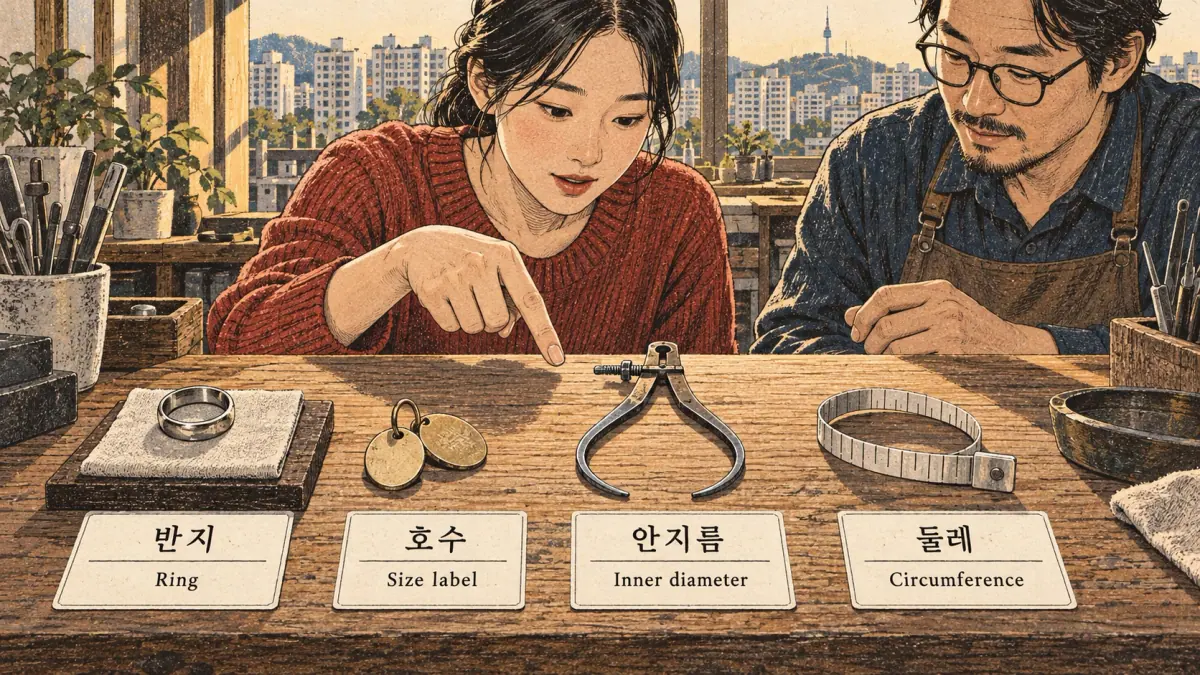
The Korean terms identify labels and dimensions, but a seller's heading still needs context. 호수refers to the sizing label in the applicable convention. 안지름refers to inner diameter. 둘레means circumference or surrounding length; confirm whether the source describes the ring opening, the finger or another seller-defined measurement.
| Term | English reading aid | Confirmation needed |
|---|---|---|
| 반지 | Ring | Ordinary rigid ring or product-specific shape |
| 호수 | Size label | Seller and gauge convention |
| 안지름 | Inner diameter | Inner edge, not outside band width |
| 둘레 | Circumference | Ring interior or measured finger |
| 신게이지 | New gauge | Named source and applicable product |
| 구게이지 | Old gauge | Named source and applicable product |
Outer diameter includes the band material. Measuring the outside of a ring and entering that as inner diameter would describe a larger opening than the one actually present. Keep the measuring endpoints on the inner edges and record uncertainty when those edges are hard to identify.
A seller's finger column is not automatically a geometric inner circumference. The source may use a fitting convention that requires jeweler confirmation. Korean shopping vocabulary provides the surrounding product language, while the converter keeps the numerical quantities explicit. Old and new gauge terminology requires the same source care.
Why Do Old and New Korean Gauges Disagree?

Old and new gauge labels can disagree because they belong to different provider conventions or product tables. A numeric label alone does not identify a universal conversion. The tool compares named tables and only uses a physical quantity that both explicitly publish.
The GS Shop Ellen Jewelry product contains source-specific old/new tables. Its later documented example associates old 13 withnew 12, a 17.0 mm diameter and 56 mm finger reading. The adjacent old 14/new 13 example uses 17.2 mm diameter and 57 mm finger reading. Those rows do not prove a universal old-minus-one equation.
Table identity matters because the inspected product source contains more than one comparison table. Preserve which table the row came from, its product scope and its date. A flexible-chain ring also needs its actual product method rather than an ordinary rigid-circle assumption.
The KS D ISO 8653 catalogue identifies a Korean standard associated with the ring-stick method. Catalogue metadata establishes that the document exists; it does not provide unrestricted authority to reproduce acomplete 1–30 national table. Complete text access, allowed reuse and qualified interpretation are separate requirements.
A missing compatible bridge between two sources produces “Cannot compare these charts directly.” Retain the individual source rows and ask a qualified jeweler to reconcile their meaning. Comparing the same numeral across two tables is not a substitute for that bridge. Geometry can independently explain an actual circular opening.
Diameter and Circumference Calculations
Circular geometry usesC=πdandd=C/π, whereCis ring inner circumference anddis ring inner diameter in the same length unit. The calculator uses the full available numericalπvalue for geometric computation, rounding to two decimals for display. No invented physical tolerance is attached to a typed number.
Metric and imperial conversion precede the geometry. One centimeter equals 10 mm, and one international inch equals 25.4 mm exactly. A diameter 0.5 intherefore equals 12.70 mm and gives approximately 39.90 mm inner circumference. Two inches of inner circumference equals 50.80 mm and gives approximately 16.17 mm diameter.
An explicit diameter uncertainty±0.10 mm propagates throughC=πdto a circumference uncertainty ofapproximately±0.314159 mm. The interval is derived from the stated uncertainty, not from how many decimal places the interface displays. A fine 0.05 mm screen adjustment likewise describes a control step, not proven measurement accuracy.
The ordinary geometry guard accepts diameter 1–100 mm and corresponding circumference up to 100πmm. These are interface limits, not population ranges or approved retail chart coverage. A geometrically valid value outside a source table still receives no fabricated size label. The worked examples show why those layers stay separate.
Worked Measurement Examples
Worked examples distinguish arithmetic from seller readings and physical calibration. The retailer facts below are individually sourced examples checked 10 October 2026. They are not a complete authorized chart bank or a promise that the product fits a particular finger.
Example 1: a Circular Ring with Diameter 17 Mm
A round ring with inner diameter 17.00 mm has inner circumferenceπ×17=53.407075…mm, displayed as 53.41 mm. The circumference describes the opening under the circular assumption. It does not declare that the finger should measure 53.41 mm,57 mmorany other retail fitting value.
If the entered diameter is 17.00±0.10 mm, the diameter interval is 16.90–17.10 mm. Applyingπto both endpoints gives a displayed inner-circumference interval 53.09–53.72 mm. A single rounded center value would hide that supplied uncertainty. Preserve the interval when asking about neighboring source rows.
Example 2: WEATT 13 Andits Finger Measurement
The WEATT Milky way product table gives its documented 13 row with 17.00 mm diameter and 57 mm finger reading. The geometry from thatdiameter remains 53.41 mm inner circumference. The 57 mm source field is a separately labelled finger measurement; it is not a contradiction inπ.
The documented 1 row gives 13.00 mm diameter and 44 mm finger reading. The 18 row gives 18.66 mm diameter and 62.5 mm finger reading. Those source facts show why a generated integer finger-size formula would lose information. Keep the provider's quantities and product scope attached to each row.
Example 3: Old and New Labels on One Product
Ellen's later comparison table associates old 13 withnew 12,17.0 mm diameter and 56 mm finger reading. WEATT's 13 example instead gives 57 mm finger reading for 17.0 mm diameter. The same inner diameter can therefore coexist with different source-labelled finger entries.
The difference is a reason to ask about the seller's gauge, measurement method and product. Do not average 56 and 57 into an invented national standard. The converter preserves the two named sources. The flexible-chain applicability note further limits any circular-ring fitting interpretation.
Example 4: Printing at the Wrong Scale
A 100 mm verification bar printed as 95 mm fails calibration. Selecting an apparently matching ring circle from that sheet would use a systematically smaller drawing. Recover by selecting the actual paper size, printing at 100%orActual size, turningFit to pageoff, and measuring again with an independent ruler.
A 50 mm horizontal check can pass while the vertical check measures 47 mm. That also fails: a stretched or compressed page can distort circles even when one axis looks correct. Both axes and the independent 100 mm bar must be checked. Passing PDF mathematics alone does not validate the physical print.
How Can I Measure an Existing Ring?
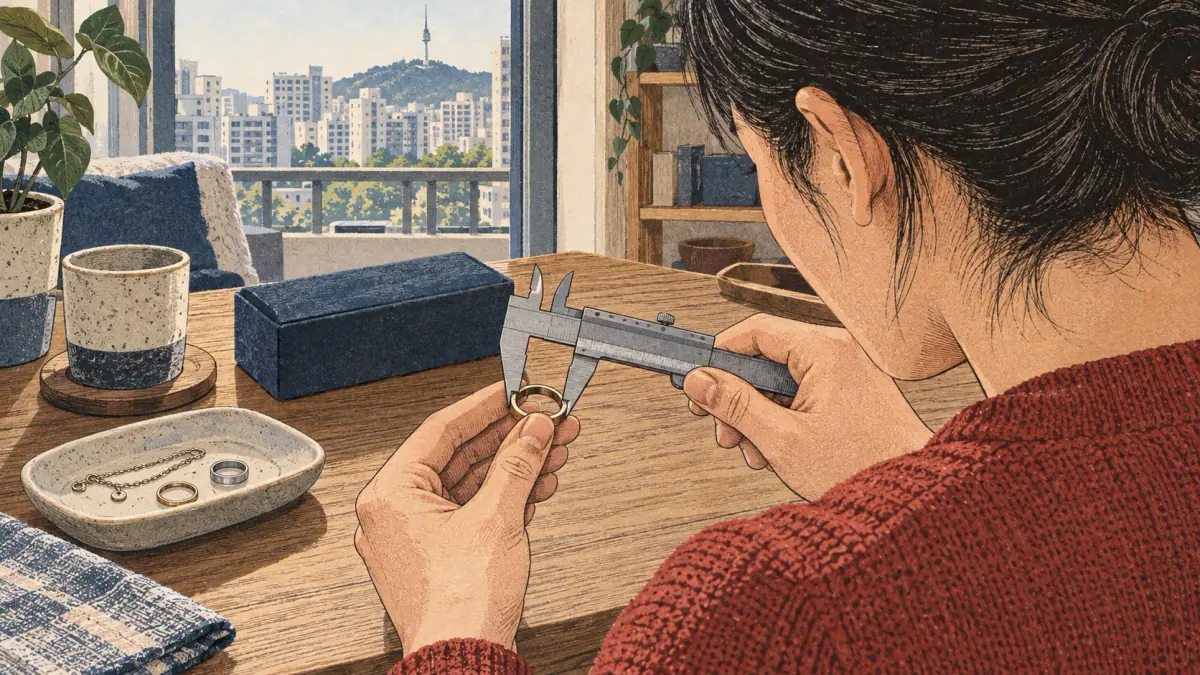
An existing rigid round ring can provide an inner measurement when the opening is accessible and the reference is trustworthy. Measure between the inner edges, not the outside band, with a suitable physical instrument. Record repeated readings and the uncertainty supported by that method.
The on-screen matcher first requires a measured physical ruler segment. Adjust the horizontal and vertical pixel spans against that same reference and confirm both. The ring circle is then drawn from those separate scales. The 0.05 mm buttons offer keyboard-operable fine adjustment; they do not certify a 0.05 mm physical reading.
Screen calibration expires when relevant viewport, device-pixel-ratio or zoom conditions change. A monitor switch can be difficult to detect automatically, so physically recheck every new session even if saved settings appear unchanged. CSS inches and a familiar phone model are not calibration references.
A noncircular opening, flexible chain or sensor ring requires its product-specific method. Do not force a diameter reading into circular geometry when the assumptions fail. A qualified jeweler can verify difficult openings, measuring-stick interpretation and the relationship to actual fit. Camera images provide another observation with additional limits.
Can a Camera Determine My Ring Size?

A camera observes projected edges; it cannot establish physical millimeters without a known measured reference. A ring and reference should share the admitted plane and perspective. Edge suggestions remain editable, and uncertain images need a new photo or manual physical measurement.
A front-only finger width does not determine three-dimensional circumference. The tool reports observed width when a side measurement is missing. Supplying front and side projected dimensions permits an explicitly assumed elliptical estimate, not an anatomical identity or a validated fit recommendation. Equal 17 mm front and side dimensions reduce the mathematical model to 53.41 mm circumference, but that does not prove a person's finger behaves as a rigid circle.
Camera or local-photo processing stays on the device. Permission is requested only after Start camera. Front/rear selection, capture, endpoint correction and Stop/delete remain available. A denied camera offers local-photo or typed alternatives without discarding the current measurement.
Automatic edge suggestions are assistance, not a claim of measured accuracy. Lighting, blur, reflections, outer-edge confusion and perspective can invalidate an estimate. No camera accuracy percentage or fit guarantee is published here. Physical reference checks and appropriate specialist validation remain necessary before purchase decisions.
Calibrated Printable Ring Sizer

The original A 4 ring aid and Letter ring aid contain vector inner-edge circles, a cut-out millimeter strip, aone-inch check and 50 mm/100 mm checks. They are measurement-only aids; no anonymous official gauge labels are inferred.
Print with the selected paper size at 100%orActual size. DisableFit to page. Check the 100 mm bar and both 50 mm axes against an independent physical ruler. The circle's ink-stroke center is the specified diameter reference; the outer edge of a thick stroke is not another nominal diameter.
The strip can record a finger measurement under the chosen method, but pressure and alignment matter. A measured finger circumference remains different from ring inner circumference. Ask the seller or jeweler about the appropriate product method and confirm the fitting result physically.
Why Does a Printed Circle Look the Wrong Size?
Printer scaling, the wrong paper size, borderless stretching, driver adjustments andFit to pagecan change dimensions. One axis may change differently from the other. Reprint rather than compensating through an unverified screen image. A physical check after printing tests the delivered page; correct vector coordinates cannot guarantee every printer configuration. The same uncertainty discipline applies to source lookup.
When Is the Conversion Too Uncertain to Use?
A conversion is too uncertain for a purchasing decision when the quantity, source, gauge or measurement method is unresolved. A precise display cannot repair those missing facts. A source row can be exact as a table reading while still needing product and physical-fit confirmation.
User-supplied uncertainty propagates through geometry and can span neighboring labels. Retain both candidates when an interval crosses a boundary. A midpoint tie also returns both; the tool does not invent a half Korean label between them. USquarterorUKhalf-letter support needs an explicit source convention or imported table.
Stop when the chart lacks the selected quantity, the input is outside its published range or a flexible shape violates the circular assumption. A named source with unknown measurement semantics cannot be promoted into an official table merely because it looks familiar. The ISO 8653 catalogue concerns a measuring method and gauge system, not a shortcut that turns every retailer numeral into one universalUS size.
Does a Wide or Comfort-Fit Band Change the Answer?
Band width and interior shape can affect a fitting decision, but they do not change the entered geometric measurement. The tool keeps the unadjusted result visible and applies a separate adjustment only when you supply the seller's supported offset and source note.
There is no universal rule that a 7 mm band implies adding half aUS size. Flat and comfort-fit controls record the product description; they do not manufacture an automatic numerical correction. Knuckle passage, repeated readings and temperature-related variation deserve appropriate physical remeasurement and product-specific advice.
A manually entered seller offset is labelled as seller-supplied, with its note. It remains distinct from circular geometry and from another provider's chart. Confirm a flexible-chain product separately. Sensor-ring manufacturers likewise use their own fitting workflows; a conventional jewelry number does not substitute for the kit.
Source-Labeled Ring-Size Reference Table
The reference table preserves source identity and quantity meaning. The examples below are documented primary-source readings, not a complete approved sizing bank. More labels require the actual source table or a locally imported chart with explicit dimensions and international fields.
| Source example | Seller label | Inner diameter | Measured finger field |
|---|---|---|---|
| WEATT Milky way | 13 | 17.00 mm | 57 mm |
| WEATT Milky way | 18 | 18.66 mm | 62.5 mm |
| Ellen later old gauge table | 13 | 17.0 mm | 56 mm |
| Ellen later new gauge table | 12 | 17.0 mm | 56 mm |
InternationalUS,UK,EU,Spain-local andJP labels need their actual provider profile. Korean and Japanese labels are not silently equated. Imports preserve original source values and do not replace independent finger measurements withπtimes diameter. A sourceURL provides provenance; it does not automatically grant reuse rights or certify fit.
Korean Phrases for Checking a Ring with the Seller
A useful seller conversation identifies the product, quantity, gauge and source. Ask in plain language whether the ring uses the new gauge and what its inner diameter is in millimeters. Show the named table rather than an anonymous conversion result. The copyable English question keeps personal finger readings out by default.
Continue with shopping phrases for exchange questions, the counters chart for numerical context, and the Korean number converter for reading a label. Ring호belongs to its sizing convention; ordinary number reading cannot establish that convention. Keep those language and measurement tasks connected without confusing them.
How Do Private Records and Exports Differ?
A private profile stores only the values you deliberately save on this browser. Saving starts off. Each record includes the selected source and date; an old screen calibration still requires physical rechecking in a new session. The profile list is capped at one hundred records and can be exported or deleted. If browser storage is unavailable, the current measurement remains in memory and a file export provides a separate backup.
A copied result names the original quantity, units and source. CSV exports neutralize spreadsheet formula prefixes in text cells. JSON preserves the chosen source context. PNG cards summarize the measurement visually, while DOCX and clearly identified Word-compatible RTF provide document formats. Browser printing can save a personalized result as PDF; the separate measuring PDFs are original physical-scale aids. A file should be inspected before sharing because it can include deliberately selected measurements.
The default share link contains source identity, not personal measurements or images. A desktop QR link follows that same private default. Optional measurement inclusion is a separate choice. The tool never automatically publishes a chart, sends a message to a seller or treats an imported table as permission to redistribute it.
Samsung’s official Galaxy Ring kit guidance provides the product-specific sensor-ring distinction discussed below. A saved jewelry profile does not replace that manufacturer’s fitting process.
Frequently Asked Questions
Do Men's and Women's Rings Use Different Units?
No. Millimeters, centimeters and inches describe the same physical length units regardless of the buyer. The seller’s product, gauge and label convention determine a size interpretation. Preserve those details instead of assuming a demographic conversion or average. A physical fitting check still matters when band width or interior shape differs.
Can I Use My Galaxy Ring Size for Ordinary Jewelry?
Do not assume a universal equivalence. Samsung recommends its own sizing kit and notes that usual ring sizes can differ for its sensor ring. Use the current manufacturer instructions for that product. Ordinary jewelry charts and circular measurements do not establish sensor placement, product-specific comfort or the correct kit size.
What If My Seller Supplies No Sizing Chart?
Ask for the gauge convention and actual inner measurements for the exact product. A bare size label cannot identify a reliable international equivalent. Keep the result unavailable rather than extrapolating from another retailer. If the ring is flexible, shaped or unusually wide, request its specific measuring and fitting method as well.
Will the Converter Work without Internet Access?
Loaded geometry and currently available source examples work without a connection. Optional offline caching can preserve the tool’s own assets when the browser supports storage. An uncached first visit or missing optional asset still needs a download. Live seller pages and their latest changes cannot be promised offline; preserve the saved source date.
How Can I Delete a Saved Measurement or Photo?
Use the profile controls to delete saved browser records. Stop/delete ends the camera stream and discards its local image buffer; leaving camera mode also stops capture. Photos are not automatically saved in profiles or uploaded. A copied or explicitly shared file remains under its recipient’s control, so inspect its contents before sharing.
Check Korean Ring Size to US before Ordering
Check Korean ring size to US with the exact seller, product and gauge. Preserve whether the number is a ring diameter, ring inner circumference or measured finger reading, and carry the source date beside any equivalent label. Verify both physical axes before using a screen or printed aid. Confirm band shape and fitting advice with the seller or jeweler. Use Korean tools for everyday quantities and shopping vocabulary practice for related learning. Report a source mismatch through the contact channel, with the table identity and original quantities.