
Korean Travel Vocabulary at a Glance
The list has 40 words in six groups, ordered as a trip is: plan, book, pack, sightsee, pay and show your papers. It is the hub of Korean Airport Vocabulary, Korean Immigration and Visa Vocabulary and Korean Tourist Attractions Vocabulary. It belongs to Places and Travel, and its words are the ones shared by all three deeper pages.
| Group | Words | Use |
|---|---|---|
| Planning a trip | 7 | Kinds of trip, itinerary and budget |
| Tickets and reservations | 7 | Booking, changing and refunding |
| Luggage | 6 | Bags, weight and storage |
| Sightseeing | 7 | Sites, maps, guides and souvenirs |
| Money and exchange | 6 | Won, cards and exchange rates |
| Visas and documents | 7 | Passport, visa, ID and the embassy |
For the single entry, see travel in Korean. If you want a guided course in trip-ready Korean, Korean for travel sequences the lessons, and travel phrases gives ready-made lines.
Which Travel Words Should You Learn First?
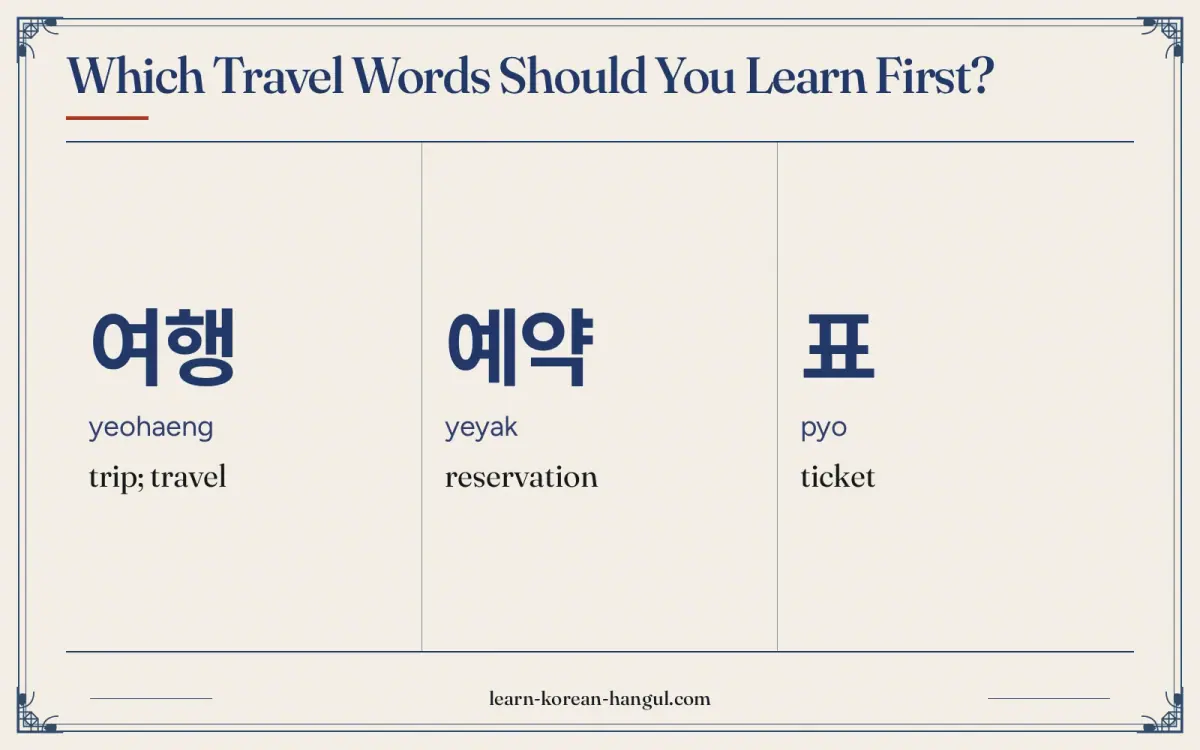
Learn 여행 (trip), 예약 (reservation), 여권 (passport), 짐 (luggage) and 환전 (currency exchange) first. They cover the five moments when a traveller most needs to speak: booking, border, bags and money. If you also learn 원 with the Sino-Korean numbers, you can read every price.
- Words to say. 여행, 예약, 여권, 짐, 환전.
- Words to recognise. 일정, 입장권, 환불, 출입국, 서류.
- Words to ask with. 안내소 and 지도 let you ask for directions in Korean.
The scene below shows a traveller's desk with ten numbered objects that match the list.
Word · 10
- 1
여행
yeohaeng
trip; travel
- 2
예약
yeyak
reservation
- 3
표
pyo
ticket
- 4
짐
jim
luggage; load
- 5
캐리어
kaerieo
wheeled suitcase
- 6
지도
jido
map
- 7
사진
sajin
photo
- 8
돈
don
money
- 9
환전
hwanjeon
currency exchange
- 10
여권
yeogwon
passport
Planning a Trip
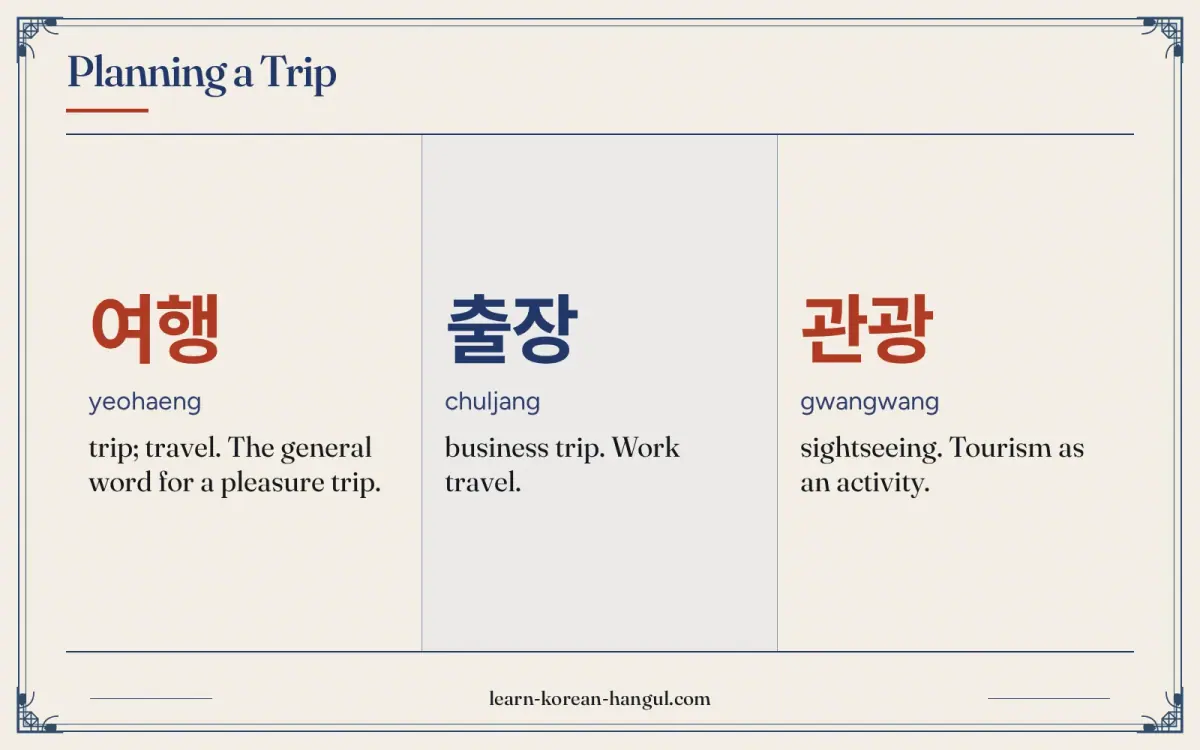
Many trips start on a travel app, and Korean travel apps use a small shared vocabulary: the plan, the booking, the place to stay and the money. Three words for kinds of trip matter most, because each shows why you travel. 여행 is a trip for pleasure, 출장 is a business trip, and 관광 is sightseeing, which can be the activity inside a 여행.
| No. | Hangul | Revised Romanization | Meaning and note | Example sentence | Audio assetId |
|---|---|---|---|---|---|
| 1 | 여행 | yeohaeng | trip; travel. The general word for a pleasure trip. | 내일 여행을 가요. (I am going on a trip tomorrow.) | au-pg-vocabulary-places-travel-1; example: au-pg-vocabulary-places-travel-41 |
| 2 | 출장 | chuljang | business trip. Work travel. | 다음 주에 출장을 가요. (I am going on a business trip next week.) | au-pg-vocabulary-places-travel-2; example: au-pg-vocabulary-places-travel-42 |
| 3 | 관광 | gwangwang | sightseeing. Tourism as an activity. | 서울에서 관광을 해요. (I go sightseeing in Seoul.) | au-pg-vocabulary-places-travel-3; example: au-pg-vocabulary-places-travel-43 |
| 4 | 일정 | iljeong | itinerary; schedule. Said [일쩡]. | 일정을 짜요. (I plan the itinerary.) | au-pg-vocabulary-places-travel-4; example: au-pg-vocabulary-places-travel-44 |
| 5 | 예약 | yeyak | reservation. Add 하다 for the verb. | 숙소를 예약해요. (I book a place to stay.) | au-pg-vocabulary-places-travel-5; example: au-pg-vocabulary-places-travel-45 |
| 6 | 숙소 | sukso | accommodation. The place you sleep on a trip. | 숙소가 깨끗해요. (The accommodation is clean.) | au-pg-vocabulary-places-travel-6; example: au-pg-vocabulary-places-travel-46 |
| 7 | 예산 | yesan | budget. Money planned for the trip. | 예산이 부족해요. (The budget is not enough.) | au-pg-vocabulary-places-travel-7; example: au-pg-vocabulary-places-travel-47 |
A common planning set on Korean travel apps is 일정, 예약, 숙소, 교통 and 예산. 교통 (transport) has its own list on Transportation, and hotel words are on hotel vocabulary. The word 예약 is for tables, rooms and tickets, while a meeting with a friend is a 약속, a point from the mistakes section. The verbs 짜다 (to put together a plan) and 깨끗하다 (be clean) make 짜요 and 깨끗해요.
How Do You Say Tickets and Reservations in Korean?
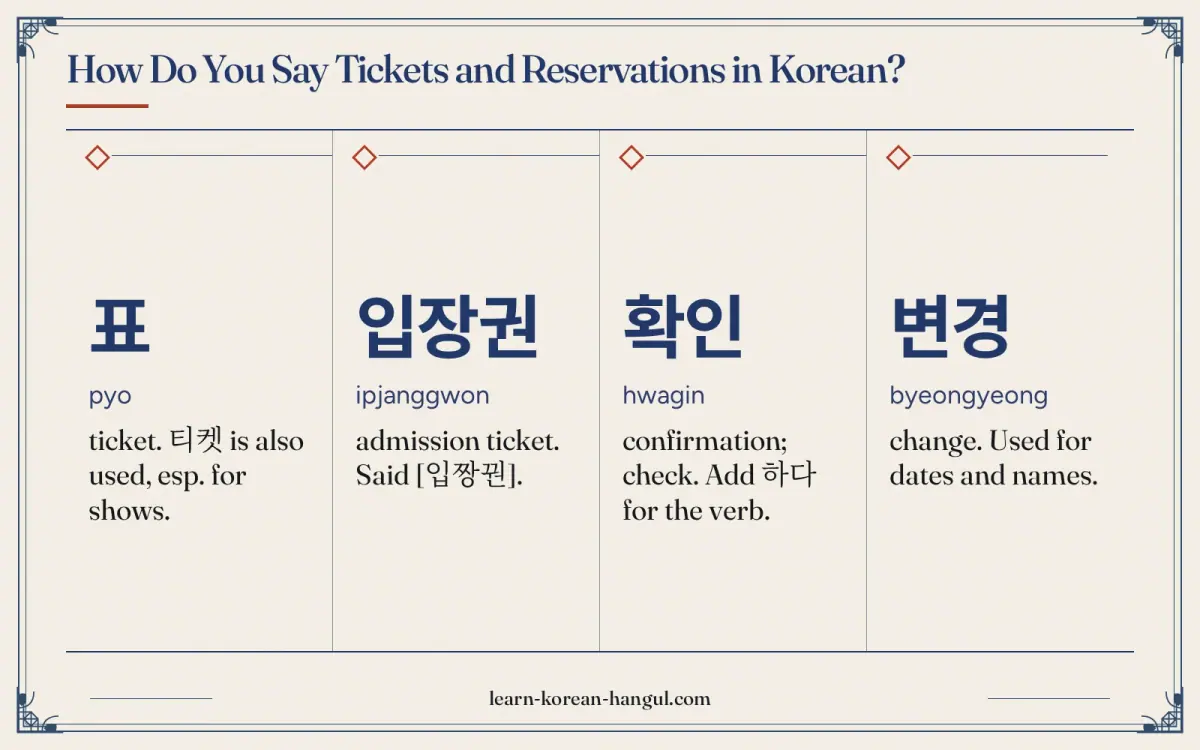
Once you have booked something, a short family of words describes what happens to the booking. You confirm it, change it, cancel it or get a refund. The same words work for a flight, a train, a show or a room, which is why they are worth learning as a set.
| No. | Hangul | Revised Romanization | Meaning and note | Example sentence | Audio assetId |
|---|---|---|---|---|---|
| 8 | 표 | pyo | ticket. 티켓 is also used, esp. for shows. | 표를 사요. (I buy a ticket.) | au-pg-vocabulary-places-travel-8; example: au-pg-vocabulary-places-travel-48 |
| 9 | 입장권 | ipjanggwon | admission ticket. Said [입짱꿘]. | 입장권을 사요. (I buy an admission ticket.) | au-pg-vocabulary-places-travel-9; example: au-pg-vocabulary-places-travel-49 |
| 10 | 확인 | hwagin | confirmation; check. Add 하다 for the verb. | 예약을 확인해요. (I check the reservation.) | au-pg-vocabulary-places-travel-10; example: au-pg-vocabulary-places-travel-50 |
| 11 | 변경 | byeongyeong | change. Used for dates and names. | 날짜를 변경해요. (I change the date.) | au-pg-vocabulary-places-travel-11; example: au-pg-vocabulary-places-travel-51 |
| 12 | 취소 | chwiso | cancellation. Add 하다 to cancel. | 예약을 취소해요. (I cancel the reservation.) | au-pg-vocabulary-places-travel-12; example: au-pg-vocabulary-places-travel-52 |
| 13 | 환불 | hwanbul | refund. Money returned. | 환불을 받아요. (I receive a refund.) | au-pg-vocabulary-places-travel-13; example: au-pg-vocabulary-places-travel-53 |
| 14 | 바우처 | bauchyeo | voucher. Loanword. | 바우처를 보여 줘요. (I show the voucher.) | au-pg-vocabulary-places-travel-14; example: au-pg-vocabulary-places-travel-54 |
Notice that 취소 and 환불 are separate steps. 취소 cancels the booking, and 환불 returns your money, which may follow later or not at all, depending on the terms. The noun 날짜 (date) in the change sentence is the day of the month; the days of the week are on Time Words. For tickets to attractions, 입장권 is the word on the booth.
Luggage
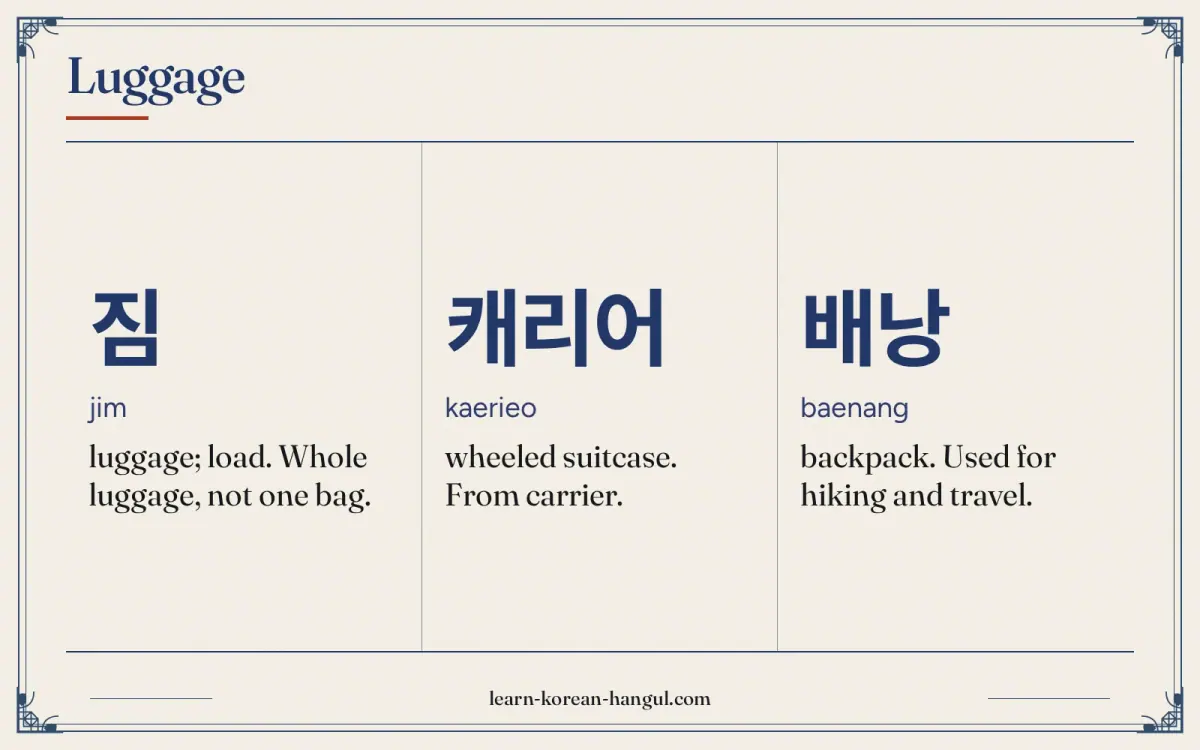
Luggage vocabulary is short and physical. You bring a bag, wheel it, weigh it and lock it, and sometimes you leave it at a storage counter while you sightsee. Korean says 짐 for luggage as a whole and gives a name to each kind of bag. The airport page covers the airline terms for checked bags.
| No. | Hangul | Revised Romanization | Meaning and note | Example sentence | Audio assetId |
|---|---|---|---|---|---|
| 15 | 짐 | jim | luggage; load. Whole luggage, not one bag. | 짐이 많아요. (I have a lot of luggage.) | au-pg-vocabulary-places-travel-15; example: au-pg-vocabulary-places-travel-55 |
| 16 | 캐리어 | kaerieo | wheeled suitcase. From carrier. | 캐리어를 끌어요. (I pull the suitcase.) | au-pg-vocabulary-places-travel-16; example: au-pg-vocabulary-places-travel-56 |
| 17 | 배낭 | baenang | backpack. Used for hiking and travel. | 배낭을 메요. (I carry a backpack.) | au-pg-vocabulary-places-travel-17; example: au-pg-vocabulary-places-travel-57 |
| 18 | 무게 | muge | weight. The thing airlines limit. | 무게를 재요. (I weigh it.) | au-pg-vocabulary-places-travel-18; example: au-pg-vocabulary-places-travel-58 |
| 19 | 자물쇠 | jamulsoe | lock; padlock. For bags and lockers. | 자물쇠를 잠가요. (I lock the padlock.) | au-pg-vocabulary-places-travel-19; example: au-pg-vocabulary-places-travel-59 |
| 20 | 짐 보관소 | jim bogwanso | baggage storage. At stations and airports. | 짐 보관소에 맡겨요. (I leave it at baggage storage.) | au-pg-vocabulary-places-travel-20; example: au-pg-vocabulary-places-travel-60 |
The word 짐 is the best one for talking about all your things, as in 짐이 많아요. The verbs show how Korean treats each object: you 끌어요 a wheeled case (pull), 메요 a backpack (carry on the shoulder), and 맡겨요 a bag at a counter (entrust). For the airline-side words such as checked baggage and baggage claim, see Korean Airport Vocabulary.
How Do You Say Sightseeing in Korean?
Sightseeing is where the trip pays off, and its vocabulary is mostly nouns for places and things to carry. A 관광지 is a tourist site in general, a 명소 is a famous spot that people go to on purpose, and the information centre can tell you which is which. See Korean Tourist Attractions Vocabulary.
| No. | Hangul | Revised Romanization | Meaning and note | Example sentence | Audio assetId |
|---|---|---|---|---|---|
| 21 | 관광지 | gwangwangji | tourist site. 지 is place. | 관광지가 많아요. (There are many tourist sites.) | au-pg-vocabulary-places-travel-21; example: au-pg-vocabulary-places-travel-61 |
| 22 | 명소 | myeongso | famous spot. 명 is famous; 소 is place. | 이곳은 유명한 명소예요. (This is a famous spot.) | au-pg-vocabulary-places-travel-22; example: au-pg-vocabulary-places-travel-62 |
| 23 | 지도 | jido | map. Paper or phone. | 지도를 봐요. (I look at the map.) | au-pg-vocabulary-places-travel-23; example: au-pg-vocabulary-places-travel-63 |
| 24 | 안내소 | annaeso | information centre. Found at stations and sites. | 안내소가 어디예요? (Where is the information centre?) | au-pg-vocabulary-places-travel-24; example: au-pg-vocabulary-places-travel-64 |
| 25 | 가이드 | gaideu | guide. Loanword. | 가이드가 설명해요. (The guide explains.) | au-pg-vocabulary-places-travel-25; example: au-pg-vocabulary-places-travel-65 |
| 26 | 사진 | sajin | photo. Taken with 찍다. | 사진을 찍어요. (I take a photo.) | au-pg-vocabulary-places-travel-26; example: au-pg-vocabulary-places-travel-66 |
| 27 | 기념품 | ginyeompum | souvenir. 기념 is commemoration. | 기념품을 사요. (I buy a souvenir.) | au-pg-vocabulary-places-travel-27; example: au-pg-vocabulary-places-travel-67 |
The shared part 소 (place) in 명소 and 안내소 and the shared 지 in 관광지 make the group easy to guess. You 찍어요 a photo, where English says you take it: 찍다 means to stamp, print or snap. 설명하다 (explain) makes 설명해요. The route between sites is the topic of Transportation.
Money and Exchange
Money words are simple to learn and very useful. The currency is the 원, the exchange counter is the 환전소, and the exchange rate is the 환율. You will often see prices written with numerals and 원, and many places accept the 신용카드. An ATM is called a 현금 인출기 on the sign and an ATM in speech.
| No. | Hangul | Revised Romanization | Meaning and note | Example sentence | Audio assetId |
|---|---|---|---|---|---|
| 28 | 돈 | don | money. The everyday word. | 돈이 필요해요. (I need money.) | au-pg-vocabulary-places-travel-28; example: au-pg-vocabulary-places-travel-68 |
| 29 | 원 | won | won (currency). Follows a Sino-Korean number. | 만 원이에요. (It is ten thousand won.) | au-pg-vocabulary-places-travel-29; example: au-pg-vocabulary-places-travel-69 |
| 30 | 신용카드 | sinyongkadeu | credit card. Said [시뇽카드]. | 신용카드를 써요. (I use a credit card.) | au-pg-vocabulary-places-travel-30; example: au-pg-vocabulary-places-travel-70 |
| 31 | 환전 | hwanjeon | currency exchange. 환 is exchange. | 공항에서 환전해요. (I exchange money at the airport.) | au-pg-vocabulary-places-travel-31; example: au-pg-vocabulary-places-travel-71 |
| 32 | 환율 | hwanyul | exchange rate. Said [화뉼]. | 오늘 환율이 얼마예요? (What is today's exchange rate?) | au-pg-vocabulary-places-travel-32; example: au-pg-vocabulary-places-travel-72 |
| 33 | 현금 인출기 | hyeongeum inchulgi | cash machine. 인출 is withdrawal. | 현금 인출기에서 돈을 찾아요. (I take money out at the cash machine.) | au-pg-vocabulary-places-travel-33; example: au-pg-vocabulary-places-travel-73 |
Prices use Sino-Korean numbers, followed by 원: 천 원 (1,000 won), 만 원 (10,000 won), 오만 원 (50,000 won). The word 만 means ten thousand, and Korean counts in units of ten thousand, not thousand. That is why a price like 30,000 is 삼만 원. See Sino-Korean numbers for the number words. The verb 찾다 means to look for and also to withdraw money.
How Do You Say Visas and Documents in Korean?
Documents are the last group and the least forgiving. Every border and hotel asks for the same few: your passport, your visa or an entry permit, an ID and any papers for insurance. These seven words are the ones you meet on forms and at counters.
| No. | Hangul | Revised Romanization | Meaning and note | Example sentence | Audio assetId |
|---|---|---|---|---|---|
| 34 | 여권 | yeogwon | passport. Said [여꿘]. | 여권을 챙겨요. (I pack my passport.) | au-pg-vocabulary-places-travel-34; example: au-pg-vocabulary-places-travel-74 |
| 35 | 비자 | bija | visa. Loanword. | 비자를 신청해요. (I apply for a visa.) | au-pg-vocabulary-places-travel-35; example: au-pg-vocabulary-places-travel-75 |
| 36 | 신분증 | sinbunjeung | ID card. Said [신분쯩]. | 신분증이 필요해요. (I need an ID.) | au-pg-vocabulary-places-travel-36; example: au-pg-vocabulary-places-travel-76 |
| 37 | 서류 | seoryu | documents; papers. Forms and papers. | 서류를 내요. (I hand in the papers.) | au-pg-vocabulary-places-travel-37; example: au-pg-vocabulary-places-travel-77 |
| 38 | 여행자 보험 | yeohaengja boheom | travel insurance. 여행자 is traveller. | 여행자 보험에 들어요. (I take out travel insurance.) | au-pg-vocabulary-places-travel-38; example: au-pg-vocabulary-places-travel-78 |
| 39 | 대사관 | daesagwan | embassy. Where you go if you lose a passport. | 대사관에 가요. (I go to the embassy.) | au-pg-vocabulary-places-travel-39; example: au-pg-vocabulary-places-travel-79 |
| 40 | 출입국 | churipguk | immigration (in and out). Said [추립꾹]. | 출입국 신고서를 써요. (I fill in the immigration form.) | au-pg-vocabulary-places-travel-40; example: au-pg-vocabulary-places-travel-80 |
출입국 is a compound of 출국 (leaving the country) and 입국 (entering it), so it means the border in both directions. See Korean Immigration and Visa Vocabulary. The verb 챙기다 (to pack or take care of) makes 챙겨요, and 신청하다 (to apply) makes 신청해요.
How Do You Pronounce Korean Travel Words?
Travel words show tensing and linking in Sino-Korean compounds. After a final ㄹ, ㄱ or ㅂ, the next consonant is often said tense, a ㄴ is added in some compounds, and a final consonant moves to the next syllable before a vowel. These changes follow the standard pronunciation rules of the National Institute of Korean Language (국립국어원). Revised Romanization leaves tense sounds unmarked.
| Spelling | Sounds like | What changes |
|---|---|---|
| 일정 | [일쩡] | After final ㄹ, the ㅈ is tense. |
| 입장권 | [입짱꿘] | After final ㅂ, the ㅈ is tense; the ㄱ of 권 is tense. |
| 환율 | [화뉼] | The final ㄴ of 환 links to the vowel of 율. |
| 신분증 | [신분쯩] | After final ㄴ in this word, the ㅈ is tense. |
| 출입국 | [추립꾹] | The ㄹ links to 입, and after final ㅂ the ㄱ is tense. |
Audio and Slow Playback
Each word and example has its own clip, and five more replay the hardest words slowly. Play 환전 first, since the question 환전 어디서 해요? is the one most visitors need on day one.
What Mistakes Do Learners Make with Travel Words?
Five distinctions are worth fixing early.
- Using 출장 for a holiday. 출장 is a business trip and needs a work reason. A holiday is a 여행. If you say 출장을 가요, the listener will assume you are travelling for work.
- Using 예약 for meeting a friend. 예약 books a room, table or seat. A plan to meet someone is a 약속: 친구와 약속이 있어요.
- Treating 취소 and 환불 as the same step. 취소 cancels the booking and 환불 returns the money. You can ask for both, one after the other.
- Reading prices in thousands. Korean counts in units of ten thousand (만), so 30,000 won is 삼만 원, three ten-thousands, not thirty thousands.
- Using 표 at an attraction. 표 works, but the booth sign says 입장권 for entry tickets, and a clerk will use it.
With these distinctions fixed, the rest of the list is mostly nouns you can recognise on signs.
Practice: Flashcards and Worksheet
Study in three steps. First, run the deck in recognition mode until the 40 words are familiar. Second, switch to listening mode and play the clip before you flip each card. Third, take the five-question quiz. Progress stays in your browser, and the vocabulary flashcard decks page lists the other decks.
Practice · 85
- 01여행
Show answer
headword 1: trip; travel
- 02출장
Show answer
headword 2: business trip
- 03관광
Show answer
headword 3: sightseeing
- 04일정
Show answer
headword 4: itinerary; schedule
- 05예약
Show answer
headword 5: reservation
- 06숙소
Show answer
headword 6: accommodation
- 07예산
Show answer
headword 7: budget
- 08표
Show answer
headword 8: ticket
- 09입장권
Show answer
headword 9: admission ticket
- 10확인
Show answer
headword 10: confirmation; check
- 11변경
Show answer
headword 11: change
- 12취소
Show answer
headword 12: cancellation
- 13환불
Show answer
headword 13: refund
- 14바우처
Show answer
headword 14: voucher
- 15짐
Show answer
headword 15: luggage; load
- 16캐리어
Show answer
headword 16: wheeled suitcase
- 17배낭
Show answer
headword 17: backpack
- 18무게
Show answer
headword 18: weight
- 19자물쇠
Show answer
headword 19: lock; padlock
- 20짐 보관소
Show answer
headword 20: baggage storage
- 21관광지
Show answer
headword 21: tourist site
- 22명소
Show answer
headword 22: famous spot
- 23지도
Show answer
headword 23: map
- 24안내소
Show answer
headword 24: information centre
- 25가이드
Show answer
headword 25: guide
- 26사진
Show answer
headword 26: photo
- 27기념품
Show answer
headword 27: souvenir
- 28돈
Show answer
headword 28: money
- 29원
Show answer
headword 29: won (currency)
- 30신용카드
Show answer
headword 30: credit card
- 31환전
Show answer
headword 31: currency exchange
- 32환율
Show answer
headword 32: exchange rate
- 33현금 인출기
Show answer
headword 33: cash machine
- 34여권
Show answer
headword 34: passport
- 35비자
Show answer
headword 35: visa
- 36신분증
Show answer
headword 36: ID card
- 37서류
Show answer
headword 37: documents; papers
- 38여행자 보험
Show answer
headword 38: travel insurance
- 39대사관
Show answer
headword 39: embassy
- 40출입국
Show answer
headword 40: immigration (in and out)
- 41내일 여행을 가요.
Show answer
example sentence for 여행
- 42다음 주에 출장을 가요.
Show answer
example sentence for 출장
- 43서울에서 관광을 해요.
Show answer
example sentence for 관광
- 44일정을 짜요.
Show answer
example sentence for 일정
- 45숙소를 예약해요.
Show answer
example sentence for 예약
- 46숙소가 깨끗해요.
Show answer
example sentence for 숙소
- 47예산이 부족해요.
Show answer
example sentence for 예산
- 48표를 사요.
Show answer
example sentence for 표
- 49입장권을 사요.
Show answer
example sentence for 입장권
- 50예약을 확인해요.
Show answer
example sentence for 확인
- 51날짜를 변경해요.
Show answer
example sentence for 변경
- 52예약을 취소해요.
Show answer
example sentence for 취소
- 53환불을 받아요.
Show answer
example sentence for 환불
- 54바우처를 보여 줘요.
Show answer
example sentence for 바우처
- 55짐이 많아요.
Show answer
example sentence for 짐
- 56캐리어를 끌어요.
Show answer
example sentence for 캐리어
- 57배낭을 메요.
Show answer
example sentence for 배낭
- 58무게를 재요.
Show answer
example sentence for 무게
- 59자물쇠를 잠가요.
Show answer
example sentence for 자물쇠
- 60짐 보관소에 맡겨요.
Show answer
example sentence for 짐 보관소
- 61관광지가 많아요.
Show answer
example sentence for 관광지
- 62이곳은 유명한 명소예요.
Show answer
example sentence for 명소
- 63지도를 봐요.
Show answer
example sentence for 지도
- 64안내소가 어디예요?
Show answer
example sentence for 안내소
- 65가이드가 설명해요.
Show answer
example sentence for 가이드
- 66사진을 찍어요.
Show answer
example sentence for 사진
- 67기념품을 사요.
Show answer
example sentence for 기념품
- 68돈이 필요해요.
Show answer
example sentence for 돈
- 69만 원이에요.
Show answer
example sentence for 원
- 70신용카드를 써요.
Show answer
example sentence for 신용카드
- 71공항에서 환전해요.
Show answer
example sentence for 환전
- 72오늘 환율이 얼마예요?
Show answer
example sentence for 환율
- 73현금 인출기에서 돈을 찾아요.
Show answer
example sentence for 현금 인출기
- 74여권을 챙겨요.
Show answer
example sentence for 여권
- 75비자를 신청해요.
Show answer
example sentence for 비자
- 76신분증이 필요해요.
Show answer
example sentence for 신분증
- 77서류를 내요.
Show answer
example sentence for 서류
- 78여행자 보험에 들어요.
Show answer
example sentence for 여행자 보험
- 79대사관에 가요.
Show answer
example sentence for 대사관
- 80출입국 신고서를 써요.
Show answer
example sentence for 출입국
- 81일정
Show answer
slow playback of 일정
- 82입장권
Show answer
slow playback of 입장권
- 83환전
Show answer
slow playback of 환전
- 84신분증
Show answer
slow playback of 신분증
- 85출입국
Show answer
slow playback of 출입국
Practice · 5
What does 여행 (yeohaeng) mean?
Show answer
trip; travel
여행 means trip; travel. Example: 내일 여행을 가요. (I am going on a trip tomorrow.)
What does 출장 (chuljang) mean?
Show answer
business trip
출장 means business trip. Example: 다음 주에 출장을 가요. (I am going on a business trip next week.)
What does 짐 (jim) mean?
Show answer
luggage; load
짐 means luggage; load. Example: 짐이 많아요. (I have a lot of luggage.)
What does 환전 (hwanjeon) mean?
Show answer
currency exchange
환전 means currency exchange. Example: 공항에서 환전해요. (I exchange money at the airport.)
What does 환율 (hwanyul) mean?
Show answer
exchange rate
환율 means exchange rate. Example: 오늘 환율이 얼마예요? (What is today's exchange rate?)
Korean Travel Vocabulary Worksheet (PDF)
A printable worksheet for these words (word list, matching, writing practice, fill-in-the-blank exercises and answer key) is available in A4 and US Letter from the download card on this page. For practice, write your own trip plan in six lines, one for each group.
Where to Go Next
After this page, continue with Korean Airport Vocabulary for check-in and arrival, or with Korean Tourist Attractions Vocabulary for places to see. For moving about once you arrive, see Transportation.
Pages in This Section
- Korean Airport Vocabulary: check-in, security, gates, baggage claim and airport services.
- Korean Immigration and Visa Vocabulary: passport, visa, entry forms and residence words.
- Korean Tourist Attractions Vocabulary: palaces, museums, viewpoints and tickets.
Frequently Asked Questions
How Do You Say Airport in Korean?
Airport is 공항 (gonghang), from 공 (air) and 항 (port), and you say 공항에 가요 for I go to the airport. The full list of airport words, from check-in to baggage claim, is on the airport page. The single-word page on travel in Korean covers the topic word 여행.
How Do You Pronounce 환전 (hwanjeon)?
Say hwan-jeon in two beats. The first syllable starts with h and a rounded w glide and ends in n. The second starts with a soft j, between j and ch, and the vowel is the open eo, as in the u of sun. It means currency exchange. Press the audio button to hear it.
How Many Travel Words Should I Learn First?
Five: 여행, 예약, 여권, 짐 and 환전. At five new words a day the 40 words take eight days plus review. Add 원 and the Sino-Korean numbers before you go, so that you can read prices.
What Is the Difference between 여행, 출장 and 관광?
여행 is a trip for pleasure or personal reasons. 출장 is a trip for work. 관광 is sightseeing, the activity of visiting sites, and it can be part of a 여행. A holiday abroad is a 해외여행.
Where Can I Practise Travel Words with Flashcards?
Use the vocabulary flashcard decks. The deck for this page holds all 40 words with Hangul, romanization and audio. Your progress stays in your browser. Drill the money group in listening mode before you go, so that prices such as 만 원 sound familiar.
Is There a Printable Worksheet for Travel Words?
A printable worksheet for these words (word list, matching, writing practice, fill-in-the-blank exercises and answer key) is available in A4 and US Letter from the download card on this page. For practice, copy the tables on this page by hand or use the deck. Another quick drill is to write your own trip plan with one word from each of the six groups.