
Native Korean Numbers Flashcards: Study the 28 Cards
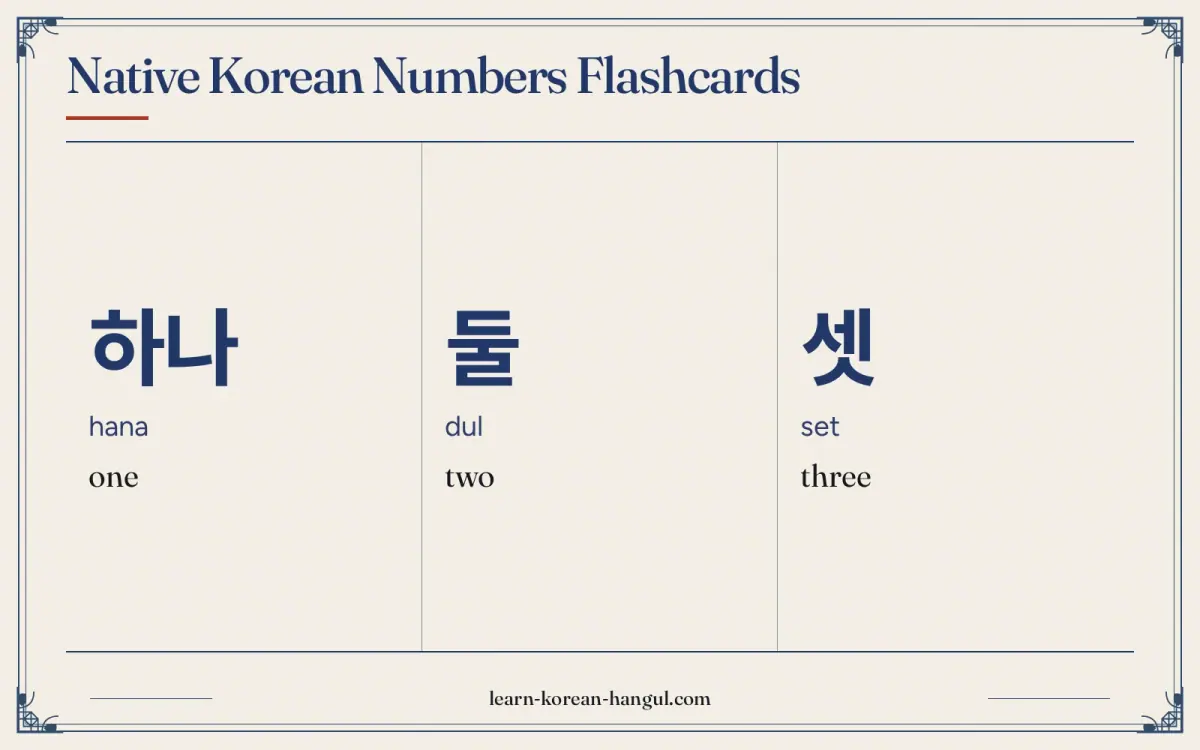
Native Korean numbers count things, people and age, and they give the hour in a clock time. The lesson behind this deck is native Korean numbers, so read it first if a card is new.
How Do I Use These Flashcards?
Use the deck above in four steps. It works with tap, click or keyboard, and nothing plays until you press an audio button.
- Choose a mode. Start with recognition (Hangul to meaning). Switch to recall (meaning to Hangul) or listening (audio to meaning) once recognition feels easy.
- Show the answer. Think of the answer first, then press Show answer (or Space). Say the number aloud before you reveal it. Turn on the romanization toggle only if you need it; the 28-card table below always shows it.
- Grade yourself. Press Got it if you answered correctly without help, or Not yet if you hesitated or guessed.
- Finish the session. A session holds up to 20 cards (you can set 10, 20 or 40). With 28 cards, a first-time learner can split the deck over three days, using the default limit of 10 new cards a day.
The Three Study Modes
Recognition shows the Hangul and asks for the meaning, which trains reading. Recall shows the meaning and asks for the Hangul, which trains remembering; you may type the answer with your Hangul keyboard or just recall it in your head. Listening plays a clip and hides the letters, which trains the ear. Listening mode only uses a card once its audio is approved, and cards without approved audio are skipped in that mode with a note.
Got It and Not Yet
Got it moves the card up one Leitner box, so it comes back later. Not yet sends the card back to box 1, so it returns in the same session or within 10 minutes. The grades are your own judgement; the deck does not score you or claim fluency.
Deck Scope: What Is and Is Not Covered
The deck covers native Korean numbers 1 to 10, the teens 11, 12, 15 and 18, the tens from 20 to 90 with 25 as a sample compound, and the five determiner forms used before counters: 한, 두, 세, 네 and 스무. It stops at 99. It does not cover Sino-Korean numbers or specific counters.
What Is Left out of This Deck?
Sino-Korean numbers are in the Sino Korean numbers flashcards, and counter words such as 명, 개, 마리 and 잔 are in the Korean counters flashcards. The deck also leaves out the rarer counter variants 석, 넉, 서 and 너. For any number between 1 and 99 the Korean number converter shows the native reading.
All 28 Cards in One Table
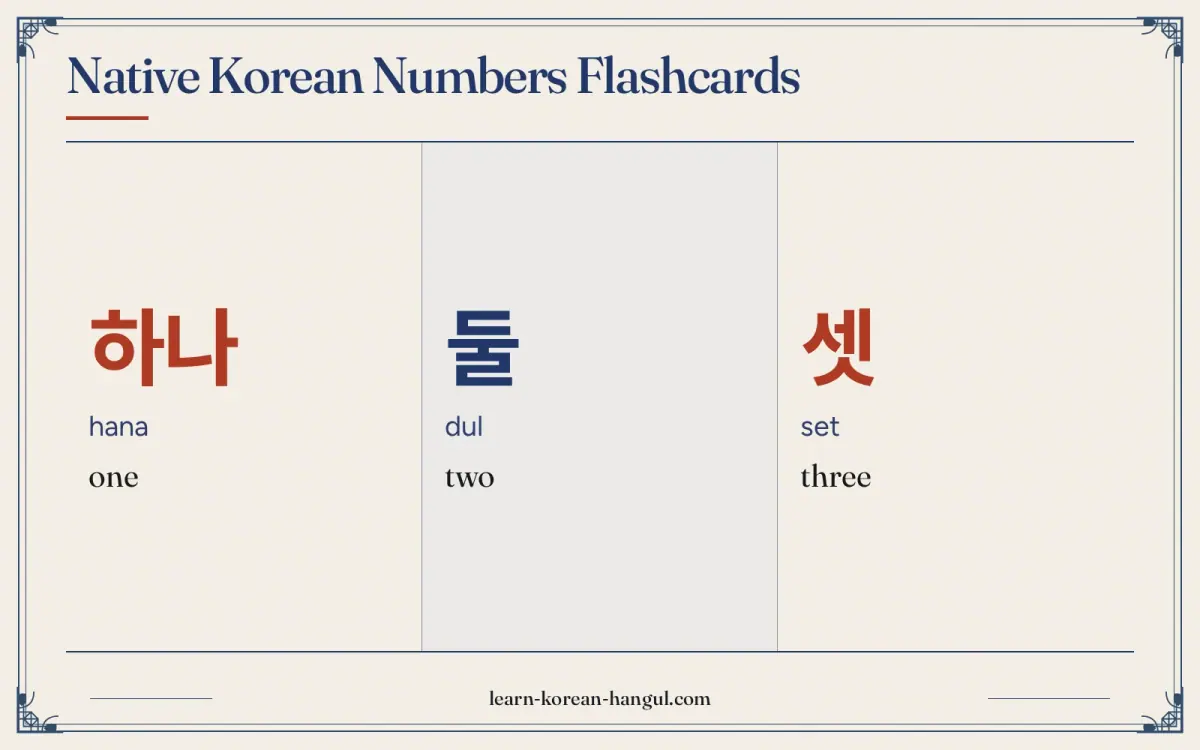
All 28 cards appear below in deck order. The table is plain HTML, so you can use it as a drill without the deck: cover the Meaning column, say each number aloud, then uncover it.
| # | Hangul | Revised Romanization | Meaning | Note | Audio assetId |
|---|---|---|---|---|---|
| 1 | 하나 | hana | one | Stands alone; becomes 한 before a counter. | au-pg-flashcards-native-numbers-1 |
| 2 | 둘 | dul | two | Stands alone; becomes 두 before a counter. | au-pg-flashcards-native-numbers-2 |
| 3 | 셋 | set | three | Becomes 세 before a counter. | au-pg-flashcards-native-numbers-3 |
| 4 | 넷 | net | four | Becomes 네 before a counter. | au-pg-flashcards-native-numbers-4 |
| 5 | 다섯 | daseot | five | Two syllables; the final ㅅ is said [ㄷ]. | au-pg-flashcards-native-numbers-5 |
| 6 | 여섯 | yeoseot | six | Two syllables; the final ㅅ is said [ㄷ]. | au-pg-flashcards-native-numbers-6 |
| 7 | 일곱 | ilgop | seven | Before 이에요 it is said [일고비에요]. | au-pg-flashcards-native-numbers-7; slow: au-pg-flashcards-native-numbers-29 |
| 8 | 여덟 | yeodeol | eight | Said [여덜]; before a vowel the ㅂ is heard: 여덟이에요 [여덜비에요]. | au-pg-flashcards-native-numbers-8; slow: au-pg-flashcards-native-numbers-30 |
| 9 | 아홉 | ahop | nine | Ends in a closed [p] sound. | au-pg-flashcards-native-numbers-9 |
| 10 | 열 | yeol | ten | The base of the native teens. | au-pg-flashcards-native-numbers-10 |
| 11 | 열하나 | yeolhana | eleven | 열 plus 하나; standard [열하나], with a weak ㅎ in fast speech. | au-pg-flashcards-native-numbers-11 |
| 12 | 열둘 | yeoldul | twelve | 열 plus 둘; before a counter use 열두. | au-pg-flashcards-native-numbers-12 |
| 13 | 열다섯 | yeoldaseot | fifteen | 열 plus 다섯. | au-pg-flashcards-native-numbers-13 |
| 14 | 열여덟 | yeollyeodeol | eighteen | Said [열려덜]; a ㄴ sound is inserted and becomes ㄹ. | au-pg-flashcards-native-numbers-14; slow: au-pg-flashcards-native-numbers-31 |
| 15 | 스물 | seumul | twenty | Becomes 스무 before a counter. | au-pg-flashcards-native-numbers-15 |
| 16 | 스물다섯 | seumuldaseot | twenty-five | A common age answer: 스물다섯 살. | au-pg-flashcards-native-numbers-16 |
| 17 | 서른 | seoreun | thirty | The tens have their own words. | au-pg-flashcards-native-numbers-17 |
| 18 | 마흔 | maheun | forty | The tens have their own words. | au-pg-flashcards-native-numbers-18 |
| 19 | 쉰 | swin | fifty | One syllable; no counter shortening. | au-pg-flashcards-native-numbers-19 |
| 20 | 예순 | yesun | sixty | The tens have their own words. | au-pg-flashcards-native-numbers-20 |
| 21 | 일흔 | ilheun | seventy | The tens have their own words. | au-pg-flashcards-native-numbers-21 |
| 22 | 여든 | yeodeun | eighty | The tens have their own words. | au-pg-flashcards-native-numbers-22 |
| 23 | 아흔 | aheun | ninety | The last native ten; 100 is Sino 백. | au-pg-flashcards-native-numbers-23 |
| 24 | 한 | han | one (before a counter) | 한 명, 한 개: shortened form of 하나. | au-pg-flashcards-native-numbers-24 |
| 25 | 두 | du | two (before a counter) | 두 명, 두 개: shortened form of 둘. | au-pg-flashcards-native-numbers-25 |
| 26 | 세 | se | three (before a counter) | 세 명, 세 잔: shortened form of 셋. | au-pg-flashcards-native-numbers-26 |
| 27 | 네 | ne | four (before a counter) | 네 권, 네 시: shortened form of 넷. | au-pg-flashcards-native-numbers-27 |
| 28 | 스무 | seumu | twenty (before a counter) | 스무 살 for age twenty. | au-pg-flashcards-native-numbers-28 |
Reading the Table
Hangul is the word. Revised Romanization (RR) is a learning aid, so try to read the Hangul before you look at it. RR follows the sound of the word, which is why some spellings change, as in 열여덟 (yeollyeodeol). The Meaning column gives the English gloss, and the Note column gives a use or sound hint. The last column lists the audio assetId; a second ID marks a slow clip. Cards 24-28 are the shortened forms; they are always followed by a counter.
Usage Notes for These Cards
Age uses native numbers plus 살. To say you are twenty-five, say 저는 스물다섯 살이에요. The counter 살 (sal) means years of age, and the number before it takes its counter form. Card 16 gives you 스물다섯 as a ready-made answer.
Five numbers shrink before a counter. Before a counter the numbers 1, 2, 3, 4 and 20 shrink to 한, 두, 세, 네 and 스무. That gives 한 명 (one person), 두 개 (two items), 세 잔 (three cups), 네 권 (four books) and 스무 살 (twenty years old). Cards 24-28 drill these forms.
Clock hours are native, minutes are Sino. The hour uses a native number and the minutes use a Sino number, so 7:30 is 일곱 시 삼십 분. Only numbers that end in 1, 2, 3 or 4, and 20 itself, change shape, so 열둘 becomes 열두 and 스물하나 becomes 스물한, while 일곱 stays 일곱.
The full forms stand alone. Without a counter you use the full forms. Answer 몇 개예요? (How many?) with 둘이에요 (it's two), and use 하나 or 셋 when pointing out one or three things.
The ceiling is 99. In modern use native numbers stop at 99, which is 아흔아홉. From 100 onwards speakers switch to Sino numbers, so 100 is 백 even when counting objects, as in 백 개.
Which Sounds Do Not Match the Spelling?
일곱 + 이에요 is said [일고비에요]. The final ㅂ of 일곱 links to the vowel that follows (liaison), so the ㅂ is heard at the start of the next syllable.
여덟 is said [여덜] when nothing follows, because the cluster ㄼ is read as ㄹ. Before a vowel, as in 여덟이에요, the ㅂ moves on and the word is said [여덜비에요].
열여덟 is said [열려덜]. A ㄴ sound is inserted before 여, and it becomes ㄹ next to the final ㄹ of 열. Reviewers should confirm these forms against the 국립국어원 standard pronunciation rules.
What Mistakes Do Learners Make with Native Korean Numbers?
- Using full forms before a counter, such as 하나 명 or 둘 개. Say 한 명 and 두 개.
- Mixing up 스물 and 스무. Say 스물 on its own, but 스무 살 before a counter.
- Using native numbers above 99. Switch to Sino numbers from 100.
- Using Sino numbers for age, such as 이십오 살. Native 스물다섯 살 is the usual form.
The shortened forms cause most of the slips, so give cards 24-28 extra passes in recall mode.
How Does the Review Schedule Work?
The deck uses a simplified Leitner system with five boxes. A new card starts in box 1. Each Got it moves it up one box, and each Not yet returns it to box 1. The box sets how long the card waits before it is due again.
| Box | Wait until the next review |
|---|---|
| 1 | same session or 10 minutes |
| 2 | 1 day |
| 3 | 3 days |
| 4 | 7 days |
| 5 | 21 days |
Each session shows due cards first, oldest due first, and then up to 10 new cards a day by default. A deck of 28 cards is introduced over three days at the default of 10 new cards a day, and the later boxes bring each card back at longer gaps. Progress is saved only in this browser, so clearing site data deletes it. Use the export button to save a small JSON file with card IDs, boxes and due dates, and import it on another device. No account is needed.
Cultural and Practical Context
Age is traditionally counted in native numbers, and people often ask 몇 살이에요? to place each other in the hierarchy of speech levels. Since June 2023 Korean law uses international age for official purposes, but the traditional Korean age is still heard in daily talk. Learners who give their age in native numbers sound natural right away.
Limits of This Deck
The deck holds 28 cards and shows only a sample of the numbers between 20 and 99. It does not teach counters, so a card such as 세 only shows the shortened form, not which counter follows. The age-law remark in the context section is stated briefly and should be checked before publishing. All Korean text is generated, and Min-ji Park reviewed and signed off the text and audio on 15 October 2026.
Next Steps after This Deck
After this deck, practise the counters in the Korean counters flashcards. Revisit the Sino Korean numbers flashcards if dates and prices still feel shaky, and write the numbers by hand with the Korean numbers worksheet. The Korean number converter lets you explore numbers beyond the fixed deck, the Korean vocabulary flashcards page lists every other deck, and the Korean flashcards hub lists all topics.
Frequently Asked Questions
Why Do 하나 and 둘 Change to 한 and 두?
Native numbers 1, 2, 3, 4 and 20 take a shorter form when a counter follows: 하나 becomes 한, 둘 becomes 두, 셋 becomes 세, 넷 becomes 네 and 스물 becomes 스무. The long forms are used alone. So you say 한 명 for one person but 하나 for the bare number.
How Do I Say My Age in Korean?
Use a native number plus the counter 살. At twenty-five you say 저는 스물다섯 살이에요. For age twenty the number shortens to 스무, so you say 스무 살. The question for age is 몇 살이에요?, and the formal word 세 takes Sino numbers.
Is It 스물 or 스무?
Both are twenty. Say 스물 when the number stands alone or leads a longer number, such as 스물다섯. Say 스무 directly before a counter, such as 스무 살 or 스무 명. The same split exists for 하나 and 한, 둘 and 두, 셋 and 세, 넷 and 네.
What Do I Use after 99?
Use Sino-Korean numbers. Native Korean numbers stop at 아흔아홉, which is 99, and 100 is 백 even when you count objects, as in 백 개. Old native words for 100 and 1,000 (온, 즈믄) survive only in old texts and names. This deck covers the tens up to 90 and a few sample numbers.
Is My Progress Saved If I Close the Page?
Yes, in the same browser on the same device. Card boxes and due dates are stored locally and nothing is sent to a server. Clearing site data, using a private window or switching browsers removes them, so use the export button to keep a backup file. No account is needed.