Korean Counters Flashcards: Study the 26 Cards
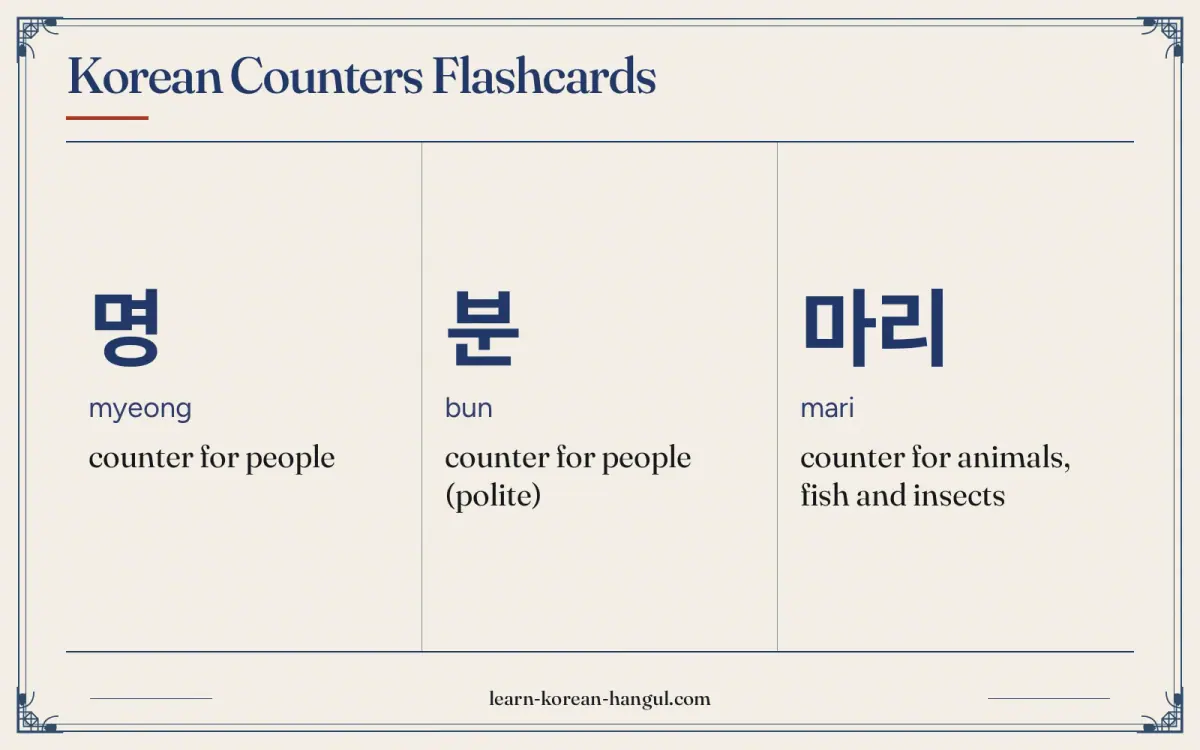
Each card shows the counter in Hangul, the Revised Romanization (RR), what it counts and an audio button, with an example in the note. The counters come from the Korean counters lesson and the counters chart.
How Do I Use These Flashcards?
Use the deck above in four steps. It works with tap, click or keyboard, and nothing plays until you press an audio button.
- Choose a mode. Start with recognition (Hangul to meaning). Switch to recall (meaning to Hangul) or listening (audio to meaning) once recognition feels easy.
- Show the answer. Think of the answer first, then press Show answer (or Space). Say the word aloud before you reveal it. Turn on the romanization toggle only if you need it; the 26-card table below always shows it.
- Grade yourself. Press Got it if you answered correctly without help, or Not yet if you hesitated or guessed.
- Finish the session. A session holds up to 20 cards (you can set 10, 20 or 40). With 26 cards, a first-time learner can split the deck over three days, using the default limit of 10 new cards a day.
The Three Study Modes
Recognition shows the Hangul and asks for the meaning, which trains reading. Recall shows the meaning and asks for the Hangul, which trains remembering; you may type the answer with your Hangul keyboard or just recall it in your head. Listening plays a clip and hides the letters, which trains the ear. Listening mode only uses a card once its audio is approved, and cards without approved audio are skipped in that mode with a note.
Got It and Not Yet
Got it moves the card up one Leitner box, so it comes back later. Not yet sends the card back to box 1, so it returns in the same session or within 10 minutes. The grades are your own judgement; the deck does not score you or claim fluency.
Deck Scope: What Is and Is Not Covered
The deck covers 26 counters from the counters chart. Each card is a single counter, and its note gives a sample phrase with the number and noun. The order follows the chart: people, animals, things, food and drink, time and age, then floors, rooms and money.
What Is Left out of This Deck?
The counters 쌍, 곡, 편, 채, 척, 부, 건, 접시, 공기, 캔, 봉지 and 회 are not cards here. They are in the counters chart. For the rules of word order and number choice, read how Korean counters work.
All 26 Cards in One Table
All 26 cards appear below in deck order. The table is plain HTML, so you can use it as a drill without the deck: cover the Meaning column, say each word aloud, then uncover it.
| # | Hangul | Revised Romanization | Meaning | Note | Audio assetId |
|---|---|---|---|---|---|
| 1 | 명 | myeong | counter for people | 학생 세 명 (three students). The neutral counter for people. | au-pg-flashcards-counters-1; slow: au-pg-flashcards-counters-27 |
| 2 | 분 | bun | counter for people (polite) | 손님 두 분 (two guests). The respectful counter for people. | au-pg-flashcards-counters-2 |
| 3 | 마리 | mari | counter for animals, fish and insects | 고양이 두 마리 (two cats). | au-pg-flashcards-counters-3; slow: au-pg-flashcards-counters-28 |
| 4 | 개 | gae | counter for general objects | 사과 세 개 (three apples). The all-purpose counter. | au-pg-flashcards-counters-4 |
| 5 | 권 | gwon | counter for books and notebooks | 책 두 권 (two books). | au-pg-flashcards-counters-5 |
| 6 | 장 | jang | counter for flat things such as paper and tickets | 표 한 장 (one ticket). | au-pg-flashcards-counters-6 |
| 7 | 대 | dae | counter for vehicles and machines | 자동차 한 대 (one car). | au-pg-flashcards-counters-7 |
| 8 | 켤레 | kyeolle | counter for pairs of shoes and socks | 신발 한 켤레 (one pair of shoes). | au-pg-flashcards-counters-8; slow: au-pg-flashcards-counters-29 |
| 9 | 벌 | beol | counter for suits and sets of clothes | 양복 한 벌 (one suit). | au-pg-flashcards-counters-9 |
| 10 | 송이 | songi | counter for flowers and clusters | 장미 세 송이 (three roses). | au-pg-flashcards-counters-10 |
| 11 | 그루 | geuru | counter for trees and plants | 나무 두 그루 (two trees). | au-pg-flashcards-counters-11 |
| 12 | 잔 | jan | counter for cups and glasses of drink | 커피 한 잔 (one cup of coffee). | au-pg-flashcards-counters-12 |
| 13 | 병 | byeong | counter for bottles | 물 두 병 (two bottles of water). | au-pg-flashcards-counters-13 |
| 14 | 그릇 | geureut | counter for bowls of food | 밥 한 그릇 (one bowl of rice). | au-pg-flashcards-counters-14 |
| 15 | 인분 | inbun | counter for servings per person | 삼겹살 이 인분 (two servings of pork belly). Takes Sino numbers. | au-pg-flashcards-counters-15 |
| 16 | 시 | si | counter for o'clock | 세 시 (three o'clock). Takes native numbers. | au-pg-flashcards-counters-16 |
| 17 | 시간 | sigan | counter for hours of duration | 두 시간 (two hours). Takes native numbers. | au-pg-flashcards-counters-17 |
| 18 | 일 | il | counter for days | 삼 일 (three days). Takes Sino numbers. | au-pg-flashcards-counters-18 |
| 19 | 주 | ju | counter for weeks | 이 주 (two weeks). Takes Sino numbers. | au-pg-flashcards-counters-19 |
| 20 | 개월 | gaewol | counter for months | 육 개월 (six months). Takes Sino numbers. | au-pg-flashcards-counters-20; slow: au-pg-flashcards-counters-30 |
| 21 | 년 | nyeon | counter for years | 오 년 (five years). Takes Sino numbers. | au-pg-flashcards-counters-21 |
| 22 | 살 | sal | counter for age in years | 스무 살 (twenty years old). Takes native numbers. | au-pg-flashcards-counters-22 |
| 23 | 번 | beon | counter for times and occasions | 한 번 (once). Takes native numbers when counting times. | au-pg-flashcards-counters-23 |
| 24 | 층 | cheung | counter for floors | 삼 층 (third floor). Takes Sino numbers. | au-pg-flashcards-counters-24 |
| 25 | 호 | ho | counter for room or issue numbers | 이백일 호 (room 201). Takes Sino numbers. | au-pg-flashcards-counters-25 |
| 26 | 원 | won | counter for Korean won | 오천 원 (5,000 won). Takes Sino numbers. | au-pg-flashcards-counters-26 |
Reading the Table
Hangul is the word. Revised Romanization (RR) is a learning aid, so try to read the Hangul before you look at it. RR follows the spelling rules of the official system, not every sound change, so it can differ from what you hear. The Meaning column gives the English gloss, and the Note column gives a use or sound hint. The last column lists the audio assetId; a second ID marks a slow clip at 0.8 times the speed. Cards 15, 18-21 and 24-26 take Sino-Korean numbers; the others take native numbers.
Usage Notes for These Cards
The order is noun, number, counter. Say 커피 두 잔 (two cups of coffee), not 두 잔 커피. The noun comes first, then the number, then the counter.
Native numbers go with most counters. Use native numbers (하나, 둘, 셋) with 개, 명, 마리, 병, 잔, 권, 장, 대, 살, 시 and 번 for times. Before a counter the numbers shrink: 한, 두, 세, 네.
Sino numbers go with a smaller set. Use Sino numbers (일, 이, 삼) with 층, 호, 원, 인분, 일, 주, 개월 and 년. 삼 층 is the third floor, and 오천 원 is 5,000 won.
명 is neutral, 분 is polite. A waiter asks 몇 분이세요? (How many people?) with the polite counter, while a friend asks 몇 명이야?
개 is the fallback. 개 is the all-purpose counter for objects. A learner who does not know the right counter can use it for most small things and be understood, but animals take 마리 and books take 권.
Which Sounds Do Not Match the Spelling?
Some of these words are said differently from how they are written. The table follows the standard pronunciation rules (표준 발음법) of the 국립국어원 (National Institute of Korean Language).
| Spelling | Sounds like | What changes |
|---|---|---|
| 몇 명 | [면명] | The final ㅊ becomes [ㄷ], then nasalizes to [ㄴ] before ㅁ. |
| 몇 개 | [멷깨] | The ㅊ becomes [ㄷ] and the following ㄱ becomes tense [ㄲ]. |
| 몇 분 | [멷뿐] | The ㅊ becomes [ㄷ] and the following ㅂ becomes tense [ㅃ]. |
| 몇 시 | [멷씨] | The ㅊ becomes [ㄷ] and the following ㅅ becomes tense [ㅆ]. |
Counters often follow 몇 (how many), and the ㅊ at the end of 몇 changes its sound. Revised Romanization shows only the spelling, so listen to the clips of 몇 명 and 몇 개 in the lesson as well.
What Mistakes Do Learners Make with Counters?
- Using Sino numbers with 개, such as 삼 개. The correct pair is 세 개.
- Using 개 for animals. Animals take 마리: 강아지 두 마리.
- Mixing 시 and 시간. 시 is o'clock and 시간 is a span of hours.
- Putting the counter first. Say 커피 두 잔, not 두 잔 커피.
- Forgetting the shortened forms. Say 한 명, not 하나 명.
How Does the Review Schedule Work?
The deck uses a simplified Leitner system with five boxes. A new card starts in box 1. Each Got it moves it up one box, and each Not yet returns it to box 1. The box sets how long the card waits before it is due again.
| Box | Wait until the next review |
|---|---|
| 1 | same session or 10 minutes |
| 2 | 1 day |
| 3 | 3 days |
| 4 | 7 days |
| 5 | 21 days |
Each session shows due cards first, oldest due first, and then up to 10 new cards a day by default. A deck of 26 cards is introduced over three days at the default of 10 new cards a day, and the later boxes bring each card back at longer gaps. Progress is saved only in this browser, so clearing site data deletes it. Use the export button to save a small JSON file with card IDs, boxes and due dates, and import it on another device. No account is needed.
Cultural and Practical Context
Counters are why Korean menus and shop talk sound so exact: bottles, cups, sheets, volumes and vehicles each have their own word. In casual shops people still happily say 두 개 for nearly everything small.
Limits of This Deck
The deck holds 26 counters out of many more, and shows one sample phrase for each. It does not drill the numbers themselves, so practice those in the number decks first. Some counters, such as 번, take different numbers for different uses. All Korean text is generated and was reviewed and signed off by Min-ji Park on 15 October 2026.
Next Steps after This Deck
The words and letters on these cards are explained in the Korean counters lesson, so read it first if a card is new. This deck is one of the Korean vocabulary flashcards on the site, so browse the full list if you want a different topic. When these cards feel easy, move on to Korean numbers flashcards to keep the same routine. If a word here still feels shaky, go back to Native Korean numbers flashcards for the earlier material. After a session, write the same words by hand with the Korean numbers worksheet. To check what you recalled, take the Korean counters quiz next. The Korean number converter tool lets you explore these items beyond the fixed deck. All flashcard decks, including Hangul, vocabulary, phrases, grammar and TOPIK, are listed on the Korean flashcards hub. The lesson Korean counters teaches the full system, and this deck is the review set.
Frequently Asked Questions
Which Counter Do I Use for Flowers, Shoes or Clothes?
Use 송이 for flowers by the head, 켤레 for pairs of shoes and socks, and 벌 for suits and sets of clothes. Each has its own card in this deck.
When Do I Use 명 and When 분?
명 is the neutral counter for people. 분 is the polite counter, used for guests and customers or when talking about someone you respect.
Do I Need a Counter Every Time I Use a Number?
Not always. A bare number can stand alone, as in 하나 or 둘, but when you count a noun you normally add the counter: 사과 세 개.
Is the Order Two Cups of Coffee or Coffee Two Cups?
The Korean order is noun, number, counter, so say 커피 두 잔. The English word order is the other way round.
Is My Progress Saved If I Close the Page?
Yes, in the same browser on the same device. Card boxes and due dates are stored locally and nothing is sent to a server. Clearing site data, using a private window or switching browsers removes them, so use the export button to keep a backup file. No account is needed.