What you'll learn
- Say that something exists, where it is and who has it with 있어요.
- Say the opposite with 없어요, without using 안.
- Choose between 이/가, 은/는 and 에 in the three basic patterns.
- Tell 있어요 apart from 이에요/예요 and from the honorific 계세요.
Prerequisites: the lesson on 이에요/예요 to be and basic particles. Time: about 15 minutes.
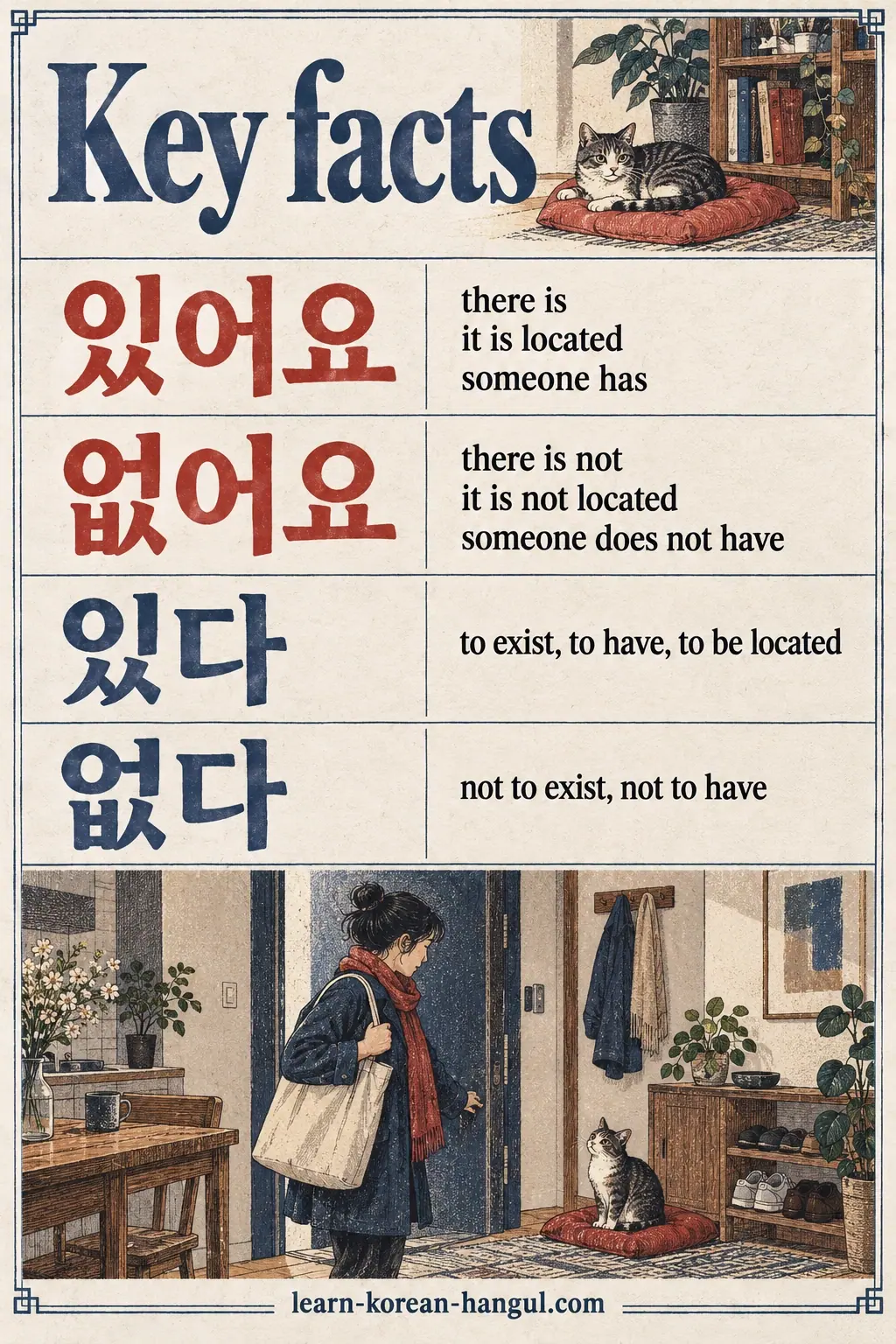
Key facts
- 있어요 and 없어요 are the polite present forms of 있다 and 없다.
- 있어요 covers three meanings: exist, be located, and have.
- Existence uses place에 N이/가 있어요. Location uses N은/는 place에 있어요.
- The opposite of 있어요 is 없어요. Do not say 안 있어요.
- For respected people, 계세요 replaces 있어요 when the meaning is presence or location.
Listen to the two model sentences for this lesson.
The next section defines the two words and shows where their three meanings come from.
What Is the 있어요 없어요 Meaning?

있어요 means "there is", "it is located" or "someone has", and 없어요 means "there is not", "it is not located" or "someone does not have". English uses three different verbs for these ideas: "there is", "is at" and "have". Korean uses one word, 있다, and lets the particles and the context show which idea is meant.
The dictionary form 있다 becomes 있어요 in polite speech, and 없다 becomes 없어요. The word 있다 is pronounced [읻따] and the polite form is said [이써요]. The word 없다 is pronounced [업따] and the polite form is [업써요]. In 있어요 the final ㅆ links onto the vowel, and in 없어요 the ㅅ of ㅄ links on as a tense [ㅆ]. Both changes follow the linking rules in the Standard Pronunciation Rules (표준 발음법) of the National Institute of Korean Language (국립국어원).
A First Example
Here are two sentences. The first shows existence and the second shows possession.
| Part | 집에 고양이가 있어요. | 저는 시간이 없어요. |
|---|---|---|
| Place or owner | 집에 (at home) | 저는 (as for me) |
| Thing | 고양이가 (a cat) | 시간이 (time) |
| Ending | 있어요 | 없어요 |
| Spoken | [지베 고양이가 이써요] | [저는 시가니 업써요] |
| RR (aid) | jibe goyangiga isseoyo | jeoneun sigani eopseoyo |
| English | There is a cat at home. | I do not have time. |
In the first sentence, 에 marks the place where the cat exists. In the second, 은/는 marks the person who has, and 이/가 marks the thing that is had. A particle is a small marker attached to a noun that shows its role in the sentence. The place particle is taught in location particle 에.
The three patterns that these examples belong to are laid out in the next section.
How Do 있어요 and 없어요 Work?

Both words follow one frame: the thing that exists takes 이/가, the place takes 에, and 있어요 or 없어요 closes the sentence. Changing which noun comes first changes which of the three meanings you express. The verb-like ending always comes last, as in every Korean sentence.
Pattern Table
| Meaning | Pattern | Example | Spoken | English |
|---|---|---|---|---|
| Existence | place에 N이/가 있어요 | 집에 고양이가 있어요. | [지베 고양이가 이써요] | There is a cat at home. |
| Location | N은/는 place에 있어요 | 고양이는 집에 있어요. | [고양이는 지베 이써요] | The cat is at home. |
| Possession | A은/는 B이/가 있어요 | 저는 동생이 있어요. | [저는 동생이 이써요] | I have a younger sibling. |
| No existence | place에 N이/가 없어요 | 방에 의자가 없어요. | [방에 의자가 업써요] | There is no chair in the room. |
| No possession | A은/는 B이/가 없어요 | 저는 돈이 없어요. | [저는 도니 업써요] | I have no money. |
The difference between the first two rows is about what the listener already knows. A new thing is introduced with 이/가: 집에 고양이가 있어요 announces that a cat exists. A known thing is the topic and takes 은/는: 고양이는 집에 있어요 tells where the known cat is. The topic particle is explained in topic particle 은/는.
The possession row uses the same words as the location row, but the first noun is a person, not a place. Korean treats "I have a younger sibling" as "As for me, a younger sibling exists." That is why the thing owned takes 이/가 and never the object particle 을/를. The word 있다 does not take a direct object.
A quick test for the three meanings. Look at the first noun. If it is a place, the sentence is about existence or location. If it is a person, the sentence is about possession. The next section builds one sentence step by step.
Worked Example: Building 집에 고양이가 있어요

To build 집에 고양이가 있어요, choose the place, choose the thing, attach the right particles and finish with 있어요. Five steps cover every existence sentence.
- Choose the place. Here it is 집, "home".
- Add the place particle. 집 ends in a consonant, but 에 never changes: 집에. It is said [지베] because the final ㅂ moves onto the next vowel.
- Choose the thing that exists. Here it is 고양이, "cat".
- Add the subject particle. 고양이 ends in a vowel, so the particle is 가: 고양이가. After a consonant it would be 이, as in 동생이.
- Finish with the verb-like ending. Existence is 있어요, so the sentence is 집에 고양이가 있어요.
You'll know it worked when the sentence ends in 있어요 or 없어요 and the thing that exists carries 이/가. To change it to the negative, replace 있어요 with 없어요: 집에 고양이가 없어요, "There is no cat at home."
Questions work in the same way. A rising tone turns 시간 있어요 into the question 시간 있어요? ("Do you have time?"). With a question word, the word itself marks the question: 화장실이 어디에 있어요? ("Where is the bathroom?") usually ends with a fall or a rise-fall. The question word 어디 stays in the place where the answer will stand, which is why the answer is 화장실은 저기에 있어요.
The next section compares 있어요 with the two words learners most often confuse it with.
있어요 vs 이에요/예요 vs 계세요

The three words answer three different questions. 이에요/예요 answers "What is it?", 있어요 answers "Is it there, and where?", and 계세요 answers the same question as 있어요 for a person you honour.
| Word | Question it answers | Example | English |
|---|---|---|---|
| 이에요/예요 | What is it? | 저는 학생이에요. | I am a student. |
| 있어요 | Does it exist, where is it, who has it? | 학생이 있어요. | There is a student. |
| 계세요 | Is the respected person there? | 선생님이 계세요. | The teacher is here. |
Compare the first two rows. 학생이에요 describes what someone is, while 학생이 있어요 says that a student exists. Both end in a "to be" idea in English, which is why English speakers mix them up. The lesson on 이에요/예요 to be covers identification in detail.
The honorific 계세요 is the respectful form of 있어요 for people. Use 선생님이 계세요 for a teacher who is present, and 할머니는 집에 계세요 for a grandmother who is at home. The honorific form has its own page in Korean honorific verbs. The negative of 계세요 for presence is 안 계세요.
An honest limit. When 있다 means "to have", Koreans often use 있으시다 for a respected person, as in 시간 있으세요? ("Do you have time?"). Beginners can use 있어요 with peers and 있으세요 with elders in this meaning. This lesson teaches the main pattern first, and the honorific forms are taught later.
The next section lists the cases where 있어요 and 없어요 behave in unexpected ways.
When Do You Use 있어요 and 없어요, and When Not?
Use 있어요 and 없어요 for existence, location and possession. They also build many common words and describe states of being at a place. Four situations show their range.
1. Staying or being at a place. 지금 집에 있어요 means "I am at home now". The word 있어요 here does not mean "have". It means "be at", and it needs 에 for the place, not 에서. The particle 에서 is for places where an action happens, as in 집에서 공부해요 ("I study at home").
2. Building words with 있다 and 없다. Many everyday describing words end in 있다 or 없다. 맛있어요 [마시써요] means "it is delicious" (literally "taste exists"), and 재미있어요 [재미이써요] means "it is fun". The opposites replace 있 with 없: 재미없어요 [재미업써요] means "it is boring". These compounds are single words, so you do not add 이/가 inside them.
3. Modifying a noun. To put 있다 before a noun, use 있는: 시간이 있는 사람 means "a person who has time". The same pattern works for 없는: 맛없는 음식 means "tasteless food". The ending -는 is explained in -는 noun modifier.
4. A puzzle for grammar learners. 있다 and 없다 look like verbs but they behave in a mixed way. In a plain written statement they stay 있다 and 없다, like adjectives (an action verb would take -는다, as in 먹는다), but in front of a noun they take -는 like verbs: 있는, 없는. Dictionaries and grammar books describe this class slightly differently, so treat 있다 and 없다 as a small special group and learn the forms as listed.
What this lesson does not cover. The past tense (있었어요, 없었어요), the formal ending (있습니다) and the many uses of 있다 inside longer grammar patterns come later. The negative of 이에요/예요, 아니에요, has its own lesson at 아니에요 not to be.
The next section collects the errors that appear most often.
What Mistakes Do Learners Make with 있어요 and 없어요?
Learners make four predictable mistakes with these words. Each has a reason and a fix.
Learners often assume the negative of 있어요 is 안 있어요. Actually the opposite of 있어요 is the separate word 없어요. The pattern 안 + verb makes a negative for ordinary verbs, as taught in 안 negation in Korean, but 있다 has its own opposite. Wrong: 시간이 안 있어요. Right: 시간이 없어요. The phrase 안 있어요 does exist, but it means "does not stay", so it changes the meaning. Fix: use 없어요 for "there isn't" and "I don't have".
Learners often assume the thing owned takes the object particle. Actually it takes 이/가. Wrong: 저는 시간을 있어요. Right: 저는 시간이 있어요. Fix: remember that 있다 says "exists" and not "possess".
Learners often assume 에서 marks the place of existence. Actually existence and location use 에. Wrong: 집에서 고양이가 있어요. Right: 집에 고양이가 있어요. Fix: use 에서 only with action verbs.
Learners often assume 있어요 and 이에요 are interchangeable. Actually 이에요 names or describes, and 있어요 reports existence. Wrong: 저는 학생이 있어요 when you mean "I am a student". Right: 저는 학생이에요. The wrong sentence means "I have a student". Fix: ask whether you are describing a thing or saying that it exists.
An honest limit: in fast speech, native speakers often drop the particles, saying 시간 있어요 or 집에 고양이 있어요. This is normal and correct in conversation. This lesson shows the full forms so that you can recognise each part.
Practice puts these rules into your own sentences, as the next section shows.
Practice and Answers

Complete the four tasks, then compare your answers with the key.
Task 1: choose the form. Pick 이/가 for each noun: 고양이, 동생, 시간, 의자, 돈.
Task 2: fix the error. Each sentence has one mistake. Rewrite it correctly.
- 저는 돈이 안 있어요. (you want to say "I have no money")
- 저는 시간을 있어요.
- 집에서 고양이가 있어요.
Task 3: translate. Write in Korean: "There is a book on the desk." and "I have a younger sibling."
Task 4: write your own. Write one sentence about something that is in your bag, and one about something you do not have.
Practice · 8
How do you say "I have no money"?
Show answer
저는 돈이 없어요.
The opposite of 있어요 is the separate word 없어요. 안 있어요 means "does not stay", so it changes the meaning.
Which sentence correctly says "I have time"?
Show answer
저는 시간이 있어요.
The thing owned takes 이/가, never 을/를, because 있다 means "exists" and does not take a direct object.
Which sentence correctly says "There is a cat at home"?
Show answer
집에 고양이가 있어요.
Existence and location use 에. 에서 is only for places where an action happens.
What does 저는 동생이 있어요 mean?
Show answer
I have a younger sibling.
When the first noun is a person, the sentence is about possession: "As for me, a younger sibling exists."
Which sentence tells where a cat the listener already knows about is?
Show answer
고양이는 집에 있어요.
A known thing is the topic and takes 은/는. 집에 고양이가 있어요 introduces a new cat with 이/가.
Which word is the respectful form of 있어요 for a person's presence?
Show answer
계세요
계세요 replaces 있어요 for respected people when the meaning is presence or location: 선생님이 계세요.
What does 저는 학생이 있어요 mean?
Show answer
I have a student.
있어요 reports existence, so this means "I have a student". To say "I am a student", use 저는 학생이에요.
Which particle marks the place in an existence sentence such as 방에 의자가 없어요?
Show answer
에
Existence uses place에 N이/가 있어요 or 없어요. 에서 belongs with action verbs.
Answer key
- 고양이가, 동생이, 시간이, 의자가, 돈이. A vowel-ending noun takes 가 and a consonant-ending noun takes 이.
- (1) 저는 돈이 없어요. (2) 저는 시간이 있어요. (3) 집에 고양이가 있어요.
- 책상 위에 책이 있어요. 저는 동생이 있어요.
- Sample answers: 가방에 지갑이 있어요. ("There is a wallet in my bag.") 저는 우산이 없어요. ("I do not have an umbrella.") Any noun is correct if the pattern is right.
If you answered all of task 1 correctly, you have the particle rule. If task 2 was hard, return to the pattern table and read the particles aloud. The next section points you to what comes after this lesson.
What Should You Learn after the 있어요 없어요 Meaning?
After the 있어요 없어요 meaning, learn how to say "it is not" with 아니에요. The lesson 아니에요 not to be is the next step in the sequence and completes the set of basic "to be" patterns. To go back one step, the lesson on 이에요/예요 to be teaches the pattern that 있어요 is most often confused with.
For a wider view, the parent page Korean sentence structure shows how this lesson fits with basic sentence patterns, word order and subject omission.
This lesson covers the polite present forms only. It does not cover past tense, formal endings or honorific negatives in depth. About this page. Last updated 2026-10-09. The Korean text, spoken forms and audio on this page were machine-generated and reviewed and signed off by Min-ji Park on 15 October 2026. Romanization follows the Revised Romanization of Korean and is shown only as a learning aid.
Frequently Asked Questions
What does 있어요 mean? 있어요 is the polite present form of 있다 and has three main meanings. It says that something exists ("There is a cat"), that something is located somewhere ("The cat is at home") and that someone has something ("I have time"). The context and the particles around it show which meaning is intended in each sentence.
How do I say "I don't have" in Korean? Use the possession pattern with 없어요. The pattern is person + 은/는, object + 이/가, then 없어요. So 저는 시간이 없어요 means "I do not have time", and 저는 돈이 없어요 means "I have no money". Do not put 안 before 있어요, because 없어요 is the dedicated opposite.
What is the most common mistake with 있어요/없어요? The most common mistake is saying 안 있어요 to mean "there isn't". The opposite of 있어요 is a separate word, 없어요. Another frequent mistake is attaching the object particle 을/를 to the thing that is owned. Use 이/가 instead, as in 시간이 있어요, because 있다 does not take a direct object.
How is 있어요 different from 이에요/예요? 이에요/예요 says what something is, as in 저는 학생이에요, "I am a student". 있어요 says that something exists, where it is or who has it, as in 학생이 있어요, "There is a student". Use 이에요/예요 to identify and describe, and use 있어요 for existence, location and possession.
Do I use 있어요/없어요 in speech, writing or both? 있어요 and 없어요 are polite spoken forms, common in conversation, messages and informal emails. Formal speech uses 있습니다 and 없습니다. Plain written Korean, such as news and essays, uses 있다 and 없다. The meanings stay the same across all three, so the learner only has to switch the ending.