
Korean sentence structure is subject-object-verb: nouns come first with particles that mark their jobs, and the verb or 이다 comes last. Subjects are optional. This hub orders six A1 lessons from SOV order to dropping the subject, each with audio examples, a pattern table and practice with answers.
What Is Korean Sentence Structure?
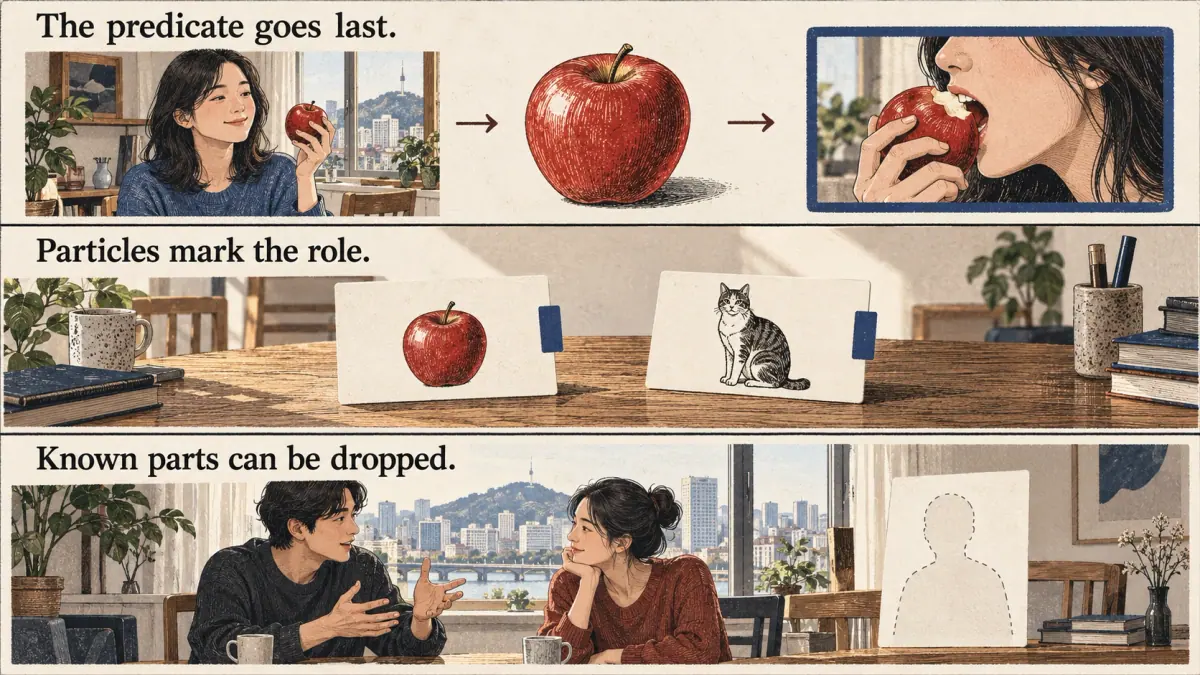
Korean sentence structure is the way a Korean sentence is built from nouns, particles and a final predicate. A particle (조사, josa) is a short word attached to a noun that shows its job, such as subject or object. The predicate (서술어) is the verb, descriptive verb or 이다 that closes the sentence.
Three rules produce nearly every beginner sentence:
- The predicate goes last. 사과를 먹어요 ends with 먹어요 (eat).
- Particles mark the role. 가 or 이 marks the subject, 는 or 은 the topic, and 를 or 을 the object.
- Known parts can be dropped. If the listener already knows who is speaking, 저는 can be left out.
English works differently, as the comparison below shows.
How Does Korean Sentence Structure Differ from English?

Korean sentence structure differs from English because English uses position to show roles and Korean uses particles. In English "I eat an apple", the order subject, verb, object (SVO) shows who eats what. In Korean, particles show the roles, so the verb can go last without losing meaning.
| English (SVO) | Korean (SOV) | Word by word |
|---|---|---|
| I eat an apple. | 저는 사과를 먹어요. | I (topic) apple (object) eat |
| The weather is nice. | 날씨가 좋아요. | weather (subject) is good |
| I am a student. | 저는 학생이에요. | I (topic) student am |
The most common first mistake is putting the verb in the middle, as English does. 먹어요 사과를 저는 sounds like a spoken afterthought, while 저는 사과를 먹어요 is the standard order. The lessons below teach each part of the structure in an order that builds one on the next.
Where Should You Start with Korean Sentence Structure?
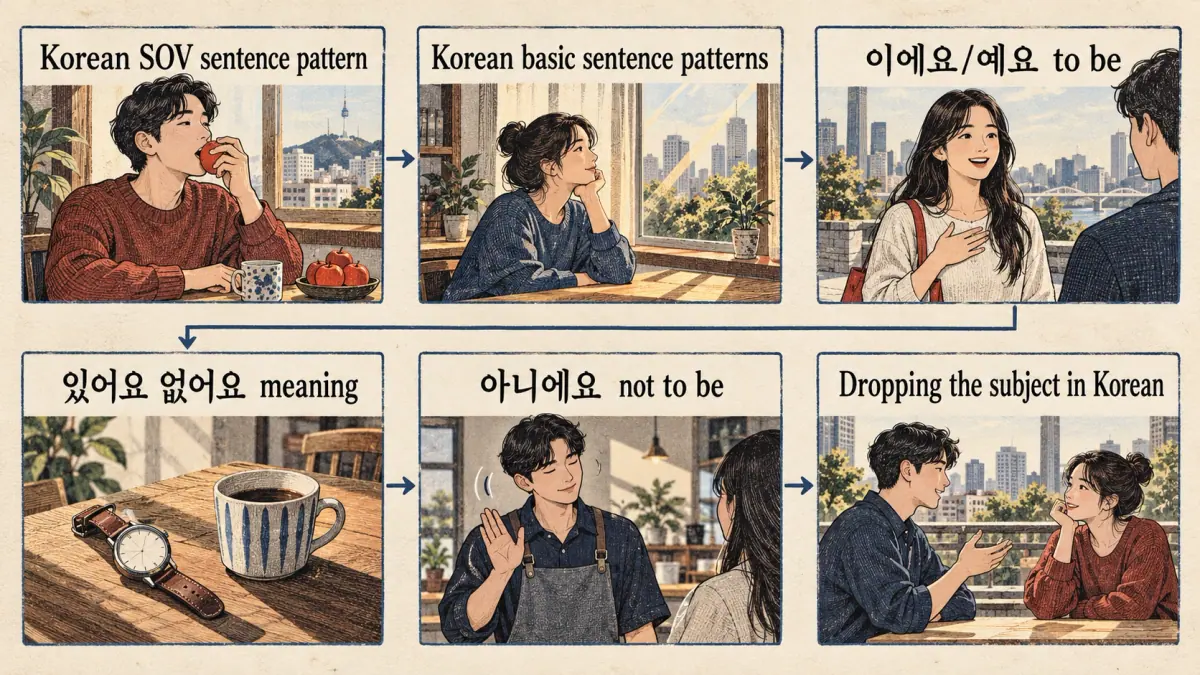
Start with the subject-object-verb lesson, then follow the six lessons in this order. Each lesson reuses the idea from the one before.
- Korean SOV sentence pattern: why the predicate comes last and how particles carry the roles.
- Korean basic sentence patterns: five frames that cover most beginner speech.
- 이에요/예요 to be: saying what something is.
- 있어요 없어요 meaning: saying what exists, what is absent and what you have.
- 아니에요 not to be: saying what something is not.
- Dropping the subject in Korean: leaving out words the listener already knows.
If you also want to know which parts can move around, the sibling hub Korean word order covers flexible order, and Korean parts of speech covers the word classes.
Browse by Topic
Each lesson below has a short summary, one example sentence with audio and a link. The summaries say what the lesson covers, so you can pick before you click.
Korean SOV Sentence Pattern
The SOV lesson explains why Korean puts the predicate last and how particles keep the meaning clear when the order changes. It compares English "I eat an apple" with Korean "I apple eat" and builds one sentence step by step. Example: 저는 사과를 먹어요. (jeoneun sagwareul meogeoyo.) "I eat an apple."
Open the SOV sentence pattern lesson.
Korean Basic Sentence Patterns
The basic patterns lesson teaches five frames: identity, existence, quality, action and action on a thing. Each frame answers one question, such as "what is it?" or "who does what?". Example: 날씨가 좋아요. (nalssiga joayo.) "The weather is nice."
Open the basic sentence patterns lesson.
이에요/예요 to Be
The 이에요/예요 lesson covers the polite "to be": 이에요 after a consonant and 예요 after a vowel. It shows how to introduce yourself and name things, and how the casual 이야 differs. Example: 저는 학생이에요. (jeoneun haksaengieyo.) "I am a student."
있어요 없어요 Meaning
The existence lesson teaches 있어요 (there is) and 없어요 (there is not), and shows how the same words express having and not having. Example: 시간이 없어요. (sigani eopseoyo.) "I have no time."
아니에요 Not to Be
The 아니에요 lesson teaches the negative of 이에요: noun + 이/가 + 아니에요. It separates 아니에요 from 아니요 ("no") and from 안 + verb. Example: 저는 학생이 아니에요. (jeoneun haksaengi anieyo.) "I am not a student."
Dropping the Subject in Korean
The subject-omission lesson explains when Korean speakers leave out the subject and object, and how listeners recover them from context. Example: 네, 학생이에요. (ne, haksaengieyo.) "Yes, I am a student," with "I" understood.
Open the dropping the subject lesson.
Which Lesson Fits Your Sentence?
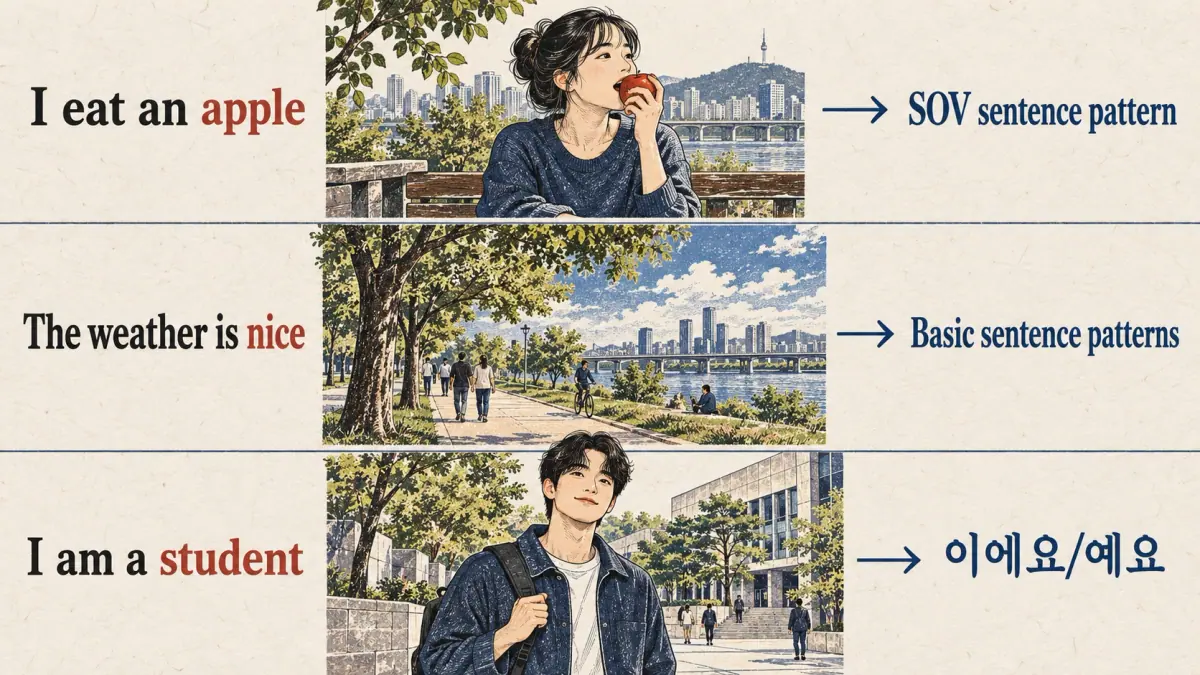
Pick the lesson by what you want to say. The table maps six sentence goals to the lesson that solves each one.
| You want to say | Open this lesson | First thing you will learn |
|---|---|---|
| "I eat an apple" | SOV sentence pattern | The predicate goes last |
| "The weather is nice" | Basic sentence patterns | Five frames and the question each answers |
| "I am a student" | 이에요/예요 | 이에요 after a consonant, 예요 after a vowel |
| "There is a book", "I have no time" | 있어요/없어요 | The existence words double as "have" |
| "This is not my book" | 아니에요 | Noun + 이/가 + 아니에요 |
| "Yes, (I) am" with nothing else said | Dropping the subject | Leave out what the listener knows |
How Do You Practise Korean Sentence Structure?
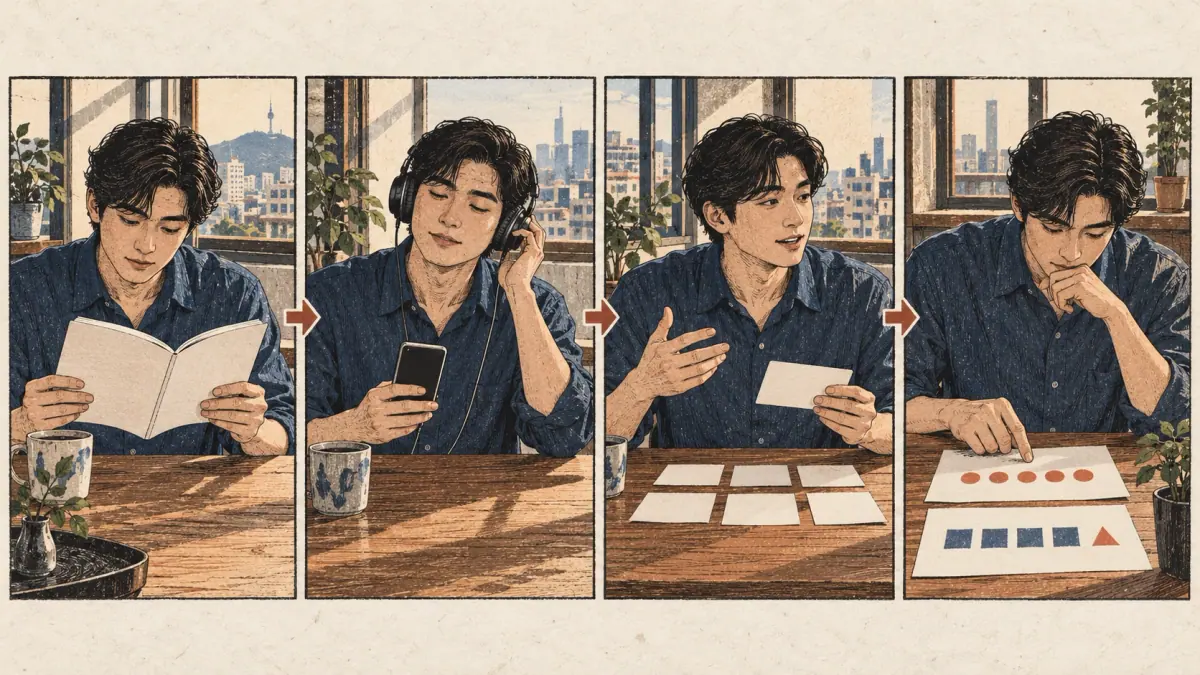
Practise by building sentences, not only reading them. Each lesson ends with four practice items and an answer key, and some add a sentence builder or a short quiz.
- Take the Korean grammar quizzes after each lesson to check frame recognition.
- Review the example words with the Korean flashcards.
- Move to the word classes in Korean parts of speech, where nouns, pronouns and descriptive verbs are taught in detail.
A practical routine is one lesson per session: read, play every audio clip twice, build the sentence yourself, then check the answers.
What Korean Sentence Structure Does Not Cover
The Korean sentence structure set covers present polite sentences with one predicate. It does not cover tenses, speech levels beyond a first mention, questions, or joined sentences. Those topics have their own sections: Korean tenses, Korean speech levels and Korean particles. This hub belongs to the wider basic Korean grammar set.
Work through the six lessons in order, and Korean sentence structure turns from a list of rules into one frame you can fill with any noun.
Frequently Asked Questions
Can a Korean sentence leave out the subject? Yes. Korean drops the subject, and often the object, whenever the listener can work them out from context. 학생이에요 can mean 'I am a student', 'you are a student' or 'she is a student'. Only the predicate at the end is needed in everyday speech. The lesson on dropping the subject gives the rules.
How do I say "I am a student" in Korean? Say 저는 학생이에요. The parts are 저 (I, polite), 는 (topic particle), 학생 (student) and 이에요 (the polite form of 'to be'). The verb-like ending comes last, as in every Korean sentence. With a friend, use the casual 나는 학생이야 instead.
Which lesson in Korean sentence structure should I read first? Read the subject-object-verb lesson first, because every other lesson assumes the predicate-last order and the idea of particles. Then follow the list: basic patterns, 이에요/예요, 있어요/없어요, 아니에요 and dropping the subject. Each lesson takes about 15 to 30 minutes, so the full set needs roughly two hours of study time.
What level is Korean sentence structure? Level A1, the starting level. You need to read Hangul and nothing else. These six lessons give you the frames for introducing yourself, saying what exists and saying what is not. Later sections such as tenses, speech levels and connectors build on the frames taught here.