The topic particle 은/는 is a Korean grammar marker attached to a noun to show what a sentence is about, often with a sense of contrast. Use 은 after a final consonant (책은) and 는 after a vowel (저는). After this lesson you can pick the right form, build a sentence with it, and avoid the most common mistakes.
What you'll learn
- Choose 은 or 는 correctly for any noun by checking its final sound.
- Build a self-introduction sentence such as 저는 학생이에요 from its parts.
- Explain the contrast meaning in 커피는 마셔요.
- Diagnose the error in 누구는 왔어요? and fix it.
Before you start: you can read Hangul blocks and know basic Korean word order. Estimated time: 20 minutes.
What Does the Topic Particle 은/는 Mean?

The topic particle 은/는 means roughly "as for X" or "speaking of X". It tells the listener which thing the rest of the sentence talks about. A particle (조사, josa) is a short ending glued to a word to show its job in the sentence, a little like a label on a box.
English has no single word for the topic particle. English shows the topic mostly through word order and stress. Korean shows it with a sound attached to the noun. When a Korean speaker says 저는, the listener hears "as for me, here is something about me".
The topic is often, but not always, the same thing as the grammatical subject. In 저는 학생이에요, "I" is both the topic and the subject. Later in this lesson you will see sentences where the topic and the subject are different words.
A First Example
The two sentences below show 은/는 on two different nouns. Read the Korean first, then the romanization, then the meaning.
- 저는 학생이에요. (jeoneun haksaengieyo) [저는 학쌩이에요] = "I am a student." Word by word: 저 (I, polite) + 는 (topic) + 학생 (student) + 이에요 (am).
- 이 책은 재미있어요. (i chaegeun jaemiisseoyo) [이 채근 재미이써요] = "This book is interesting." Word by word: 이 (this) + 책 (book) + 은 (topic) + 재미있어요 (is interesting).
Notice two things. First, 저 ends in a vowel, so it takes 는, while 책 ends in the consonant ㄱ, so it takes 은. Second, in 책은 the ㄱ slides into the next syllable and sounds like [채근]. That sound change is called liaison, and it happens whenever 은 follows a final consonant other than ㅇ. Final ㅇ stays in place, so 학생은 is said [학쌩은]. With the meaning in place, the next question is why Korean needs this marker at all.
Why Does Korean Need a Topic Particle?

Korean needs a topic particle because word order alone does not show who does what. Korean puts the verb at the end and lets the other words move around fairly freely. Particles carry the information that English packs into word order.
Here is a quick comparison. In English, "The cat sees the dog" and "The dog sees the cat" differ only in order. In Korean, the particles do that work, so the order can change while the meaning stays the same. If you have not met this idea yet, the lesson on the korean sov sentence pattern explains subject–object–verb order step by step.
The topic particle adds one more layer. It does not say "this is the doer". It says "this is what we are talking about". That lets a speaker set the scene first and then comment on it: 오늘은 바빠요 (oneureun bappayo) means "As for today, I'm busy." Today is not doing anything; it is the frame for the comment. Now that the purpose is clear, the next step is the form rule.
How Does the Topic Particle 은/는 Work?
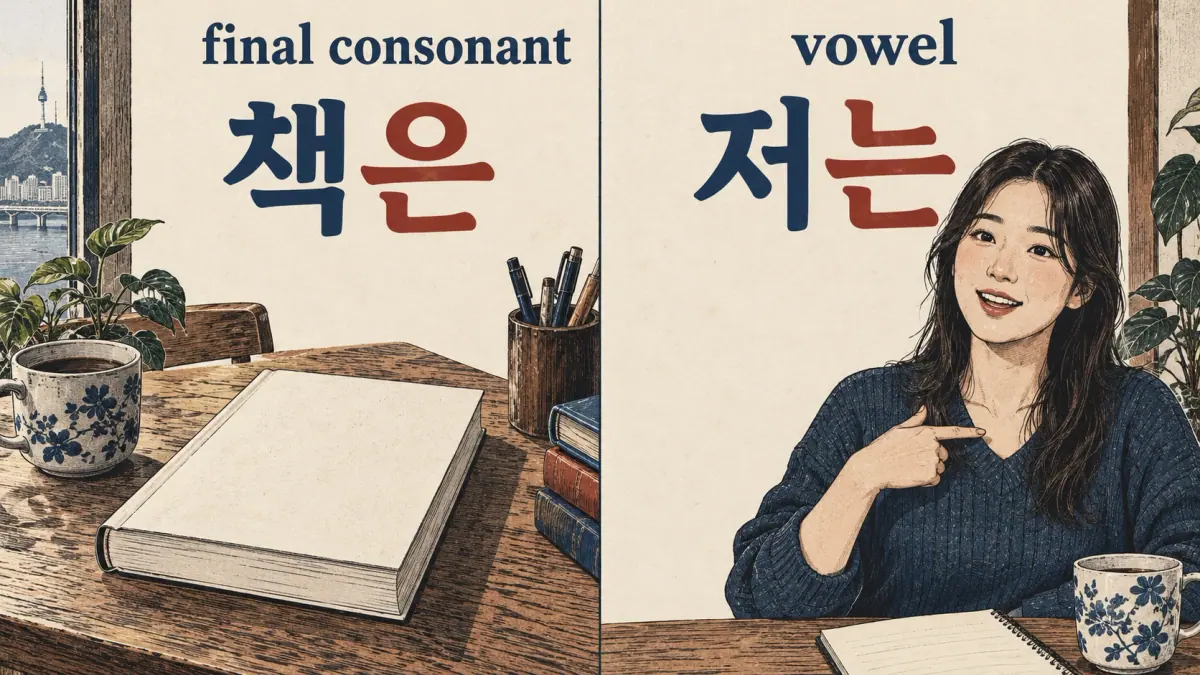
The topic particle 은/는 has two forms, and the choice depends only on the last sound of the noun. Meaning plays no part in the choice between 은 and 는.
- Look at the last syllable block of the noun.
- If that block has a final consonant (받침, batchim), add 은.
- If that block ends in a vowel, add 는.
- Write the particle with no space: 책은, not 책 은.
The final consonant is the letter at the bottom of a syllable block, such as the ㄱ in 책 or the ㄹ in 서울. A beginner-friendly test: if the last block has a letter underneath, use 은.
Pattern Table
The table shows common nouns with their topic forms and the way each one sounds. Brackets show pronunciation where it differs from the spelling.
| Noun | Last block ends in | Topic form | Pronunciation | Meaning |
|---|---|---|---|---|
| 저 | vowel ㅓ | 저는 | [저는] | as for me (polite) |
| 나 | vowel ㅏ | 나는 | [나는] | as for me (casual) |
| 친구 | vowel ㅜ | 친구는 | [친구는] | as for my friend |
| 커피 | vowel ㅣ | 커피는 | [커피는] | as for coffee |
| 학생 | consonant ㅇ | 학생은 | [학쌩은] | as for the student |
| 책 | consonant ㄱ | 책은 | [채근] | as for the book |
| 오늘 | consonant ㄹ | 오늘은 | [오느른] | as for today |
| 사람 | consonant ㅁ | 사람은 | [사라믄] | as for the person |
| 서울 | consonant ㄹ | 서울은 | [서우른] | as for Seoul |
The vowel and consonant split mirrors other particle pairs you will meet, such as 이/가 and 을/를. In each pair, the form that starts with a vowel sound (은, 이, 을) follows a consonant, which keeps the syllables easy to say.
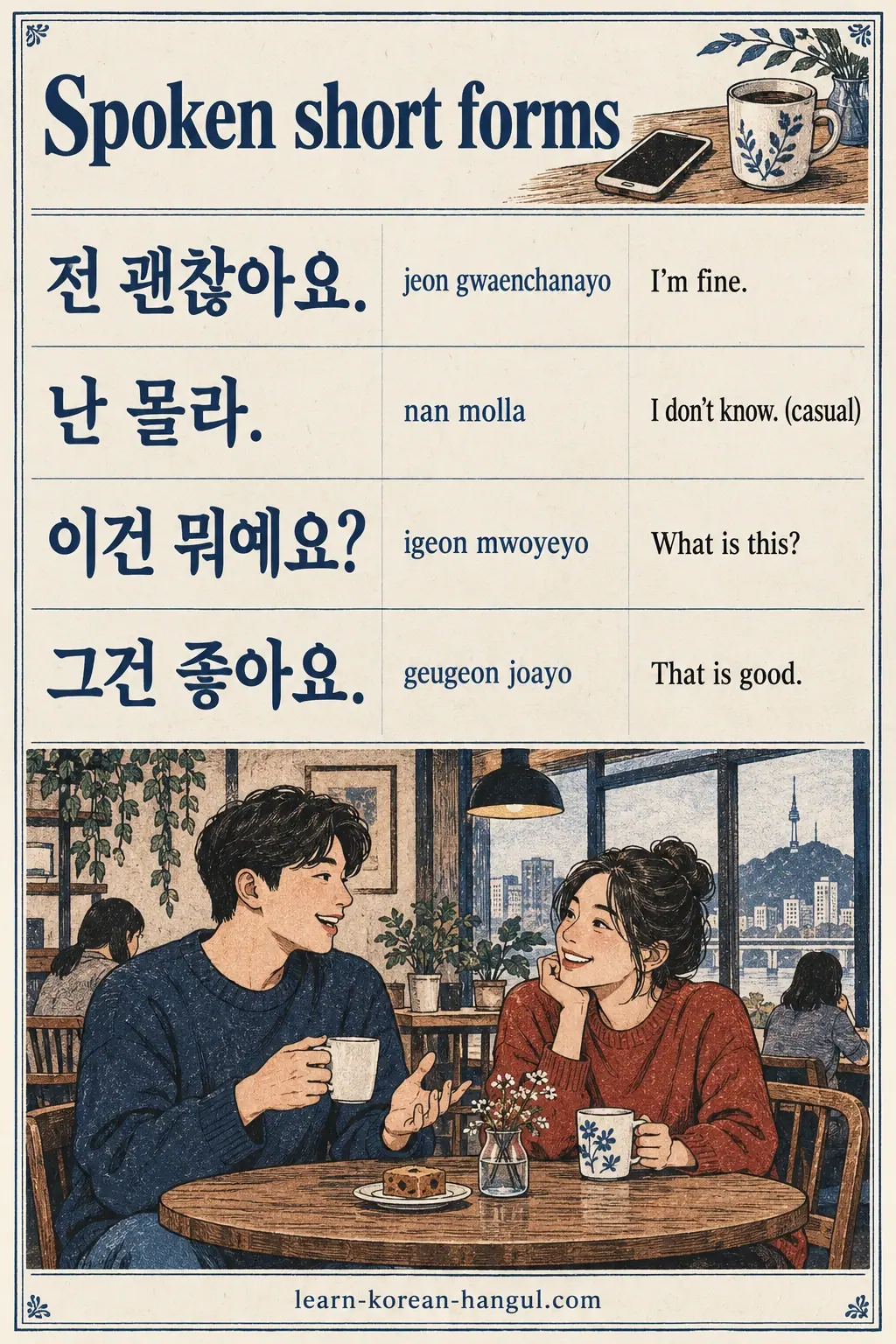
Spoken Short Forms
In everyday speech, 는 often shrinks to a single ㄴ attached to the noun. These short forms are normal in conversation and in casual writing such as text messages.
| Full form | Short form | Example |
|---|---|---|
| 저는 | 전 | 전 괜찮아요. (jeon gwaenchanayo) = I'm fine. |
| 나는 | 난 | 난 몰라. (nan molla) = I don't know. (casual) |
| 이것은 | 이건 | 이건 뭐예요? (igeon mwoyeyo) = What is this? |
| 그것은 | 그건 | 그건 좋아요. (geugeon joayo) = That is good. |
Use the full forms in formal writing and in exam answers. Recognize the short forms when you listen, because native speakers use them constantly.
What 은/는 Can Replace and Join
The topic particle can replace the subject particle 이/가 and the object particle 을/를. It can also sit after other particles such as 에 (at, to) and 에서 (in, from).
- Replacing 을/를: 커피를 마셔요 (I drink coffee) becomes 커피는 마셔요 (Coffee, I do drink).
- Replacing 이/가: 날씨가 좋아요 (The weather is nice) becomes 날씨는 좋아요 (The weather, at least, is nice).
- After 에: 서울에는 친구가 많아요. (seoureneun chinguga manayo) = In Seoul, I have many friends.
The topic particle never stacks directly after 이/가 or 을/를. Forms such as 커피를는 do not exist. Combinations with location and direction particles have their own lesson on combining particles 에는 에서도 에게만. The form rule is now complete, so the next section builds one sentence from scratch.
Worked Example, Step by Step

This worked example builds 저는 학생이에요 ("I am a student") from its parts. Each step names one decision, so you can repeat the process with any noun.
- Choose the topic. You want to talk about yourself to someone you do not know well, so use the polite word 저 (I).
- Check the last sound of the topic. 저 ends in the vowel ㅓ, with no letter underneath.
- Pick the particle form. A vowel ending takes 는, so the topic is 저는.
- Choose the comment. You want to say "student", which is 학생.
- Add "to be". 학생 ends in the consonant ㅇ, so it takes 이에요, giving 학생이에요. The lesson on 이에요/예요 to be explains this ending.
- Put the verb part last. Korean ends with the predicate: 저는 학생이에요.
- Say it aloud. 학생 is pronounced [학쌩], with a tense ㅆ sound, so the whole sentence is [저는 학쌩이에요].
You'll know it worked when you can swap the parts and still choose correctly. Try 제 친구 (my friend): it ends in a vowel, so 제 친구는 학생이에요 (My friend is a student). Try 민준 (a name): it ends in ㄴ, so 민준은 학생이에요. The same steps also handle the two most common uses of the particle, which the next section compares with its closest neighbour.
How Is 은/는 Different from 이/가?

The topic particle 은/는 marks a known or contrasted topic, while the subject particle 이/가 marks a subject that is new, specific or in focus. Both can attach to the same noun, so the choice changes the message, not the grammar.
| 은/는 (topic) | 이/가 (subject) | |
|---|---|---|
| Main job | sets what the sentence is about | marks who or what does or is something |
| Information | known, shared, or contrasted | new, specific, or the focus |
| Answers "who?" | no | yes: 누가 왔어요? 민수가 왔어요. |
| Self-introduction | yes: 저는 민수예요. | only to answer "who is Minsu?" |
| Contrast | yes: 커피는 마셔요. | no |
| Example | 저는 학생이에요. = As for me, I'm a student. | 제가 학생이에요. = I'm the student (it's me). |
A short test helps. If someone asks 누가 학생이에요? (Who is the student?), the answer is 제가 학생이에요 with 이/가, because "me" is the new information. If you are introducing yourself, the answer is 저는 학생이에요 with 은/는, because you are the topic. The full rule set, with more pairs and a decision guide, is in 은/는 vs 이/가. The form 이/가 itself has its own lesson on the subject particle 이/가.
The two particles can also appear in one sentence. In 저는 머리가 아파요 (jeoneun meoriga apayo), "As for me, my head hurts", 저 is the topic and 머리 (head) is the subject. This pattern is covered in the lesson on the double subject construction in korean. With that contrast in mind, the next section lists when to use 은/는 and when to avoid it.
When Do You Use 은/는, and When Not?

Use 은/는 for introductions, topic changes, contrasts and general statements. Avoid it on question words, on the answer to a who or what question, and inside describing clauses.
Four Uses of 은/는
Each use comes with one example sentence you can reuse.
- Introducing the topic. 저는 캐나다 사람이에요. (jeoneun kaenada saramieyo) = I'm Canadian.
- Changing the topic. After someone talks about themselves, you ask 그럼 민수 씨는요? (geureom minsu ssineunyo) = And what about you, Minsu?
- Showing contrast. 커피는 마셔요. 그런데 차는 안 마셔요. = Coffee, I drink. But tea, I don't drink.
- General statements and definitions. 고래는 포유류예요. (goraeneun poyuryuyeyo) = Whales are mammals.
The Contrast Meaning in Detail
The contrast use is the one learners miss most often. 커피는 마셔요 on its own means "I drink coffee", but with a hint: "coffee, at least" or "coffee, as opposed to something else". A listener may wait for the second half: what don't you drink? Speakers may stress the particle slightly when they mean contrast.
The contrast reading becomes stronger when 은/는 replaces an object or a time word. 오늘은 바빠요 can mean "Today I'm busy (but another day I'm free)." If you only want to say "I drink coffee" with no hint, use the object particle: 커피를 마셔요.
Three Places to Avoid 은/는
- On question words. Words such as 누구 (who) and 뭐 (what) take 이/가 when they are the subject: 누가 왔어요? (Who came?), not 누구는 왔어요?
- On the answer to that question. The answer carries the new information, so it also takes 이/가: 민수가 왔어요 (Minsu came).
- Inside a describing clause. When a short clause describes a noun, its subject takes 이/가: 제가 만든 김치 (the kimchi that I made), not 저는 만든 김치.
Speech and Writing
The topic particle 은/는 is used in every register: casual talk, polite talk, news, essays and official documents. Only the short forms 전, 난 and 이건 belong mainly to speech and casual writing. Knowing the uses is half the job; the other half is spotting the mistakes covered next.
What Mistakes Do Learners Make with 은/는?
Learners usually make five predictable mistakes with 은/는. Each one below follows the pattern "learners often assume X; actually Y, because Z".
- "은/는 means 'is'." Learners often assume 저는 means "I am". Actually 는 only marks the topic, and "am" is 이에요. The proof: 저는 가요 means "I go", with no "am" anywhere.
- Choosing the form by meaning. Learners often think 은 is for things and 는 is for people. Actually only the final sound matters: 책은 (book) and 학생은 (student) both use 은, while 커피는 (coffee) and 친구는 (friend) both use 는.
- Using 은/는 on question words. Learners often say 누구는 왔어요? Actually question words that are subjects take 이/가, because a question word asks for new information: 누가 왔어요?
- Putting 저는 in every sentence. Learners often start each sentence with 저는. Actually Korean drops a topic everyone already knows. After 저는 학생이에요, the next sentence can be just 한국어를 공부해요 (I study Korean). The lesson on omitting particles in korean shows when particles and topics can go.
- Expecting no contrast. Learners often use 은/는 on an object without meaning anything special. Actually 김치는 먹어요 suggests "kimchi, at least, I eat", and a Korean listener may ask what you don't eat.
A rule of thumb: when in doubt in a first sentence about yourself, use 저는. When in doubt in an answer to "who?", use 이/가. Those two defaults fix most beginner errors. The practice set below tests them.
Practice and Answers
These four exercises check the outcomes listed at the top of the lesson. Write or say your answers first, then check them in the answer key.
Practice · 8
Which topic form is correct for 선생님 (teacher)?
Show answer
선생님은
선생님 ends in the consonant ㅁ, so it takes 은, written with no space.
Which topic form is correct for 우유 (milk)?
Show answer
우유는
우유 ends in a vowel, so it takes 는, written with no space.
What decides whether you use 은 or 는?
Show answer
The last sound of the noun
Only the final sound matters: 은 after a final consonant, 는 after a vowel.
Which sentence correctly says "As for today, I'm busy"?
Show answer
오늘은 바빠요.
오늘 ends in ㄹ, so the topic form is 오늘은.
Which question correctly asks "Who is the student?"
Show answer
누가 학생이에요?
A question word used as the subject takes 이/가, not 은/는, and 누구 + 가 shortens to 누가.
Someone asks 누가 왔어요? and you simply want to answer "Minsu came." Which answer fits?
Show answer
민수가 왔어요.
The answer to a who question carries the new information, so it takes 이/가.
What hint does 커피는 마셔요 carry?
Show answer
Coffee, at least, I drink (perhaps not other drinks)
은/는 on an object adds contrast; for a plain "I drink coffee" use 커피를 마셔요.
What is the spoken short form of 저는?
Show answer
전
In speech 는 shrinks to a final ㄴ: 저는 becomes 전, while 난 comes from 나는 and 이건 from 이것은.
Exercise 1: Choose the form. Add 은 or 는.
- 선생님__ (teacher)
- 우유__ (milk)
- 한국어__ (Korean language)
- 이름__ (name)
Exercise 2: Fix the error. Each sentence has one particle problem.
- 누구는 학생이에요?
- 책는 재미있어요.
Exercise 3: Translate. "As for today, I'm busy." (busy = 바빠요)
Exercise 4: Write your own. Write two sentences that contrast two foods, one you eat and one you don't eat. Use 은/는 on both foods and 안 (not) before the second verb.
Answer Key
- Exercise 1: 1 선생님은 (ends in ㅁ) [선생니믄]. 2 우유는 (ends in a vowel). 3 한국어는 (어 ends in a vowel) [한구거는]. 4 이름은 (ends in ㅁ) [이르믄].
- Exercise 2: 1 누가 학생이에요? A question word that is the subject takes 이/가, and 누구 + 가 shortens to 누가. 2 책은 재미있어요. 책 ends in ㄱ, so it needs 은.
- Exercise 3: 오늘은 바빠요. (oneureun bappayo) 오늘 ends in ㄹ, so it takes 은.
- Exercise 4: One model answer: 고기는 먹어요. 그런데 생선은 안 먹어요. (gogineun meogeoyo. geureonde saengseoneun an meogeoyo) = Meat, I eat. But fish, I don't eat. Any pair is correct if each food has the right form of 은/는.
If you missed Exercise 1, return to the pattern table and say each noun aloud. If you missed Exercise 2, reread the section on where to avoid 은/는. The next section points to where to go from here.
Next Lessons and Where to Go from Here
The natural next lesson is the subject particle 이/가, which covers the marker for new information and for answers to "who?" After that, 은/는 vs 이/가 puts the two side by side with a one-line decision rule and more practice.
What this lesson does not cover. This lesson does not cover the honorific subject particle 께서, the full rules for dropping particles in speech, or every combination with other particles. Those topics live in the other lessons of korean topic and subject particles, where each form has its own page with audio and practice.
In short, the topic particle 은/는 tells your listener what you are talking about: 은 after a consonant, 는 after a vowel, and a hint of contrast whenever another option is in the air.
Frequently Asked Questions
Can I use 은/는 twice in one sentence? Yes. A sentence can have a main topic and a second, contrasted word. In 저는 커피는 마셔요, 저는 marks the topic (me) and 커피는 adds contrast: I drink coffee, at least, perhaps not other drinks. Using 은/는 twice without any contrast in mind sounds odd, so add the second one only when you mean it.
Why do Koreans say 전 instead of 저는? 전 is the spoken short form of 저는: the particle 는 shrinks to a final ㄴ under 저. The same happens in 난 (나는), 이건 (이것은) and 그건 (그것은). The short forms are normal in conversation and text messages. Use the full forms in formal writing, emails to strangers and exam answers.
Do I use 은/는 in speech, writing or both? Both. The topic particle 은/는 appears in casual chat, polite conversation, news reports, essays and official documents. The particle itself does not change with politeness. What changes is the sentence ending, for example 저는 학생이에요 in polite speech and 저는 학생입니다 in formal speech. Only the short forms such as 전 lean casual.
Does 은/는 change with the speech level? No. 은/는 has the same two forms at every speech level, from casual 나는 학생이야 to formal 저는 학생입니다. Politeness in Korean is carried by the word for I (나 or 저) and by the verb ending, not by the topic particle. Choose 은 or 는 only by the final sound of the noun.
Is 은/는 the same as "the" in English? No, although the two overlap. 은/는 often marks something both speakers already know, which English marks with the. But 은/는 also marks general statements such as 고래는 포유류예요 (Whales are mammals) and contrasts, which have nothing to do with the. Korean has no articles, so treat 은/는 as a topic marker.