What you'll learn
- Attach -아/어서 to any verb, adjective or 이다.
- Tell its two meanings apart: reason and "and then".
- Remember what cannot go inside it, and what cannot follow it.
- Choose between -아/어서, -(으)니까 and -고.
Prerequisites: the polite ending -아요/어요, and the lesson on -고. Time: about 15 minutes.
Key facts
- -아/어서 uses the same vowel rule as -아요/어요, so you may already know it.
- It has two meanings: a reason ("because, so") and a sequence ("and then").
- Past, future and guess markers do not go inside it. They go on the last verb only.
- In the reason meaning, a command or suggestion cannot follow it.
- It is built into many daily phrases, such as 만나서 반갑습니다.
Listen to two model sentences, one for each meaning.
The next section defines the pattern.
What Does -아/어서 Grammar Mean?

-아/어서 is a connective ending, an ending that joins one clause to the next. It links a cause to its result, or one action to the action that follows.
Meaning 1: reason. The first clause is the cause and the last clause is the result. 비가 와서 집에 있었어요: the rain caused you to stay in. The cause is presented as a plain fact, with no argument.
Meaning 2: and then. The first clause is an action that leads to the next one. In 서울에 가서 친구를 만났어요, going to Seoul comes first, and meeting a friend follows, in that place. The two actions are closely connected. The result of the first action, being in Seoul, stays true during the second.
| Part | 비가 와서 집에 있었어요. | 서울에 가서 친구를 만났어요. |
|---|---|---|
| First clause | 비가 와서 (it rained, so) | 서울에 가서 (I went to Seoul, and then) |
| Second clause | 집에 있었어요 (I stayed home) | 친구를 만났어요 (I met a friend) |
| Meaning | reason | and then |
| Spoken | [비가 와서 지베 이써써요] | [서우레 가서 친구를 만나써요] |
| RR (aid) | biga waseo jibe isseosseoyo | seoure gaseo chingureul mannasseoyo |
| English | It rained, so I stayed home. | I went to Seoul and met a friend. |
One short test helps. If you can put "because" in the English sentence, it is the reason use. If you can put "and then" or "and there," it is the sequence use. Some sentences can be read both ways, and that is fine. The next section shows how to build the form.
How Do You Form -아/어서?
The rule follows the last vowel of the stem. The stem is the dictionary form without 다. For 먹다 the stem is 먹.
- If the last vowel is ㅏ or ㅗ, add 아서.
- If it is any other vowel, add 어서.
- For 하다 words, use 해서.
- When the stem ends in a vowel, the vowels often merge.
Stems Ending in a Vowel
A vowel stem merges with 아 or 어, which makes the word shorter.
| Dictionary form | Stem | Result | RR (aid) | Note |
|---|---|---|---|---|
| 가다 (go) | 가 | 가서 | gaseo | 가 + 아서 merges |
| 오다 (come) | 오 | 와서 | waseo | 오 + 아서 becomes 와서 |
| 사다 (buy) | 사 | 사서 | saseo | 사 + 아서 merges |
| 만나다 (meet) | 만나 | 만나서 | mannaseo | merges |
| 서다 (stand) | 서 | 서서 | seoseo | 서 + 어서 merges |
| 마시다 (drink) | 마시 | 마셔서 | masyeoseo | 시 + 어서 becomes 셔서 |
| 주다 (give) | 주 | 줘서 | jwoseo | 주 + 어서 becomes 줘서 |
| 배우다 (learn) | 배우 | 배워서 | baewoseo | 우 + 어서 becomes 워서 |
| 공부하다 (study) | 공부하 | 공부해서 | gongbuhaeseo | 하다 becomes 해서 |
| 피곤하다 (be tired) | 피곤하 | 피곤해서 | pigonhaeseo | 하다 becomes 해서 |
Stems Ending in a Consonant
A consonant stem keeps its final consonant, and the ending is added after it.
| Dictionary form | Last vowel | Result | Spoken | RR (aid) |
|---|---|---|---|---|
| 앉다 (sit) | ㅏ | 앉아서 | [안자서] | anjaseo |
| 좋다 (be good) | ㅗ | 좋아서 | [조아서] | joaseo |
| 많다 (be many) | ㅏ | 많아서 | [마나서] | manaseo |
| 먹다 (eat) | ㅓ | 먹어서 | [머거서] | meogeoseo |
| 읽다 (read) | ㅣ | 읽어서 | [일거서] | ilgeoseo |
| 있다 (exist) | ㅣ | 있어서 | [이써서] | isseoseo |
| 늦다 (be late) | ㅡ | 늦어서 | [느저서] | neujeoseo |
Note how the final consonant moves across to the next syllable in speech. 늦어서 sounds like [느저서], and the ㅈ is plain. RR writes neujeoseo. The same happens with 좋아서, where the ㅎ is silent before a vowel: [조아서].
Irregular Stems and Nouns
Irregular stems change just as they do before -아요/어요.
| Type | Dictionary form | With -아/어서 | Note |
|---|---|---|---|
| ㅂ | 덥다 (be hot) | 더워서 | ㅂ becomes 우 |
| ㅂ | 어렵다 (be hard) | 어려워서 | ㅂ becomes 우 |
| ㄷ | 듣다 (listen) | 들어서 | ㄷ becomes ㄹ |
| 르 | 모르다 (not know) | 몰라서 | 르 becomes ㄹ라 |
| ㅅ | 낫다 (get better) | 나아서 | ㅅ drops |
| ㅎ | 그렇다 (be so) | 그래서 | ㅎ drops, ㅓ becomes ㅐ |
| ㅡ | 바쁘다 (be busy) | 바빠서 | ㅡ drops |
| ㅡ | 아프다 (be sick) | 아파서 | ㅡ drops |
| ㅡ | 크다 (be big) | 커서 | ㅡ drops |
| ㅡ | 쓰다 (write) | 써서 | ㅡ drops |
| ㄹ | 살다 (live) | 살아서 | ㄹ stays |
| ㄹ | 만들다 (make) | 만들어서 | ㄹ stays |
The word 그래서 is also the sentence word "so" or "and so", used to start a new sentence. 비가 왔어요. 그래서 집에 있었어요. It uses the same ending.
For nouns, use (이)라서, the form of 이다. After a consonant use 이라서, and after a vowel use 라서: 학생이라서, 의사라서. 학생이라서 is said [학쌩이라서]. The regular form 이어서 / 여서 is also standard and is common in writing: 학생이어서, 의사여서. The negative is 아니라서 or 아니어서. A noun reason can also be given with 때문에, which has its own page: -기 때문에.
The next section builds a full sentence.
Worked Example: Building 비가 와서 집에 있었어요

Say that it rained, so you stayed home. Follow five steps.
- Write the cause. "It rains" is 비가 오다. The stem is 오.
- Check the last vowel. 오 has ㅗ, so the ending is 아서.
- Merge the vowels. 오 + 아서 becomes 와서. Do not put a tense marker here, because "rained" will be shown later.
- Write the result in the past. "I stayed home" is 집에 있었어요. The past marker 었 goes here, on the last verb.
- Join the parts. 비가 와서 집에 있었어요.
You'll know it worked when the first verb ends in 서 with no 았/었 inside it, and the last verb carries the tense and the polite ending 요. The same steps give 길이 막혀서 늦었어요 ("The road was jammed, so I was late").
Sentence
It rained, so I stayed home.
Show answer
비가 와서 집에 있었어요
The next section covers tense and sentence types.
Which Tenses and Sentence Types Work with -아/어서?
The grid shows what can go inside the ending, and what can follow it. Where the reason use and the sequence use differ, both columns are shown.
| Slot | Reason ("because") | Sequence ("and then") |
|---|---|---|
| Past 았/었 inside | no | no |
| Future or guess 겠 inside | no | no |
| Honorific -(으)시- inside | yes: 와 주셔서 | yes: 일어나셔서 |
| Same subject in both clauses | not required | yes |
| Statement after | yes | yes |
| Question after | yes | yes |
| Command after | no | yes: 앉아서 기다리세요 |
| Suggestion after | no | yes: 앉아서 이야기해요 |
Two rules explain the grid. First, the ending carries no tense of its own. It borrows the tense of the last verb. So 비가 와서 집에 있었어요 is understood as past because 있었어요 is past. Writing 왔어서 is not standard Korean.
Second, in the reason use, the ending states a cause as a fact. A command or suggestion depends on the speaker's choice, so it does not fit a fact-based cause. 피곤해서 쉬세요 sounds unnatural. Use -(으)니까 there: 피곤하니까 쉬세요 ("You are tired, so rest"). In the sequence use, the first action is just an earlier step, so a command after it is fine.
Yes/no questions end with a rise: 비가 와서 늦었어요? A wh-question puts the stress on the question word and often ends with a fall or a rise-fall, rather than a sharp rise: 왜 늦었어요? A reason answer to that question is 길이 막혀서요, which ends in 요 with no more clause. Both are correct.
The next section compares -아/어서 with its neighbours.
How Is -아/어서 Different from -(으)니까?

Both can be translated as "because." The difference is in what the speaker is doing with the reason.
| Feature | -아/어서 | -(으)니까 | -기 때문에 | -고 |
|---|---|---|---|---|
| Core idea | plain cause and effect | the speaker's reason | firm, stated reason | and; and then |
| Tense inside | no | yes | yes | yes |
| Followed by a command | no (reason) | yes | rarely | yes |
| Thanks or apology | yes | no | no | no |
| Register | everyday | everyday | formal or firm | every setting |
| Example | 비가 와서 집에 있어요. | 비가 오니까 집에 있으세요. | 비가 오기 때문에 집에 있어요. | 비가 오고 바람이 불어요. |
The key test is what comes after the connector. If you want to command or suggest, choose -(으)니까. If you want to say thanks or sorry, choose -아/어서.
- 늦어서 죄송합니다. "I'm sorry I'm late." Being late is the cause of the apology, a plain fact.
- 늦었으니까 서두르세요. "We're late, so hurry." The command needs -(으)니까, and 늦었 shows the past inside it.
For -고 the question is whether the two events are connected. 밥을 먹고 학교에 갔어요 only lists two separate actions in order. 서울에 가서 친구를 만났어요 ties them: the friend was met in Seoul. If the second action does not depend on the first, use -고, as in -고 vs -아/어서.
For a full side-by-side with practice, see -아/어서 vs -(으)니까.
The next section covers set phrases and edge cases.
Variations and Edge Cases of -아/어서

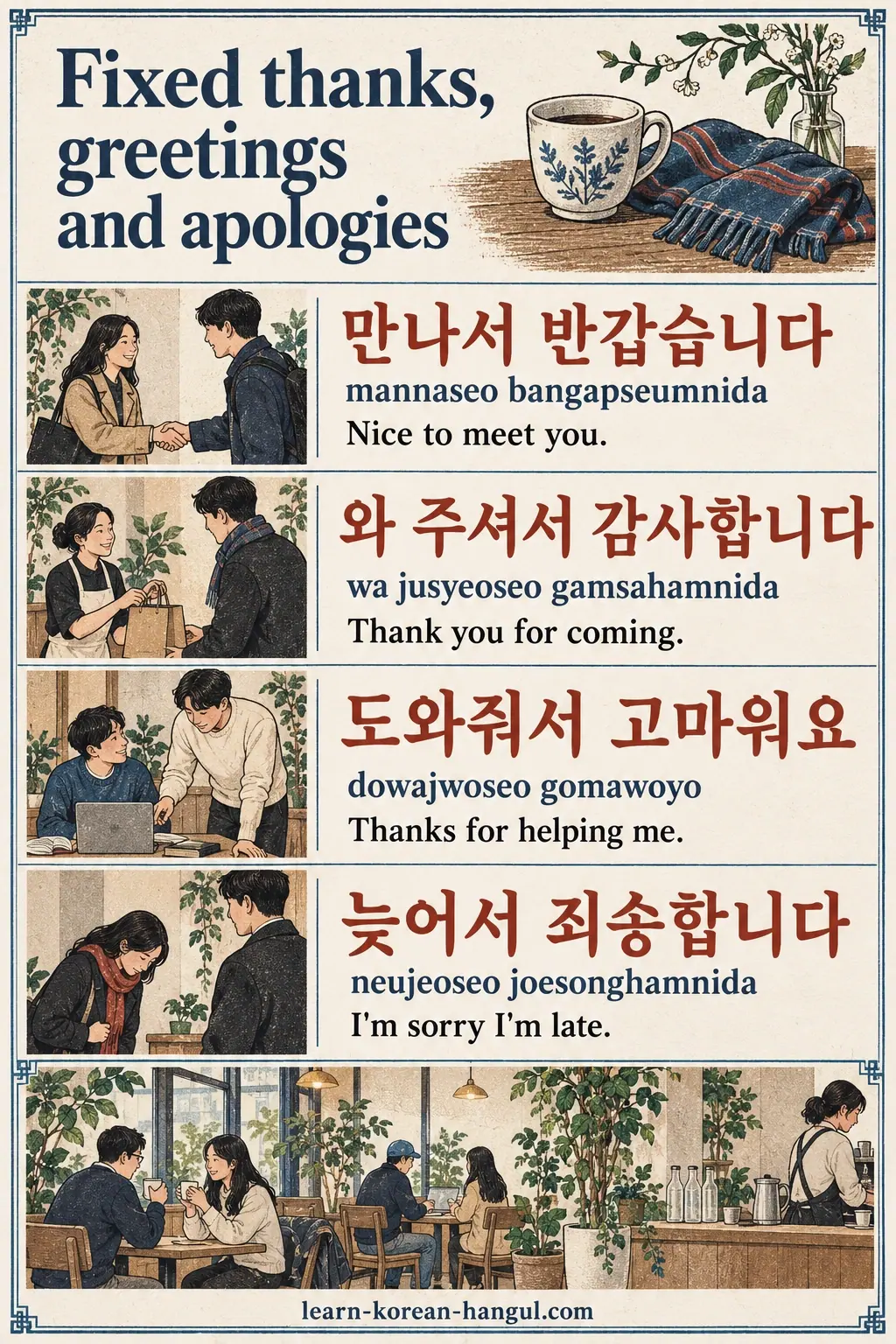
Fixed Thanks, Greetings and Apologies
Some phrases are built from the ending. You will use them every day.
| Phrase | Meaning | RR (aid) |
|---|---|---|
| 만나서 반갑습니다 | Nice to meet you. | mannaseo bangapseumnida |
| 와 주셔서 감사합니다 | Thank you for coming. | wa jusyeoseo gamsahamnida |
| 도와줘서 고마워요 | Thanks for helping me. | dowajwoseo gomawoyo |
| 늦어서 죄송합니다 | I'm sorry I'm late. | neujeoseo joesonghamnida |
만나서 반갑습니다 is said [만나서 반갑씀니다]. Notice the honorific 시 in 와 주셔서, which is allowed inside the ending.
Answering 왜 with -아/어서요
When someone asks 왜? ("Why?"), you can answer with the reason clause and 요. Nothing else is needed. 왜 안 가요? 피곤해서요. means "Why aren't you going? Because I'm tired."
Manner and Means: 걸어서 가요
The sequence meaning also gives the manner of an action. 걸어서 가요 means "go on foot", with 걸어서 as "walking, (and then) go". Similar phrases: 앉아서 먹어요 ("eat sitting down") and 서서 기다려요 ("wait standing up").
Maybe Because: -아/어서 그런지
Add 그런지 to say "maybe because": 피곤해서 그런지 머리가 아파요 means "Maybe because I'm tired, my head hurts." This is a common spoken extension.
A Sentence-Level "so": 그래서
그래서 starts a new sentence and means "so" or "and so". 비가 왔어요. 그래서 집에 있었어요. Here the first sentence can carry the past marker, because it stands alone.
The next section lists the mistakes that appear most often.
What Mistakes Do Learners Make with -아/어서?
Learners make seven predictable mistakes. Each has a reason and a fix.
Learners often put the past tense inside. Actually the tense goes on the last verb. Wrong: 비가 왔어서 집에 있었어요. Right: 비가 와서 집에 있었어요. Fix: remove 았/었 from the first verb.
Learners often follow the reason with a command. Actually this does not fit the reason meaning. Wrong: 피곤해서 쉬세요. Right: 피곤하니까 쉬세요. Fix: use -(으)니까 before a command or suggestion.
Learners often pick the wrong vowel. Wrong: 먹아서 and 좋어서. Right: 먹어서 and 좋아서. Fix: look at the last vowel of the stem: ㅏ or ㅗ takes 아서, and every other vowel takes 어서.
Learners often forget to contract. Wrong: 가아서 and 오아서. Right: 가서 and 와서. Fix: merge the vowels after a vowel stem.
Learners often skip the irregular change. Wrong: 덥어서 and 모르어서. Right: 더워서 and 몰라서. Fix: change the stem first, as you do before 요.
Learners often use it for two unrelated actions. Actually the actions must be connected. Wrong: 밥을 먹어서 학교에 갔어요. Right: 밥을 먹고 학교에 갔어요. Fix: use -고 when the second action does not depend on the first.
Learners often use the wrong noun form. Wrong: 학생이서. Right: 학생이라서 (or 학생이어서). Fix: for a noun, use (이)라서, (이)어서 or 때문에.
The next section gives you practice.
Practice and Answers
Do the four tasks, then compare with the key.
Task 1: attach the ending. Write the form with -아/어서.
- 가다
- 먹다
- 덥다
- 바쁘다
- 학생
Task 2: fix the error. Each sentence has one mistake. Rewrite it correctly.
- 비가 왔어서 집에 있었어요.
- 피곤해서 쉬세요.
- 밥을 먹어서 학교에 갔어요. (the two actions are unrelated)
Task 3: translate. Write in Korean: "I was tired, so I slept early." and "Thank you for helping me."
Task 4: write your own. Write one sentence that gives a reason, and one that links two connected actions.
Practice · 5
Which form of 오다 (come) is correct before "so"?
Show answer
와서
The vowel ㅗ takes 아서, and 오 + 아서 merges into 와서. A past marker never goes inside.
Which form of 덥다 (be hot) is correct?
Show answer
더워서
ㅂ-irregular stems change ㅂ to 우 before a vowel ending, and 우 + 어서 becomes 워서.
Which sentence is natural?
Show answer
피곤하니까 쉬세요.
A command after a reason needs -(으)니까.
Which phrase is a fixed apology built from the ending?
Show answer
늦어서 죄송합니다
Thanks and apology phrases use -아/어서, as in 늦어서 죄송합니다.
How do you give a reason with the noun 학생 (student)?
Show answer
학생이라서
A noun takes (이)라서: 이라서 after a consonant, 라서 after a vowel.
Answer key
- (1) 가서 (2) 먹어서 (3) 더워서 (4) 바빠서 (5) 학생이라서
- (1) 비가 와서 집에 있었어요. (2) 피곤하니까 쉬세요. (3) 밥을 먹고 학교에 갔어요.
- 피곤해서 일찍 잤어요. 도와줘서 고마워요. Other correct versions exist, for example 도와주셔서 감사합니다 (more formal).
- Sample answers: 배가 아파서 병원에 갔어요. 서점에 가서 책을 샀어요. Any pair is correct if there is no tense inside the first verb and the ending matches the stem's last vowel.
If task 1 was correct, you have the vowel rule. If task 2 was hard, check whether you put a tense inside or a command after. The next section points you to what comes after this lesson.
What Should You Learn after -아/어서 Grammar?
After -아/어서, learn -(으)니까, which handles reasons that lead to commands. Then read -기 때문에, the firmer, more formal way to state a reason. To check the "and then" meaning, return to -고.
For a wider view, the parent page Cause and Reason lists every pattern in this group. To plan by level, use Beginner Grammar. For tense questions, see past tense -았/었-.
This lesson covers -아/어서 in the polite, casual and formal styles. It does not cover every spoken shortening. About this page. Last updated 2026-10-09. Revised Romanization follows the national rules and is shown only as a learning aid.
Frequently Asked Questions
What Does -아/어서 Mean?
-아/어서 means "because" or "so", and it also means "and then" when two actions follow each other. 비가 와서 집에 있었어요 means "It rained, so I stayed home". 서울에 가서 친구를 만났어요 means "I went to Seoul and met a friend". Context tells you which meaning is intended.
How Do I Attach -아/어서 to a Verb or Adjective?
Look at the last vowel of the stem. After ㅏ or ㅗ add 아서: 좋아서, 와서. After any other vowel add 어서: 먹어서, 있어서. 하다 becomes 해서. Vowel stems often contract: 가 + 아서 is 가서, 마시 + 어서 is 마셔서. For 이다, use (이)라서: 학생이라서.
Can -아/어서 Be Used in the past Tense?
Not inside the pattern. Do not write 왔어서 or 먹었어서. Put the tense on the last verb only: 비가 와서 집에 있었어요. The first clause is understood to share that tense. You can use the honorific -(으)시- inside, as in 와 주셔서 감사합니다 ("thank you for coming").
Is -아/어서 Used in Speech or Only in Writing?
Both. It is one of the most natural connectors in everyday speech, and it also appears in writing. It works in polite and casual styles. It is also fixed in many daily phrases, such as 만나서 반갑습니다 ("nice to meet you") and 늦어서 죄송합니다 ("sorry I am late").
What Is the Difference between -아/어서 and -(으)니까?
-아/어서 presents the cause as a plain fact and cannot lead into a command or a suggestion. -(으)니까 gives the speaker's own reason, can take a past marker, and can lead into commands. 비가 오니까 우산을 가져가세요 is correct. 비가 와서 우산을 가져가세요 is not natural.