What you'll learn
- Attach -(으)ㄴ 채로 to verbs that leave a lasting state.
- Say "without having done" with -지 않은 채로.
- Tell -(으)ㄴ 채로 apart from -(으)면서, -고 and 그대로.
- Avoid mixing up 채, 체 and the counter 채.
Prerequisites: the polite ending -아요/어요 and the pattern -(으)면서. Time: about 15 minutes.
Key facts
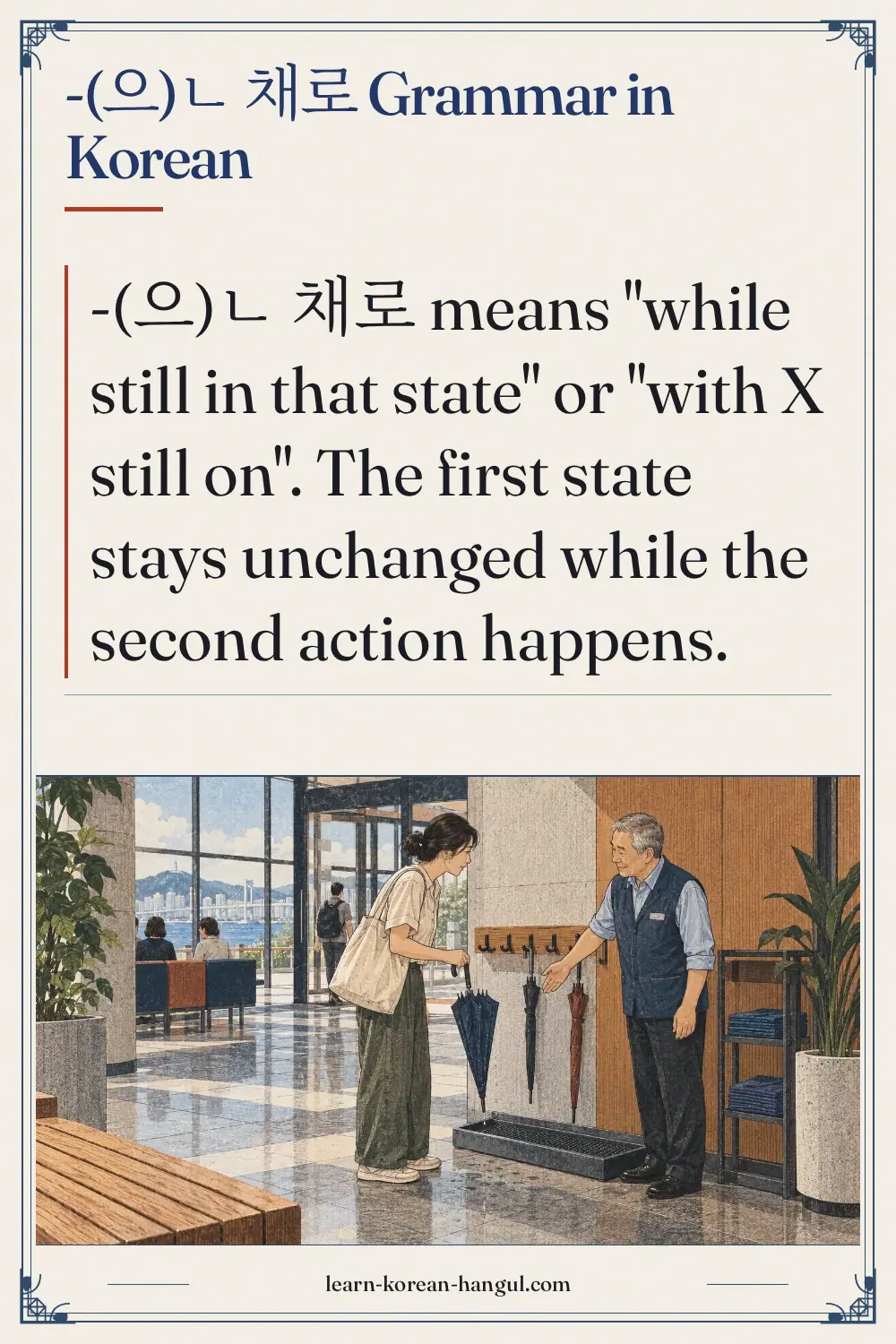
- -(으)ㄴ 채로 means "while still in that state" or "with X still on".
- The form is stem + ㄴ 채로 after a vowel (켠 채로) and stem + 은 채로 after a final consonant (입은 채로).
- The first verb must leave a state that stays, such as 입다 or 켜다.
- The same person usually does both parts.
- It often sounds like "even though that should have changed".
Listen to two model sentences.
The next section defines the pattern.
What Does -(으)ㄴ 채로 Grammar Mean?
-(으)ㄴ 채로 means "while still in that state" or "with X still on". The noun 채 means "a state left as it is". The particle 로 marks the way or condition, so 채로 is "in that state". The part before it, such as 입은, is the past modifier ending, which looks at a state that is done and has stayed.
Picture a photo. The first clause is the picture: clothes on, light on, shoes on. In the second clause, an action takes place inside the picture. The picture does not change.
Here are two glossed examples.
| Part | 옷을 입은 채로 잤어요. | 불을 켠 채로 나갔어요. |
|---|---|---|
| State | 옷을 입은 채로 (with my clothes on) | 불을 켠 채로 (with the light on) |
| Main clause | 잤어요 (I slept) | 나갔어요 (I went out) |
| Spoken | [오슬 이븐 채로 자써요] | [부를 켠 채로 나가써요] |
| RR (aid) | oseul ibeun chaero jasseoyo | bureul kyeon chaero nagasseoyo |
| English | I slept with my clothes on. | I went out with the light left on. |
Revised Romanization (RR) is the national system for writing Korean in the Latin alphabet. It is shown here only as a learning aid.
The next section shows how to build the form.
How Do You Form -(으)ㄴ 채로?
Take the dictionary form, remove 다 to get the stem, and look at the last sound of the stem. The stem is the verb without its dictionary ending -다. For 입다 the stem is 입. Then add the past modifier ending and 채로.
| Stem ends in | Add | Dictionary form | Result | Spoken | RR (aid) |
|---|---|---|---|---|---|
| a vowel | ㄴ 채로 | 켜다 (turn on) | 켠 채로 | [켠 채로] | kyeon chaero |
| a vowel | ㄴ 채로 | 서다 (stand) | 선 채로 | [선 채로] | seon chaero |
| a vowel | ㄴ 채로 | 두다 (leave, put) | 둔 채로 | [둔 채로] | dun chaero |
| a final consonant | 은 채로 | 입다 (wear) | 입은 채로 | [이븐 채로] | ibeun chaero |
| a final consonant | 은 채로 | 신다 (wear shoes) | 신은 채로 | [시는 채로] | sineun chaero |
| a final consonant | 은 채로 | 앉다 (sit) | 앉은 채로 | [안즌 채로] | anjeun chaero |
| a final consonant | 은 채로 | 벗다 (take off) | 벗은 채로 | [버슨 채로] | beoseun chaero |
| ㄹ (drops) | ㄴ 채로 | 열다 (open) | 연 채로 | [연 채로] | yeon chaero |
The form is the same as the past modifier in 먹은 음식 ("the food I ate"). The full set of modifier endings is on the Noun-Modifying Forms page. Here the modifier does not say "in the past". It says "done, and the result is still there".
Which Verbs Fit
Only verbs that leave a state can join this pattern. Ask yourself: "After I do this, does something stay the way it is?"
| Group | Verbs |
|---|---|
| clothes and objects on the body | 입다 (wear), 신다 (put on shoes), 쓰다 (wear a hat or glasses), 벗다 (take off) |
| devices and doors | 켜다 (turn on), 열다 (open), 닫다 (close) |
| body positions | 앉다 (sit), 서다 (stand), 눕다 (lie down) |
| eyes | 눈을 뜨다 (open the eyes), 눈을 감다 (close the eyes) |
| placing | 두다 (leave), 놓다 (put down) |
By contrast, 걷다 ("walk") or 먹다 ("eat") do not leave a state, so they do not fit.
Stems Ending in a Vowel
Vowel stems take ㄴ directly, and the ㄴ sits under the last syllable: 켜 + ㄴ = 켠, 서 + ㄴ = 선, 두 + ㄴ = 둔.
Stems Ending in a Consonant
Consonant stems take 은: 입 + 은 = 입은, 신 + 은 = 신은, 앉 + 은 = 앉은.
Irregular Stems
| Type | Dictionary form | With -(으)ㄴ 채로 | Note |
|---|---|---|---|
| ㄹ stem | 열다 (open) | 연 채로 | ㄹ drops before ㄴ |
| ㅂ-irregular | 눕다 (lie down) | 누운 채로 | ㅂ becomes 우; spoken [누운 채로] |
| vowel stem ending in ㅡ | 쓰다 (wear) | 쓴 채로 | the ㄴ attaches directly to 쓰 |
For 안경을 쓴 채로 ("with glasses on"), the verb is 쓰다, and the ㄴ attaches directly to 쓰.
The next section builds a full sentence.
Worked Example: Building 옷을 입은 채로 잤어요
Say that you fell asleep in your clothes. Follow five steps.
- Write the state. "I wear my clothes" is 옷을 입어요 in the polite style.
- Find the stem. The dictionary form is 입다, so the stem is 입.
- Add 은 채로. The stem ends in a final consonant, so 입 + 은 채로 = 입은 채로. Take away the polite ending, because the ending belongs to the last verb only.
- Write the main action. "I slept" is 잤어요. The verb 자다 gives 잤어요 in the past.
- Join the two parts. 옷을 입은 채로 잤어요.
You'll know it worked when the first verb ends in 은 채로 with nothing after it, and the polite ending 요 appears only once, at the end. Try the same steps with "I went out leaving the door open": 열다 gives 연 채로, and 나갔어요 follows.
Sentence
I slept with my clothes on.
Show answer
옷을 입은 채로 잤어요
The next section covers negatives, passives and tense.
Which Forms and Sentence Types Work with -(으)ㄴ 채로?
The first clause does not take 았/었 or 겠. The main verb shows the tense of the whole sentence.
| Main verb | Example | English |
|---|---|---|
| present or habit | 옷을 입은 채로 자요. | I sleep with my clothes on. |
| past | 옷을 입은 채로 잤어요. | I slept with my clothes on. |
| future | 옷을 입은 채로 잘 거예요. | I will sleep with my clothes on. |
Negative: without Having Done
For "without having done", use -지 않은 채로. 씻지 않은 채로 잤어요 means "I slept without washing", spoken [씯찌 아는 채로 자써요]. You can also say 아무것도 먹지 않은 채로 ("without eating anything"). The pattern says that the person never did the usual thing before the action.
Passive and State Verbs
When the state belongs to an object, use a passive verb: 문이 열린 채로 잤어요 means "I slept with the door left open", spoken [무니 열린 채로 자써요]. Here the object 문 is the subject of the first clause, and the sleeper is the subject of the second. This is how two different subjects fit.
The pattern works with every sentence type.
| Sentence type | Example | English |
|---|---|---|
| statement | 앉은 채로 졸았어요. | I dozed off sitting up. |
| yes/no question | 신발을 신은 채로 들어왔어요? | Did you come in with your shoes on? |
| wh-question | 왜 옷을 입은 채로 잤어요? | Why did you sleep in your clothes? |
| command | 불을 켠 채로 나가지 마세요. | Please don't go out with the light on. |
| suggestion | 앉은 채로 이야기해요. | Let's talk while staying seated. |
Yes/no questions usually end with a rise. A wh-question puts the stress on the question word and often ends with a fall or a rise-fall, rather than a sharp final rise.
The next section compares -(으)ㄴ 채로 with similar patterns.
How Is -(으)ㄴ 채로 Different from Nearby Patterns?
Four patterns can describe "doing X in a certain condition". Each has a different feeling.
| Pattern | Core idea | Example | Feeling |
|---|---|---|---|
| -(으)ㄴ 채로 | a state stays frozen | 옷을 입은 채로 잤어요. | I slept in my clothes, maybe by accident. |
| -고 | neutral "and" or "wearing" | 옷을 입고 잤어요. | I wore clothes and slept. Plain, with no surprise. |
| -(으)면서 | two actions together | 노래를 부르면서 걸어요. | I sing while I walk. Both go on at once. |
| 그대로 | exactly as it is | 불을 켜 놓은 그대로 두고 나갔어요. | I went out and left the light on just as it was. |
The main test is the verb in the first clause. If it is a state that stays, use -(으)ㄴ 채로. If it is an action that goes on, use -(으)면서. 걷는 채로 전화해요 is wrong, because walking is an action. 걸으면서 전화해요 is right.
The difference between -(으)ㄴ 채로 and -고 is one of tone. 신발을 신고 걸어요 is a plain description. 신발을 신은 채로 들어왔어요 suggests that the person should have taken the shoes off. Many everyday sentences use either form, but 채로 adds the note of "even so".
The next section covers look-alike words and edge cases.
Variations and Edge Cases of -(으)ㄴ 채로
채 without 로
You can drop 로 and say 채: 옷을 입은 채 잤어요. The short form is slightly more written.
채 Versus 체
Three words sound alike. 채 in this pattern means "a state left as it is". 체 appears in 아는 체하다 ("act as if you know") and means "pretend"; the word 척 has the same meaning, as in 아는 척하다. A third 채 is the counter for houses: 집 한 채 ("one house"). They are different words with different jobs.
그대로
The word 그대로 means "as it is". It often sits in the same slot: 불을 그대로 켜 놓고 나갔어요 ("I left the light on as it was and went out"). It can replace 채로 when the state is the object itself.
열어 놓은 채로
Use 놓다 or 두다 after -아/어 to stress that you left something in place on purpose: 문을 열어 놓은 채로 나갔어요 ("I went out leaving the door open"), spoken [무늘 여러 노은 채로 나가써요]. The RR aid is muneul yeoreo noeun chaero nagasseoyo.
The next section lists the mistakes that appear most often.
What Mistakes Do Learners Make with -(으)ㄴ 채로?
Learners make six predictable mistakes. Each has a reason and a fix.
Learners often use it for an action in progress. Wrong: 걷는 채로 전화했어요. Right: 걸으면서 전화했어요. Fix: only a state that stays can fill the first clause. For two actions at once, use -(으)면서.
Learners often use the present modifier. Wrong: 입는 채로 잤어요. Right: 입은 채로 잤어요. Fix: always use the finished form -(으)ㄴ here.
Learners often put 았/었 inside. Wrong: 입었은 채로 잤어요. Right: 입은 채로 잤어요. Fix: the -(으)ㄴ already marks the state as done. Tense goes on the last verb.
Learners often forget the space. Wrong: 입은채로 잤어요. Right: 입은 채로 잤어요. Fix: 채 is a noun and stands alone.
Learners often use it with adjectives. Unnatural: 예쁜 채로 있었어요. Better: name the action that left the state, as in 옷을 입은 채로 있었어요. Fix: -(으)ㄴ 채로 normally follows a verb whose action leaves a state, not a plain description such as 예쁘다.
Learners often use it when nothing is unusual. Less natural: 안경을 쓴 채로 책을 읽어요. Plainer: 안경을 쓰고 책을 읽어요. Fix: if the state is normal and expected, -고 is the plainer choice. 채로 fits best when the state is surprising or should have changed.
The next section gives you practice.
Practice and Answers
Do the four tasks, then compare with the key.
Task 1: add -(으)ㄴ 채로. Write the form of each verb.
- 켜다 (turn on)
- 입다 (wear)
- 앉다 (sit)
- 열다 (open)
- 눕다 (lie down)
Task 2: join the sentences with -(으)ㄴ 채로. Write one sentence for each pair.
- 저는 신발을 신었어요. / 방에 들어왔어요.
- 저는 불을 켰어요. / 잤어요.
- 저는 서 있었어요. / 기다렸어요.
Task 3: fix the error. Each sentence has one mistake. Rewrite it correctly.
- 입는 채로 잤어요.
- 입었은 채로 잤어요.
- 걷는 채로 전화했어요.
Task 4: write your own. Write one sentence about something you left on or open when you went out, and one with 씻지 않은 채로.
Practice · 5
Which form of 입다 means "with my clothes on"?
Show answer
입은 채로
The stem 입 ends in a final consonant, so it takes 은 채로. The tense is not marked inside.
How do you say "with the light on" using 켜다?
Show answer
켠 채로
켜 ends in a vowel, so it takes ㄴ 채로: 켠 채로.
Which sentence uses -(으)ㄴ 채로 correctly?
Show answer
신발을 신은 채로 들어왔어요.
신다 leaves a state that stays. Walking and eating are actions in progress, so they do not fit.
Which pattern fits "I talk on the phone while walking"?
Show answer
걸으면서 전화해요
Walking is an action that goes on, so -(으)면서 is right. ㄷ-irregular 걷다 becomes 걸으면서.
What does 씻지 않은 채로 잤어요 mean?
Show answer
I slept without washing.
-지 않은 채로 means "without having done" the action.
Answer key
- (1) 켠 채로 (2) 입은 채로 (3) 앉은 채로 (4) 연 채로 (5) 누운 채로
- (1) 저는 신발을 신은 채로 방에 들어왔어요. (2) 저는 불을 켠 채로 잤어요. (3) 저는 선 채로 기다렸어요.
- (1) 입은 채로 잤어요. (2) 입은 채로 잤어요. (3) 걸으면서 전화했어요.
- Sample answers: 창문을 열어 놓은 채로 나갔어요. 씻지 않은 채로 잠들었어요. Any pair is correct if the first verb ends in ㄴ 채로 or 은 채로 and describes a state that stays.
If task 1 was correct, you have the formation rule. If task 3 was hard, check whether the first verb is a state or an action in progress. The next section points you to what comes after this lesson.
What Should You Learn after -(으)ㄴ 채로 Grammar?
After -(으)ㄴ 채로, review -(으)면서 for two actions at the same time, and -고 for a neutral "and". To see a break between two actions, read -다가.
For a wider view, the parent page Time and Sequence lists every time connector in this group. To plan by level, use Intermediate Grammar.
This lesson shows -(으)ㄴ 채로 with polite-style endings; the pattern itself is the same in every speech style, because the style comes from the last verb. It does not cover every written variation. About this page. Last updated 2026-10-09. Revised Romanization follows the national rules and is shown only as a learning aid.
Frequently Asked Questions
What Does -(으)ㄴ 채로 Mean?
-(으)ㄴ 채로 means "while still in that state" or "with X still on". The first clause describes a state that does not change, and the second clause is an action done in that state. 옷을 입은 채로 잤어요 means "I slept with my clothes on." The noun 채 means "a state left as it is".
How Do I Attach -(으)ㄴ 채로 to a Verb or Adjective?
Use verbs that leave a state. Remove 다 to get the stem. After a vowel, add ㄴ 채로: 켜다 becomes 켠 채로. After a final consonant, add 은 채로: 입다 becomes 입은 채로. An ㄹ stem drops its ㄹ: 열다 becomes 연 채로. Adjectives do not take this pattern.
Can -(으)ㄴ 채로 Be Used in the past Tense?
The form already uses the past modifier -(으)ㄴ, but it does not mark time. You never add 았/었 inside it, as in 입었은 채로. The main verb shows the time of the whole sentence. 옷을 입은 채로 자요 is the present habit, and 옷을 입은 채로 잤어요 is the past.
Is -(으)ㄴ 채로 Used in Speech or Only in Writing?
It is used in both. The full form 채로 is common in speech, and the shorter 채 is slightly more written, as in 옷을 입은 채 잤어요. It works in polite, casual and formal styles, since the final verb sets the style. In writing, it often describes a scene or a mistake.
What Is the Most Common Mistake with -(으)ㄴ 채로?
Learners use it for an action that is still going on, as in 걷는 채로 전화했어요. Only a state that stays can follow 채로. For two actions at the same time, use -(으)면서. A second frequent slip is using the present modifier, as in 입는 채로, when the form must be 입은 채로.
What Is the Difference between -(으)ㄴ 채로 and -(으)면서?
-(으)면서 joins two actions that go on together, such as 걸으면서 전화해요. -(으)ㄴ 채로 keeps a state frozen while something else happens, such as 신발을 신은 채로 들어왔어요. The first clause of -(으)ㄴ 채로 is a fixed condition, not an action. It also often hints that the state should have changed.