What you'll learn
- Choose between -기, -는 것 and -(으)ㅁ for a given sentence.
- Name the predicates that attach to each form.
- Show time with -는 것, and recognise the written style of -(으)ㅁ.
- Avoid errors such as 그가 학생이기를 알아요 and 만나는 것로 했어요.
Prerequisites: the three single lessons (-기 nominalizer, -(으)ㅁ nominalizer and -는 것 nominalizer). Time: about 15 minutes.
Listen to the two model sentences for this lesson.
The next section gives the verdict in one table.
Which Nominalizer Should You Use?
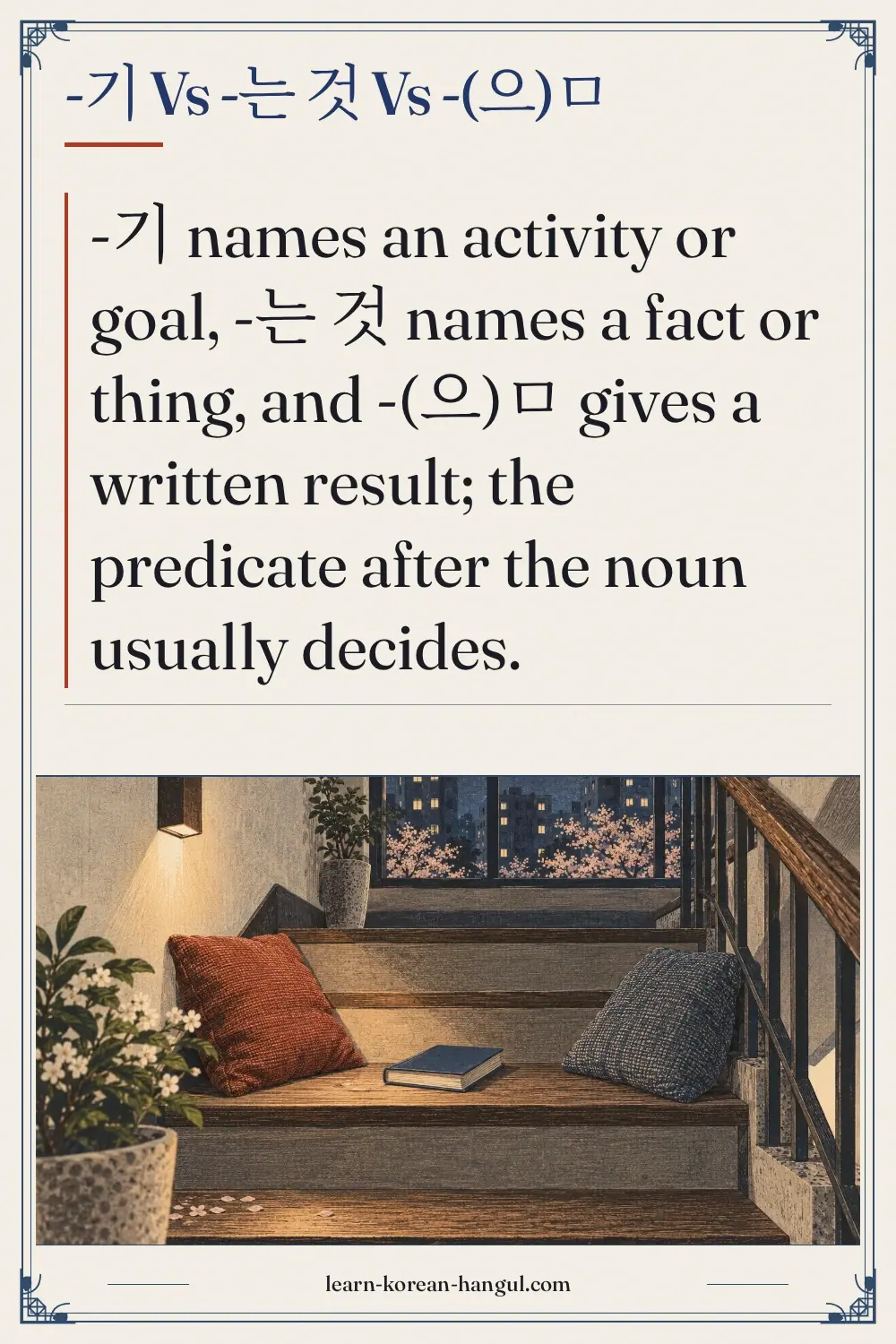
Choose by the situation: -기 for activities and fixed patterns, -는 것 for facts and things, and -(으)ㅁ for written notes. The table gives a quick answer for each case, and the later sections explain the reasons.
| You want to say | Use | Example | Meaning |
|---|---|---|---|
| It is easy, hard, good or unpleasant to do something | -기 | 운동하기가 쉬워요. | It is easy to exercise. |
| I decided, began or hope to do something | -기 | 내일 만나기로 했어요. | We decided to meet tomorrow. |
| I know, saw, heard or remember that something happens | -는 것 | 운동하는 것을 봤어요. | I saw him exercising. |
| Something is important, needed or good in general | -는 것 | 운동하는 것이 중요해요. | Exercising is important. |
| A result or state in a note, form or formal text | -(으)ㅁ | 숙제를 확인함. | Homework checked. |
The three forms do not compete equally. -는 것 works with the widest set of verbs, -기 works with a short list of partners and patterns, and -(으)ㅁ belongs to writing. The master table below compares them on five points.
| Point | -기 | -는 것 | -(으)ㅁ |
|---|---|---|---|
| Names | an activity, goal or wish | a fact or thing | a result or state |
| Typical partners | 쉽다, 어렵다, 좋다, 싫다, 바라다, 시작하다 | 알다, 보다, 듣다, 중요하다, 필요하다 | notes, forms, reports |
| Time | none of its own | present, past or future | none of its own |
| Style | speech and writing | speech and writing | written, neutral |
| Spoken shortening | none | 거, 게, 건, 걸 | none |
The next sections go through the points one by one. The first point is meaning.
What Does Each Form Name?
The -기 noun names an action as an activity, the -는 것 phrase names a fact or a thing, and the -(으)ㅁ noun names a result. The same verb shows the difference.
| Form | Example with 읽다 | Meaning |
|---|---|---|
| -기 | 읽기가 어려워요. | Reading (as an activity) is hard. |
| -는 것 | 읽는 것이 어려워요. | The act of reading is hard. |
| -(으)ㅁ | 책을 읽음. | Read the book (a note). |
The first two sentences are close in English. The difference shows when the verb is one that reports a fact. After 알다 ("know") or 보다 ("see"), only -는 것 is possible: 그가 학생인 것을 알아요 ("I know that he is a student"). The form 그가 학생이기를 알아요 is wrong, because -기 cannot report a fact.
Verdict for meaning: -는 것 wins for facts and things, and -기 wins for activities and goals.
The next section shows which predicates pick which form.
Which Predicates Pick Which Form?
Many predicates choose their nominalizer by habit, and learning the habits is the fastest way to choose correctly. The lists below group the main predicates.
Predicates that go with -기. These describe how an action feels or how it moves on.
- 쉽다 and 어렵다 ("easy" and "hard"): 이 책은 읽기 쉬워요.
- 좋다 and 싫다 ("good" and "unwelcome"): 걷기 좋은 날씨예요.
- 바라다 ("hope"): 건강하시기를 바랍니다.
- 시작하다 ("begin"): 비가 오기 시작했어요.
- 하다 in the pattern -기로 하다 ("decide"): 내일 만나기로 했어요.
Predicates that go with -는 것. These report or evaluate something.
- 알다, 보다, 듣다, 느끼다 and 기억하다 (know, see, hear, feel, remember): 노래하는 것을 들었어요 ("I heard someone singing").
- 중요하다 and 필요하다 ("important" and "necessary"): 한국어를 배우는 것이 중요해요.
Predicates that accept both. 좋아하다, 싫어하다 and 잘하다 take either form with little change in meaning. 말하기를 좋아해요 and 말하는 것을 좋아해요 both mean "I like speaking". Choose the one that sounds natural to you, and listen for what Korean speakers say in the same situation.
Verdict for predicates: -기 wins when the predicate is on its list or is a fixed pattern, and -는 것 wins everywhere else.
The next section looks at time.
How Do the Forms Show Time?
Only -는 것 can show time, because it contains a modifier ending. The -기 noun and the -(으)ㅁ noun have no modifier ending, so they cannot place an event before or after another one this way. At most they take the past marker 았/었, as in 먹었기 때문에 and 먹었음. The same noun 것 takes all three modifier endings, so it can point to the present, the past or the future.
| Form | Present | Past | Future |
|---|---|---|---|
| -는 것 | 먹는 것 | 먹은 것 | 먹을 것 |
| -기 | 먹기 | 먹었기 (only in a few patterns, such as -기 때문에) | (none) |
| -(으)ㅁ | 먹음 | 먹었음 | (rare) |
A sentence shows the effect. 어제 영화를 본 것을 기억해요 means "I remember seeing the movie yesterday". The past modifier -(으)ㄴ inside the phrase puts the viewing before the remembering. The -기 version of this sentence does not exist. A note in the -(으)ㅁ form marks the past by adding 았/었 before ㅁ, as in 숙제를 확인했음 ("homework was checked").
Verdict for time: -는 것 wins, because it is the only one with its own time.
The next section looks at style.
How Do the Forms Differ in Style?
The -(으)ㅁ form is written and neutral, while -기 and -는 것 work in both speech and writing. In speech, -는 것 shrinks into 거, 게, 건 and 걸, as explained in 거 게 건 걸 contractions in korean.
The same message appears in three styles in the table.
| Style | Sentence | Meaning |
|---|---|---|
| Spoken, friendly | 그가 온 걸 알아요. | I know that he came. |
| Polite, neutral | 그가 온 것을 알아요. | I know that he came. |
| Formal writing | 그가 왔음을 알았다. | I learned that he had come. |
The first line uses the shortened 걸, the second keeps 것을, and the third uses the -(으)ㅁ nominalizer with the plain written ending -다. The -기 noun has no such ladder, since it is already short and neutral.
Verdict for style: -(으)ㅁ wins in formal writing and notes, and -는 것 wins in everything else.
The next section gives a rule that works in a conversation.
What Is a One-Line Rule You Can Apply While Speaking?
Apply three questions in order. The first question that gets a "yes" gives the form.
- Is it a written note, a form or a formal report? If yes, use -(으)ㅁ: 숙제를 확인함.
- Is the next word one of the -기 partners or a fixed pattern? If yes, use -기. The partners are 쉽다, 어렵다, 좋다, 싫다, 바라다, 시작하다, and the patterns are -기로 하다, -기 전에, -기 때문에 and -기 위해(서).
- Otherwise, use -는 것. It works for 알다, 보다, 중요하다, 필요하다 and most other verbs.
The links to the separate pattern lessons are -기 전에 (before), -기 때문에 (because) and -기 위해(서) (in order to).
The next section applies the rule to four kinds of learner.
Which Should You Choose? Four Learner Situations
Four learner situations give four different priorities.
The Conversation Learner
Learn -는 것 first, because it works with the widest set of verbs and shrinks into the everyday 거. Then add the -기 partners as ready-made chunks: 읽기 쉬워요, 하기 싫어요, 만나기로 했어요.
The Learner Who Writes Messages and Emails
Use -기 for plans and hopes (건강하시기를 바랍니다) and -는 것 for facts. Keep -(으)ㅁ out of friendly messages, because it sounds like a form.
The Learner Who Reads News and Reports
Expect -(으)ㅁ in reports, notes and formal clauses, as in 그가 왔음을 알았다. Recognise it as a noun made from a verb. Learners seldom need to produce it.
The Learner Who Takes Written Exams
Know all three, and memorise the -기 partners. A test question usually hangs on one verb, so recognising 알다 (-는 것), 쉽다 (-기) or a note line (-(으)ㅁ) answers it.
An honest limit. The overlap is large. Native speakers often accept two forms for the same idea, and the choice can depend on habit or rhythm. No rule predicts every sentence. The rule above covers the common cases, and the rest comes from listening.
The next section collects the errors that appear most often.
What Mistakes Do Learners Make When Choosing?
Learners make six predictable mistakes. Each one has a reason and a fix.
Learners often use -기 to report a fact. Actually facts need -는 것. Wrong: 그가 학생이기를 알아요. Right: 그가 학생인 것을 알아요. Fix: after 알다, 보다 and 듣다, use -는 것.
Learners often use -는 것 inside a fixed -기 pattern. Actually the pattern is -기로 하다. Wrong: 만나는 것로 했어요. Right: 만나기로 했어요. Fix: learn the pattern as a unit.
Learners often use -기 for importance. Actually 중요하다 and 필요하다 normally go with -는 것. Less natural: 운동하기가 중요해요. Natural: 운동하는 것이 중요해요. Fix: for importance, use -는 것.
Learners often use -(으)ㅁ in speech. Actually -(으)ㅁ is written. Wrong: 어제 갔음을 알았어요 in a chat. Right: 어제 간 것을 알았어요. Fix: save -(으)ㅁ for notes and formal text.
Learners often name a skill with -는 것. Actually skills and course names use -기. Wrong: 한국어 말하는 것 as a course title. Right: 한국어 말하기. Fix: use -기 for names of activities.
Learners often try to mark time on -기. Actually -기 cannot show that one event came before another. Wrong: 어제 보기를 기억해요. Right: 어제 본 것을 기억해요. Fix: when time matters, switch to -는 것.
Practice turns these rules into habits, as the next section shows.
Practice and Answers
Complete the four tasks, then compare your answers with the key.
Task 1: choose the form. Fill each gap with -기, -는 것 or -(으)ㅁ.
- 이 책은 읽___ 쉬워요.
- 그가 학생인 ___을 알아요.
- A note says: 숙제를 확인___.
- 우리는 내일 만나___로 했어요.
Task 2: fix the error. Each sentence has one mistake. Rewrite it correctly.
- 그가 학생이기를 알아요.
- 어제 보기를 기억해요.
- 만나는 것로 했어요.
Task 3: translate. Write in Korean: "I know that he is a student." and "It is easy to exercise."
Task 4: write your own. Write one sentence with -기 and one with -는 것 about a hobby, for example 저는 걷기를 좋아해요 and 저는 걷는 것을 좋아해요.
Sentence
I know that he is a student.
Show answer
그가 학생인 것을 알아요
Practice · 5
Which sentence means "This book is easy to read"?
Show answer
이 책은 읽기 쉬워요.
쉽다 is a -기 partner: 읽기 쉽다 means easy to read.
Which sentence means "I know that he is a student"?
Show answer
그가 학생인 것을 알아요.
알다 reports a fact, so it takes -는 것 or the modifier plus 것. -기 cannot report a fact.
Which line best records "homework checked" in a written note?
Show answer
숙제를 확인함.
-(으)ㅁ gives a short written record of a result. 거 is spoken.
Which pattern means "decide to"?
Show answer
-기로 하다
-기로 하다 is a fixed pattern for deciding. It is learned as a unit.
Which phrase means "what I ate"?
Show answer
먹은 것
Only 것 takes a modifier ending, so 먹은 것 is the form for a finished action that you name.
Answer key
- (1) 기 (2) 것 (3) 함 (4) 기.
- (1) 그가 학생인 것을 알아요. (2) 어제 본 것을 기억해요. (3) 만나기로 했어요.
- 그가 학생인 것을 알아요. 운동하기가 쉬워요.
- Sample answers: 저는 걷기를 좋아해요. 저는 걷는 것을 좋아해요. Either form with 좋아해요 is correct.
If task 1 was correct, you can choose the form. If task 2 was hard, return to the section on predicates. The next section points you to the lessons that follow.
Next Lessons after -기 vs -는 것 vs -(으)ㅁ
After -기 vs -는 것 vs -(으)ㅁ, learn the spoken shortenings in 거 게 건 걸 contractions in korean and the other nouns that need a modifier in Korean dependent nouns 것 수 때 줄 적.
The wider set is listed on the parent page, Korean nominalization. More comparisons of confusing forms are collected in Confusing Grammar Compared. Each form also has its own lesson: -기 nominalizer, -는 것 nominalizer and -(으)ㅁ nominalizer.
This lesson covers the choice among the three forms. It does not cover every pattern built on them. About this page. Last updated 2026-10-09. The Korean text and spoken forms on this page were generated with AI assistance. Romanization follows the Revised Romanization of Korean and is shown only as a learning aid.
Frequently Asked Questions
What does -기 vs -는 것 vs -(으)ㅁ mean? It names the choice among Korean's three ways to turn a verb into a noun. -기 names an activity, goal or wish, as in 읽기 쉬워요. -는 것 names a fact or thing, as in 읽는 것이 중요해요. -(으)ㅁ gives a result in writing, as in 숙제를 확인함. The verb that follows usually decides which one fits.
How do I choose between -기, -는 것 and -(으)ㅁ? Ask three questions in order. Is this a written note or formal text? Then use -(으)ㅁ. Is the next word 쉽다, 어렵다, 좋다, 싫다, 바라다, 시작하다 or a fixed pattern such as -기로 하다? Then use -기. Otherwise use -는 것, which works with 알다, 보다 and 중요하다.
What is the most common mistake when choosing? The most common mistake is using -기 to report a fact, as in 그가 학생이기를 알아요. After 알다, 보다 and 듣다, the correct form is -는 것: 그가 학생인 것을 알아요. The second mistake is using -(으)ㅁ in speech, where -기 or -는 것 is natural.
Can -기 and -는 것 mean the same thing? Sometimes. With 좋아하다, 싫어하다 and 잘하다, both forms work and the meaning barely changes: 말하기를 좋아해요 and 말하는 것을 좋아해요 both mean "I like speaking". With 알다 or 보다, only -는 것 works; with 중요하다, -는 것 is the natural choice; and with 쉽다 or -기로 하다, -기 is the natural choice.
Do I use these forms in speech, writing or both? -기 and -는 것 work in both. In speech, -는 것 often shrinks to 거, 게, 건 or 걸, as in 이게 뭐예요? The -(으)ㅁ form belongs to writing, notes and forms, such as 해당 없음. In casual conversation, avoid -(으)ㅁ and use -기 or -는 것.