What you'll learn
- Match 거, 게, 건 and 걸 to 것, 것이, 것은 and 것을.
- Read and say 이거, 이게, 이건 and 이걸, and the same family with 그 and 저.
- Tell the contractions apart from the endings -(으)ㄹ게요 and -(으)ㄹ걸요.
- Avoid errors such as 이걸 맛있어요 and 먹을거 있어요.
Prerequisites: the particles 이/가, 은/는 and 을/를, and the demonstratives (이 그 저 korean demonstratives). Time: about 15 minutes.
Listen to the two model sentences for this lesson.
The next section defines the contractions and shows them in two sentences.
What Do 거, 게, 건 and 걸 Mean?
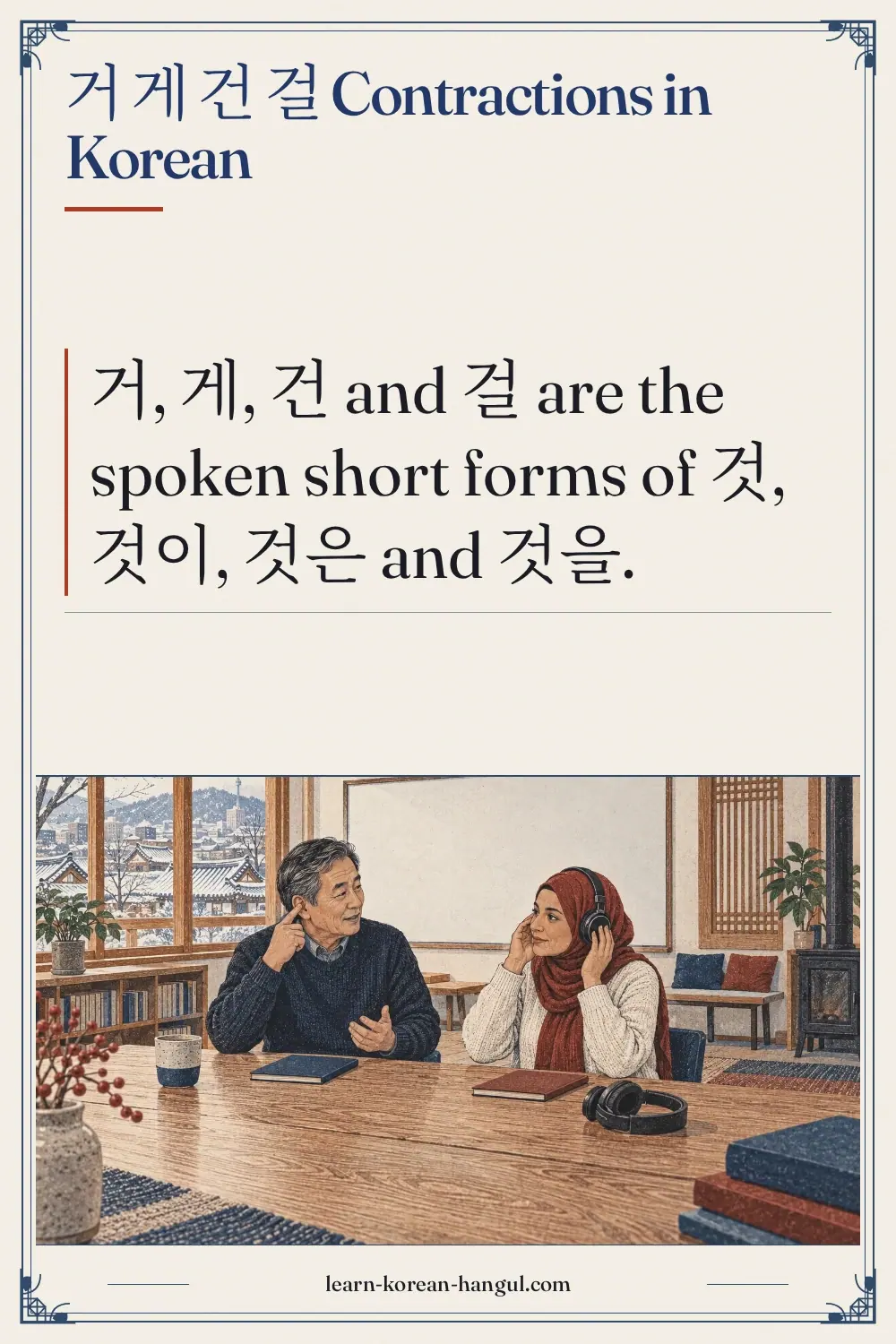
거, 게, 건 and 걸 are contracted spellings of 것 plus a particle, and each one stands for a thing. The noun 것 is a dependent noun: it means "thing", "one" or "fact", and it needs a word in front of it, such as 제 (my), 이 (this) or a modifier. A particle is a small word such as 이/가 or 을/를 that marks a noun's job in the sentence. In speech, 것 and its particle melt into one syllable.
The Standard Korean Dictionary (표준국어대사전) lists 거 as the spoken form of 것, and 게, 건 and 걸 as the shortened forms of 것이, 것은 and 것을. They are not slang. They are the normal way to speak, and formal writing keeps the full forms.
| Full form | Contraction | Particle inside | Example |
|---|---|---|---|
| 것 | 거 | none | 제 거 (mine) |
| 것이 | 게 | 이 (subject) | 이게 (this, as subject) |
| 것은 | 건 | 은 (topic) | 이건 (this, as topic) |
| 것을 | 걸 | 을 (object) | 이걸 (this, as object) |
| 것으로 | 걸로 | 으로 (by, with) | 이걸로 (with this) |
| 것이에요 | 거예요 | 이에요 (it is) | 제 거예요 (it is mine) |
A First Example
| Part | 이거 제 거예요. | 이게 뭐예요? |
|---|---|---|
| Key word | 이거 (this) and 제 거 (mine) | 이게 (this, as subject) |
| Full form | 이것 제 것이에요 | 이것이 무엇이에요 |
| Predicate | 거예요 (it is the one) | 뭐예요 (what is it) |
| Spoken | [이거 제 거예요] | [이게 뭐예요] |
| RR (aid) | igeo je geoyeyo | ige mwoyeyo |
| English | This is mine. | What is this? |
Both sentences are normal in conversation. The next section lists the whole family of demonstrative words.
How Do the Contractions Work with 이, 그 and 저?
The three demonstratives 이 (this), 그 (that) and 저 (that over there) combine with 것 and give a family of words. Each word has a full form and a short form.
| Meaning | Full form | Short forms |
|---|---|---|
| this | 이것 | 이거, 이게, 이건, 이걸 |
| that | 그것 | 그거, 그게, 그건, 그걸 |
| that over there | 저것 | 저거, 저게, 저건, 저걸 |
| what | 무엇 | 뭐, 뭐가, 뭘 |
The word 뭐 ("what") is a contraction of 무엇 and works in a similar way: 뭐가 is the subject form, and 뭘 is the object form. It is not a contraction of 것, so it is taught in 뭐 무엇 what in korean.
Here is the full set in everyday sentences.
- 이거 is the plain noun: 이거 주세요. ("Please give me this.")
- 이게 is the subject: 이게 맛있어요. ("This is tasty.")
- 이건 is the topic or contrast: 이건 얼마예요? ("How much is this one?")
- 이걸 is the object: 이걸 주세요. ("Please give me this one.")
Pronunciation matches the spelling in every case. RR writes ige, igeon and igeol. The demonstrative pages explain the choice of 이, 그 and 저 in more detail, and the phrase page what is this in Korean uses 이게 뭐예요? in context.
The next section shows the same contractions after a modifier.
How Do the Contractions Work after a Modifier?
After a modifier ending, 것 turns into 거, 게, 건 or 걸 and stays a separate word. The modifier endings -는, -(으)ㄴ and -(으)ㄹ are explained in -는 noun modifier, so only the new part is shown here.
| Pattern | Full form | Short form | English |
|---|---|---|---|
| 먹을 것 + 이 | 먹을 것이 없어요 | 먹을 게 없어요 | There is nothing to eat. |
| 먹을 것 + 을 | 먹을 것을 사요 | 먹을 걸 사요 | I buy something to eat. |
| 먹은 것 + 은 | 먹은 것은 빵이에요 | 먹은 건 빵이에요 | What I ate was bread. |
| 갈 것 + 이에요 | 갈 것이에요 | 갈 거예요 | I will go. |
Two sound changes appear. After the future modifier -(으)ㄹ, the first sound of the next syllable becomes tense (Standard Pronunciation Rules, Article 27). So 먹을 게 sounds like [머글께], 먹을 걸 like [머글껄], and 갈 거예요 like [갈꺼예요]. The spelling keeps the plain ㄱ. After -는 and -(으)ㄴ the sound stays plain, so 먹은 건 sounds like [머근 건].
Look at the last row. 갈 거예요 is the everyday future form, taught in future tense -(으)ㄹ 거예요. It is simply -(으)ㄹ 것이에요 in its spoken shape. The tensing rule has its own page at Korean ㄹ ending tensification.
The next section builds a sentence step by step.
Worked Example: Building 먹을 게 없어요
To say "There is nothing to eat", start from the full sentence and shorten the noun in four steps.
- Start with the full form. The sentence is 먹을 것이 없어요. The modifier 먹을 means "to eat", 것 is the thing, and 이 marks it as the subject.
- Find the noun and its particle. The pair is 것 + 이.
- Replace the pair. 것이 becomes 게.
- Keep the space. 먹을 and 게 are two words, so the sentence is 먹을 게 없어요.
You'll know it worked when the contraction carries the job of the old particle. 게 is a subject, so 없어요 ("there is not") has its subject. A full particle must not be added again: 먹을 게가 없어요 is wrong.
The next section explains why three different 게 and three different 걸 exist.
Is Every 게 and Every 걸 a Contraction of 것?
No. The sounds 게 and 걸 also appear in endings that have nothing to do with 것, and the two groups look the same in Hangul. Spacing is the quickest clue.
| Form | What it is | Example | Meaning |
|---|---|---|---|
| 게 (spaced) | 것이 contracted | 이게 맛있어요 | this is tasty |
| -게 (attached) | adverb ending | 맛있게 먹어요 | eat deliciously |
| -(으)ㄹ게요 (attached) | promise ending | 제가 갈게요 | I will go (I promise) |
| 걸 (spaced) | 것을 contracted | 이걸 주세요 | give me this |
| -(으)ㄴ/는걸 (attached) | exclamation ending | 좋은걸요 | it is nice, I find |
| -(으)ㄹ걸요 (attached) | guess ending | 맛있을걸요 | it is probably tasty |
The contractions 거, 게, 건 and 걸 follow a modifier or a demonstrative and are written as a separate word. The endings are attached to the verb stem and carry no space. The adverb ending -게 is explained in adverb -게 in korean, and the promise ending is compared with -(으)ㄹ 거예요 in -(으)ㄹ게요 vs -(으)ㄹ 거예요. The guess ending has its own page: -(으)ㄹ걸요 (I think / probably).
The promise ending is pronounced with a tense sound: 갈게요 sounds like [갈께요]. The sound is the same as in 먹을 게 [머글께], but the grammar is different. In the first, 게 is part of the verb ending, and in the second, 게 is a noun plus a particle.
What this lesson does not cover. It does not cover the full grammar of -(으)ㄹ 것 같다 or -는 거예요 as a way of explaining things. It also skips 거든요 and 거야 as sentence endings.
An honest limit. The contractions are spoken forms. Textbooks, news articles and formal letters keep 것, and a test or an essay should do the same unless the Korean is meant to sound like speech.
The next section collects the errors that appear most often.
What Mistakes Do Learners Make with 거, 게, 건 and 걸?
Learners make six predictable mistakes. Each one has a reason and a fix.
Learners often use 걸 as a subject. Actually 걸 contains the object particle 을. Wrong: 이걸 맛있어요. Right: 이게 맛있어요 or 이건 맛있어요. Fix: choose the contraction by the job of the noun: 게 for subject, 건 for topic, 걸 for object.
Learners often add the particle again. Actually the particle is already inside. Wrong: 이게가 뭐예요 and 이걸을 주세요. Right: 이게 뭐예요 and 이걸 주세요. Fix: say the contraction alone.
Learners often join the modifier and the noun. Actually 거 and 게 are separate words. Wrong: 먹을거 있어요? Right: 먹을 거 있어요? Fix: put a space after the modifier.
Learners often use the short forms in formal writing. Actually reports and essays keep 것. Wrong in an essay: 중요한 게 있다. Right: 중요한 것이 있다. Fix: ask who will read the text.
Learners often read -(으)ㄹ게요 as 것이. Actually it is an ending. 제가 갈게요 means "I will go" as a promise. It does not mean "the thing that I go". Fix: if there is no space and the word follows a verb stem, treat it as an ending.
Learners often split an attached ending. Actually -(으)ㄴ걸요 is one ending. Wrong: 좋은 걸요 for "it is nice, I find". Right: 좋은걸요. Fix: attach the ending to the stem.
Practice turns these rules into habits, as the next section shows.
Practice and Answers
Complete the four tasks, then compare your answers with the key.
Task 1: contract. Write the short form of each phrase.
- 이것이
- 그것은
- 저것을
- 제 것이에요
Task 2: fix the error. Each sentence has one mistake. Rewrite it correctly.
- 먹을거 있어요?
- 이걸 맛있어요.
- 이게가 뭐예요?
Task 3: translate. Write in Korean: "This is mine." and "How much is this one?"
Task 4: write your own. Ask about three things near you with 이게, 그게 or 저게 and 뭐예요, for example 저게 뭐예요?
Sentence
This is mine.
Show answer
이거 제 거예요
Practice · 5
Which is the short form of 것을?
Show answer
걸
것을 contains the object particle 을 and shortens to 걸.
In 이게 뭐예요?, what is 게?
Show answer
것이 contracted
이게 is 이것이: the demonstrative 이, the noun 것 and the subject particle 이.
Which sentence means "There is nothing to eat"?
Show answer
먹을 게 없어요.
게 is the subject form of 것이, so it already carries the subject particle. Do not add another.
Where is 것 better than 거?
Show answer
in a formal report
The contractions are spoken forms. Formal writing keeps the full 것.
What does 제가 갈게요 mean?
Show answer
I will go (a promise).
-(으)ㄹ게요 is an attached ending of promise. It is not 것이.
Answer key
- (1) 이게 (2) 그건 (3) 저걸 (4) 제 거예요.
- (1) 먹을 거 있어요? (2) 이게 맛있어요. (3) 이게 뭐예요?
- 이거 제 거예요. 이건 얼마예요?
- Sample answers: 저게 뭐예요? 그게 뭐예요? Any demonstrative plus 게 and 뭐예요 is correct.
If task 1 was correct, you have the main rule. If task 2 was hard, return to the section on whether every 게 and 걸 is a contraction. The next section points you to the lessons that follow.
Next Lessons after the 거 게 건 걸 Contractions in Korean
After the 거 게 건 걸 contractions in Korean, learn the full noun-making form in -는 것 nominalizer and the other nouns that need a modifier in Korean dependent nouns 것 수 때 줄 적. Then compare the three nominalizers in -기 vs -는 것 vs -(으)ㅁ.
The wider set is listed on the parent page, Korean nominalization. For the activity noun, see -기 nominalizer. The object particle that sits inside 걸 is explained in object particle 을/를.
This lesson covers the four contractions and the endings that look like them. It does not cover other spoken shortenings. About this page. Last updated 2026-10-09. The Korean text and spoken forms on this page were generated with AI assistance. Romanization follows the Revised Romanization of Korean and is shown only as a learning aid.
Frequently Asked Questions
What do 거, 게, 건 and 걸 mean? They are spoken short forms of 것 ("thing") and the particle after it. 거 is 것, 게 is 것이, 건 is 것은 and 걸 is 것을. So 이게 뭐예요? means "What is this?", 이건 얼마예요? means "How much is this one?", and 이걸 주세요 means "Please give me this one."
How do I form 거, 게, 건 and 걸? Replace 것 and its particle with the matching short form: 것 gives 거, 것이 gives 게, 것은 gives 건 and 것을 gives 걸. The same works after 이, 그, 저 and after a modifier, as in 이게, 그건, 저걸 and 먹을 게. Write the short form as a separate word after a modifier, with a space.
What is the most common mistake with 거, 게, 건 and 걸? The most common mistake is choosing the wrong contraction for the noun's job. 이걸 맛있어요 is wrong because 걸 contains the object particle 을, and this is the subject. The correct sentence is 이게 맛있어요. The second mistake is adding a particle again, as in 이게가.
How are these contractions different from -(으)ㄹ게요 and -(으)ㄹ걸요? The endings are attached to a verb stem and have no space, while the contractions are separate words. 제가 갈게요 is a promise ("I will go"), and 맛있을걸요 means "it is probably tasty". By contrast, 먹을 게 없어요 means "there is nothing to eat", where 게 stands for 것이.
Do I use 거, 게, 건 and 걸 in speech, writing or both? They belong to speech, messages and informal writing. Formal writing, such as essays, reports and news, keeps 것, 것이, 것은 and 것을. A polite sentence can still use the short forms, as in 이게 뭐예요? The politeness of the sentence comes from the ending, not from the contraction.