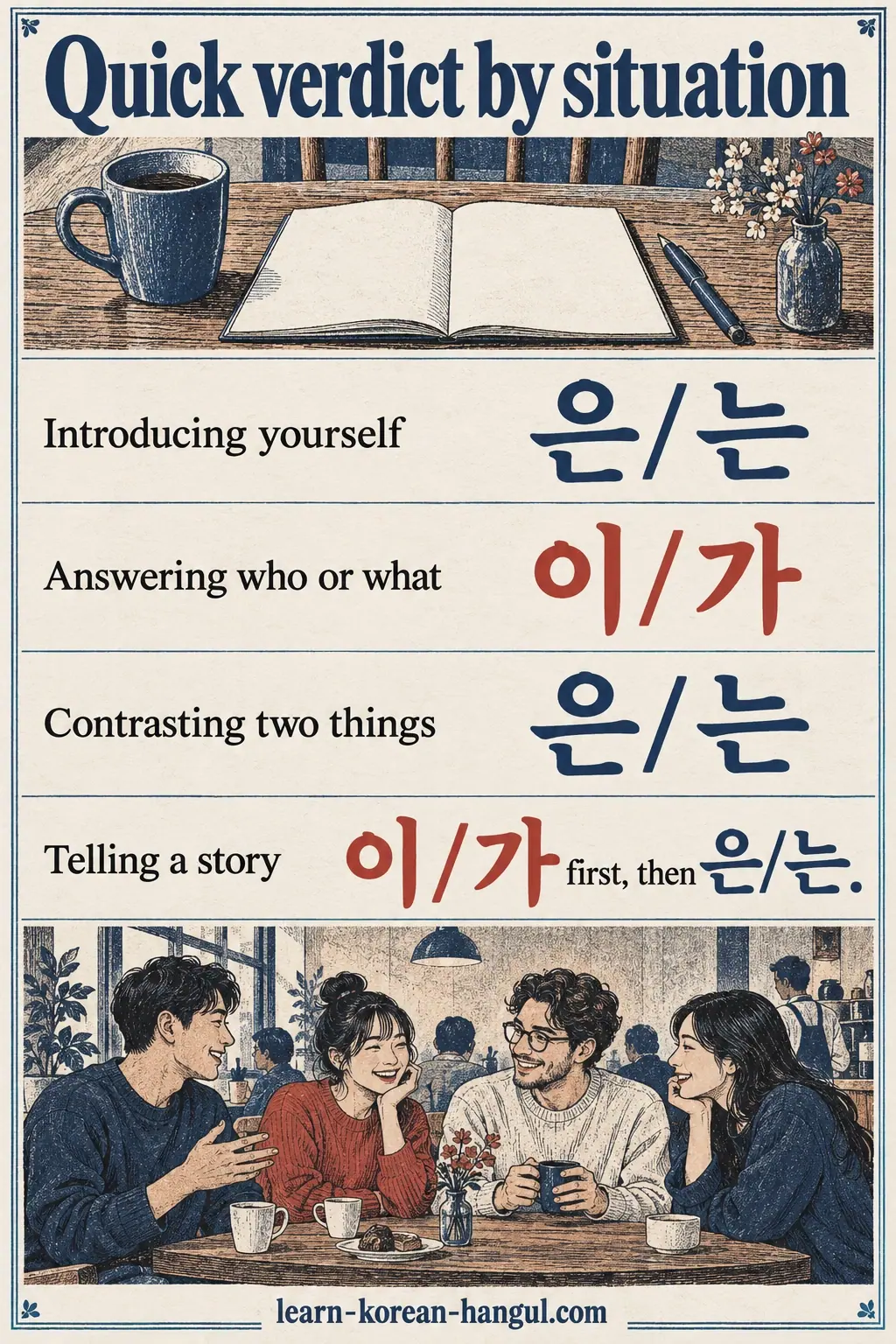
은/는 vs 이/가 is the choice between marking a sentence topic and marking a sentence subject in Korean. Use 이/가 for new information and for the answer to a who or what question. Use 은/는 for a topic both speakers know, for contrast and for general statements. Most sentences become clear once you ask, "Is this word the news?"
Quick verdict by situation
- Introducing yourself: 은/는 (저는 사라예요).
- Answering who or what: 이/가 (제가 했어요).
- Telling a story: 이/가 first, then 은/는.
- Saying what you have or feel: 이/가 on the thing (시간이 없어요).
- Contrasting two things: 은/는 on both.
Before you start: you can attach both particles correctly. Estimated time: 25 minutes.
은/는 vs 이/가: What Is the Difference?
The difference between 은/는 and 이/가 is about information, not grammar. Both particles can attach to the same noun in the same position, and both sentences are correct Korean. What changes is what the listener understands as the topic and what as the news.
The topic particle 은/는 says "as for this". It points to something already in the conversation, or something the speaker wants to contrast with something else. The subject particle 이/가 says "this one, specifically". It marks the doer or the thing described, especially when that word is the new or important part.
A pair shows it best. 저는 학생이에요 means "As for me, I'm a student", a normal self-introduction. 제가 학생이에요 means "I'm the student" or "It's me who is the student", the answer to "Which of you is the student?" The words are the same; only the focus moves.
The One-Line Rule
If the word is the news, use 이/가. If the word is the frame for the news, use 은/는.
That rule covers most beginner sentences. The rest of this page breaks it into seven criteria, each with an example pair, so that you can check harder cases one at a time.
Side-by-Side Comparison Table
The table compares the two particles across the criteria that decide most choices. The bold cell in each row marks the particle that criterion favours.
| Criterion | 은/는 (topic) | 이/가 (subject) |
|---|---|---|
| Information status | known or shared: 버스는 10분마다 와요. | new: 저기 버스가 와요. |
| Answer to who or what | never the answer | the answer: 제가 했어요. |
| Question words | not in neutral questions | always as subject: 누가, 뭐가 |
| Contrast | yes: 민수는 왔어요. (others didn't) | no contrast implied |
| General statements | yes: 고양이는 귀여워요. | describes one specific case |
| Stories | later mentions: 할아버지는 | first mention: 할아버지가 |
| Inside a describing or if-clause | not used | used: 제가 본 영화, 비가 오면 |
| Form rule | 은 after a consonant, 는 after a vowel | 이 after a consonant, 가 after a vowel; 제가, 내가, 네가, 누가 |
The form rows are covered in full in the lessons on the topic particle 은/는 and the subject particle 이/가. This page assumes you can already attach each form; the next section shows the choice in one worked exchange.
How Does the Choice Work in a Worked Example?
The choice works by asking whether the noun is the news. This worked example runs one short exchange in a classroom where a new teacher is looking for the student who sent an email.
은/는
topic: as for X
이/가
subject: X, specifically
Use 이/가 for the answer to who; use 은/는 for the introduction.
Step 1: The question. The teacher asks 누가 학생이에요? (nuga haksaengieyo) = "Who is the student?" The question word 누구 is the subject, so it takes 가 and shortens to 누가.
Step 2: The answer. You are the student, so "me" is the news. The answer marks it with 이/가, and 저 + 가 becomes 제가: 제가 학생이에요. (jega haksaengieyo) = "I'm the student."
Step 3: The introduction. The teacher now asks you to say something about yourself. You are now the topic, not the news, so you switch to 은/는: 저는 학생이에요. 한국어를 공부해요. = "I'm a student. I study Korean."
Checkpoint. You'll know you have it when you can explain why the same person is 제가 in step 2 and 저는 in step 3. In step 2, "me" answers the question. In step 3, "me" is the frame for new facts. The seven criteria below test that idea in other situations.
Criterion 1: Is the Information New or Known?
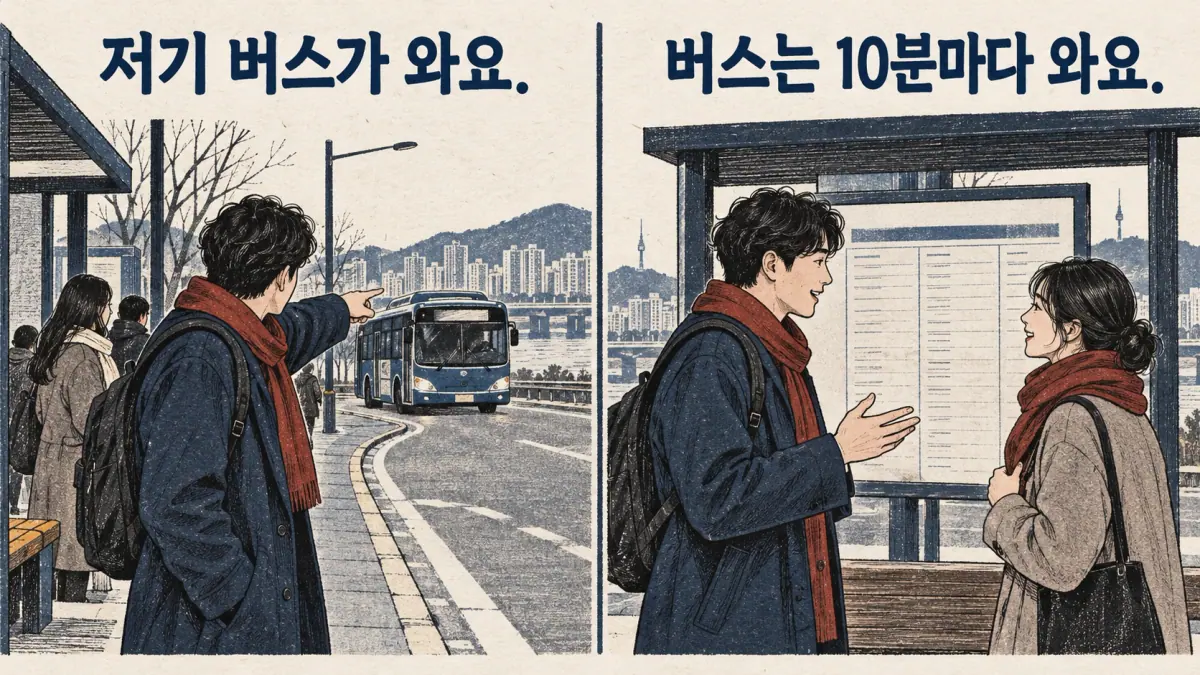
Use 이/가 when the noun is new to the conversation and 은/는 when both speakers already know it. Newness is the most general criterion, and the others mostly follow from it.
- 저기 버스가 와요. (jeogi beoseuga wayo) = "Look, a bus is coming." The bus has just appeared.
- 버스는 10분마다 와요. (beoseuneun sipbunmada wayo) = "Buses come every ten minutes." Buses are the known topic, and the timetable is the news.
Winner for new information: 이/가. Winner for known topics: 은/는.
Criterion 2: Does the Noun Answer Who or What?
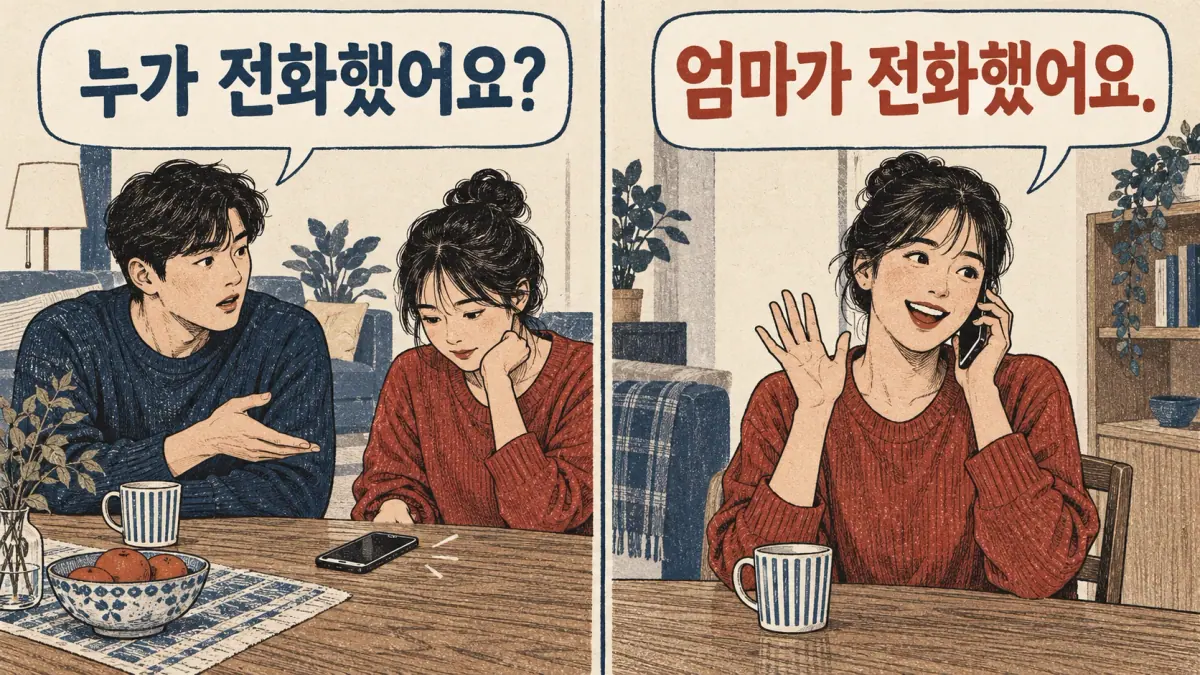
Use 이/가 on the word that answers a who or what question, and on the question word itself. The answer is by definition the news.
- 누가 전화했어요? 엄마가 전화했어요. = "Who called? Mom called."
- 뭐가 맛있어요? 이 김치가 맛있어요. = "What is tasty? This kimchi is tasty."
Using 은/는 in the answer sounds evasive or contrastive: 엄마는 전화했어요 suggests "Mom called, at least (but someone else didn't)". Winner for answers and question words: 이/가.
Criterion 3: Are You Contrasting Two Things?

Use 은/는 to contrast one thing with another, stated or implied. The topic particle carries a built-in "as opposed to".
- 민수가 왔어요. = "Minsu came." Plain news.
- 민수는 왔어요. = "Minsu came, at least." The listener expects that someone else did not.
- 커피는 마셔요. 그런데 술은 안 마셔요. = "Coffee I drink, but alcohol I don't."
Winner for contrast: 은/는.
Criterion 4: Is It a General Statement?
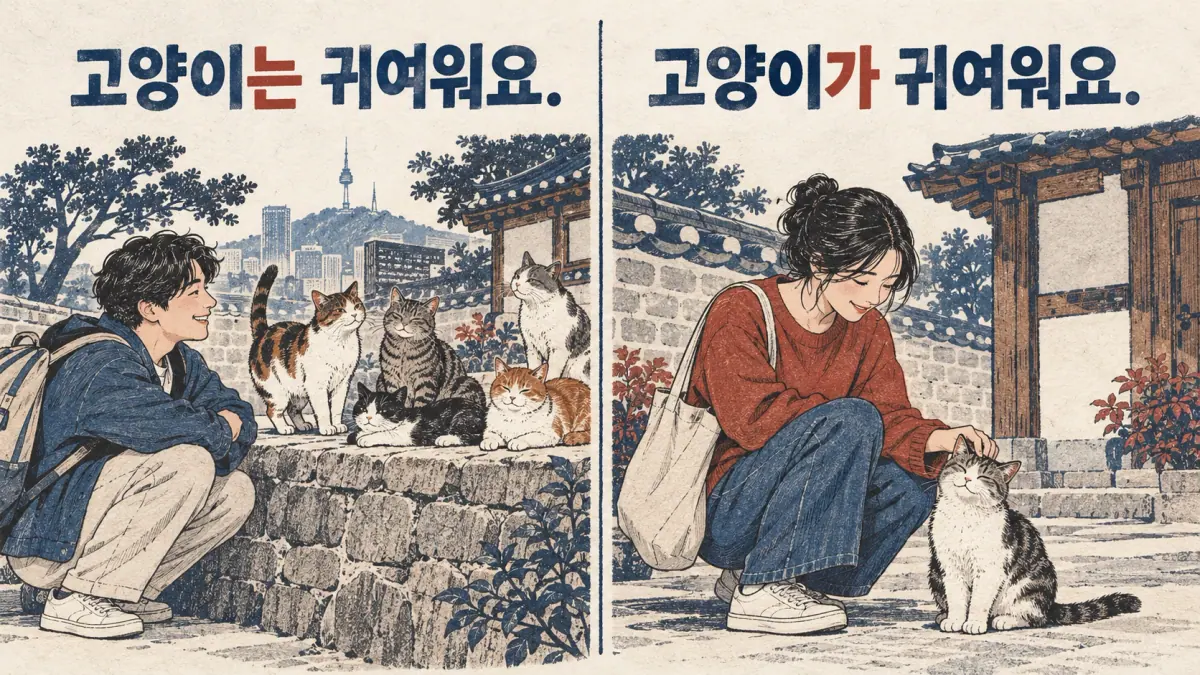
Use 은/는 for general truths, definitions and descriptions of a whole category. Use 이/가 when you describe one specific case in front of you.
- 고양이는 귀여워요. (goyangineun gwiyeowoyo) = "Cats are cute." A statement about cats in general.
- 고양이가 귀여워요. = "The cat is cute." You are looking at one cat, or answering "What is cute?"
Winner for general statements: 은/는.
Criterion 5: Is It the First Mention in a Story?
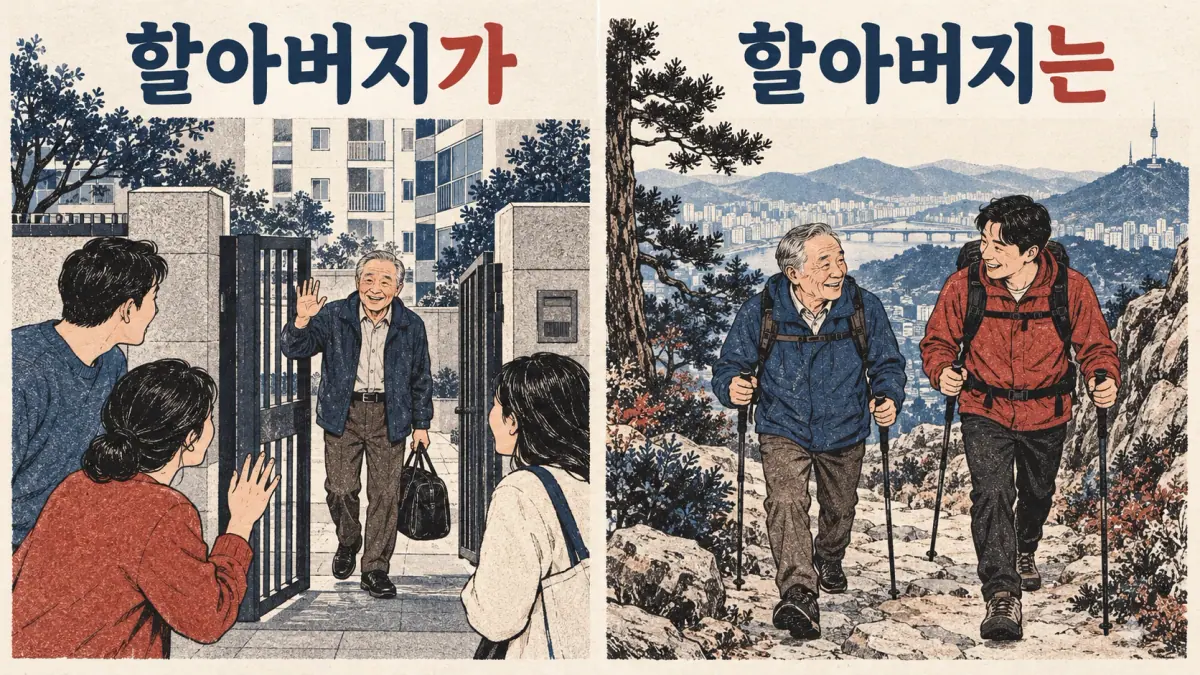
Use 이/가 the first time a new character or thing enters a story, and 은/는 when you mention it again. The switch follows the information: new at first, known afterwards.
- 옛날에 한 할아버지가 살았어요. = "Once upon a time, there lived an old man."
- 할아버지는 매일 산에 갔어요. = "The old man went to the mountain every day."
The same pattern appears in news and everyday reports. Note that the switch happens across sentences, not inside one short sentence. Winner for first mentions: 이/가; for later mentions: 은/는.
Criterion 6: Is the Noun inside a Smaller Clause?
Use 이/가 for the subject of a describing clause or an "if" or "when" clause inside a bigger sentence. The topic particle belongs to the main sentence, not to these inner clauses.
- 제가 어제 본 영화는 재미있었어요. = "The movie I saw yesterday was fun." 제가 is the subject of the inner clause 어제 본 (saw yesterday); 영화는 is the topic of the whole sentence.
- 비가 오면 집에 있어요. = "If it rains, I stay home." The rain sits inside the if-clause, so it takes 가.
Beginner textbooks often skip this criterion, yet it explains many sentences that otherwise look irregular. Winner inside clauses: 이/가.
Criterion 7: Can Both Appear in One Sentence?
Yes. Many Korean sentences use both: 은/는 for the overall topic and 이/가 for the subject of the description. This is called the double subject pattern.
- 저는 머리가 아파요. (jeoneun meoriga apayo) = "I have a headache." Literally: as for me, the head hurts.
- 코끼리는 코가 길어요. (kokkirineun koga gireoyo) = "Elephants have long trunks." Literally: as for elephants, the trunk is long.
The full pattern has its own lesson on the double subject construction in korean. Winner: neither; each particle does its own job. With the criteria covered, the next section turns them into situation-by-situation advice.
Which Should You Choose in Each Situation?
Choose by the situation you are in. The five common beginner situations below each get a firm recommendation.
Introducing Yourself
Use 은/는. 저는 사라예요. 영국 사람이에요. = "I'm Sarah. I'm British." You are the topic; the facts are the news. After the first sentence, drop 저는, because Korean leaves out a topic everyone knows.
Answering a Who or What Question
Use 이/가. 누가 했어요? 제가 했어요. = "Who did it? I did." The same applies to volunteering: 제가 할게요 means "I'll do it", with the sense "me, not someone else".
Telling a Story or Reporting Events
Start with 이/가 for each new person or thing, then switch to 은/는. 친구가 한 명 있어요. 그 친구는 부산에 살아요. = "I have a friend. That friend lives in Busan."
Describing What You Have, Feel or See
Use 이/가 on the thing that exists, hurts or has a quality, often after a 은/는 topic. 저는 시간이 없어요. = "I don't have time." 날씨가 좋아요. = "The weather is nice."
Comparing or Contrasting
Use 은/는 on both sides. 여름은 더워요. 겨울은 추워요. = "Summer is hot. Winter is cold." The next section lists the mistakes that come from mixing these situations up.
What Mistakes Do Learners Make?
Learners make four common mistakes with 은/는 vs 이/가. Each one follows the pattern "learners often assume X; actually Y, because Z".
- Using 은/는 everywhere. Learners often feel that 은/는 means "is" and put it on every subject. Actually this hides the focus that 이/가 gives, so answers sound vague: 엄마는 전화했어요 instead of 엄마가 전화했어요. Ask whether the word is the news.
- Using 이/가 to introduce yourself. Learners often say 제가 사라예요 at the start of a conversation. Actually that sounds like "I'm the Sarah you're looking for". Use 저는 사라예요.
- Putting 은/는 on a question word. Learners say 누구는 왔어요? Actually a neutral question word that is the subject takes 이/가: 누가 왔어요?
- Putting 은/는 inside a describing clause. Learners write 저는 만든 케이크. Actually the subject of a describing clause takes 이/가: 제가 만든 케이크 (the cake I made).
A practical rule of thumb: when you are unsure in an answer, use 이/가; when you are unsure in a first sentence about yourself, use 은/는. The next section explains where even this rule stops working.
Where the Simple Rule Breaks Down
The "new versus known" rule is a teaching simplification, and it has honest limits. Korean speakers make some choices for reasons of rhythm, emphasis or style that no short rule predicts.
- Contrast can override newness. A brand-new noun can still take 은/는 if you contrast it: 비는 와요, 그런데 바람은 안 불어요 = "It does rain, but the wind isn't blowing."
- Casual speech drops both. In conversation, 비 와요 and 나 학생이야 are normal with no particle at all. The lesson on omitting particles in korean explains when that is safe.
- Respect changes the form. For a respected person, the subject particle becomes 께서, and the topic version becomes 께서는.
- Both can be correct. In many sentences, either particle is grammatical and the difference is only nuance. A native speaker may accept both answers where a textbook marks one wrong.
If a sentence does not fit any criterion, choose by the question test and move on. The more Korean you hear, the more the remaining cases become automatic. The practice below checks the core cases.
Practice and Answers
These four exercises check the core outcome: choosing between 은/는 and 이/가 in a new sentence and explaining why. Try each one before reading the answers.
Practice · 8
A asks 누가 전화했어요? B wants to say plainly "Mom called." Which answer fits?
Show answer
엄마가 전화했어요.
The word that answers a who question is the news, so it takes 이/가; 엄마는 would suggest someone else did not call.
Which sentence correctly starts a self-introduction, "I'm Michael"?
Show answer
저는 마이클이에요.
In a self-introduction you are the topic, so use 저는; 제가 마이클이에요 sounds like "I'm the Michael you're looking for".
Which sentence states the general truth "Cats are cute"?
Show answer
고양이는 귀여워요.
General statements about a whole category take 은/는; 고양이가 귀여워요 describes one specific cat.
How does a story mark a new character?
Show answer
이/가 at first mention, then 은/는 later
A new character is new information at first (이/가) and a known topic afterwards (은/는).
Which phrase correctly says "the cake I made"?
Show answer
제가 만든 케이크
The subject of a describing clause takes 이/가, and 저 + 가 becomes 제가.
Which sentence correctly says "If it rains, I stay home"?
Show answer
비가 오면 집에 있어요.
The subject inside an if-clause takes 이/가, not 은/는.
You want to contrast two things, as in "Summer is hot. Winter is cold." Which particle do you use?
Show answer
은/는 on both nouns
The topic particle carries a built-in "as opposed to", so contrast uses 은/는 on both sides: 여름은 더워요. 겨울은 추워요.
Which particle adds respect when the subject is someone you honour?
Show answer
께서
Neither 은/는 nor 이/가 carries politeness; 께서 replaces 이/가 for a respected subject.
Exercise 1: Choose the particle. A: 누가 전화했어요? B: 엄마__ 전화했어요.
Exercise 2: Fix the error. A learner starts a self-introduction with 제가 마이클이에요. 미국 사람이에요.
Exercise 3: Translate. "Cats are cute." (cat = 고양이, are cute = 귀여워요)
Exercise 4: Write your own. Write a two-sentence mini story. Introduce a pet in the first sentence and say its age in the second.
Answer Key
- Exercise 1: 엄마가 전화했어요. Mom answers the who-question, so she is the news and takes 이/가. 엄마 ends in a vowel, so the form is 가.
- Exercise 2: 저는 마이클이에요. 미국 사람이에요. A self-introduction makes you the topic, so use 저는. The second sentence correctly drops the topic.
- Exercise 3: 고양이는 귀여워요. (goyangineun gwiyeowoyo) A general statement about a category takes 은/는.
- Exercise 4: One model answer: 우리 집에 강아지가 있어요. 강아지는 세 살이에요. = "We have a puppy at home. The puppy is three years old." The first mention takes 이/가 with 있어요; the second mention takes 은/는.
If you missed Exercise 1 or 4, reread Criteria 2 and 5. The next section shows where to go from here.
Next Lessons and Where to Go from Here
The next lesson in this set is the honorific subject particle 께서, which replaces 이/가 when the subject is someone you respect. If any criterion on this page felt shaky, return to the single-particle lessons on the topic particle 은/는 and the subject particle 이/가.
What this lesson does not cover. This lesson does not cover the object particle 을/를, the full rules for dropping particles, or advanced contrastive stress. Other confusable pairs, such as 에 vs 에서, are collected under korean grammar differences. Every lesson in this particle set is listed on korean topic and subject particles.
In short, 은/는 vs 이/가 comes down to one question: is this word the news? If it is, use 이/가; if it frames the news, contrasts, or states a general truth, use 은/는.
Frequently Asked Questions
Is 이/가 more polite than 은/는? No. Neither particle carries politeness. Politeness in Korean comes from word choice, such as 저 instead of 나, and from the verb ending, such as 이에요 or 입니다. The only particle that adds respect is 께서, which replaces 이/가 when the subject is a person you honour, such as a grandparent or a teacher.
Why do textbooks teach 은/는 first? Most textbooks start with self-introductions, and a self-introduction uses the topic particle: 저는 학생이에요. That makes 은/는 the first particle learners see. The subject particle 이/가 usually follows within a few lessons, with 있어요 and 없어요. Neither is more basic; the order simply follows the first conversations a learner needs.
Can I just use 은/는 for everything at first? You will be understood, but you will sound vague or contrastive, especially in answers. 엄마는 전화했어요 suggests someone else did not call. A safer beginner habit is two defaults: 저는 in a first sentence about yourself, and 이/가 on any word that answers who or what, or that goes with 있어요 or 없어요.
Do Korean speakers ever disagree on the choice? Yes, in borderline sentences. When a noun is both somewhat known and somewhat new, native speakers may accept either particle and describe only a small difference in nuance. Clear cases, such as answers to who-questions, question words and describing clauses, are not disputed. Learn the clear cases first and treat the rest as nuance.
How do I say "And you?" in Korean, with 은/는 or 이/가? Use 은/는. Asking 그럼 민수 씨는요? or casually 너는? turns the conversation to a new topic, the other person, and invites them to answer the same question. The polite 요 attaches after the particle. Avoid 이/가 here, because 민수 씨가요? sounds like asking whether Minsu is the one who did something.