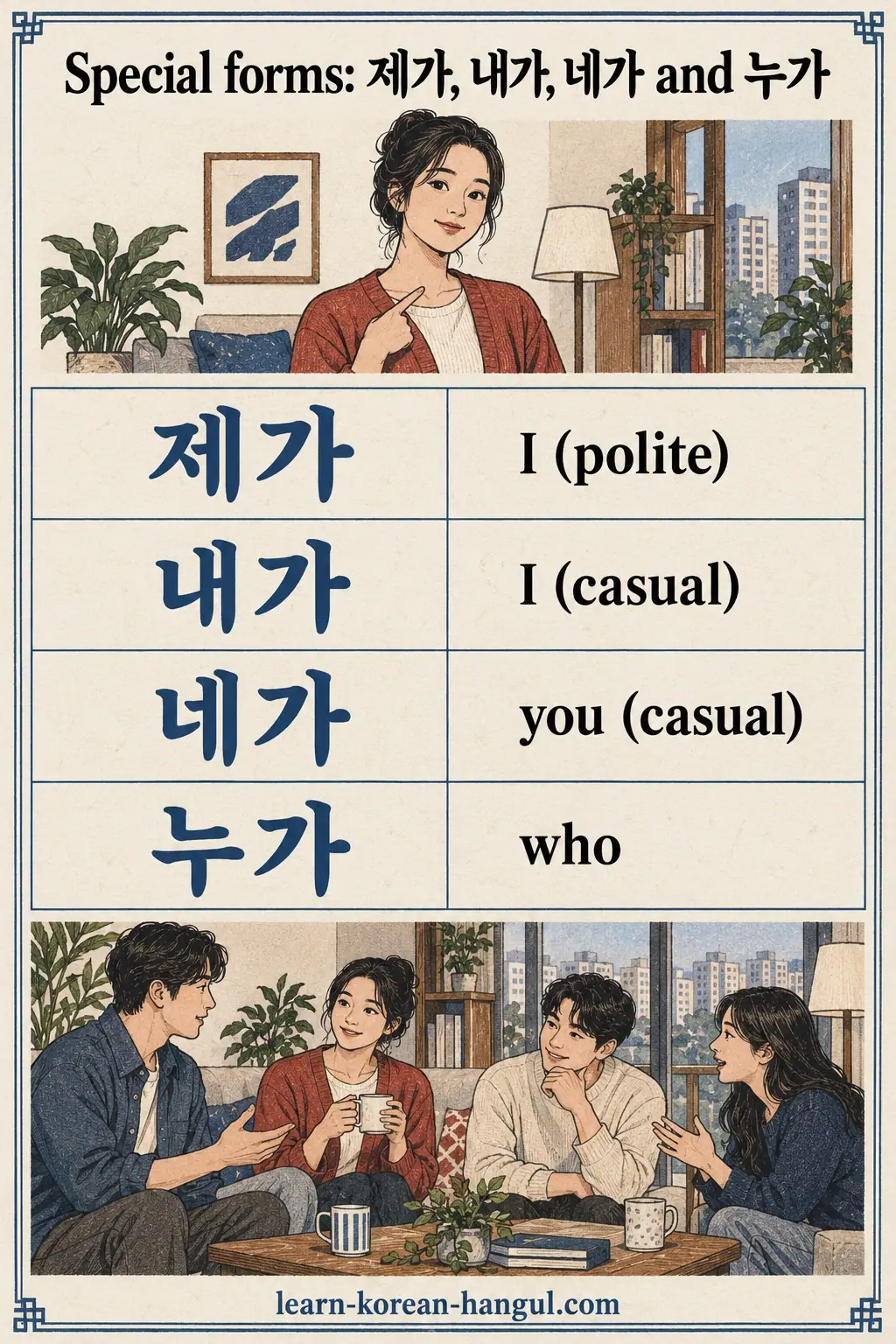
The subject particle 이/가 is a Korean grammar marker attached to a noun to show who or what does something or is in a state, usually as new or focused information. Use 이 after a final consonant (책이) and 가 after a vowel (비가). After this lesson you can choose the form and use 제가 and 누가 correctly.
What you'll learn
- Choose 이 or 가 for any noun by checking its final sound.
- Produce the special forms 제가, 내가, 네가 and 누가 without the common errors 저가 and 누구가.
- Answer a who-question such as 누가 했어요? with the right particle.
- Distinguish 제가 학생이에요 from 저는 학생이에요.
Before you start: you can read Hangul blocks and have met the topic particle 은/는. Estimated time: 20 minutes.
What Does the Subject Particle 이/가 Mean?

The subject particle 이/가 marks the subject: the person or thing that acts, exists or has a quality. It also points the listener's attention at that noun, as if saying "this one, specifically". A particle (조사, josa) is a short ending glued to a word to show its job in the sentence.
English marks the subject by putting it before the verb. Korean marks it with a sound attached to the noun, so the subject can be recognized wherever it sits. In 비가 와요, the 가 tells you that 비 (rain) is the thing doing the action.
The focus part matters as much as the grammar part. Compare English "Minsu came" said flatly with "MINSU came", where stress tells you Minsu is the news. Korean 민수가 왔어요 carries some of that second meaning without any extra stress.
A First Example
The two sentences below show 이/가 on two different nouns. Read the Korean first, then the romanization, then the meaning.
- 비가 와요. (biga wayo) = "It is raining." Word by word: 비 (rain) + 가 (subject) + 와요 (comes). Korean says "rain comes" where English uses an empty "it".
- 친구가 왔어요. (chinguga wasseoyo) [친구가 와써요] = "A friend came" or "My friend is here." Word by word: 친구 (friend) + 가 (subject) + 왔어요 (came).
Both nouns end in a vowel, so both take 가. Both sentences also report something new: rain has started, a friend has arrived. That newness is the typical setting for 이/가. The next section explains why Korean needs a separate marker for it.
Why Does Korean Need a Subject Particle?

Korean needs a subject particle because the verb comes last and the other words can move around. Without a marker, a listener could not always tell the doer from the thing being acted on.
Look at two orders of the same idea. 고양이가 개를 봐요 and 개를 고양이가 봐요 both mean "The cat sees the dog", because 가 marks the cat as the subject and 를 marks the dog as the object. The order changes the emphasis a little, not the meaning. The lesson on the korean sov sentence pattern shows this word order step by step.
The subject particle also separates "this is new" from "this is the topic". Korean has a second marker, the topic particle 은/는, for things already under discussion. Having both lets a speaker say "as for me" (저는) and "it's me" (제가) with different words. With the purpose clear, the next section gives the form rule.
How Does the Subject Particle 이/가 Work?

The subject particle 이/가 has two regular forms, and the choice depends only on the last sound of the noun. Four common words also change shape before 가.
- Look at the last syllable block of the noun.
- If that block has a final consonant (받침, batchim), add 이.
- If that block ends in a vowel, add 가.
- Check the four special words: 저, 나, 너 and 누구.
- Write the particle with no space: 책이, not 책 이.
The final consonant is the letter at the bottom of a syllable block, such as the ㄱ in 책 or the ㄹ in 물. If the last block has a letter underneath, use 이.
Pattern Table
The table shows common nouns with their subject forms and pronunciation. Brackets show the sound where it differs from the spelling.
| Noun | Last block ends in | Subject form | Pronunciation | Meaning |
|---|---|---|---|---|
| 비 | vowel ㅣ | 비가 | [비가] | rain |
| 친구 | vowel ㅜ | 친구가 | [친구가] | friend |
| 커피 | vowel ㅣ | 커피가 | [커피가] | coffee |
| 학생 | consonant ㅇ | 학생이 | [학쌩이] | student |
| 책 | consonant ㄱ | 책이 | [채기] | book |
| 물 | consonant ㄹ | 물이 | [무리] | water |
| 시간 | consonant ㄴ | 시간이 | [시가니] | time |
| 날씨 | vowel ㅣ | 날씨가 | [날씨가] | weather |
When 이 follows a consonant, that consonant slides into the 이 syllable. This is called liaison, and it is why 책이 sounds like [채기] and 물이 like [무리]. Final ㅇ is the exception: it stays put, so 학생이 is [학쌩이].
Special Forms: 제가, 내가, 네가 and 누가
Four everyday words change before 가. These forms are fixed, so learn them as whole words.
| Word | Meaning | With 가 | Wrong form |
|---|---|---|---|
| 저 | I (polite) | 제가 | 저가 |
| 나 | I (casual) | 내가 | 나가 |
| 너 | you (casual) | 네가 | 너가 |
| 누구 | who | 누가 | 누구가 |
In speech, many people say 네가 as [니가] to keep it apart from 내가, which sounds almost the same in Seoul speech. The written standard remains 네가. With 은/는 these words stay regular: 저는, 나는, 너는, 누구는.
Words That Usually Take 이/가
Some predicates almost always pair with a noun marked by 이/가. With most of them that noun is the subject; with 아니에요 and 되다 it is the complement (보어), the noun that completes "is not" or "become", but the particle is the same. Learning them as chunks saves a lot of guessing.
- 있어요 / 없어요 (there is / there isn't, have / don't have): 시간이 없어요. (sigani eopseoyo) = I don't have time.
- Descriptive verbs (adjectives): 날씨가 좋아요. (nalssiga joayo) = The weather is nice.
- 아니에요 (is not): 저는 학생이 아니에요. = I'm not a student. See the lesson on 아니에요 not to be.
- 되다 (to become): 의사가 되고 싶어요. = I want to become a doctor.
- 아파요 (hurts): 머리가 아파요. = My head hurts.
The form rule and the chunks are now in place. The next section builds one sentence from scratch.
Worked Example, Step by Step

This worked example builds 친구가 왔어요 ("My friend is here") from its parts. You have just opened the door, and you are telling someone at home what happened.
- Decide what is new. The news is that a friend arrived, so the friend is the focus.
- Choose the noun. Friend is 친구.
- Check the last sound. 친구 ends in the vowel ㅜ, with no letter underneath.
- Pick the particle form. A vowel ending takes 가, giving 친구가.
- Choose the verb. To come is 오다. Its polite past form is 왔어요 (came), explained in the lesson on past tense -았/었-.
- Put the verb last. 친구가 왔어요.
- Say it aloud. 왔어요 is pronounced [와써요], so the sentence is [친구가 와써요].
You'll know it worked when you can change the noun and still choose correctly. With 동생 (younger sibling), which ends in ㅇ, you get 동생이 왔어요. With yourself as the person who came, use the special form: 제가 왔어요 (It's me, I'm here). The next section compares this marker with the topic particle.
How Is 이/가 Different from 은/는?

The subject particle 이/가 marks a subject that is new, specific or in focus, while the topic particle 은/는 marks a topic that is known, contrasted or general. Both can attach to the same noun, and the choice changes the message.
| 이/가 (subject) | 은/는 (topic) | |
|---|---|---|
| Main job | marks who or what does or is something | sets what the sentence is about |
| Information | new, specific, focused | known, shared, contrasted |
| Answers "who?" or "what?" | yes: 누가 왔어요? 민수가 왔어요. | no |
| Question words | yes: 누가, 뭐가, 어디가 | no, in neutral questions |
| General truths | rarely | yes: 고래는 포유류예요. |
| Example | 제가 학생이에요. = I'm the student (it's me). | 저는 학생이에요. = As for me, I'm a student. |
Use the question test. If someone asks 누가 학생이에요? (Who is the student?), answer 제가 학생이에요. If someone asks you to introduce yourself, say 저는 학생이에요. The lesson on the topic particle 은/는 covers the other side in detail, and 은/는 vs 이/가 gives a full decision guide.
For older people or people you respect, the honorific subject particle 께서 replaces 이/가: 할머니께서 오셨어요 (Grandmother came). The lesson on the honorific subject particle 께서 explains when it is expected. The next section lists the situations that call for 이/가.
When Do You Use 이/가, and When Not?

Use 이/가 for new information, answers to who or what, question words, existence and description, and subjects inside describing clauses. Avoid it when you introduce yourself, state a general truth, or contrast two things.
Five Uses of 이/가
Each use comes with one example you can reuse.
- Reporting something new. 버스가 와요. (beoseuga wayo) = The bus is coming.
- Answering who or what. 누가 했어요? 제가 했어요. = Who did it? I did.
- Asking with a question word. 뭐가 있어요? (mwoga isseoyo) = What is there? 어디가 아파요? = Where does it hurt?
- Existence and description. 방에 고양이가 있어요. = There is a cat in the room.
- Inside a describing clause. 제가 만든 김치예요. = This is the kimchi I made. The subject of the short clause takes 이/가, never 은/는.
Question Words Take 이/가 as Subjects
The question words 누구 (who), 뭐 (what) and 어디 (where) take 이/가 when they are the subject: 누가 왔어요? and 뭐가 있어요? A question word asks for new information, and new information is the job of 이/가. The answer keeps the same particle: 민수가 왔어요, 물이 있어요.
Two Subjects in One Sentence
Some sentences have a topic and a subject together. In 저는 머리가 아파요 (jeoneun meoriga apayo), "As for me, my head hurts", 저 is the topic and 머리 (head) is the subject of 아파요. In 코끼리는 코가 길어요, "Elephants have long trunks", the elephant is the topic and the trunk is the subject. This pattern has its own lesson on the double subject construction in korean.
Speech and Writing
The subject particle 이/가 appears in every register, from casual chat to news reports and official documents. The particle does not change with politeness; only the verb ending does. In casual speech, Koreans often drop 이/가 when the meaning is clear, as in 비 와요. With the uses mapped, the next section covers the errors to watch for.
What Mistakes Do Learners Make with 이/가?
Learners make five predictable mistakes with 이/가. Each one below follows the pattern "learners often assume X; actually Y, because Z".
- Writing 저가. Learners often attach 가 to 저 like any other vowel-final noun. Actually the required form is 제가, because 저, 나 and 너 change their vowel before 가. 저가 학생이에요 is wrong; 제가 학생이에요 is right.
- Writing 누구가. Learners apply the regular rule to 누구. Actually 누구 + 가 shortens to 누가: 누가 왔어요?
- Confusing 이 with 이에요. Learners see 학생이 and 학생이에요 and think they are related. Actually 이 in 학생이 is the subject particle, while 이에요 means "am, is, are". 학생이 와요 means "A student is coming"; 학생이에요 means "I'm a student".
- Using 이/가 for self-introductions. Learners say 제가 민수예요 to introduce themselves. Actually that answers "Which one is Minsu?" A plain self-introduction uses the topic: 저는 민수예요.
- Using 은/는 with 있어요 for new things. Learners say 방에 고양이는 있어요 to mean "There is a cat in the room". Actually that sounds like "a cat, at least, there is". New things that exist take 이/가: 방에 고양이가 있어요.
A rule of thumb that works for most beginner sentences: if your sentence answers a question, introduces something new, or uses 있어요, 없어요 or an adjective, start with 이/가. The practice set below tests these points.
Practice and Answers
These four exercises check the outcomes listed at the top of the lesson. Try each one before you look at the answer key.
Practice · 8
Which subject form is correct for 사과 (apple)?
Show answer
사과가
사과 ends in a vowel, so it takes 가, written with no space.
Which subject form is correct for 가방 (bag)?
Show answer
가방이
가방 ends in the consonant ㅇ, so it takes 이.
What does 저 + 가 become?
Show answer
제가
저 changes its vowel before 가, so the fixed form is 제가; 저가 is an error.
What does 누구 + 가 become?
Show answer
누가
누구 + 가 shortens to the fixed form 누가, as in 누가 왔어요?
Which sentence correctly says "I don't have time"?
Show answer
시간이 없어요.
시간 ends in ㄴ, so it takes 이, and 없어요 pairs with a noun marked by 이/가.
Someone asks 누가 커피를 마셨어요? How do you answer "I did"?
Show answer
제가 마셨어요.
The answer to a who question takes 이/가, and 저 becomes 제 before 가.
Which sentence is a plain self-introduction ("I'm Minsu")?
Show answer
저는 민수예요.
A plain self-introduction uses the topic 저는; 제가 민수예요 answers "Which one is Minsu?" and 저가 is never correct.
Which sentence correctly says "There is a cat in the room"?
Show answer
방에 고양이가 있어요.
고양이 ends in a vowel, so it takes 가, and something new that exists with 있어요 is marked by 이/가.
Exercise 1: Choose the form. Add 이 or 가, or write the special form.
- 사과__ (apple)
- 가방__ (bag)
- 저 + 가 = ?
- 누구 + 가 = ?
Exercise 2: Fix the error. Each sentence has one particle problem.
- 저가 했어요.
- 누구가 왔어요?
Exercise 3: Translate. "I don't have time." (time = 시간, there isn't = 없어요)
Exercise 4: Write your own. Someone asks 누가 커피를 마셨어요? (Who drank the coffee?). Answer that you did, using the correct form of "I".
Answer Key
- Exercise 1: 1 사과가 (ends in a vowel). 2 가방이 (ends in ㅇ) [가방이]. 3 제가. 4 누가.
- Exercise 2: 1 제가 했어요. 저 changes to 제 before 가. 2 누가 왔어요? 누구 + 가 shortens to 누가.
- Exercise 3: 시간이 없어요. (sigani eopseoyo) [시가니 업써요]. 시간 ends in ㄴ, so it takes 이, and 없어요 pairs with a subject in 이/가.
- Exercise 4: 제가 마셨어요. (jega masyeosseoyo) [제가 마셔써요] = I drank it. The answer to "who?" is new information, so it takes 이/가, and 저 becomes 제.
If you missed Exercise 1 or 2, review the table of special forms and say each one aloud three times. The next section shows where to go from here.
Next Lessons and Where to Go from Here
The natural next lesson is 은/는 vs 이/가, which puts both particles side by side with minimal pairs, a one-line decision rule and more practice. If you skipped it, the lesson on the topic particle 은/는 is the other half of this pair.
What this lesson does not cover. This lesson does not cover every use of 께서, the full rules for dropping particles in speech, or the double-subject pattern in depth. Each of those has its own page in korean topic and subject particles, with audio and practice.
In short, the subject particle 이/가 points at who or what does or is something, especially when it is new: 이 after a consonant, 가 after a vowel, and the fixed forms 제가, 내가, 네가 and 누가.
Frequently Asked Questions
Why is it 제가 and not 저가? 제가 is a fixed historical form. Before the particle 가, the pronoun 저 changes its vowel to 제, and the casual 나 and 너 change in the same way to 내가 and 네가. The forms 저가, 나가 and 너가 are treated as errors in standard Korean, although 너가 is sometimes heard in casual speech.
Can I drop 이/가 in conversation? Yes, in casual speech, when the meaning is clear. 비 와요 (It's raining) and 시간 없어요 (No time) are both natural without the particle. Keep 이/가 when the subject is the focus, such as an answer to who, and in writing. The lesson on omitting particles explains the limits in more detail.
Is 이/가 used in formal writing or only in speech? Both. The subject particle 이/가 appears in casual chat, polite conversation, news, essays and official documents, and its form never changes with politeness. Only the verb ending changes, as in 비가 와요 (polite) and 비가 옵니다 (formal). In honorific contexts about a respected person, 께서 replaces 이/가.
Why does 좋아요 take 이/가 when it means I like? 좋아요 is a descriptive verb meaning is good or is liked, so the liked thing is its subject: 저는 커피가 좋아요, literally As for me, coffee is good. The action verb 좋아해요 (to like) takes an object instead: 커피를 좋아해요. Both mean I like coffee, with different particles.
What level of Korean is the subject particle 이/가? The subject particle 이/가 is A1 grammar, the first level of the CEFR scale, and it is tested from TOPIK I onward. It appears in the first chapters of beginner textbooks, often in the same unit as 은/는. Full control of when to prefer 이/가 over 은/는 takes longer and keeps improving through intermediate study.