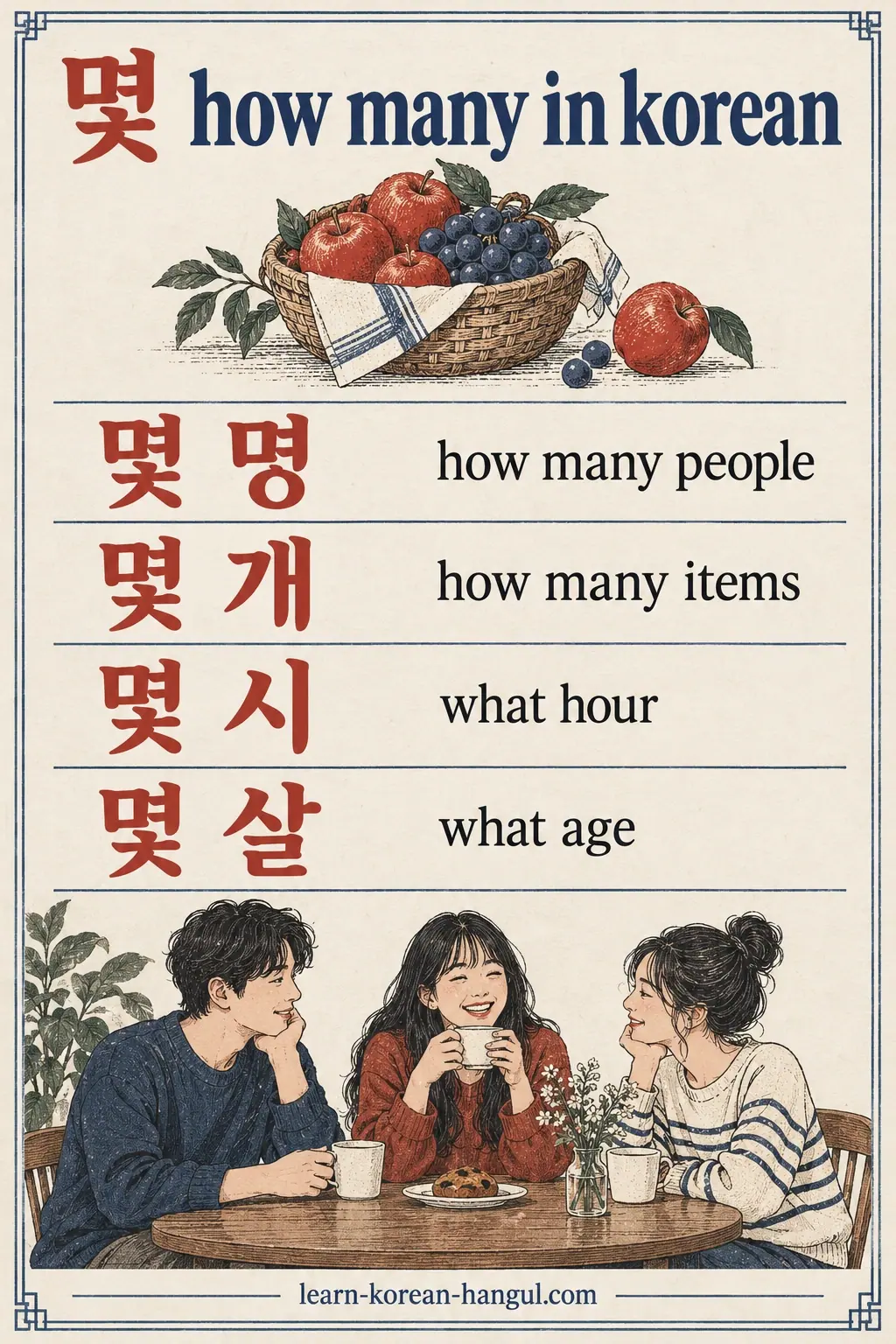
What you'll learn
- Ask "how many" and "what number" with 몇 plus a counter in a polite sentence.
- Use the common counters 명, 개, 시, 살, 월, 번 and 층 with 몇.
- Choose native Korean or Sino-Korean numbers for the answer.
- Tell 몇 apart from 얼마 (how much, price).
- Fix the most common mistakes: 몇 without a counter and 몇 일 for the date.
Before you start: you should know the polite ending -아요/-어요 and the basic order subject, object, verb. If not, read Korean sentence structure first. A basic idea of the two Korean number systems helps, and the Korean numbers hub covers both. Audio plays only when you press a button.
What Does 몇 How Many in Korean Mean?

몇 is a determiner (관형사, gwanhyeongsa) that stands for an unknown number. It means "how many" for things you can count and "what number" for position, time and age. In questions it normally comes right before a counter (단위 명사, danwi myeongsa). 몇 can also stand alone as a number word, as in 몇이 왔어요? ("How many came?"), but beginners should always add a counter.
A counter is the unit word in a phrase such as "three people" or "two cups." Korean always uses one when it counts: 세 명 (three people), 두 잔 (two cups). The question 몇 명? simply puts 몇 where the number 세 stood.
A First Example
Two annotated sentences show the pattern.
- 몇 살이에요? (myeot sarieyo?) [멷싸리에요] = "How old are you?" The parts are 몇 (how many), 살 (years of age), 이에요 (is).
- 지금 몇 시예요? (jigeum myeot siyeyo?) [지금 멷씨예요] = "What time is it now?" The parts are 지금 (now), 몇 (what number), 시 (o'clock), 예요 (is).
Both sentences put a counter right after 몇. The sound of 몇 also changes in front of a counter, and the next section explains the rule together with the pronunciation.
How Does 몇 How Many in Korean Work?
Put 몇 directly before a counter, leave out any particle between the two, and then add the ending you would use for a statement. The answer replaces 몇 with a number, and the type of number depends on the counter. Some counters use native Korean numbers (하나, 둘, 셋), and some use Sino-Korean numbers (일, 이, 삼). The Korean numbers hub explains both systems.
The pronunciation follows one rule. The final ㅊ of 몇 is spoken as a ㄷ sound, so 몇 is [멷] on its own. The standard pronunciation rules (국립국어원 표준 발음법) then tense or nasalise the next sound. A tense sound follows before ㅅ, ㄱ and ㅂ: 몇 시 is [멷씨], 몇 개 is [멷깨]. A nasal sound follows before ㅁ and ㄴ: 몇 명 is [면명]. You do not change the spelling, only the sound.
Pattern Table
The table lists the counters learners use most. Each row gives the phrase, its meaning, the number system for the answer and a model sentence.
| Phrase | Meaning | Answer uses | Model sentence |
|---|---|---|---|
| 몇 명 | how many people | native: 한 명, 두 명, 세 명 | 가족이 몇 명이에요? |
| 몇 개 | how many items | native: 한 개, 두 개 | 사과가 몇 개 있어요? |
| 몇 시 | what hour | native: 한 시, 두 시 | 지금 몇 시예요? |
| 몇 살 | what age | native: 스무 살, 서른 살 | 몇 살이에요? |
| 몇 월 | what month | Sino: 일월, 삼월 (but 6 and 10 are 유월, 시월) | 몇 월에 태어났어요? |
| 몇 번 | what number, how many times | Sino for numbers, native for times | 몇 번이에요? |
| 몇 층 | what floor | Sino: 이 층, 삼 층 | 화장실이 몇 층이에요? |
The table shows that 몇 itself never changes. The counter and the answer carry the details. A worked example shows how to build a 몇 question from a statement.
How Do You Build a Question with 몇 Step by Step?
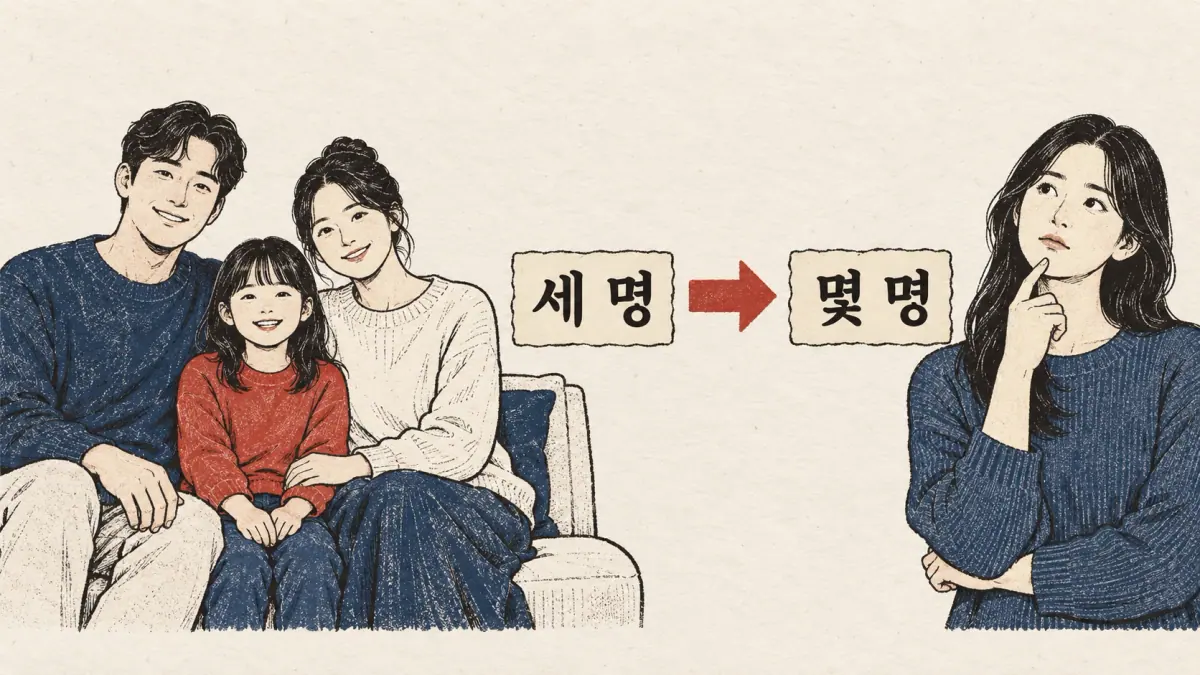
You build a 몇 question by replacing the number in a statement with 몇. Follow the steps with the sentence "There are three people in my family."
- Start with the statement. 우리 가족은 세 명이에요. (uri gajogeun se myeongieyo.) = "There are three people in my family." The number phrase is 세 명.
- Find the number. 세 is the part you want to ask about. The counter 명 stays.
- Replace the number with 몇. 세 명 becomes 몇 명. Keep the counter.
- Adjust the subject. Ask about the listener: 가족이 몇 명이에요? The word 가족 ("family") is the topic.
- Say it as a question. 가족이 몇 명이에요? (gajogi myeot myeongieyo?) [가조기 면명이에요] = "How many people are in your family?" The question word already marks the question, so the end often falls rather than rises.
You will know it worked when the counter is unchanged and 몇 stands where the number stood. The common slip is dropping the counter, as in 가족이 몇이에요?, which is vague and less natural than the version with 명. The same method gives 사과가 몇 개 있어요? ("How many apples are there?") and 몇 번 가 봤어요? ("How many times have you been?"). With the build clear, the next question is how 몇 differs from 얼마.
How Is 몇 Different from 얼마?

몇 asks for a countable number and needs a counter, while 얼마 asks for an amount, a price or a degree and needs no counter. The test is whether the answer is a number of things or a quantity. A restaurant bill is 얼마예요?, and a table for people is 몇 명이에요?.
| Question word | Needs a counter? | What it asks | Model sentence |
|---|---|---|---|
| 몇 | Yes | How many, what number | 사과가 몇 개 있어요? (How many apples are there?) |
| 얼마 | No | How much, price, amount | 이거 얼마예요? (How much is this?) |
Compare the replies. To 사과가 몇 개 있어요? you say 세 개 있어요. To 이거 얼마예요? you say 오천 원이에요 ("It's 5,000 won"). The 얼마 얼마나 how much in korean lesson covers the price and amount question in full. Outside questions, 몇 has a few extra uses.
When Do You Use 몇, and When Not?

Use 몇 when a counter is present and you want a number, and avoid it for prices, reasons and kinds. Several uses are worth learning as whole phrases.
- Asking time. 몇 시예요? asks the hour. To ask "at what time," add 에: 몇 시에 만나요? (myeot sie mannayo?) = "At what time do we meet?" The particle is explained in time particle 에.
- Restaurant and shop phrases. 몇 분이세요? (myeot buniseyo?) [멷 뿌니세요] = "How many people are in your party?" The word 분 is the respectful counter for people, and staff use it with customers.
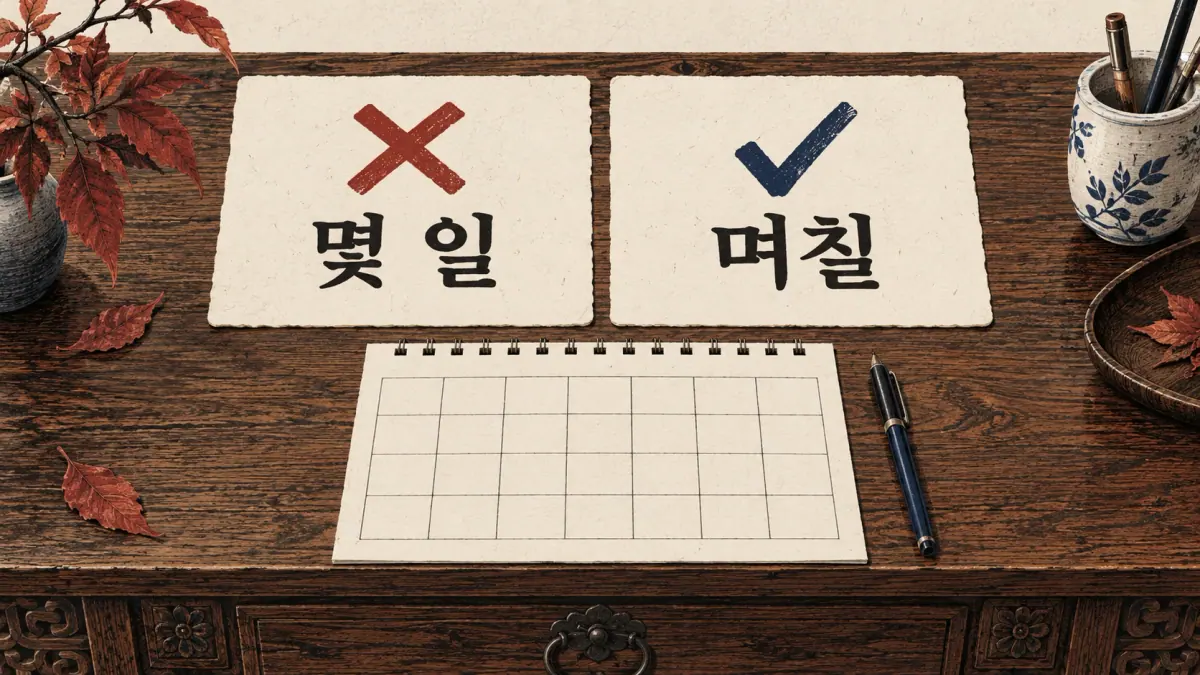
- Dates. The month is 몇 월, spoken [며둴] because the ㄷ sound of 몇 links to the vowel, but the day of the month is 며칠, not 몇 일. 오늘 며칠이에요? = "What is today's date?"
- "A few." In a statement, 몇 means "a few": 몇 명이 왔어요. (myeot myeongi wasseoyo.) [면명이 와써요] = "A few people came." In a question, the same words ask "How many people came?" Tone and context decide.
- Each. The particle 씩 adds "each": 하루에 몇 번씩 먹어요? ("How many times a day do you eat?"). See 씩 each particle.
- Age and respect. 몇 살이에요? suits children and close friends. For an older adult, a polite question is 연세가 어떻게 되세요?, built on the honorific noun 연세. See korean honorific nouns.
- Not for price. Use 얼마 for money, as above.
An honest limit: asking someone's age is not always welcome. In Korea a person's age sets the speech level, so the question is common between new acquaintances, but a stranger or an older colleague may find 몇 살이에요? too direct. This lesson teaches the grammar, not the full social etiquette of age questions. The usual errors, though, are grammatical, and the next section lists them.
What Mistakes Do Learners Make with 몇?
Learners most often drop the counter or choose the wrong number system. Four mistakes appear again and again, and each has a quick repair.
- Using 몇 without a counter. 몇이 있어요? is vague, because nothing says what is being counted. Say 몇 명이 있어요? ("How many people are there?") or 몇 개 있어요? ("How many are there?").
- Writing 몇 일 for the date. 오늘 몇 일이에요? is wrong. The date question is 오늘 며칠이에요? (oneul myeochirieyo?) [오늘 며치리에요]. The month, though, is 몇 월.
- Using the wrong number system in the answer. 몇 시 takes native numbers for the hour (세 시) and Sino numbers for minutes (십오 분). Saying 삼 시 is wrong, and 세 분 means "three people (respectful)," not three minutes.
- Using 몇 살 with an older adult. 몇 살이에요? is fine for peers and children. For an older adult, use 연세가 어떻게 되세요?.
Run through this checklist when a 몇 sentence feels wrong: Is a counter right after 몇? Is the number system right for that counter? Is the person you ask suitable for 몇 살? The practice below tests these checks.
Practice and Answers
Try the four items before you read the answer key. Cover the answers with your hand.
- Choose the form. You want the date of the month. Complete: 오늘 ___ 이에요? (몇 일 / 며칠)
- Fix the error. A learner asks 가족이 몇이에요? What is the better question?
- Translate. "How old are you?" and "What time do we meet?"
- Write your own. Write one 몇 question with 명 and one with 개, and answer each with a native number.
Sentence
How many people are in your family?
Show answer
가족이 몇 명이에요?
Practice · 8
Where does 몇 go in a question?
Show answer
Directly before a counter, such as 몇 명 or 몇 개
몇 is a determiner: it stands where the number would stand, right before the counter, with no particle in between.
How do you ask "What is today's date?"
Show answer
오늘 며칠이에요?
The day of the month is the separate word 며칠; 몇 일 is a spelling mistake, and 몇 월 asks the month.
A learner asks 가족이 몇이에요? What is the better question?
Show answer
가족이 몇 명이에요?
Keep a counter after 몇, and the counter for people is 명. 얼마 asks a price, and 개 counts items.
How is 몇 시 pronounced?
Show answer
[멷씨]
The final ㅊ of 몇 is spoken as a ㄷ sound, and the following ㅅ becomes tense, so 몇 시 is [멷씨].
Which answer to 지금 몇 시예요? is correct for three o'clock?
Show answer
세 시예요.
The hour uses native numbers, so it is 세 시. 삼 시 uses the wrong system, and 세 분 means "three people (respectful)".
Which counter takes Sino-Korean numbers in the answer?
Show answer
층 (floor), as in 이 층
Floors use Sino-Korean numbers (이 층, 삼 층), while 명, 개, 살 and 시 take native numbers.
You want to know the price of something. Which question is right?
Show answer
이거 얼마예요?
Money is an amount with no counter, so it is asked with 얼마. 몇 always asks for a countable number.
In the statement 몇 명이 왔어요., what can 몇 mean?
Show answer
"A few": a few people came
In a statement 몇 can mean "a few", so 몇 명이 왔어요 can mean "A few people came"; context and tone decide.
Answer key
- 며칠. The date of the month uses 며칠, giving 오늘 며칠이에요? ("What is today's date?").
- Add the counter 명: 가족이 몇 명이에요? The counter 명 makes it clear that you are counting people.
- 몇 살이에요? (myeot sarieyo?) and 몇 시에 만나요? (myeot sie mannayo?) [멷씨에 만나요].
- Answers vary. Check that each counter follows 몇 and the answer uses native numbers. Examples: 학생이 몇 명이에요? 열 명이에요. and 책이 몇 개 있어요? 다섯 개 있어요.
A rule of thumb to remember: 몇 plus a counter asks for a number. If the answer is money or a quantity with no counter, use 얼마.
What Should You Learn Next after 몇 How Many in Korean?
After 몇 how many in korean, study the amount question, then the questions that need no question word. This lesson covers the counting question and does not teach the number systems in depth. Those live on their own pages.
- Start with 얼마 얼마나 how much in korean for price, amount and length.
- Continue with yes no questions in korean for questions that need no question word.
- Learn the numbers themselves in Korean numbers.
- Review the time particle in time particle 에.
- Return to Korean questions to see every lesson in the set.
With these steps, 몇 how many in korean becomes automatic: put 몇 before a counter, match the number system in the answer, and use 며칠 for the date.
Frequently Asked Questions
What Does 몇 Mean in Korean?
몇 means "how many" or "what number." It normally goes before a counter such as 명 (people), 개 (items), 시 (hours) or 살 (years of age). 몇 명이에요? asks how many people there are. In statements, 몇 can also mean "a few," as in 몇 명이 왔어요 ("a few people came").
Why Is the Date 며칠 and Not 몇 일?
며칠 is a separate word for "which day of the month," so it is not written as 몇 plus 일. Say 오늘 며칠이에요? for "What is the date today?" The month still uses 몇: 몇 월이에요? ("What month is it?"). Writing 몇 일 is a very common spelling mistake.
Which Numbers Do I Use in the Answer to 몇?
It depends on the counter. Native Korean numbers go with 명, 개, 살 and 시: 세 명, 두 개, 열 살, 네 시. Sino-Korean numbers go with 월, 분, 층 and 번 (as a number): 삼월, 오 분, 이 층. The question stays the same.
How Do I Ask Someone Their Age Politely?
Between peers or to children, 몇 살이에요? works. To an older adult, use the honorific noun 연세: 연세가 어떻게 되세요?. Korean speech levels depend on age, so the question is common, but a stranger may find 몇 살 direct. A softer opener is 실례지만 ("excuse me, but").
What Is the Difference between 몇 and 얼마?
몇 needs a counter and asks for a countable number, like 몇 개 ("how many items"). 얼마 needs no counter and asks for a price, amount or degree, like 이거 얼마예요? ("How much is this?"). If the answer is money, use 얼마. If the answer is a count, use 몇.