Key facts
- Level: A1. Estimated study time: 25 minutes.
What you'll learn
- Turn any polite statement into a yes-no question with rising intonation.
- Choose the question ending for formal, polite, casual and soft speech.
- Tell a yes-no question from a wh-question that has the same words.
- Answer with 네 and 아니요 and a short verb.
Before you start: you should know the polite ending -아요/어요 and the basic word order of a Korean sentence. Time: about 25 minutes.
What Does a Yes No Question in Korean Look Like?

A yes no question in Korean looks exactly like the statement it comes from. It asks the listener to confirm or deny the content, so the answer is "yes" or "no" and not a piece of new information. Written Korean adds a question mark. Spoken Korean raises the pitch on the last syllable.
Compare a statement with its question:
| Sentence | Intonation | Meaning |
|---|---|---|
| 한국어를 공부해요. | falling ↘ | You study Korean. / I study Korean. |
| 한국어를 공부해요? | rising ↗ | Do you study Korean? |
Nothing is added, deleted or moved. This is different from English, which adds "do" ("Do you study Korean?") or moves the verb ("Are you tired?"). Korean marks the question with pitch and, in some endings, with a special question ending.
A First Example
Listen to each sentence at normal speed, then slowly.
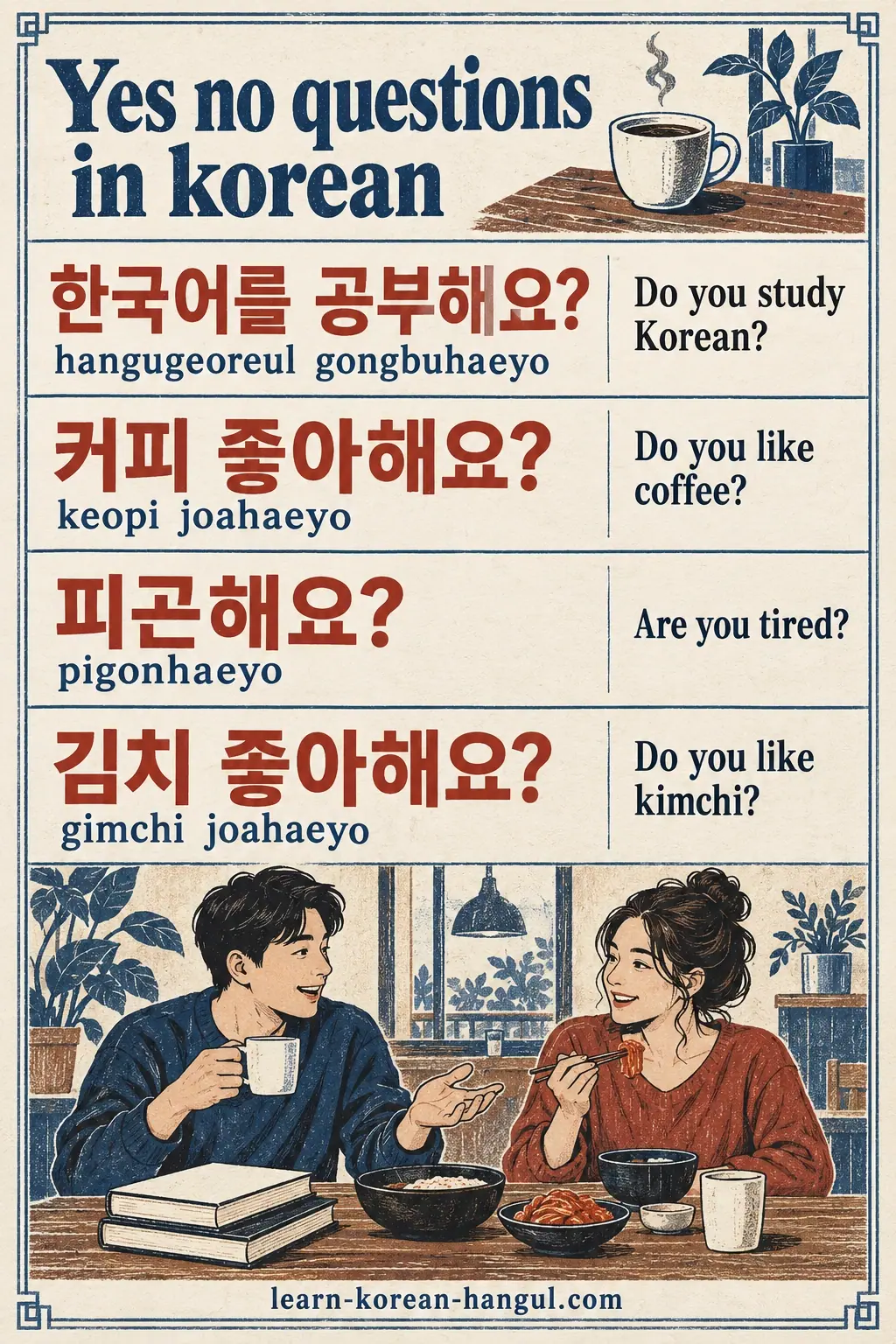
1. 한국어를 공부해요? (hangugeoreul gongbuhaeyo) "Do you study Korean?"
Pronunciation: [한구거를 공부해요]. The final ㄱ of 한국 moves onto the next syllable, so 한국어를 sounds like 한구거를. The pitch rises on the last syllable 요.
2. 커피 좋아해요? (keopi joahaeyo) "Do you like coffee?"
Here the object particle 를 is dropped, which is normal in speech. The pronunciation is [커피 조아해요]. The rise at the end is the only sign of the question.
The two sentences show a full question and a relaxed one. The next section explains the endings that sit at the end of each type.
How Do Yes No Questions in Korean Work?

Yes no questions in Korean work by choosing a sentence ending and then raising the pitch, or by using an ending that is already a question form. The same verb has a different question ending in each speech level, and the meaning stays the same.
Pattern Table
| Level | Question form | Example | Meaning |
|---|---|---|---|
| Polite | -아요/어요? with rising pitch | 먹어요? | Do you eat? |
| Polite with 이다 | 이에요/예요? | 학생이에요? | Are you a student? |
| Formal | -ㅂ니까/습니까? | 먹습니까? | Do you eat? |
| Casual | -아/어? or -니? | 먹어? / 먹니? | Do you eat? |
| Soft | -나요? / -(으)ㄴ가요? | 먹나요? / 학생인가요? | Do you eat? / Are you a student? |
| Confirming | -지요? / -죠? | 맛있죠? | It's tasty, isn't it? |
Pronunciation: 먹습니까? is [먹씀니까] (meokseumnikka), 먹니? is [멍니] (meongni), 먹나요? is [멍나요] (meongnayo), and 학생이에요? is [학쌩이에요] (haksaengieyo). The nasal sound in [멍니] and [멍나요] appears because ㄱ turns into ㅇ before ㄴ.
Three details make the table easy to apply.
- Use the polite row first. -아요/어요 with rising pitch is correct with almost everyone. The formation of the ending itself is taught in 해요체 polite speech -아요/어요.
- Use -ㅂ니까 only in formal speech. The formal question ending is -ㅂ니까 or -습니까, as in 공부합니까? Learn it in formal question -ㅂ니까/습니까.
- Use -나요 and -(으)ㄴ가요 to sound gentle. They avoid the bluntness of a plain question. See -나요/-(으)ㄴ가요 soft questions.
Four Politeness Levels
| Level | Form | Use |
|---|---|---|
| Formal | 공부합니까? | news, announcements, service |
| Polite | 공부해요? | everyday speech with strangers and elders |
| Casual | 공부해? | friends and family |
| Soft | 공부하나요? | a gentle question to someone you do not know well |
Only the ending changes. Once the pieces are clear, you can build a question from scratch.
How Do You Turn a Statement into a Yes No Question?

To turn a statement into a yes no question in Korean, keep every word, choose the question ending for your speech level, and raise the pitch at the end. Follow these steps for any sentence.
- Start from the statement. Write the polite sentence: 지금 커피를 마셔요. ("I am drinking coffee now.")
- Keep the word order. The verb stays last. Subject and object particles stay in place or drop as usual.
- Add the question mark. In writing, 지금 커피를 마셔요? is already a question.
- Raise the pitch on the last syllable. Say 마셔요 with a rise: ↗.
- Pick a softer ending if needed. For a stranger, 지금 커피를 마시나요? sounds gentler.
You'll know it worked when a Korean friend answers with 네 or 아니요 and not with a piece of information. Common mistake at this step: looking for a "do" word or moving the verb to the front. Korean uses neither.
Sentence
Are you drinking coffee now?
Show answer
지금 커피를 마셔요?
Now that you can build the question, the next section compares it with the question type learners confuse it with.
How Are Yes No Questions Different from Wh-Questions?

Yes-no questions ask for confirmation and use rising pitch, while wh-questions contain a question word such as 뭐, 누구 or 어디 and ask for new information, usually with a falling or rise-fall end. The two types can share the same words, so intonation does the sorting.
| Feature | Yes-no question | Wh-question |
|---|---|---|
| Asks for | confirmation | information |
| Question word | none | 뭐, 누구, 어디, 언제, 왜 |
| Typical pitch | rising ↗ | falling ↘ |
| Answer | 네 / 아니요 + verb | the missing information |
| Example | 커피 마셔요? | 뭐 마셔요? |
The same sentence can switch type by tone. 뭐 먹어요? with falling pitch asks "What do you eat?" With rising pitch, the word 뭐 is read as "something", and the question means "Do you eat something?" Pronunciation: [뭐 머거요]. The same happens with 누구 있어요? (Is anyone there?) and 어디 가요? (Are you going somewhere?).
An expert rule of thumb: if you hear a question word and the pitch rises at the end, look for the "something" reading before you look for the "what" reading. The wh-side of the system is introduced in Korean question word position, and the tone patterns are covered in korean polite question intonation. With the contrast clear, the next section covers how to answer.
How Do You Answer a Yes No Question in Korean?

To answer a yes no question in Korean, say 네 for "yes" or 아니요 for "no", then repeat the verb. 네 means "that is right", and 아니요 means "that is not right". The verb in the answer matches the question, not the English "do" form.
| Question | Yes | No |
|---|---|---|
| 커피 좋아해요? | 네, 좋아해요. | 아니요, 안 좋아해요. |
| 학생이에요? | 네, 학생이에요. | 아니요, 학생이 아니에요. |
| 먹었어요? | 네, 먹었어요. | 아니요, 안 먹었어요. |
| 한국어가 어렵나요? | 네, 어려워요. | 아니요, 안 어려워요. |
Pronunciation: 안 좋아해요 is [안 조아해요], 안 먹었어요 is [안 머거써요], and 어려워요 is [어려워요] (eoryeowoyo). A bare 네 or 아니요 is enough with friends, and a full answer is safer with strangers. The negative answers use the words taught in 안 negation in Korean.
Negative questions need extra care. For 안 먹어요? ("Aren't you eating?"), 네 confirms the negative content in Korean, so 네 can mean "Yes, I'm not eating". The lesson answering yes or no questions in korean explains this, and the word itself is taught on the page for yes in korean.
With answers in place, the next section covers the uses of rising intonation that are not yes-no questions at all.
When Does Rising Pitch Mean Something Else?
Rising pitch does not always mean a yes-no question. Question marks are a writing convention, and speech relies on pitch and on sentence-final particles. The same polite sentence can be a statement, a question or a suggestion, and the situation decides.
| Sentence | Pitch | Meaning |
|---|---|---|
| 같이 가요. | falling ↘ | I am going with you. / Let's go together. |
| 같이 가요? | rising ↗ | Are you going together? / Shall we go together? |
| 같이 갈까요? | rising ↗ | Shall we go together? |
| 맛있죠? | rising ↗ | It's tasty, isn't it? |
Pronunciation: 같이 가요 is [가치 가요] (gachi gayo), 같이 갈까요 is [가치 갈까요] (gachi galkkayo), and 맛있죠 is [마싣쬬] (masitjyo).
Two edge cases deserve attention.
- -(으)ㄹ까요 is not a plain yes-no question. 먹을까요? means "Shall we eat?" or "I wonder whether I should eat", not "Do you eat?" Use it for suggestions and for thinking aloud.
- -죠? asks for agreement. The speaker expects a "yes". 맛있죠? means "It's tasty, isn't it?" and invites the listener to agree.
Limitation: this lesson covers the main yes-no forms of A1 speech. It does not cover tag questions with -잖아요, rhetorical questions or the indirect form -는지, which sit in later lessons. The next section lists the errors to avoid.
Common Mistakes with Yes No Questions
Five mistakes cover most wrong yes-no questions.
- Looking for a "do" word. Learners search for the Korean version of "Do you...?". Korean uses no helper verb. Say 한국어를 공부해요?, not 한국어를 해요 공부해요?
- Moving the verb to the front. English "Are you tired?" puts "are" first. Korean keeps the verb last: 피곤해요?
- Adding 까 to a 요 ending. 공부해요까? is wrong. The formal question ends in -ㅂ니까, and the polite question ends in 요 with rising pitch. Choose one: 공부합니까? or 공부해요?
- Falling pitch on a question. A flat or falling 공부해요 sounds like a statement. Practise a clear rise on the last syllable.
- Answering with "yes" to a negative question without thinking. Learners answer 안 먹어요? with 네 and mean "I do eat". In Korean, 네 agrees with the negative content. Repeat the verb to be safe: 네, 안 먹어요. or 아니요, 먹어요.
Other question types follow the same logic of staying close to the statement, so the same habits carry over to 몇 how many in korean and 왜 why in korean. Now test yourself.
Practice and Answers
Try all four items before you read the answers. Each answer has audio, normal and slow.
Practice · 8
How do you turn the polite statement 한국어를 공부해요. into a yes-no question?
Show answer
Keep every word and raise the pitch on the last syllable: 한국어를 공부해요?
A Korean yes-no question uses the same words as the statement; only the rising pitch (and the question mark in writing) changes.
A learner writes 한국어를 공부해요까? Why is it wrong?
Show answer
It combines the polite 요 ending with the formal 까; use 공부해요? or 공부합니까?
The polite question ends in 요 with rising pitch and the formal one ends in -ㅂ니까. Choose one, never both.
Which form is the formal yes-no question of 먹다?
Show answer
먹습니까?
Formal speech uses -ㅂ니까/습니까. 먹어? is casual, and 먹을까요? is a suggestion ("Shall we eat?"), not a plain yes-no question.
How do you say "Are you tired?" in polite speech?
Show answer
피곤해요? with rising pitch
Korean keeps the verb last and marks the question with a rise on the last syllable; falling pitch makes it a statement.
What is the polite "no" answer to 학생이에요?
Show answer
아니요, 학생이 아니에요.
Answer with 아니요 and repeat the verb in its negative form; with 이다 the negative is 학생이 아니에요.
With rising pitch, what does 뭐 먹어요? mean?
Show answer
Do you eat something?
With a rise at the end, the question word 뭐 is read as "something", so the sentence becomes a yes-no question.
What does the ending -죠? do in 맛있죠?
Show answer
It asks for agreement: "It's tasty, isn't it?"
-지요/-죠? is a confirming question; the speaker expects the listener to agree.
Someone asks 안 먹어요? ("Aren't you eating?") and you are not eating. Which answer says that clearly?
Show answer
네, 안 먹어요.
In Korean, 네 agrees with the negative content of the question, and repeating the verb (안 먹어요) removes any doubt.
- Choose the form. The statement is 지금 비가 와요. ("It is raining now.") Which version asks "Is it raining now?" Choose between falling and rising pitch, and write it with the right punctuation.
- Fix the error. 한국어를 공부해요까? (The speaker wants a polite or formal yes-no question.)
- Translate. "Are you tired?"
- Write your own. Ask a friend whether they like kimchi, using 좋아하다 (to like).
Answer Key
- 지금 비가 와요? (jigeum biga wayo) Rising pitch and a question mark turn the statement into a question. Pronounced [지금 비가 와요].
- 한국어를 공부해요? or 한국어를 공부합니까? (hangugeoreul gongbuhaeyo / gongbuhamnikka) Pronounced [한구거를 공부해요] and [한구거를 공부함니까]. Do not combine 요 and 까.
- 피곤해요? (pigonhaeyo) Pronounced [피곤해요]. The adjective 피곤하다 means "to be tired", and rising pitch makes it a question.
- Sample answer: 김치 좋아해요? (gimchi joahaeyo) "Do you like kimchi?" Pronounced [김치 조아해요]. Any noun plus 좋아해요 with rising pitch is correct.
If you wrote a question mark but still sound flat, practise the rise on the last syllable with the audio. Then continue with the next lessons.
Next Lessons and Where to Go from Here
After yes no questions in korean, the natural next lesson is -나요/-(으)ㄴ가요 soft questions, which adds a gentle question ending. To count things in a question, study 몇 how many in korean. For the sound side, read korean polite question intonation. The set overview, Korean questions, lists every lesson in order.
This page uses Revised Romanization only as a learning aid; the Hangul is the reference. To remember the idea in one line: yes no questions in korean keep the statement unchanged and add rising pitch, a question mark or a question ending, and the answer is 네 or 아니요.
Frequently Asked Questions
How Do You Ask a Yes No Question in Korean?
Say the statement with rising pitch on the last syllable and write it with a question mark: 한국어를 공부해요? means "Do you study Korean?". Korean has no "do" helper verb and does not move words. For formal speech use -ㅂ니까 or -습니까, as in 공부합니까?, and for casual speech drop the 요: 공부해?
How Do I Answer a Yes No Question in Korean?
Answer with 네 for "yes" or 아니요 for "no" and repeat the verb: 네, 좋아해요 or 아니요, 안 좋아해요. A bare 네 or 아니요 is fine with friends. With negative questions, 네 agrees with the negative content, so repeat the verb to avoid confusion about whether you eat or not.
What Is the Most Common Mistake with Yes No Questions in Korean?
The most common mistake is searching for a "do" word or moving the verb to the front, as English does. Korean keeps the verb last and changes nothing except pitch. A second mistake is adding 까 to a 요 ending, as in 공부해요까?. Use 공부해요? or 공부합니까?, never both.
How Are Yes No Questions Different from Wh-Questions?
Yes-no questions ask for confirmation and have no question word, so they rise at the end and take 네 or 아니요. Wh-questions contain a word like 뭐 or 어디 and ask for information, usually with a falling or rise-fall end. With rising pitch, 뭐 먹어요? can even mean "Do you eat something?".
Do I Use Yes No Questions in Speech, Writing or Both?
Both. Writing marks the question with a question mark, and speech marks it with rising pitch. Casual speech drops the polite 요, polite speech keeps it, and formal speech uses -ㅂ니까. Soft endings such as -나요 appear in both speech and writing and sound gentler. The core pattern stays the same.