
At a glance
- A Korean question word stays where the answer would go: 뭐 해요? ("What are you doing?").
- A yes-no question keeps statement word order and ends on a rising voice.
- The set has 15 lessons, from the single question words to the soft endings -나요 and -(으)ㄴ가요.
What Are Korean Questions?

Korean questions are sentences that ask for information or a yes-or-no answer, and they follow two simple patterns. A question word (의문사) such as 뭐 ("what") or 어디 ("where") replaces the missing information and stays in the position of the answer. Linguists call this pattern wh-in-situ, "the question word stays in place". A yes-no question keeps the statement and changes only the voice at the end.
| Statement | Question | Pattern |
|---|---|---|
| 서울에 가요. (I go to Seoul.) | 어디에 가요? (Where are you going?) | 서울 becomes the question word 어디 |
| 학생이에요. (I am a student.) | 학생이에요? (Are you a student?) | same words, rising voice |
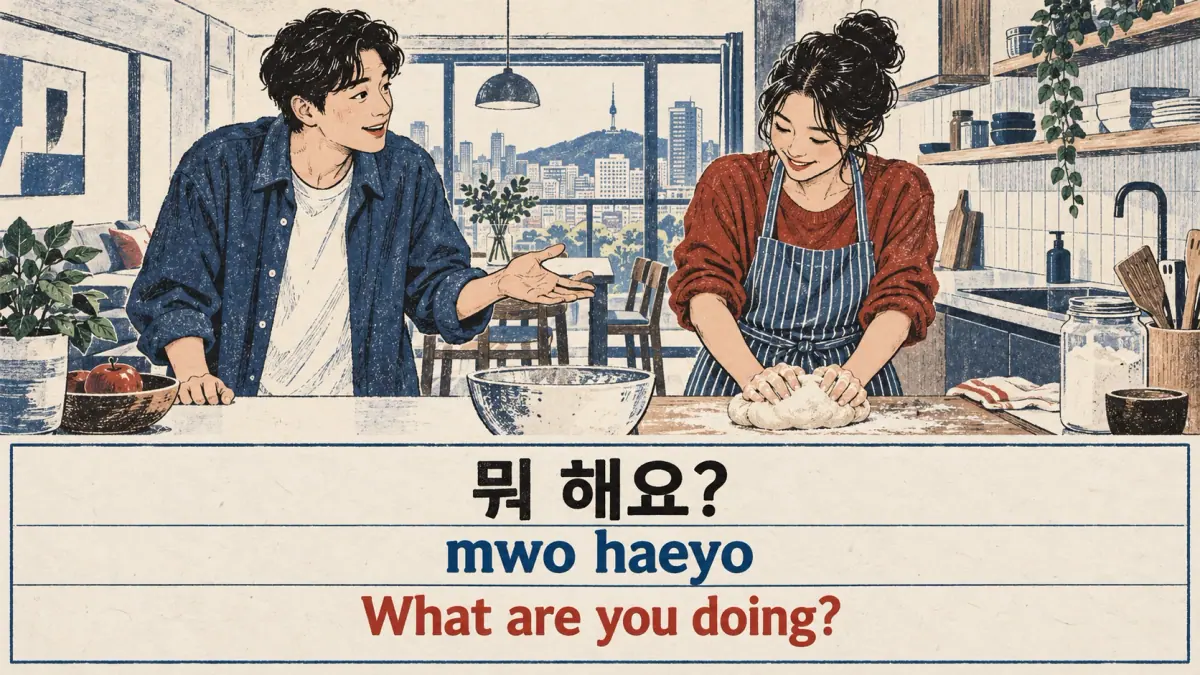
Here is one question with audio. 뭐 해요? (mwo haeyo) "What are you doing?"
Because the word order does not change, the lessons concentrate on which question word to choose and which particle or ending goes with it.
Where Should You Start with Korean Questions?
Start with 뭐/무엇, then the "what kind" and "which" words, then who, where, when, why and how, and finish with yes-no questions and soft endings. The order moves from the simplest sentence to the most polite one.
- 뭐 무엇 what in Korean: the basic "what".
- 무슨 what kind of: "what" before a noun.
- 어떤 what kind of which: the nature of something.
- 어느 which in Korean: one from a set.
- 무슨 vs 어떤 vs 어느: the three compared.
- 누구 누가 who in Korean: people.
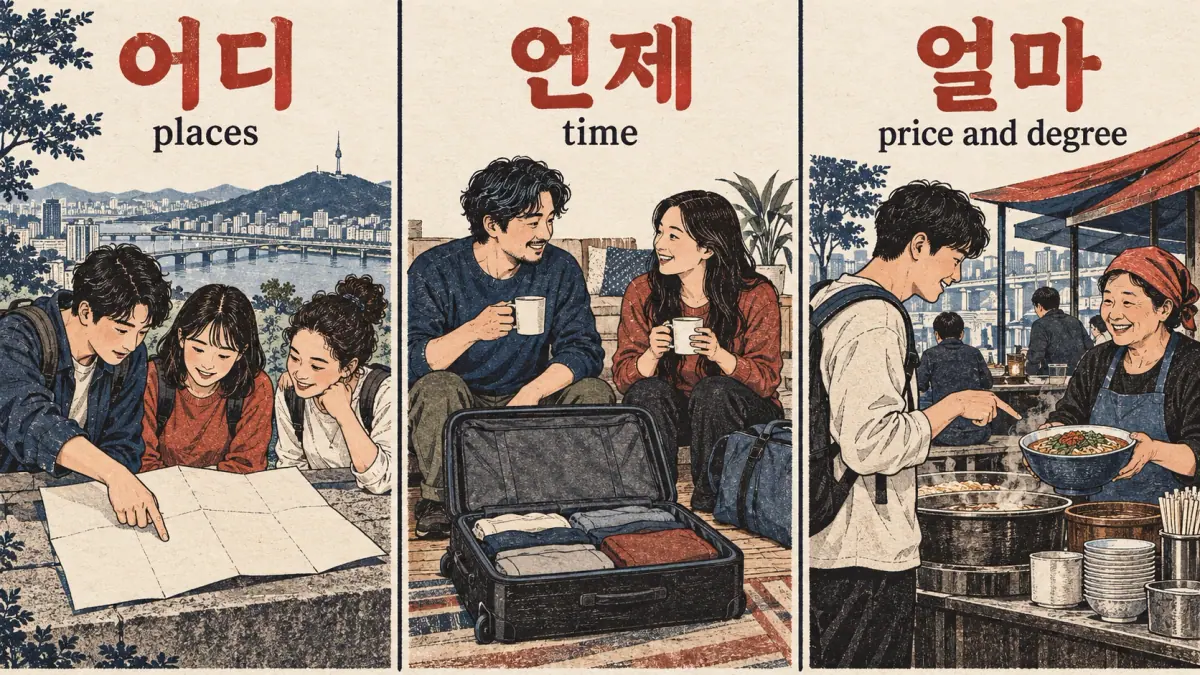
- 어디 where in Korean: places.
- 언제 when in Korean: time.
- 왜 why in Korean: reasons.
- 어떻게 how in Korean: manner.
- 어떻게 vs 어때요: "how" versus "how is it".
- 얼마 얼마나 how much in Korean: price and degree.
- 몇 how many in Korean: counts.
- Yes-no questions in Korean: rising intonation.
- -나요/-(으)ㄴ가요 soft questions: gentle, polite endings.
Once the order is clear, the next section gives each lesson a short summary.
Browse by Topic

The lessons form four clusters. Each summary has one example with Revised Romanization.
Question Words for Things and Kinds
- 뭐 무엇 what in Korean explains the short spoken 뭐, the longer written 무엇 and the object forms 뭘 and 무엇을. Example: 뭐 해요? (mwo haeyo), "What are you doing?"
- 무슨 what kind of covers "what" before a noun. Example: 무슨 음식을 좋아해요? (museun eumsigeul joahaeyo), "What food do you like?"
- 어떤 what kind of which asks about the nature of something. Example: 어떤 영화 (eotteon yeonghwa), "what kind of movie".
- 어느 which in Korean asks which one from a set. Example: 어느 나라 사람이에요? (eoneu nara saramieyo), "Which country are you from?"
- 무슨 vs 어떤 vs 어느 puts the three determiners before the same noun to show when each one fits.
Question Words for People, Places, Times and Reasons
- 누구 누가 who in Korean covers 누구 and the subject form 누가. Example: 누가 왔어요? (nuga wasseoyo), "Who came?"
- 어디 where in Korean asks about places, destinations and starting points. Example: 화장실이 어디예요? (hwajangsiri eodiyeyo), "Where is the restroom?"
- 언제 when in Korean asks about time. Example: 언제 가요? (eonje gayo), "When are you going?"
- 왜 why in Korean asks for a reason. Example: 왜 늦었어요? (wae neujeosseoyo), "Why were you late?"
Question Words for Manner, Amount and Number
- 어떻게 how in Korean asks about the way something is done. Example: 어떻게 가요? (eotteoke gayo), "How do you get there?"
- 어떻게 vs 어때요 separates "how" (method) from "how is it" (opinion). Example: 날씨가 어때요? (nalssiga eottaeyo), "How is the weather?"
- 얼마 얼마나 how much in Korean asks about price, time, distance and degree. Example: 이거 얼마예요? (igeo eolmayeyo), "How much is this?"
- 몇 how many in Korean asks about counts with a counter. Example: 몇 시예요? (myeot siyeyo), "What time is it?"
Yes-No Questions and Soft Endings
- Yes-no questions in Korean shows how a rising voice turns a statement into a question. Example: 학생이에요? (haksaengieyo), "Are you a student?"
- -나요/-(으)ㄴ가요 soft questions teaches the gentle endings used to ask politely. Example: 어디 가나요? (eodi ganayo), "Where are you going?" Level A2.
Which Lesson Fits Your Sentence?
Use this table to open the lesson that matches the question you want to ask.
| You want to ask | Open this lesson |
|---|---|
| What something is or what someone does | 뭐 무엇 what |
| What kind of thing it is | 무슨 or 어떤 |
| Which one of the choices in front of you | 어느 which |
| Who did something | 누구 누가 who |
| Where something is or where to go | 어디 where |
| When something happens | 언제 when |
| The price or how long it takes | 얼마 얼마나 how much |
| How many of something | 몇 how many |
| A plain yes-or-no question | Yes-no questions |
How Do 무슨, 어떤 and 어느 Differ?
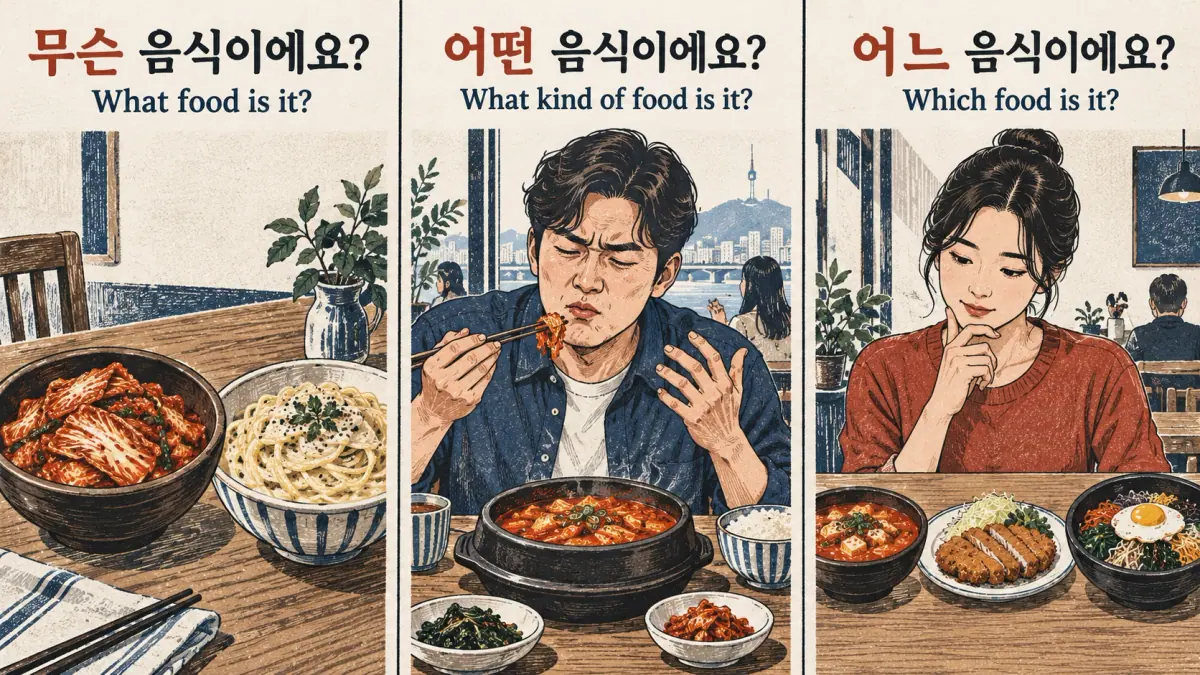
무슨 asks "what kind", 어떤 asks about the nature of the thing and 어느 asks "which one" from a set. The snapshot below puts each one before the same noun, 음식 ("food").
| Question | Meaning | Asks for |
|---|---|---|
| 무슨 음식이에요? | What food is it? | the category, such as kimchi or pasta |
| 어떤 음식이에요? | What kind of food is it? | the quality, such as spicy or sweet |
| 어느 음식이에요? | Which food is it? | one choice from a visible set |
The most common first mistake in this set is putting 뭐 before a noun, as in 뭐 음식. Use 무슨 음식 instead: 뭐 stands alone ("what"), while 무슨 attaches to a noun ("what kind of"). The full lesson is 무슨 vs 어떤 vs 어느.
How Do You Practise This Set?
Practise in three ways. First, finish the practice set at the end of each lesson; every answer has audio at normal and slow speed. Second, use the grammar quizzes to test your choice of question word. Third, review the words with the grammar flashcard decks. To check the verb endings in the examples, use the Korean verb conjugator.
The set of Korean questions sits inside Korean grammar. The word list of question words, for memorising, is on the Korean question words vocabulary page. This set teaches how to ask questions and use each question word in a sentence. Plan on 15 to 25 minutes per lesson, so roughly five hours for all 15 (the lessons' own estimates, not a promise).
What this set does not cover: indirect questions, such as "I don't know where it is", are taught on the -(으)ㄴ/는지 grammar page. The set is written for English speakers who can read Hangul.
Frequently Asked Questions
How Do I Ask a Yes-No Question in Korean?
Say the statement and raise your voice at the end. 학생이에요. (I am a student.) becomes 학생이에요? (Are you a student?) with no change in word order. In writing, the question mark shows the rise. Polite endings such as -나요 and -(으)ㄴ가요 also make a question softer.
Do Korean Questions Change Word Order?
No. Korean keeps the verb at the end, and a question word stays in the position of the answer. The statement 저는 서울에 가요 (I go to Seoul) becomes 어디에 가요? (Where are you going?) by replacing 서울 with 어디. English moves the question word to the front; Korean does not.
How Do I Choose: 무슨 vs 어떤 vs 어느?
Use 어느 when you choose one from a set you can see or name: 어느 것이 좋아요? Use 무슨 for an open "what kind" or "what" before a noun: 무슨 음식이에요? Use 어떤 when you ask about the quality or nature of something: 어떤 사람이에요? A full comparison lesson follows the three single lessons.
Which Lesson in Asking Questions in Korean Should I Read First?
Start with 뭐/무엇 (what), because it shows the stay-in-place pattern in the simplest sentence. Then read the "what kind" and "which" words, followed by who, where, when, why and how. Yes-no questions and the soft endings -나요 and -(으)ㄴ가요 come at the end of the list.
What Is the Difference between 뭐 and 무엇?
뭐 and 무엇 mean the same thing, "what". 뭐 is the short spoken form, as in 뭐 해요? (What are you doing?). 무엇 is the longer form used in writing and formal speech, as in 무엇입니까? (What is it?). The object forms are 뭘 in speech and 무엇을 in writing.