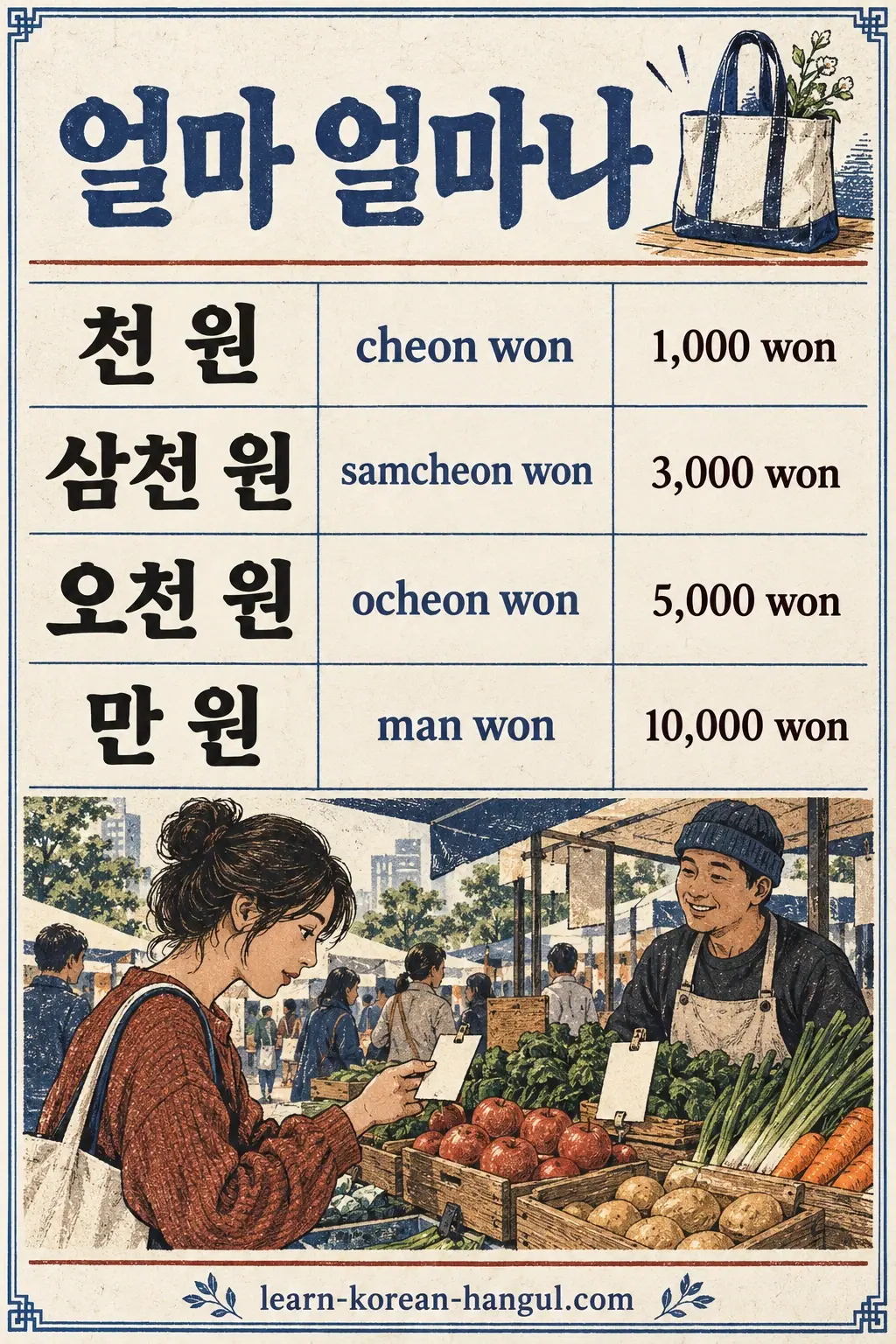
What you'll learn
- Ask the price of an item with 얼마예요.
- Ask how long, how far, how big and how often with 얼마나.
- Choose between 얼마 and 몇 (how many).
- Answer a price question with Sino-Korean numbers and 원 (won).
Before you start: you should be able to read Hangul and know that Korean question words stay in the answer slot (see Korean questions). Time: about 25 minutes.
What Do 얼마 얼마나 Mean in Korean?

얼마 means "how much" for a price or an amount, and 얼마나 means "how much" or "how" for a degree, a time or a distance. Both are question words (의문사): words that stand in for the missing information in a question. In Korean the question word stays in the position of the answer, so you do not move it to the front.
| Word | Core meaning | Asks about | Example |
|---|---|---|---|
| 얼마 | how much | price, amount | 이거 얼마예요? |
| 얼마나 | how much, how | degree, time, distance, frequency | 얼마나 걸려요? |
The second word is the first one plus 나. You can think of 얼마나 as "to what extent". That is why it fits time, distance and degree: all of them are amounts on a scale.
A First Example
Listen to each sentence at normal speed, then slowly.
1. 이거 얼마예요? (igeo eolmayeyo) "How much is this?"
Pronunciation: [이거 얼마예요]. In everyday speech the ending 예요 is often softened to [에요]. The sentence leaves out the topic particle that would normally follow 이거; this is common in speech.
2. 얼마나 걸려요? (eolmana geollyeoyo) "How long does it take?"
Pronunciation: [얼마나 걸려요]. The verb 걸리다 means "to take (time)", and 얼마나 asks for the amount of time.
The two sentences show the two jobs. The next section sets out the full pattern.
How Do 얼마 얼마나 Work?
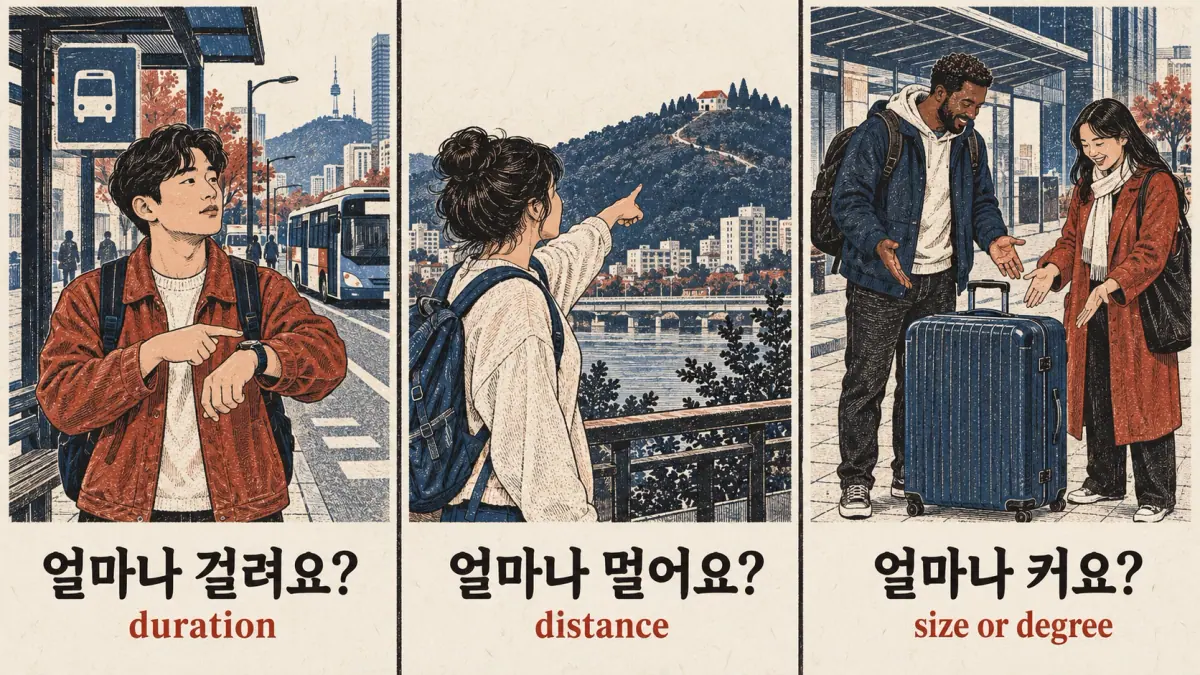
얼마 works like a noun, and 얼마나 works like an adverb. Use 얼마예요? for a price and 얼마나 걸려요? for time, 얼마나 커요? for degree and 얼마나 자주 for frequency.
Pattern Table
| Question | Asks | Typical answer | Meaning of the answer |
|---|---|---|---|
| 얼마예요? | price or total | 오천 원이에요. | It is 5,000 won. |
| 얼마에 샀어요? | the price paid | 만 원에 샀어요. | I bought it for 10,000 won. |
| 얼마나 걸려요? | duration | 한 시간 걸려요. | It takes one hour. |
| 얼마나 멀어요? | distance | 걸어서 십 분이에요. | It is ten minutes on foot. |
| 얼마나 커요? | size or degree | 아주 커요. | It is very big. |
| 얼마나 자주 가요? | frequency | 매일 가요. | I go every day. |
Pronunciation: 얼마에 샀어요 is [얼마에 사써요] (eolmae sasseoyo), 한 시간 걸려요 is [한 시간 걸려요] (han sigan geollyeoyo), and 매일 가요 is maeil gayo.
Three details make the table easy to apply.
- A price uses Sino-Korean numbers. Prices in won use the Sino-Korean number words (일, 이, 삼, 천, 만), not the native words (하나, 둘, 셋). The word for won is 원. The list is in Korean numbers.
- An hour count uses the native number, minutes use Sino. 한 시간 ("one hour") uses 한 from the native system, and 삼십 분 ("30 minutes") uses Sino-Korean 삼십. The numbers hub explains the split.
- 얼마나 goes before the word it measures. Put it before 걸려요, 멀어요, 커요, 자주 or 오래 ("for a long time"): 얼마나 오래 걸려요? ("How long will it take?", stressing a long stretch of time).
With the pattern in view, you can build the shop question yourself.
How Do You Ask "How Much Is This?" in Korean?

To ask a price, say the item and then 얼마예요: 이거 얼마예요? The answer is a number plus 원 and the copula. Follow these steps to build any price question.
- Name the item. Use 이거 ("this thing") when you point, or the item's name: 이 가방 ("this bag").
- Add 얼마. The question word replaces the price: 이거 얼마.
- Choose the ending. 얼마 ends in a vowel, so the copula is 예요, not 이에요: 얼마예요.
- Optional particle. In speech you can add 은 or 가 to the item (이거는, 이게), but most speakers leave it out.
- Listen for the answer. The answer is a Sino-Korean number plus 원 and 이에요, because 원 ends in the consonant ㄴ: 오천 원이에요 [오천 워니에요], "It's 5,000 won."
You'll know it worked when the sentence is item + 얼마 + 예요 and the shopkeeper replies with a number and 원. Common mistake at this step: adding 나, as in 이거 얼마나예요? That asks about degree, not price. For prices, use 얼마 alone.
To ask for the total of several items, add 다 or 모두 ("all"): 다 얼마예요? ("How much is it all together?"). When the amount is a time or a distance, the same steps work with 얼마나 and the matching verb. Next, here is how to understand the answers.
How Do You Understand the Answer to a 얼마 Question?

To understand a price answer, read the Sino-Korean number first and then 원. Korean groups large numbers by thousands (천) and ten-thousands (만), and it drops the 일 ("one") before 천 and 만.
| Price | Korean | Pronunciation |
|---|---|---|
| 1,000 won | 천 원 | cheon won |
| 3,000 won | 삼천 원 | samcheon won |
| 5,000 won | 오천 원 | ocheon won |
| 10,000 won | 만 원 | man won |
| 15,000 won | 만 오천 원 | man ocheon won |
| 25,000 won | 이만 오천 원 | iman ocheon won |
Notice that 10,000 is just 만, not 일만, and that 25,000 is built as 이만 ("two ten-thousands") plus 오천 ("five thousand"). The pattern is the same for every price you will meet: [number of ten-thousands] 만 [number of thousands] 천 원.
To understand a time answer, listen for a unit word. Hours use native numbers with 시간, and minutes use Sino-Korean numbers with 분:
| Answer | Meaning |
|---|---|
| 삼십 분 걸려요. | It takes 30 minutes. |
| 한 시간 걸려요. | It takes one hour. |
| 두 시간 걸려요. | It takes two hours. |
| 한 시간 반 걸려요. | It takes an hour and a half. |
The word 반 means "half". Because the answer repeats the verb 걸려요, you can reply with only the time, such as 삼십 분이요, in casual speech. With the answers clear, the next step is to separate 얼마, 얼마나 and 몇.
How Is 얼마 Different from 얼마나 and 몇?
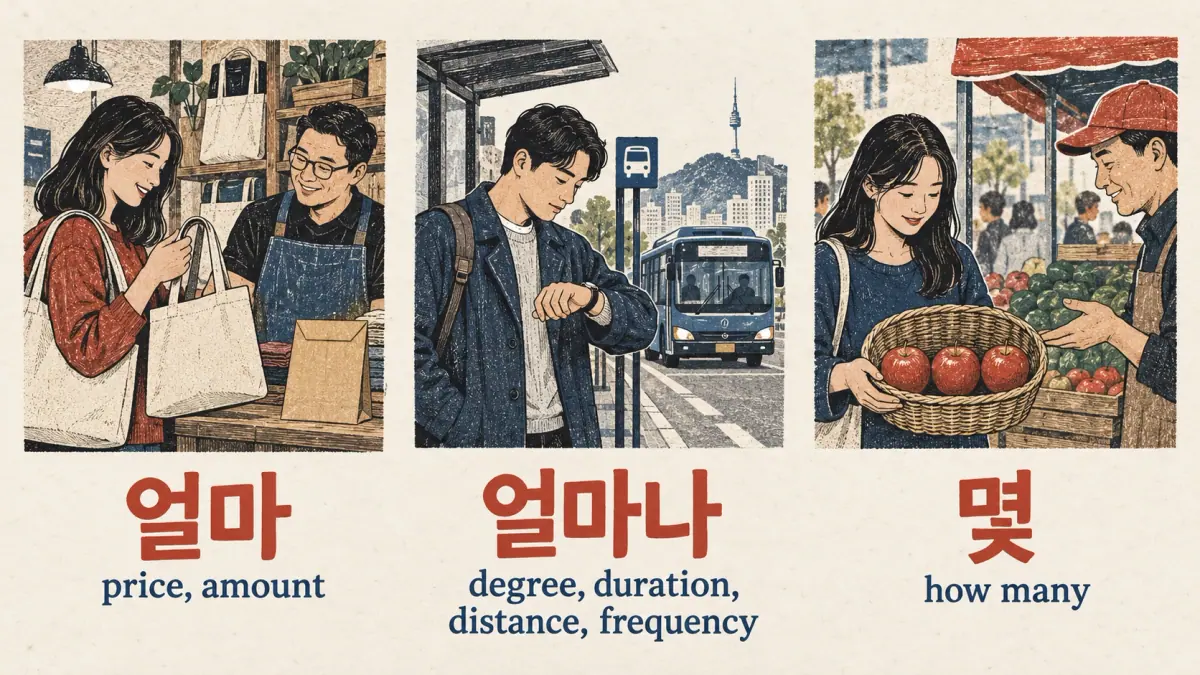
얼마 asks about price and quantity you do not count in units, 얼마나 asks about degree, and 몇 asks "how many" of countable things. Choose by what the answer will be.
| Feature | 얼마 | 얼마나 | 몇 |
|---|---|---|---|
| Asks | price, amount | degree, duration, distance, frequency | how many |
| Used with | 예요, 에 (price) | 걸려요, 멀어요, 커요, 자주, 오래 | a counter or time unit |
| Answer shape | number + 원 | a time, a distance or a degree word | a number + counter |
| Example | 이거 얼마예요? | 얼마나 걸려요? | 몇 명이에요? |
| Example meaning | How much is this? | How long does it take? | How many people are there? |
Two rules of thumb separate them.
- If the answer is money, use 얼마. Prices always use 얼마.
- If the answer is a count, use 몇 plus a counter. The lesson on 몇 how many in korean covers counters such as 명 (people), 개 (items) and 시 (o'clock). Both 몇 and 얼마 relate to numbers, so keep them apart by asking "can I count it?".
The question word also relates to how people ask "what is it like?", which is the topic of 어떻게 vs 어때요. With the three question words sorted, the next section covers the cases where 얼마 acts differently.
When Does 얼마 Mean "a Little" or Take Other Forms?
얼마 does not always ask a question. In a negative sentence, it often means "a little" or "not much".
| Expression | Literal idea | Meaning |
|---|---|---|
| 얼마 안 남았어요. | not much remains | There is not much left. |
| 얼마 안 걸려요. | does not take much | It does not take long. |
| 얼마 전에 | a short while before | a little while ago, recently |
| 얼마든지 | any amount at all | as much as you like |
Pronunciation: 남았어요 is [나마써요] (namasseoyo), and 얼마 안 걸려요 is [얼마 안 걸려요]. 얼마 전에 is eolma jeone and is a common way to say "recently": 얼마 전에 갔어요 ("I went a little while ago").
Dropping 나. In speech you may hear 얼마 걸려요? with no 나, especially when talking about travel. The form with 나 is the usual, safe one, so learn it first.
Counting along with amounts. To say "each" with an amount, Korean uses 씩 each particle. To say "about", use 쯤 about particle, as in 한 시간쯤 걸려요 ("It takes about an hour"). To state an end point, use 까지 until particle, as in 서울까지 얼마나 걸려요? ("How long does it take to Seoul?").
Exclamations. The word 얼마나 also forms exclamations, such as 얼마나 예쁜지 몰라요 ("You can't imagine how pretty it is"). That pattern needs the ending -(으)ㄴ지 and belongs to a later lesson.
Honest limit of this lesson: it covers prices and the common 얼마나 questions with polite endings. Large-number reading rules for prices and the full counter system are left to the numbers lessons.
Now that the exceptions are mapped, the next section lists the errors to avoid.
Common Mistakes with 얼마 and 얼마나
Five mistakes cover most errors. Each follows the pattern "learners often assume X, but actually Y, because Z."
- Using 얼마 for a count. Learners often say 사과가 얼마 있어요? Actually 얼마 asks about amount or price, not a count. Use 몇 and a counter: 사과가 몇 개 있어요?
- Using 얼마나 for a price. Learners often say 이거 얼마나예요? Actually 얼마나 asks degree, not price: 이거 얼마예요?
- Using 이에요 after 얼마. Learners often write 얼마이에요. Actually 얼마 ends in a vowel, so the copula contracts to 예요: 얼마예요.
- Using native numbers for won. Learners often say 하나 원 or 다섯 원. Actually prices use Sino-Korean numbers: 오천 원, 만 원.
- Using 얼마 for a time of day. Learners often ask 지금 얼마예요? for "What time is it?" Actually the time of day is asked with 몇 시: 지금 몇 시예요?
Many of these errors come from English, where "how much" and "how many" differ only in whether the noun is countable. Korean makes the same split with 얼마 and 몇. Now test yourself.
Practice and Answers
Try all four items before you read the answers. Each answer has audio, normal and slow.
Sentence
How much is this bag?
Show answer
이 가방 얼마예요
Practice · 8
Which sentence asks the price of an item?
Show answer
이거 얼마예요?
A price uses 얼마 alone plus 예요. Adding 나 turns it into a question about degree, and 얼마나 걸려요? asks about time.
Complete the question "How long does it take to Seoul?": 서울까지 ___ 걸려요?
Show answer
얼마나
Duration, distance and degree are asked with 얼마나, placed before the verb it measures (걸려요).
How do you ask "How many apples are there?"
Show answer
사과가 몇 개 있어요?
Apples can be counted, so use 몇 with the counter 개. 얼마 asks about a price or an amount you do not count in units.
Why is it 얼마예요 and not 얼마이에요?
Show answer
얼마 ends in a vowel, so the copula is 예요
After a word that ends in a vowel, the copula is 예요; 이에요 follows a consonant, as in 원이에요.
Which number system do prices in won use?
Show answer
Sino-Korean numbers (일, 이, 삼, 천, 만)
Prices always use Sino-Korean numbers with 원, as in 오천 원 and 만 원.
How do you say 25,000 won?
Show answer
이만 오천 원
Korean groups by ten-thousands: 이만 (two 만) plus 오천 (five thousand) plus 원. 만 오천 원 is 15,000 won.
What does 얼마 안 걸려요 mean?
Show answer
It does not take long.
In a negative sentence 얼마 often means "not much", so 얼마 안 걸려요 says the trip is short.
How do you ask "What time is it?"
Show answer
지금 몇 시예요?
The time of day is a count of o'clock, so it uses 몇 with 시, not 얼마.
- Choose the form. 서울까지 (얼마/얼마나) 걸려요? ("How long does it take to Seoul?")
- Fix the error. 사과가 얼마 있어요? (The speaker means "How many apples are there?")
- Translate. "How much is this bag?"
- Write your own. Ask how far someone's home is, using 멀다 (to be far).
Answer Key
- 서울까지 얼마나 걸려요? (seoulkkaji eolmana geollyeoyo) Time and duration use 얼마나. Pronounced [서울까지 얼마나 걸려요].
- 사과가 몇 개 있어요? (sagwaga myeot gae isseoyo) Apples are countable, so use 몇 with the counter 개. Pronounced [사과가 멷 깨 이써요].
- 이 가방 얼마예요? (i gabang eolmayeyo) A price uses 얼마, and the ending after the vowel is 예요.
- Sample answer: 집이 얼마나 멀어요? (jibi eolmana meoreoyo) "How far is your home?" Pronounced [지비 얼마나 머러요]. Any 얼마나 plus 멀어요 sentence is correct.
If you chose the wrong word, ask yourself what the answer will be: money, a count or a degree. Then continue with the next lessons.
Next Lessons and Where to Go from Here
After 얼마 얼마나 how much in korean, the best next lesson is 몇 how many in korean, which completes the "how much / how many" pair. To strengthen the numbers you need for prices and times, study Korean numbers. To ask where a shop is before you ask the price, review 어디 where in korean. The set overview, Korean questions, lists every lesson in order.
For practice, take the grammar quizzes. This page uses Revised Romanization only as a learning aid; the Hangul is the reference. To remember the idea in one line: 얼마 얼마나 how much in korean splits into price (얼마예요) and degree, time or distance (얼마나), and anything you can count uses 몇.
Frequently Asked Questions
What Does 얼마/얼마나 Mean?
얼마 means "how much" and is used mainly for prices and amounts: 이거 얼마예요? asks "How much is this?". 얼마나 means "how much" or "how" in the sense of degree, time or distance: 얼마나 걸려요? asks "How long does it take?". Both stay in the answer position.
How Do I Form 얼마/얼마나 Questions?
For a price, say the item, then 얼마예요: 이거 얼마예요? For time, distance or degree, put 얼마나 before the verb or adjective: 얼마나 걸려요?, 얼마나 멀어요?, 얼마나 커요? For frequency, add 자주: 얼마나 자주 가요? The question word never moves to the front.
What Is the Most Common Mistake with 얼마/얼마나?
The most common mistake is using 얼마 to ask how many of something you can count. 사과가 얼마 있어요 is wrong for "How many apples are there?"; use 몇 plus a counter: 사과가 몇 개 있어요? Another frequent error is adding 나 to a price question.
How Is 얼마 Different from 몇?
얼마 asks about a price or an amount you do not count in units. 몇 asks how many, and it always attaches to a counter or a time unit: 몇 명 (how many people), 몇 개 (how many items), 몇 시 (what time). If the answer is a number of countable things, use 몇.
Do I Use 얼마/얼마나 in Speech, Writing or Both?
Both. The words are the same in speech and writing. In casual speech the sentence ending changes (얼마야?) and particles are dropped. Speakers sometimes shorten 얼마나 걸려요 to 얼마 걸려요 in conversation, but 얼마나 걸려요 is the standard form to learn first.