Key facts
- It is the casual (banmal) partner of -군요/-는군요: change 구나 to 군요 for polite speech.
What you'll learn
- Choose -는구나 for verbs, -구나 for adjectives and (이)구나 for nouns.
- Say the past (-았/었구나) and the inference (-겠구나) forms, including the sympathy phrase 힘들었구나.
- Decide when a casual ending is safe and when to switch to -군요/-는군요.
- Match the casual and polite pairs: -네/-네요 and -구나/-군요.
- Fix the common learner mistakes with the pattern.
Before you start: you should know how to find a verb stem (see verb stem), the difference between action verbs and adjectives, and what banmal means. A short reading of -군요/-는군요 helps, because this ending is its casual partner. Audio plays only when you press a button.
What Does -구나/-는구나 Grammar Mean?
-구나/-는구나 grammar means "oh!" or "I see": the speaker voices a small discovery in casual speech. The discovery can come from something the speaker sees, something a friend says or a fact the speaker has just worked out. The ending sounds natural between friends, from an adult to a child and in a speaker's own thoughts.
Here are two first examples. The pattern is the same in both, and only the type of word before the ending changes.
- 벌써 비가 오는구나. (beolsseo biga oneunguna.) [벌써 비가 오는구나] = "Oh, it's raining already."
- 네가 제일 크구나. (nega jeil keuguna.) [네가 제일 크구나] = "Oh, you're the tallest."
In 오는구나, 오 is the stem of 오다 (to come), 는 marks a present action, and 구나 is the ending. In 크구나, 크 is the stem of the adjective 크다 (to be big), and 구나 follows it directly. Grammar books call this meaning a "realization" or "mirative" use, and call the ending an exclamative (감탄형) of the plain style. Next comes the rule that builds the pattern.
How Do You Form -구나/-는구나?
-구나/-는구나 is formed by dropping 다 from the dictionary form and adding -는구나 to a verb or -구나 to an adjective. The 는 is the present-tense marker of action verbs, the same 는 you see in 먹는 (eating). Adjectives never carry it, so the two classes split.
| Word class | Pattern | Example | Spoken | Meaning |
|---|---|---|---|---|
| Action verb | stem + 는구나 | 가는구나 | [가는구나] | Oh, you go |
| Action verb with final consonant | stem + 는구나 | 먹는구나 | [멍는구나] | Oh, you eat |
| ㄹ-stem verb | drop ㄹ + 는구나 | 사는구나 | [사는구나] | Oh, you live |
| Adjective | stem + 구나 | 크구나 | [크구나] | Oh, it's big |
| Noun + 이다 | (이)구나 | 학생이구나 | [학쌩이구나] | Oh, you're a student |
| Past | stem + 았/었구나 | 먹었구나 | [머걷꾸나] | Oh, you ate |
To choose between the first and fourth rows, ask whether the word describes an action or a state. 가다 (to go) is an action, so it takes 는. 크다 (to be big) is a state, so it does not. The next three parts look at the groups of stems one at a time.
Stems Ending in a Vowel
A vowel stem takes the ending directly. A verb gets 는: 오다 becomes 오는구나, 보다 becomes 보는구나, and 공부하다 becomes 공부하는구나. An adjective gets 구나: 크다 becomes 크구나, and 예쁘다 becomes 예쁘구나.
- 여기가 네 방이구나. (yeogiga ne bangiguna.) [여기가 네 방이구나] = "Oh, so this is your room."
- 우리 딸이 많이 컸구나. (uri ttari mani keotguna.) [우리 따리 마니 컫꾸나] = "Our daughter has grown a lot."
The second sentence is typical of an adult speaking to a child. Vowel stems are the simplest case. A stem with a final consonant looks the same on the page, but it sounds different.
Stems Ending in a Consonant
A consonant stem also takes the ending directly, with no linking vowel. The spelling stays whole, and the sound follows the standard pronunciation rules (표준 발음법) of the 국립국어원 (National Institute of Korean Language). Three rules matter here:
- Nasalization: a final ㄱ, ㄷ or ㅂ becomes a nasal before ㄴ. The 는 in 먹는구나 starts with ㄴ, so 먹 is spoken [멍]: [멍는구나]. Likewise 읽는구나 is [잉는구나].
- Tensing: a plain ㄱ is spoken tense after a final ㄱ, ㄷ or ㅂ, so 춥구나 is [춥꾸나] and 먹었구나 is [머걷꾸나].
- Aspiration: ㅎ plus ㄱ makes a [ㅋ] sound, so 좋구나 is [조쿠나] and 그렇구나 is [그러쿠나].
Sentences that show each rule:
- 이 노래 정말 좋구나. (i norae jeongmal jokuna.) [이 노래 정말 조쿠나] = "This song is really good."
- 벌써 다 먹었구나. (beolsseo da meogeotguna.) [벌써 다 머걷꾸나] = "You've already eaten everything."
- 힘들었구나. (himdeureotguna.) [힘드럳꾸나] = "That must have been hard."
Write the plain spelling and say the changed sound. Two groups of stems need a short note, because learners expect trouble with them.
Irregular Stems and Nouns
Irregular stems follow the normal rule for the ending, because both 는 and 구 start with a consonant.
- ㄹ-stems: the ㄹ drops before 는 (a ㄴ sound). 살다 becomes 사는구나, 알다 becomes 아는구나, and 만들다 becomes 만드는구나. An adjective ㄹ-stem keeps its ㄹ before 구나, because 구 starts with ㄱ: 멀구나 and 길구나.
- ㅂ, ㄷ and 르 stems: they keep their dictionary stem before a consonant. 춥구나, 돕는구나 [돔는구나], 듣는구나 [든는구나] and 모르는구나 are regular in shape.
- 있다 and 없다: in the dictionary these two words (and 맛있다, 멋있다) take the verb form: 있는구나, 없는구나, 맛있는구나. In everyday speech the shorter 있구나 and 맛있구나 are also very common.
- Nouns: 이다 gives (이)구나. After a consonant you say 이구나: 학생이구나. After a vowel, 이 is often dropped: 의사구나. The negative is 아니구나.
With a clear stem and ending, one full sentence can be built step by step.
Worked Example: Building a Sentence with -구나/-는구나
-구나/-는구나 grammar turns a plain statement into a casual reaction. Follow the steps with the sentence "You are reading a book."
- Start with the plain sentence. 네가 책을 읽어. (nega chaegeul ilgeo.) = "You are reading a book." The predicate is 읽어.
- Find the dictionary form. 읽어 comes from 읽다 (to read). It is an action verb.
- Find the stem. Drop 다: 읽.
- Choose the ending. An action verb takes 는구나, so 읽 + 는구나 = 읽는구나.
- Rebuild the sentence. 네가 책을 읽는구나. (nega chaegeul ingneunguna.) [네가 채글 잉는구나] = "Oh, you're reading a book."
Sentence
Oh, you are reading a book.
Show answer
네가 책을 읽는구나
You will know it worked when the subject (네가) and the object (책을) stay in place and only the last word changed from 읽어 to 읽는구나. The most common slip is writing 읽구나, which drops 는. Always check that a verb has 는. A reaction can appear in more than one tense, and each form has limits.
Which Tenses and Sentence Types Work with -구나/-는구나?
-구나/-는구나 works in the present, the past and the inference form, in statements and exclamations. It does not work in commands, suggestions or real questions. The tense markers go before 구나, and in the past and the inference forms the 는 disappears.
| Form | Pattern | Example | Meaning |
|---|---|---|---|
| Present verb | stem + 는구나 | 가는구나. | Oh, you go. |
| Present adjective | stem + 구나 | 크구나. | Oh, it is big. |
| Noun | (이)구나 | 선생님이구나. | Oh, you are a teacher. |
| Past | stem + 았/었구나 | 힘들었구나. [힘드럳꾸나] | That must have been hard. |
| Inference | stem + 겠구나 | 내일은 비가 오겠구나. [오겓꾸나] | It will probably rain tomorrow. |
| Negative | stem + 지 않는구나 / 지 않구나 | 비가 오지 않는구나. | Oh, it is not raining. |
| Polite partner | 구나 becomes 군요 | 비가 오는군요. | Oh, it is raining (polite). |
The past form reports a past event or state that the speaker has just understood. 벌써 다 먹었구나 is what you say when you see an empty plate, and 힘들었구나 is what you say when you realize how a friend must have felt. The inference form -겠구나 is a conclusion from clues, such as dark clouds.
- 내일은 비가 오겠구나. (naeireun biga ogetguna.) [내이른 비가 오겓꾸나] = "It will probably rain tomorrow."
Commands and suggestions never take -구나. The ending is also not used to ask a real question, so a friend who wants information says 비 와? or 비 오니? instead. These limits make the polite partner, -군요, the most useful comparison.
How Is -구나/-는구나 Different from -군요/-는군요?
-구나/-는구나 and -군요/-는군요 carry the same meaning, "oh, I see", and differ only in politeness. -구나 is casual and -군요 is polite. A speaker picks one by looking at the listener, not at the information.
-구나/-는구나
oh!: the casual realization
-군요/-는군요
oh, I see: the polite realization
-네
oh, how ...: the casual fresh perception
| Comparison | -구나/-는구나 | -군요/-는군요 | -네 |
|---|---|---|---|
| Politeness | casual | polite | casual |
| Stem rule | verb 는구나, adjective 구나 | verb 는군요, adjective 군요 | bare stem + 네 |
| Used with a teacher | no | yes | no |
| Source of the information | news, words or a conclusion | news, words or a conclusion | your senses, right now |
Use -구나/-는구나 with friends, younger people and yourself; use -군요/-는군요 with anyone you speak to politely; use -네/-네요 when the discovery comes straight from your senses.
The pairs below show how each polite ending has a casual partner. The two realization endings are the ones this lesson and the -군요/-는군요 lesson cover.
| Polite | Casual | Meaning |
|---|---|---|
| -네요 | -네 | oh, how ... (fresh perception) |
| -군요/-는군요 | -구나/-는구나 | oh, I see (realization) |
| -잖아요 | -잖아 | you know |
| -거든요 | -거든 | you see (giving a reason) |
| -지요/-죠 | -지 | right? |
A casual ending cannot be made polite by adding 요 to it: 비가 오는구나요 is not the standard form. Switch to -군요, as in 비가 오는군요. The lesson on -네요 covers the other pair, and the side-by-side lesson -네요 vs -군요 compares the two polite endings. These contrasts lead to the smaller variations of the pattern.
Variations and Edge Cases of -구나/-는구나
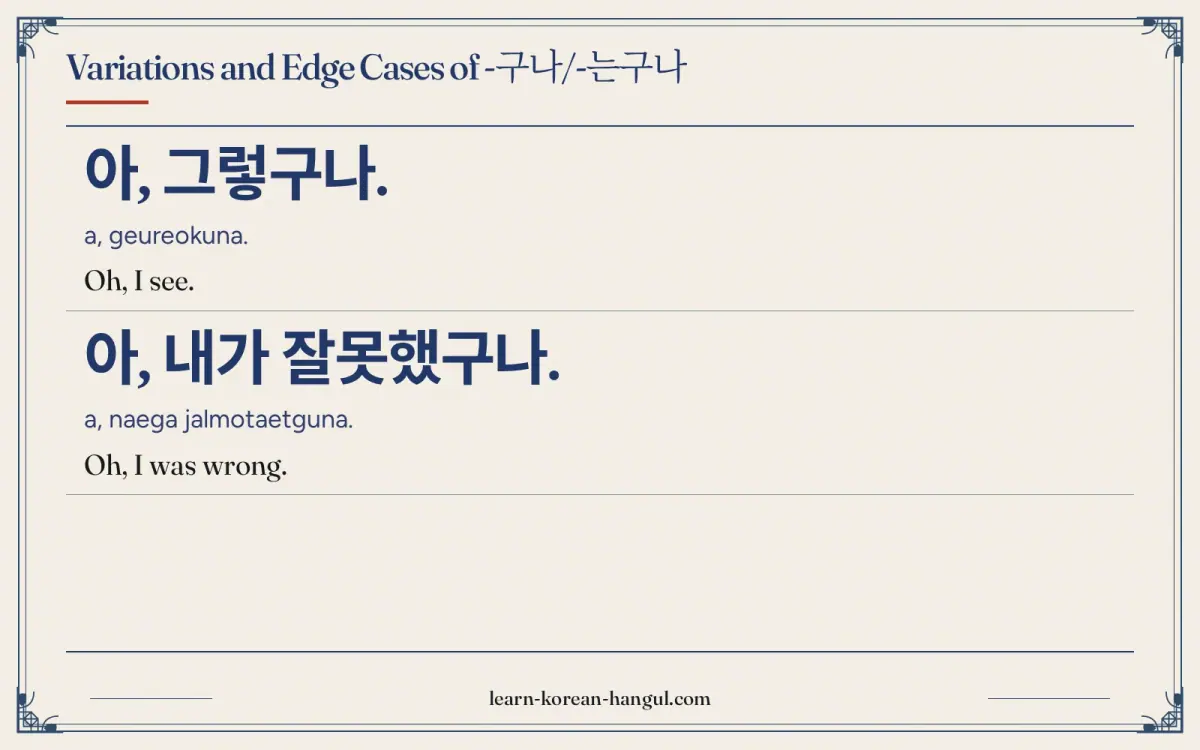
-구나/-는구나 has four common variations: a set reply, a sympathy phrase, self-talk and speech from adults to children. Each one is short, and each appears in real conversation.
- The reply 그렇구나. After a friend explains something, 아, 그렇구나 means "Oh, I see." The past form 그랬구나 means "So that's how it was." Both are among the most common replies between friends.
- Sympathy. 힘들었구나 and 속상했구나 ("You must have been upset") tell a friend that you understand their feelings. Adults use the same pattern to comfort children.
- Self-talk. Speakers say -구나 to themselves when they realize something: 아, 내가 잘못했구나 ("Oh, I was wrong"). Nobody else needs to be present.
- Adults to children. 우리 딸이 많이 컸구나 is a natural thing for a parent or an older relative to say to a child. The same sentence from a child to an adult would sound too familiar.
아, 그렇구나.
a, geureokuna.
Oh, I see.
아, 내가 잘못했구나.
a, naega jalmotaetguna.
Oh, I was wrong.
A reaction can also give the reason: 아, 그래서 늦었구나 ("Oh, that's why you're late"). The word 그래서 links the earlier explanation to the new understanding.
This lesson covers the casual forms used with friends and children, not the full range of Korean exclamations. Endings such as -더구나 ("I noticed that, as I experienced it") and the literary -도다 belong elsewhere. The mistakes below show where the boundary with other patterns causes real errors.
What Mistakes Do Learners Make with -구나/-는구나?
Learners most often get the politeness level, the stem class or the tense wrong. Four mistakes appear again and again.
- Using it with a teacher or an older stranger. Learners often assume that -구나 is just a friendly version of -군요 that works anywhere. Actually the casual register is rude to someone who needs polite speech. 선생님, 한국어를 잘하는구나 sounds as if a student were judging the teacher. Say 한국어를 잘하시는군요.
- Adding 는 to an adjective. 예쁘는구나 and 바쁘는구나 are wrong. Say 예쁘구나 and 바쁘구나. (크다 is different: as a verb meaning "to grow" it takes 는, and 많이 컸구나 above is that verb.)
- Leaving out 는 after a verb. 비가 오구나 is wrong in the present tense. Say 비가 오는구나.
- Putting 는 in the past tense. 먹었는구나 is wrong. Say 먹었구나.
A quick check for any sentence: Is the listener someone I can speak casually to? Is the word before the ending an action verb or an adjective? Is it present or past? If you can answer all three, the sentence is sound.
The practice set below tests these points directly.
Practice and Answers
Try the four items before you read the answer key. Cover the answers with your hand.
- Choose the form. Your friend shows you a new bag. React: 와, 가방이 정말 ___. (예쁘구나 / 예쁘는구나)
- Fix the error. A learner tells a teacher 선생님이 오늘 바쁘구나. Correct it to polite speech.
- Translate. "So that person is a teacher." Use 선생님 and -구나.
- Write your own. Write one -구나/-는구나 reaction to news from a friend. Then change it to the polite form.
Practice · 6
A friend your age shows you their new bag. Which reaction fits? 와, 가방이 정말 ___.
Show answer
예쁘구나
An adjective takes -구나 with no 는, and 구나 suits a friend. 구나요 is not a standard polite form.
A friend tells you they exercise every day. React casually: 네가 매일 운동을 ___.
Show answer
하는구나
A present action verb needs 는, and the casual 구나 suits a friend.
You speak to your teacher. Which ending is appropriate?
Show answer
-는군요
-는군요 is polite. -는구나 is casual and can sound rude to a teacher.
Which form shows sympathy: "That must have been hard"?
Show answer
힘들었구나
The past marker -었- goes before -구나, and 는 is dropped.
What is the polite partner of 비가 오는구나?
Show answer
비가 오는군요
Change 구나 to 군요 for polite speech; adding 요 to 구나 is not standard, and a verb keeps 는.
Complete: 그 사람이 ___. ("So that person is a teacher.")
Show answer
선생님이구나
A noun takes (이)구나, and after a consonant you say 이구나.
Answer key
- 예쁘구나. 예쁘다 is an adjective, so it takes -구나 with no 는.
- 선생님이 오늘 바쁘시군요. (seonsaengnimi oneul bappeusigunyo.) = "You are busy today, I see." The listener is a teacher, so -군요 replaces -구나, and -시- shows respect.
- 그 사람이 선생님이구나. (geu sarami seonsaengnimiguna.) [그 사라미 선생니미구나] = "So that person is a teacher."
- Answers vary. Check that verbs have 는 and adjectives do not, and that the polite form uses 군요. An example: 새 직장을 구했구나 becomes 새 직장을 구했군요 ("You found a new job").
If you can complete items 1 to 3 without the key, you can use the pattern in conversation. The lesson now hands off to related patterns.
What Should You Learn Next after -구나/-는구나 Grammar?
After -구나/-는구나 grammar, learn its polite partner and the ending for fresh perceptions. This lesson teaches the casual realization ending and does not cover polite speech rules, retrospective endings or reminders in depth. Those live on their own pages.
- Start with -군요/-는군요, which carries the same meaning in polite speech.
- Continue with -네요, which reacts to what your senses show.
- Review the wider system in the casual speech pages, especially banmal forms and when to use banmal.
- Return to Exclamations and Realization to see every lesson in this set, or to the Intermediate Grammar list for other B1 patterns.
With these steps, -구나/-는구나 becomes automatic: ask whether the word is an action or a description, add 는구나 or 구나, and keep it for friends, children and yourself.
Frequently Asked Questions
What does -구나/-는구나 mean in one sentence?
-구나/-는구나 means "oh!" or "I see" in casual speech. The speaker has just noticed or understood something and says it aloud, often to a friend or to themselves. 벌써 비가 오는구나 means "Oh, it is raining already." The feeling is a small surprise or a quiet nod.
How do I attach -구나/-는구나 to a verb or adjective?
Drop 다, then add -는구나 to an action verb and -구나 to an adjective: 먹는구나 but 크구나. A noun takes (이)구나, as in 학생이구나. ㄹ-stem verbs lose the ㄹ before 는, so 살다 becomes 사는구나. Adjectives never take 는, so 예쁘는구나 is wrong.
Can -구나/-는구나 be used in the past tense?
Yes. Put -았/었- before -구나 and drop 는: 먹었구나 means "Oh, you ate it," and 힘들었구나 means "That must have been hard." The second example is a common way to show sympathy. A form such as 먹었는구나 is not used.
Is -구나/-는구나 polite or casual?
-구나/-는구나 is casual. Friends use it with friends, adults use it with children, and people use it for self-talk. Do not use it with teachers, bosses or older strangers; switch to -군요/-는군요, which carries the same meaning in polite speech. Adding 요 to 구나 (구나요) is not the standard way to make it polite.
What is the most common mistake with -구나/-는구나?
The most common mistake is using it with someone who needs polite speech. 선생님, 한국어를 잘하는구나 sounds rude to a teacher. Say 선생님, 한국어를 잘하시는군요 or use -네요. A second mistake is giving adjectives a 는, as in 예쁘는구나, when 예쁘구나 is correct.