Key facts
- Level: A1. Estimated study time: 30 minutes.
What you'll learn
- Form -아요/어요 from any verb or adjective with the vowel rule.
- Contract stems that end in a vowel, such as 가+아요 to 가요 and 오+아요 to 와요.
- Use one form for statements, questions, suggestions and commands.
- Tell 해요체 from the formal and casual styles.
Before you start: you should read Hangul and know that Korean puts the verb last. Time: about 30 minutes.
What Does 해요체 Polite Speech -아요/어요 Mean?

해요체 is the polite, everyday speech level of Korean. The name has two parts: 해요 is the polite form of 하다 ("to do"), and 체 (che) means "style". So 해요체 means "the 해요 style". Its ending, -아요/어요, shows respect to the listener while staying friendly.
Compare the dictionary form with the polite sentence:
| Form | Example | Meaning |
|---|---|---|
| dictionary form (stem + 다) | 가다 | to go |
| polite sentence (stem + 아요/어요) | 가요 | I go. / Do you go? / Let us go. |
Korean grammar calls this a sentence-final ending (종결어미), the last piece of a sentence that carries tense, mood and politeness. The stem 가 (the form without 다) never stands alone, so every sentence needs an ending.
A First Example
Listen to each sentence at normal speed, then slowly.
1. 같이 가요. (gachi gayo) "Let us go together."
Pronunciation: [가치 가요]. The word 같이 ("together") is spoken as 가치, because ㅌ before 이 becomes ㅊ. The stem 가 plus 아요 merges into 가요.
2. 이거 얼마예요? (igeo eolmayeyo) "How much is this?"
Here the noun 얼마 ("how much") takes the polite copula 예요. The pronunciation is [이거 얼마예요]; in everyday speech 예요 is often softened to [에요], giving [이거 얼마에요].
The first sentence uses a verb and the second uses 이다, and both end in 요. The next section explains how to build the ending.
How Does 해요체 Polite Speech -아요/어요 Work?

The ending is chosen by the last vowel of the verb stem. This pattern is called vowel harmony (모음조화): bright vowels go with bright vowels. Stems whose last vowel is ㅏ or ㅗ take 아요, all other stems take 어요, and 하다 verbs take 해요.
Pattern Table
| Dictionary form | Stem | Last vowel | Ending | Polite form | Spoken |
|---|---|---|---|---|---|
| 좋다 (to be good) | 좋 | ㅗ | 아요 | 좋아요 | [조아요] |
| 살다 (to live) | 살 | ㅏ | 아요 | 살아요 | [사라요] |
| 받다 (to receive) | 받 | ㅏ | 아요 | 받아요 | [바다요] |
| 먹다 (to eat) | 먹 | ㅓ | 어요 | 먹어요 | [머거요] |
| 읽다 (to read) | 읽 | ㅣ | 어요 | 읽어요 | [일거요] |
| 있다 (to exist) | 있 | ㅣ | 어요 | 있어요 | [이써요] |
| 없다 (not to exist) | 없 | ㅓ | 어요 | 없어요 | [업써요] |
| 공부하다 (to study) | 공부하 | 하 | 해요 | 공부해요 | [공부해요] |
Three details make the table easy to apply.
- Look at the last vowel of the stem only. 먹 has ㅓ, so the ending is 어요. The vowels earlier in the word do not matter.
- Move a final consonant to the next syllable when you say it. 좋아요 is [조아요] and 살아요 is [사라요]. The consonant joins the vowel of 아요.
- Use 해요 for every 하다 verb. 해요 is the short form of 하여요, which survives only in formal writing, so 하어요 and 하아요 are never used.
The stem itself is explained in verb stems, and the full chart is in the polite present conjugation lesson.
Stems That End in a Vowel Merge with the Ending
When a stem ends in a vowel, the stem vowel and the ending vowel merge into one syllable. The merged form is what you write and say.
| Dictionary form | Merge | Polite form | Spoken |
|---|---|---|---|
| 가다 (to go) | 가 + 아요 | 가요 | [가요] |
| 사다 (to buy) | 사 + 아요 | 사요 | [사요] |
| 만나다 (to meet) | 만나 + 아요 | 만나요 | [만나요] |
| 오다 (to come) | 오 + 아요 | 와요 | [와요] |
| 보다 (to see) | 보 + 아요 | 봐요 | [봐요] |
| 마시다 (to drink) | 마시 + 어요 | 마셔요 | [마셔요] |
| 주다 (to give) | 주 + 어요 | 줘요 | [줘요] |
| 배우다 (to learn) | 배우 + 어요 | 배워요 | [배워요] |
| 기다리다 (to wait) | 기다리 + 어요 | 기다려요 | [기다려요] |
The pattern: ㅏ plus 아 keeps one ㅏ, ㅗ plus 아 becomes ㅘ, ㅜ plus 어 becomes ㅝ, and ㅣ plus 어 becomes ㅕ. The ㅏ merge and 와요 for 오다 are required. For the others the merged form is what people normally say and write; unmerged forms such as 보아요 and 주어요 appear mainly in careful or older writing.
Irregular Stems and the ㅡ-Drop
A small group of stems changes before the ending. The most common one is the ㅡ-drop: a stem that ends in ㅡ loses the ㅡ, and the vowel before it chooses 아요 or 어요.
| Dictionary form | What happens | Polite form | Spoken |
|---|---|---|---|
| 바쁘다 (to be busy) | ㅡ drops, vowel before is ㅏ | 바빠요 | [바빠요] |
| 아프다 (to hurt) | ㅡ drops, vowel before is ㅏ | 아파요 | [아파요] |
| 쓰다 (to write) | ㅡ drops, no vowel before | 써요 | [써요] |
| 크다 (to be big) | ㅡ drops, no vowel before | 커요 | [커요] |
| 예쁘다 (to be pretty) | ㅡ drops, vowel before is ㅖ | 예뻐요 | [예뻐요] |
Other irregular groups, such as 듣다 to 들어요 and 모르다 to 몰라요, follow their own rules and are taught in the verbs hub. Use the Korean verb conjugator when you are unsure. The next section builds a sentence step by step.
How Do You Make a 해요체 Sentence Step by Step?

To make a 해요체 sentence, take the dictionary form, remove 다, check the last vowel and add the ending. Follow these steps with 같이 가요 and then repeat with 먹다 and 하다.
- Start from the dictionary form. 가다 ("to go").
- Remove 다. The stem is 가.
- Check the last vowel. 가 ends in ㅏ, so the ending is 아요.
- Merge the vowels. 가 + 아요 becomes 가요.
- Add the other words. 같이 ("together") goes before the verb: 같이 가요.
You'll know it worked when the verb is the last word of the sentence and ends in 요. Common mistake at this step: adding 요 straight to the stem of a consonant-final verb, as in 먹요. The ending needs its vowel: 먹어요.
Repeat the same steps with two more verbs. For 먹다, the stem is 먹, the last vowel is ㅓ, and the result is 먹어요. For 공부하다, the stem is 공부하, the verb ends in 하, and the result is 공부해요.
Reference Examples
| Form | Example | Meaning |
|---|---|---|
| dictionary form (stem + 다) | 가다 | to go |
| polite sentence (stem + 아요/어요) | 가요 | I go. / Do you go? / Let us go. |
| Dictionary form | Stem | Last vowel | Ending | Polite form | Spoken |
|---|---|---|---|---|---|
| 좋다 (to be good) | 좋 | ㅗ | 아요 | 좋아요 | [조아요] |
| 살다 (to live) | 살 | ㅏ | 아요 | 살아요 | [사라요] |
| 받다 (to receive) | 받 | ㅏ | 아요 | 받아요 | [바다요] |
| 먹다 (to eat) | 먹 | ㅓ | 어요 | 먹어요 | [머거요] |
| 읽다 (to read) | 읽 | ㅣ | 어요 | 읽어요 | [일거요] |
| 있다 (to exist) | 있 | ㅣ | 어요 | 있어요 | [이써요] |
| 없다 (not to exist) | 없 | ㅓ | 어요 | 없어요 | [업써요] |
| 공부하다 (to study) | 공부하 | 하 | 해요 | 공부해요 | [공부해요] |
| Dictionary form | Merge | Polite form | Spoken |
|---|---|---|---|
| 가다 (to go) | 가 + 아요 | 가요 | [가요] |
| 사다 (to buy) | 사 + 아요 | 사요 | [사요] |
| 만나다 (to meet) | 만나 + 아요 | 만나요 | [만나요] |
| 오다 (to come) | 오 + 아요 | 와요 | [와요] |
| 보다 (to see) | 보 + 아요 | 봐요 | [봐요] |
| 마시다 (to drink) | 마시 + 어요 | 마셔요 | [마셔요] |
| 주다 (to give) | 주 + 어요 | 줘요 | [줘요] |
| 배우다 (to learn) | 배우 + 어요 | 배워요 | [배워요] |
| 기다리다 (to wait) | 기다리 + 어요 | 기다려요 | [기다려요] |
| Dictionary form | What happens | Polite form | Spoken |
|---|---|---|---|
| 바쁘다 (to be busy) | ㅡ drops, vowel before is ㅏ | 바빠요 | [바빠요] |
| 아프다 (to hurt) | ㅡ drops, vowel before is ㅏ | 아파요 | [아파요] |
| 쓰다 (to write) | ㅡ drops, no vowel before | 써요 | [써요] |
| 크다 (to be big) | ㅡ drops, no vowel before | 커요 | [커요] |
| 예쁘다 (to be pretty) | ㅡ drops, vowel before is ㅖ | 예뻐요 | [예뻐요] |
| Feature | 하십시오체 (formal) | 해요체 (polite) | 해체 (casual) |
|---|---|---|---|
| Ending of 먹다 | 먹습니다 | 먹어요 | 먹어 |
| Ending of 가다 | 갑니다 | 가요 | 가 |
| Question | 갑니까? | 가요? | 가? |
| Typical listener | audience, customers | strangers, colleagues, elders | close friends |
| Sounds | official, distant | friendly, respectful | intimate, direct |
| Function | Example | Meaning | Clue |
|---|---|---|---|
| Statement | 같이 가요. | I am going with you. | falling pitch |
| Question | 같이 가요? | Are you going together? | rising pitch |
| Suggestion | 우리 같이 가요. | Let us go together. | 우리 ("we") and context |
| Command | 빨리 와요. | Come quickly. | urgent tone, a request to someone close |
| Sentence | Meaning | Spoken |
|---|---|---|
| 뭐 해요? | What are you doing? | [뭐 해요] |
| 어디 가요? | Where are you going? | [어디 가요] |
| 괜찮아요. | It is fine. | [괜차나요] |
| 맛있어요. | It is tasty. | [마시써요] |
| 잘 모르겠어요. | I am not sure. | [잘 모르게써요] |
| 물 주세요. | Please give me water. | [물 주세요] |
With the ending clear, the next question is how 해요체 compares with the other levels.
How Is 해요체 Different from 하십시오체 and 해체?
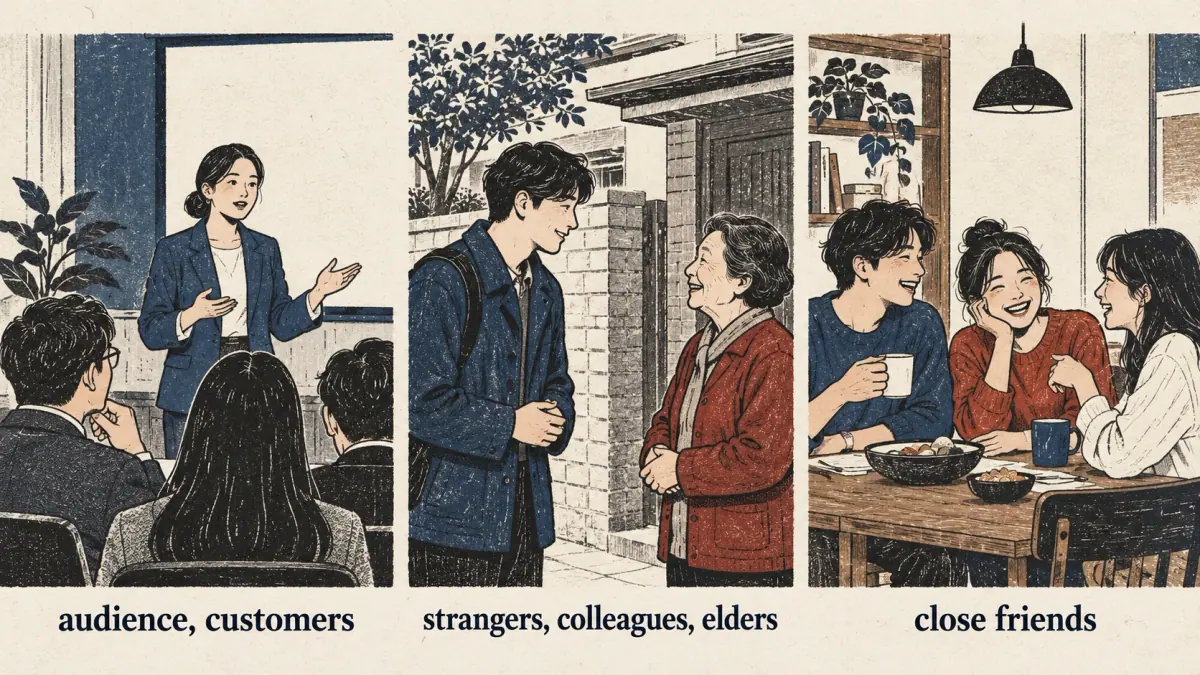
해요체 sits between the formal 하십시오체 and the casual 해체. It ends in -아요/어요, while 하십시오체 ends in -ㅂ니다/습니다 and 해체 ends in -아/어. The three can all be translated with the same English sentence, but the relationship they signal differs.
| Feature | 하십시오체 (formal) | 해요체 (polite) | 해체 (casual) |
|---|---|---|---|
| Ending of 먹다 | 먹습니다 | 먹어요 | 먹어 |
| Ending of 가다 | 갑니다 | 가요 | 가 |
| Question | 갑니까? | 가요? | 가? |
| Typical listener | audience, customers | strangers, colleagues, elders | close friends |
| Sounds | official, distant | friendly, respectful | intimate, direct |
Pronunciation: 먹습니다 is [먹씀니다] (meokseumnida), and 갑니까 is [감니까] (gamnikka). The easiest way to remember the relationship is that 해요체 equals 해체 plus 요. Casual 가 plus 요 gives polite 가요, and casual 먹어 plus 요 gives polite 먹어요. The shortcut breaks only for 이다, where casual 이야 becomes 이에요 and not 이야요.
For the formal comparison in depth, read -ㅂ니다 vs -아요/어요. For casual forms, read how to make banmal casual speech. With the comparison clear, the next section covers the many jobs of one polite form.
Can the Same Polite Form Be a Statement, a Question and a Suggestion?

Yes. The same -아요/어요 form serves as a statement, a question, a suggestion and, with context, a command. Pitch and situation tell the listener which one is meant, so the verb itself never changes.
| Function | Example | Meaning | Clue |
|---|---|---|---|
| Statement | 같이 가요. | I am going with you. | falling pitch |
| Question | 같이 가요? | Are you going together? | rising pitch |
| Suggestion | 우리 같이 가요. | Let us go together. | 우리 ("we") and context |
| Command | 빨리 와요. | Come quickly. | urgent tone, a request to someone close |
Pronunciation: 우리 같이 가요 is [우리 가치 가요] (uri gachi gayo), and 빨리 와요 is [빨리 와요] (ppalli wayo). In practice the polite command is softer than English "Come!" but less respectful than the honorific 오세요. For an older listener, add -(으)시-: 빨리 오세요. The pitch pattern for questions is taught in korean polite question intonation.
Six everyday polite sentences show the form in real use.
| Sentence | Meaning | Spoken |
|---|---|---|
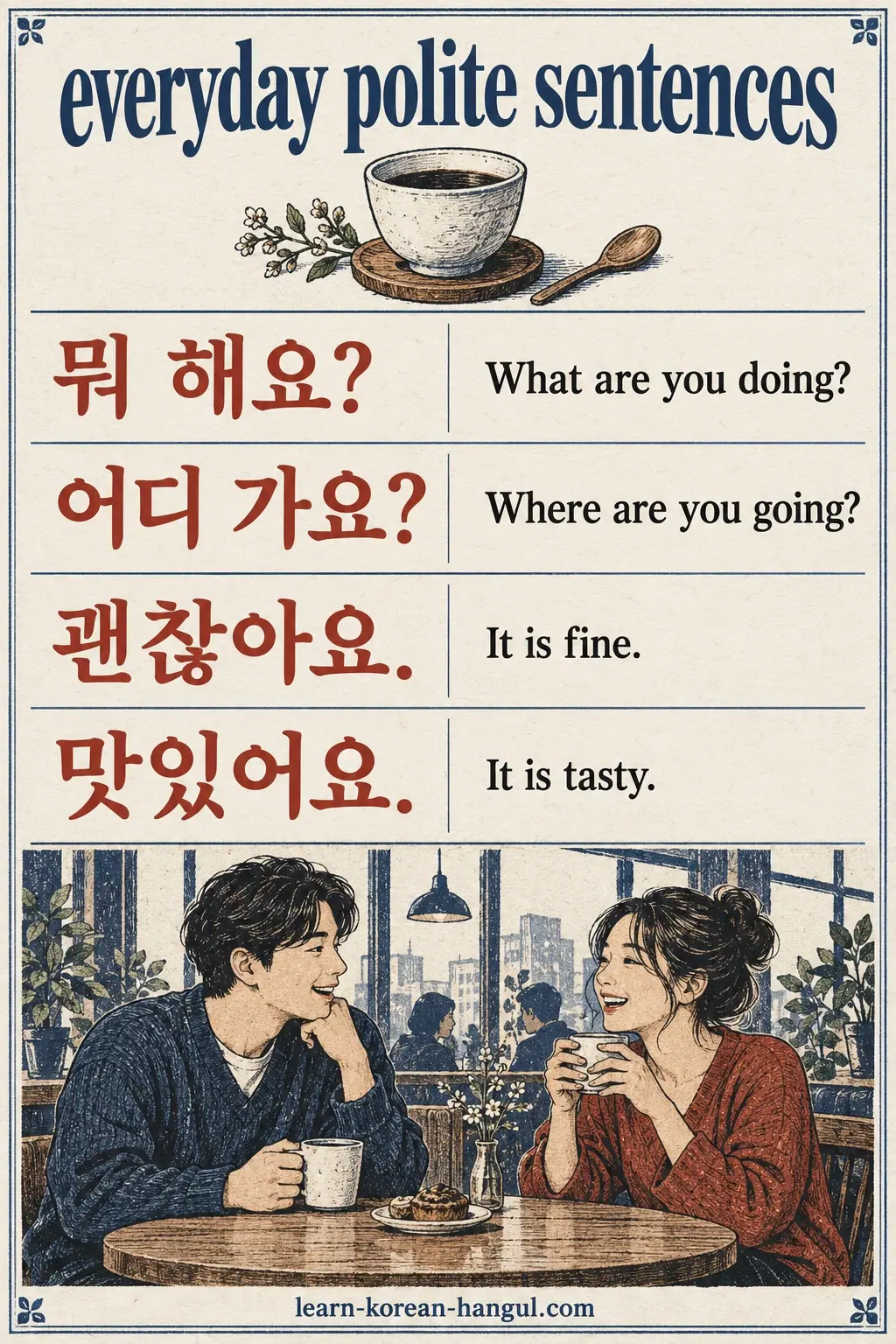
| 뭐 해요? | What are you doing? | [뭐 해요] |
| 어디 가요? | Where are you going? | [어디 가요] |
| 괜찮아요. | It is fine. | [괜차나요] |
| 맛있어요. | It is tasty. | [마시써요] |
| 잘 모르겠어요. | I am not sure. | [잘 모르게써요] |
| 물 주세요. | Please give me water. | [물 주세요] |
The last sentence uses 주세요, the honorific polite form of 주다, which is the normal way to ask for something in a shop or restaurant. The same form also covers present and near-future meaning. 내일 가요 means "I will go tomorrow", and 지금 가요 means "I am going now". The wider uses of the present form are in korean present tense uses. The next section lists the errors to avoid.
Common Mistakes with 해요체

Five mistakes cover most wrong 해요체 sentences.
- Treating -아요/어요 as only for questions, or only for statements. Learners hear 가요? in a shop and 가요 on a bus and think they are different forms. They are one form, and pitch decides. Say 가요. for a statement and 가요? for a question.
- Using the wrong vowel. 먹아요 and 좋어요 are wrong. Look at the last vowel of the stem: 먹 has ㅓ, so 먹어요; 좋 has ㅗ, so 좋아요.
- Adding 하어요 to 하다 verbs. 공부하어요 is wrong. Every 하다 verb takes 해요: 공부해요.
- Confusing 이에요 and 예요. 학생예요 and 의사이에요 are wrong. A noun ending in a consonant takes 이에요 (학생이에요), and a noun ending in a vowel takes 예요 (의사예요).
- Keeping the ㅡ. 바쁘어요 is wrong. The ㅡ drops: 바빠요.
The same habits carry over to when to use polite speech in korean. Now test yourself.
Practice and Answers
Try all four items before you read the answers. Each answer has audio, normal and slow.
Sentence
Let us go together.
Show answer
같이 가요
Practice · 8
What is the 해요체 form of 먹다 (to eat)?
Show answer
먹어요
The last vowel of 먹 is ㅓ, so the ending is 어요. 요 cannot attach straight to a consonant-final stem.
What is the 해요체 form of 좋다 (to be good)?
Show answer
좋아요
Stems whose last vowel is ㅏ or ㅗ take 아요, so 좋 becomes 좋아요.
How do you say "I study" politely with 공부하다?
Show answer
공부해요
Every 하다 verb takes 해요. 하어요 and 하아요 are never used.
What is the polite form of 오다 (to come)?
Show answer
와요
ㅗ plus 아 merges into ㅘ, and for 오다 the merged form 와요 is required.
What is the polite form of 바쁘다 (to be busy)?
Show answer
바빠요
A stem ending in ㅡ drops the ㅡ, and the vowel before it (ㅏ) chooses 아요: 바빠요.
Which is correct for "I am a student"?
Show answer
학생이에요
A noun ending in a consonant takes 이에요; a noun ending in a vowel takes 예요 (의사예요).
How does a listener tell the statement 같이 가요. from the question 같이 가요?
Show answer
By the pitch: falling for a statement, rising for a question.
One 해요체 form serves statements, questions and suggestions. Pitch and context show which is meant.
Which shortcut links 해요체 and casual 해체?
Show answer
해요체 = 해체 + 요 (먹어 + 요 = 먹어요)
Polite equals casual plus 요. The shortcut breaks only for 이다, where 이야 becomes 이에요.
- Choose the form. 먹다 ("to eat"): 먹아요 or 먹어요?
- Fix the error. 공부하어요 (The speaker wants to say "I study" politely.)
- Translate. "I like coffee." Use 좋아하다 (to like).
- Write your own. Write one polite sentence about what you do in the morning, using 마시다 (to drink) or 먹다.
Answer Key
- 먹어요 (meogeoyo) Pronounced [머거요]. The last vowel of 먹 is ㅓ, so the ending is 어요.
- 공부해요 (gongbuhaeyo) Pronounced [공부해요]. Every 하다 verb takes 해요.
- 커피를 좋아해요. (keopireul joahaeyo) Pronounced [커피를 조아해요]. The verb 좋아하다 ends in 하다, so it takes 해요.
- Sample answer: 아침에 커피를 마셔요. (achime keopireul masyeoyo) "I drink coffee in the morning." Pronounced [아치메 커피를 마셔요]. Any morning action with a correct 아요/어요 ending is right.
If you chose the wrong ending, check the last vowel of the stem: ㅏ or ㅗ takes 아요, other vowels take 어요, and 하다 takes 해요. Then continue with the next lessons.
Next Lessons and Where to Go from Here
After 해요체 polite speech -아요/어요, the natural next lesson is korean polite question intonation, which shows how pitch turns a polite sentence into a question. To decide who receives polite speech, study when to use polite speech in korean. To compare the neighbouring style, read -ㅂ니다 vs -아요/어요. The set overview, korean polite speech, lists every lesson in order. The basic sentence pattern behind all of them is explained in the Korean SOV sentence pattern.
This page uses Revised Romanization only as a learning aid; the Hangul is the reference. To remember the idea in one line: 해요체 polite speech -아요/어요 attaches 아요 after ㅏ or ㅗ, 어요 after other vowels and 해요 to 하다 verbs, and one form serves statements, questions, suggestions and commands.
Frequently Asked Questions
What Is 해요체?
해요체 is the everyday polite speech level in Korean, formed by adding -아요/어요 to a verb stem, as in 가요 and 먹어요. The name combines the model verb 해요 with 체, meaning "style". It is the safe default with strangers, colleagues and anyone older, and it works in speech, messages and informal writing.
How Do I Form -아요/어요?
Remove 다, check the last vowel of the stem, and add 아요 after ㅏ or ㅗ and 어요 after other vowels: 좋아요, 먹어요. Use 해요 for 하다 verbs. When the stem ends in a vowel, the sounds merge, so 오+아요 becomes 와요 and 마시+어요 becomes 마셔요.
What Is the Most Common Mistake with 해요체?
Learners treat -아요/어요 as a question-only or statement-only form. It serves both, and pitch decides: 가요. is a statement and 가요? is a question. A second common error is the wrong vowel, such as 먹아요 for 먹어요. Check the last vowel of the stem, not the whole word.
How Is 해요체 Different from 하십시오체?
해요체 ends in -아요/어요 and sounds friendly and respectful, while 하십시오체 ends in -ㅂ니다/습니다 and sounds formal. 먹어요 and 먹습니다 mean the same. Use 해요체 in conversation with people you do not know well, and 하십시오체 in announcements, news, service and presentations.
Do I Use 해요체 in Speech, Writing or Both?
Both, with one limit. 해요체 is the main style of spoken conversation, messages and informal writing. Newspapers, reports and academic texts use the plain written style, such as 먹는다, instead. In formal speech the ending becomes -ㅂ니다. The stem stays the same while the ending changes.