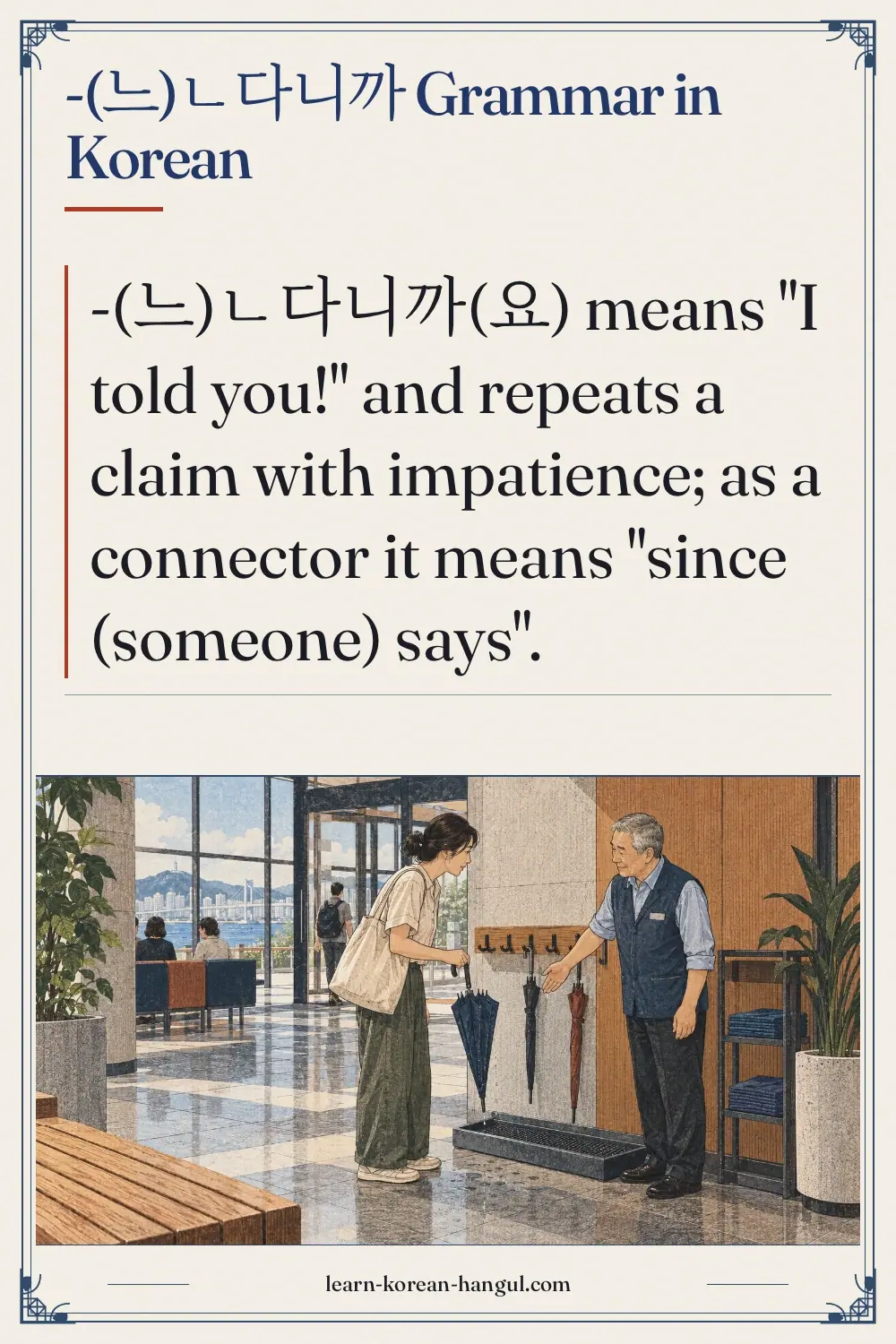
What you'll learn
- Attach -(느)ㄴ다니까 to verbs, adjectives, 있다/없다, past forms and nouns.
- Use -(느)ㄴ다니까(요) to insist on what you already said, and hear the impatience in it.
- Tell the insisting meaning from the "since they say" meaning.
- Choose between -(느)ㄴ다니까, -(느)ㄴ다고요? and -거든요, and avoid the usual errors.
Before you start: you should know the plain-style endings -ㄴ/는다 and -다, and the polite ending -아요/어요. Time: about 30 minutes. This site places the pattern at level B2, which is an editorial estimate. The official TOPIK information is published at topik.go.kr.
What Does -(느)ㄴ다니까 Grammar Mean?
-(느)ㄴ다니까 means "I'm telling you" or "I said". The speaker repeats a statement they have already made, with a little impatience, because the listener did not accept it the first time. An English speaker would say "I told you it's fine!" or "It really is delicious, I tell you!"
The pattern has three working parts.
| Part | Form | Job |
|---|---|---|
| Plain statement | -(느)ㄴ다 | the sentence being repeated, in plain style |
| Quotation marker | 고 하 (dropped) | "(I) said that...", shortened away |
| Reason ending | -(으)니까 | "since, because" |
The full, unshortened form is -(느)ㄴ다고 하니까, "because I said that...". Speakers contract it to -(느)ㄴ다니까, and then the second half of the sentence is usually dropped. What remains is a sentence that stops after 니까 or 니까요, and the listener understands "...so please believe me."
A First Example
Listen to each sentence at normal speed.
1. 괜찮다니까요. (gwaenchantanikkayo.) "I told you it's okay."
Pronunciation: [괜찬타니까요]. The ㅎ of 괜찮 joins the ㄷ of 다, so 찮다 sounds like [찬타].
2. 정말 맛있다니까! (jeongmal masitdanikka!) "It's really tasty, I tell you!"
Pronunciation: [정말 마싣따니까]. The ㅆ of 있 is said as [ㄷ], and the ㄷ of 다 becomes tense [ㄸ].
Both sentences repeat a claim the speaker already made. The first answers someone who keeps asking "Are you sure?" The second answers someone who is hesitating to taste a dish. In both, -니까 does not give a reason in the English sense. It carries the feeling "stop doubting me."
How Do You Form -(느)ㄴ다니까?
Take the plain-style statement form and add 니까. Verbs add -ㄴ/는 before 다, while adjectives, 있다/없다 and the past tense do not. This is the same rule as for -다고 해서, and the two patterns share the same front half.
- Action verbs: present stem + ㄴ다 (vowel stem) or 는다 (consonant stem), then 니까.
- Adjectives and 있다/없다: the dictionary form already ends in 다, so just add 니까.
- Past: stem + 았/었다니까.
- Nouns: noun + (이)라니까. After a consonant use 이라니까, and after a vowel use 라니까.
- Future: stem + (으)ㄹ 거라니까.
- Polite: add 요 after 니까, as in 괜찮다니까요.
| Type | Dictionary form | With -(느)ㄴ다니까 | RR and spoken form |
|---|---|---|---|
| Verb, vowel stem | 하다 | 한다니까 | handanikka |
| Verb, vowel stem | 가다 | 간다니까 | gandanikka |
| Verb, consonant stem | 먹다 | 먹는다니까 | meongneundanikka [멍는다니까] |
| Verb, ㄹ-stem | 살다 | 산다니까 | sandanikka |
| Adjective | 괜찮다 | 괜찮다니까 | gwaenchantanikka [괜찬타니까] |
| Adjective | 좋다 | 좋다니까 | jotanikka [조타니까] |
| Existence | 있다 | 있다니까 | itdanikka [읻따니까] |
| Existence | 없다 | 없다니까 | eopdanikka [업따니까] |
| Past | 오다 | 왔다니까 | watdanikka [왇따니까] |
| Noun after a consonant | 학생 | 학생이라니까 | haksaengiranikka [학쌩이라니까] |
| Noun after a vowel | 의사 | 의사라니까 | uisaranikka |
| Future | 가다 | 갈 거라니까 | gal georanikka [갈꺼라니까] |
An ㄹ-stem drops its ㄹ before ㄴ, so 살다 gives 산다니까 and 만들다 gives 만든다니까.
Verbs
An action verb needs the extra ㄴ/는 in the present, because the plain present of a verb is -ㄴ/는다.
내가 한다니까. (naega handanikka.) "I said I'll do it." This is casual speech, said to a friend or a younger person. Pronunciation: [내가 한다니까].
저 정말 안 갈 거라니까요. (jeo jeongmal an gal georanikkayo.) "I told you, I'm really not going." Pronunciation: [저 정말 안 갈꺼라니까요]. The ㄱ of 거 is tense after the ending -ㄹ, so you hear 꺼.
Adjectives, Nouns and the Past
An adjective keeps its plain form, and a noun uses (이)라니까.
진짜라니까요. (jinjjaranikkayo.) "I told you, it's real." The noun 진짜 ends in a vowel, so it takes 라니까. Pronunciation: [진짜라니까요].
어제 이미 말했다니까요. (eojae imi malhaetdanikkayo.) "I already told you yesterday." Pronunciation: [어제 이미 말핻따니까요]. The ㅆ of 했 is said as [ㄷ], and the ㄷ of 다 becomes tense [ㄸ].
Worked Example: Building a Sentence with -(느)ㄴ다니까
Goal: tell a friend who keeps asking "Are you sure?" that you really will pay.
- Choose the verb. "to pay" is 내다 (or 계산하다). Use 내다 here. It is a vowel stem.
- Make the plain present. 내 + ㄴ다 → 낸다.
- Add the ending. 낸다 + 니까 → 낸다니까.
- Add the subject. "I'll pay": 내가 낸다니까.
- Add 요 for a polite listener. 제가 낸다니까요.
Result: 내가 낸다니까. (naega naendanikka.) "I said I'll pay!" And the polite version: 제가 낸다니까요. (jega naendanikkayo.) Pronunciation: [내가 낸다니까] and [제가 낸다니까요].
Sentence
Show answer
내가 낸다니까
How Does the Tone of -(느)ㄴ다니까 Work?
-(느)ㄴ다니까 sounds impatient. It tells the listener "I have already said this." That is why the ending is common between friends and family, and risky with people of higher status.
| Situation | Sounds | Better choice |
|---|---|---|
| Friend keeps doubting you | natural, a bit annoyed | 괜찮다니까 |
| Family member, relaxed | natural | 괜찮다니까요 |
| Teacher, boss, older stranger | rude or irritated | 아까 말씀드렸는데요 |
| Enthusiastic recommendation | warm, playful | 정말 맛있다니까요 |
The word 아까 말씀드렸는데요 (akka malsseumdeuryeonneundeyo) means "As I mentioned earlier." It repeats the point without any edge. Pronunciation: [아까 말씀드련는데요]. For choosing between this pattern and the polite forms you already know, see when to use polite speech.
Tone also depends on your voice. A flat or falling voice makes the sentence firm, and a lighter, brighter voice makes it playful. 정말 맛있다니까요! said with a smile is friendly encouragement, not a complaint. The words are the same, but the meaning is not.
What Is the "since They Say" Meaning?
The second meaning is a normal connector. -(느)ㄴ다니까 can join two clauses to mean "since (someone) says that X, then Y." The first clause is something a person has said, and the second clause is your reaction or a suggestion based on it.
내일 비가 온다니까 우산을 가져가세요. (naeil biga ondanikka usaneul gajyeogaseyo.) "Since they say it will rain tomorrow, take an umbrella."
Pronunciation: [내일 비가 온다니까 우사늘 가저가세요].
엄마가 오신다니까 빨리 치우자. (eommaga osindanikka ppalli chiuja.) "Since Mom says she is coming, let's tidy up quickly." Pronunciation: [엄마가 오신다니까 빨리 치우자]. The honorific -(으)시- marks the respect for the person who is coming.
Unlike -다고 해서, this connector allows a command or a suggestion in the second clause (가져가세요, 치우자). That is because it keeps the freedom of -(으)니까, which also allows commands. When a sentence ends right after 니까 or 니까요, you have the insisting meaning. When another clause follows, you have the "since they say" meaning.
How Is -(느)ㄴ다니까 Different from -(느)ㄴ다고요? and -거든요?
All three patterns respond to something. They differ in who is speaking and what they want.
| Pattern | Who speaks | Core meaning | Example |
|---|---|---|---|
| -(느)ㄴ다니까(요) | the person who made the claim | I told you (insisting) | 괜찮다니까요. |
| -(느)ㄴ다고요? | the person who heard the claim | You said...? (checking or doubting) | 괜찮다고요? |
| -거든요 | the speaker giving a reason | you see, the reason is... | 괜찮거든요. |
Here is a short exchange.
- A: 정말 괜찮아요? (jeongmal gwaenchanayo?) = "Are you really okay?" Pronunciation: [정말 괜차나요].
- B: 괜찮다니까요. (gwaenchantanikkayo.) = "I told you I'm okay."
- A: 괜찮다고요? 얼굴이 안 좋아 보여요. (gwaenchantagoyo? eolguri an joa boyeoyo.) = "You're okay? You don't look well." Pronunciation: [괜찬타고요 얼구리 안 조아 보여요].
Speaker B insists with -다니까요. Speaker A then echoes the claim with -다고요? to show doubt. You can read about that echo question in the lesson on -(느)ㄴ다고요?. The third pattern, -거든요, explains why something is so, and it does not carry the "I told you" push.
Variations and Edge Cases of -(느)ㄴ다니까
Other quotation types. The same shortening works with the other endings of reported speech. -(으)라니까 insists on a command, and -자니까 insists on a suggestion. 먹으라니까 (meogeuranikka) means "I told you to eat." Pronunciation: [머그라니까]. 가자니까 (gajanikka) means "I said let's go." Pronunciation: [가자니까].
Question version. -냐니까 insists on a question. 어디 가냐니까 (eodi ganyanikka) means "I'm asking where you are going!" It is blunt and best kept for close friends. Pronunciation: [어디 가냐니까].
The 요 can be dropped. 괜찮다니까 (casual) and 괜찮다니까요 (polite) differ only in respect. Between friends, the shorter form is normal.
Spacing and spelling. -(느)ㄴ다니까 is written as one word with the stem, as in 괜찮다니까. Do not insert a space before 니까.
Not the same as -(으)니까. 좋으니까 (joeunikka) means "because it is good", while 좋다니까 (jotanikka) means "I said it is good." The extra 다 is what turns a reason into a repeated claim.
What Mistakes Do Learners Make with -(느)ㄴ다니까?

- Adding ㄴ/는 to an adjective. 괜찮는다니까 and 좋은다니까 are wrong. Adjectives keep the plain form: 괜찮다니까, 좋다니까.
- Leaving ㄴ/는 off a verb. 먹다니까 and 가다니까 are wrong for the present. Say 먹는다니까 and 간다니까.
- Keeping the ㄹ of an ㄹ-stem. 살는다니까 is wrong. Say 산다니까.
- Using 이다니까 for nouns. 학생이다니까 is wrong. Say 학생이라니까, and after a vowel 의사라니까.
- Using it with a superior. 괜찮다니까 to a teacher sounds rude. Use a gentler line such as 아까 말씀드렸는데요.
- Confusing it with -(으)니까. 좋으니까 gives a reason, and 좋다니까 repeats a claim.
Practice and Answers
Try all four items before you read the answers. Each answer has audio.
- Choose the form. "I told you it's delicious." 맛있다니까요 or 맛있는다니까요?
- Fix the error. 저는 정말 가다니까요. (The speaker wants to say "I told you, I'm really going.")
- Translate. "I told you, it's true." (Use 사실 and the noun pattern.)
- Write your own. Write one sentence in which you insist on something you already said, using 괜찮다 or 하다.
Answer Key
- 맛있다니까요. (masitdanikkayo.) Pronunciation: [마싣따니까요]. 맛있다 ends in 있다, so it keeps the plain 다 form.
- 저는 정말 간다니까요. (jeoneun jeongmal gandanikkayo.) Pronunciation: [저는 정말 간다니까요]. The verb 가다 needs ㄴ before 다니까.
- 사실이라니까요. (sasiriranikkayo.) Pronunciation: [사시리라니까요]. The noun 사실 ends in a consonant, so it takes 이라니까.
- Sample answer: 정말 괜찮다니까요. (jeongmal gwaenchantanikkayo.) "I told you, I'm really okay." Pronunciation: [정말 괜찬타니까요]. Any verb or adjective with the right plain form plus 니까 is correct.
Practice · 5
Which means "I told you I'm going"?
Show answer
간다니까
A present verb takes ㄴ/는 before 다니까, so 가다 becomes 간다니까.
Which is correct for the adjective 좋다 when you insist?
Show answer
좋다니까
An adjective keeps its plain form before 니까.
What tone does -(느)ㄴ다니까 usually carry?
Show answer
Impatience, because you are repeating yourself
The ending repeats an earlier claim, so it usually sounds impatient or emphatic.
Which is the right noun form for 의사 (doctor)?
Show answer
의사라니까
After a vowel a noun takes 라니까, so it becomes 의사라니까.
What is the difference between 좋으니까 and 좋다니까?
Show answer
좋으니까 gives a reason and 좋다니까 repeats a claim
-(으)니까 gives a reason. -(느)ㄴ다니까 repeats a claim you already made.
If a sentence went wrong, check three things: verbs take ㄴ/는, adjectives stay plain, and nouns take (이)라니까.
What Should You Learn Next?
The listener's side of this exchange is -(느)ㄴ다고요?, which echoes a claim to check it or to show surprise. To give a simple reason, study -(으)니까. For a different kind of "just because" warning, see -다고 해서. The Reported Speech section lists every pattern, and the Advanced Grammar page shows where this one sits among the B2 patterns.
This page uses Revised Romanization only as a learning aid. The Hangul is the reference. To remember the idea in one line: statement + 다니까(요) means "I told you", and it always carries a little impatience.
Frequently Asked Questions
What Does -(느)ㄴ다니까 Mean in Korean?
-(느)ㄴ다니까 means "I told you" or "I said". The speaker repeats a claim with some impatience because the listener doubted or ignored it. 괜찮다니까요 means "I told you it's okay." As a connector, it can also mean "since (someone) says that...", as in 내일 비가 온다니까 우산을 가져가세요.
How Do I Form -(느)ㄴ다니까?
Use the plain-style statement form and add 니까. Verbs take ㄴ/는: 가다 becomes 간다니까, and 먹다 becomes 먹는다니까. Adjectives, 있다/없다 and past forms keep the plain -다: 좋다니까, 맛있다니까, 왔다니까. Nouns take (이)라니까: 학생이라니까, 의사라니까. An ㄹ-stem drops the ㄹ: 산다니까. Add 요 to be polite.
Does -(느)ㄴ다니까 Sound Rude?
It can sound irritated, because it means "I already said this." Between friends and family it is natural, especially with a warm voice. With a teacher, a boss or an older stranger, use a gentler line such as 아까 말씀드렸는데요 ("As I mentioned earlier").
What Is the Difference between -(느)ㄴ다니까 and -(느)ㄴ다고요?
-(느)ㄴ다니까 is said by the person who made the claim, to insist on it: 괜찮다니까요 ("I told you I'm okay"). -(느)ㄴ다고요? is said by the person who heard the claim, to check it or show surprise: 괜찮다고요? ("You're okay?").
What Is the Difference between 좋으니까 and 좋다니까?
좋으니까 uses -(으)니까 and gives a reason: "because it is good". 좋다니까 uses -(느)ㄴ다니까 and repeats a claim: "I said it is good!" The extra 다 turns a reason into an insistence.
Can -(느)ㄴ다니까 Take a Command or a Suggestion after It?
Yes, when it works as a connector meaning "since they say". 엄마가 오신다니까 빨리 치우자 means "Since Mom says she is coming, let's tidy up quickly." When the sentence ends right after 니까 or 니까요, it is the insisting use instead.