
What Is Korean Indirect Speech?
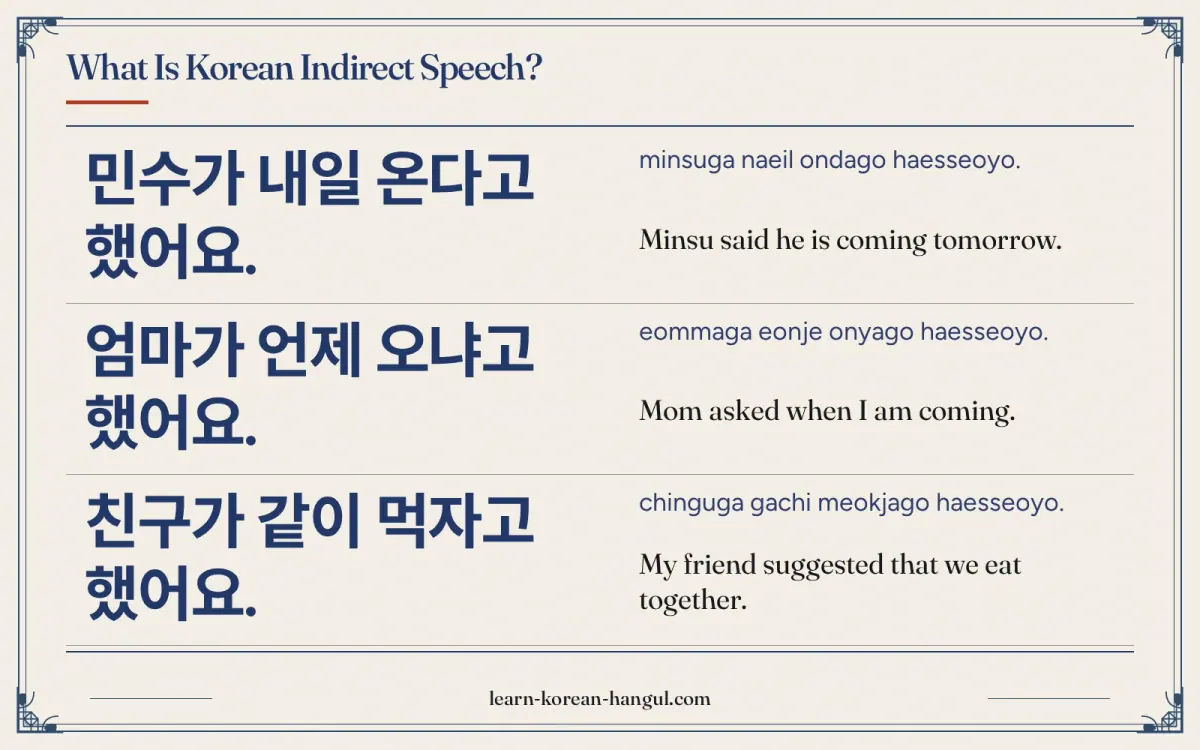
Korean indirect speech is the grammar for repeating someone's words as part of your own sentence, instead of quoting them word for word. The quoted clause takes a plain-style ending, a quote marker -고, and then a verb of saying such as 하다, 말하다 or 묻다 ("ask"). Revised Romanization (RR, the official Latin spelling) is shown below only as a learning aid.
The ending depends on what kind of sentence was said. The table uses the plain style, the blunt written style that Korean uses inside quotes.
| What was said | Original | Reported (full form) | Spoken short form |
|---|---|---|---|
| statement | 내일 와요. "I'm coming tomorrow." | 내일 온다고 했어요. | 내일 온대요. |
| question | 언제 와요? "When are you coming?" | 언제 오냐고 했어요. | 언제 오냬요. |
| suggestion | 같이 먹어요. "Let's eat together." | 같이 먹자고 했어요. | 같이 먹재요. |
| command | 조금 기다리세요. "Please wait a little." | 조금 기다리라고 했어요. | 조금 기다리래요. |
Listen to one example of each type.
민수가 내일 온다고 했어요.
minsuga naeil ondago haesseoyo.
Minsu said he is coming tomorrow.
엄마가 언제 오냐고 했어요.
eommaga eonje onyago haesseoyo.
Mom asked when I am coming.
친구가 같이 먹자고 했어요.
chinguga gachi meokjago haesseoyo.
My friend suggested that we eat together.
선생님이 조금 기다리라고 했어요.
seonsaengnimi jogeum gidarirago haesseoyo.
The teacher told me to wait a little.
Three things shift when you report. First, pronouns follow the reporter: 제가 갈게요 ("I'll go") becomes 자기가 간다고 했어요 or simply 간다고 했어요 ("he said he'd go"). Second, time words can shift: 내일 said yesterday is 오늘 today. Third, politeness moves to the final 하다, so the quote itself stays plain and only 했어요 or 했습니다 shows respect to your listener. The next section gives the order in which to learn the patterns.
Which Pattern Should You Learn First?
Learn -(느)ㄴ다고 하다 first, because statements are the most common thing people report. Then read the overview of direct and indirect quotation, which shows how the four endings form one system. The levels below are an editorial estimate mapped to TOPIK I and II, not an official list.
| Level | Patterns | What you can do |
|---|---|---|
| A2 | 1 | name things and ask what something is called with -(이)라고 하다 |
| B1 | 10 | report statements, questions, suggestions and commands, and use the short spoken forms |
| B2 | 6 | report requests and prohibitions, check rumours, insist and argue from hearsay |
At A2, the naming pattern -(이)라고 하다 is enough. From B1, a practical order is: -(느)ㄴ다고 하다, the quotation overview, -냐고 하다, -자고 하다, -(으)라고 하다, then the -대요 contractions. The B2 patterns build on these four endings, so leave them until the B1 set feels automatic. If verb stems and plain forms are new to you, review the Beginner Grammar list first. The next section describes every pattern.
The Patterns, Grouped by Meaning
Each entry gives the pattern, its meaning and one example, and links to the full lesson.
















Beginner Patterns (A2)
- -(이)라고 하다: "is called, is named". This pattern names things and introduces names, and it is the most useful reporting form for beginners. Example: 이건 한국어로 뭐라고 해요? (igeon hangugeoro mworago haeyo?) [이건 한구거로 뭐라고 해요] "What is this called in Korean?" As a question-word question, it ends with a fall or a rise-fall, not a sharp rise.
Intermediate Patterns (B1)
- -(느)ㄴ다고 하다: "(someone) says that". The core statement report. Verbs take -ㄴ/는다고 (간다고, 먹는다고), adjectives -다고 (바쁘다고) and nouns -(이)라고 (학생이라고). Example: 민수가 내일 온다고 했어요. "Minsu said he is coming tomorrow."
- Direct and indirect quotation: how Korean quotes people. The overview of both styles, with quotation marks and -라고 for exact words, and the four endings for reported words.
- -냐고 하다: "(someone) asks whether, what". Reports questions, usually with 하다 or 묻다. Example: 언제 오냐고 했어요. "She asked when I am coming."
- -자고 하다: "(someone) suggests that we". Reports invitations and proposals built on the -자 form. Example: 같이 먹자고 했어요. "He suggested that we eat together."
- -(으)라고 하다: "(someone) tells you to". Reports commands and instructions: -라고 after a vowel stem (가라고), -으라고 after a consonant stem (먹으라고).
- -대요, -냬요, -재요, -래요: the short reported forms. The everyday spoken contractions of the four full forms. Example: 민수가 내일 온대요. (minsuga naeil ondaeyo.) "Minsu says he's coming tomorrow."
- -다고 들었어요: "I heard that". Names hearsay as hearsay, which sounds careful and polite. Example: 그 식당이 맛있다고 들었어요. [그 식땅이 마싣따고 드러써요] "I heard that restaurant is good."
- -다고 생각하다: "I think that". Uses the same quote frame for your own opinion, common in TOPIK writing answers. Example: 한국어가 재미있다고 생각해요. "I think Korean is fun."
- -(으)ㄴ/는지: "whether, if". Embeds a question inside a sentence, usually before 알다, 모르다 or 궁금하다. Example: 어디에 가는지 알아요? "Do you know where he is going?"
- -(느)ㄴ다고요?: "you said...?". Repeats or checks what someone just said, or stresses your own words. Example: 내일 온다고요? "You said he's coming tomorrow?"
Upper-Intermediate Patterns (B2)
- -아/어 달라고 하다: "(someone) asks for". Reports a request for the speaker's own benefit, where 주다 becomes 달다. Example: 친구가 도와 달라고 했어요. "My friend asked me to help him."
- -지 말라고 하다: "(someone) tells you not to". Reports a prohibition. Example: 늦지 말라고 했어요. [늗찌 말라고 해써요] "She told me not to be late."
- -(느)ㄴ다면서요: "I heard that... is that true?". Checks a rumour with the listener. Example: 다음 달에 한국에 간다면서요? "I heard you're going to Korea next month. Is that right?"
- -다던데: "I heard (so)...". Passes on hearsay as background for advice or a reaction, often left unfinished.
- -다고 해서: "just because". Used in 비싸다고 해서 다 좋은 건 아니에요, "Just because it's expensive doesn't mean it's good." It can also mean "because someone said so".
- -(느)ㄴ다니까: "I told you". Insists on something already said, often with irritation: 간다니까요. "I said I'm going."
The next section helps you pick between patterns that look alike.
How Do You Choose between Look-Alike Patterns?
Choose by the meaning you want first, then check the confusable pairs below. This quick chooser covers the six most common reporting needs.
| Meaning you want | Pattern | Level |
|---|---|---|
| "(someone) says that" | -(느)ㄴ다고 하다 | B1 |
| "(someone) asks whether, what" | -냐고 하다 | B1 |
| "(someone) suggests that we" | -자고 하다 | B1 |
| "(someone) tells you to" | -(으)라고 하다 | B1 |
| "(someone) asks for (a favour)" | -아/어 달라고 하다 | B2 |
| "(someone) tells you not to" | -지 말라고 하다 | B2 |
Four pairs cause most mistakes:
- -(느)ㄴ다고 하다 vs direct quotation. Indirect speech turns a statement into a clause, and pronouns and tenses shift to the reporter's viewpoint. Direct quotation keeps the exact words in quotation marks and adds -라고 (or -하고 for sounds and imitation). See Korean quotation marks for how the marks are written.
- -다고 해요 vs -대요. They mean the same thing. -대요 is the spoken short form; -다고 해요 is the full form for writing and careful speech. The -다고 하다 vs -대요 lesson compares them side by side.
- -(느)ㄴ다면서요 vs -다고 들었어요. Both report hearsay. -다고 들었어요 states it, while -(느)ㄴ다면서요 asks the listener to confirm it.
- -(느)ㄴ다고요 vs -(느)ㄴ다니까. -(느)ㄴ다고요? checks words you just heard; -(느)ㄴ다니까 repeats your own words because the listener did not accept them.
The full set of side-by-side lessons is on Confusing Grammar Compared. The next section lists where to practise.
Where Can You Practise?
Practise by taking one short sentence, such as 내일 와요, and reporting it as a statement, a question, a suggestion and a command, then shrinking each into its short form. The table in the first section is a ready-made drill.
- Review the core intermediate patterns with the Intermediate Korean Grammar Flashcards, which include reported-speech cards.
- Test yourself in the Grammar Quizzes.
- Plan the wider B1 syllabus with Intermediate Grammar.
A useful real-life drill is to retell a short conversation from a drama scene in reported speech, one line at a time. The next section sets the limits of this section.
What Does This Section Not Cover?
This section covers the endings that report other people's words. It does not teach the building blocks those endings rely on.
- Politeness levels and the honorific -(으)시- are in speech levels.
- Past and future forms inside a quote follow Korean tenses.
- Particles such as 이/가 (the subject particle) and 은/는 (the topic particle) are in Korean particles.
- Clause-linking endings such as -아서 and -(으)니까 are in Korean connectors.
The other meaning families, such as wishes and guesses, are on the Korean Sentence Endings hub, and the full map is on Korean Grammar. Korean indirect speech is one of the most frequent patterns in daily talk, so it repays steady practice.
Frequently Asked Questions
What is the difference between direct and indirect speech in Korean?
Direct speech repeats the exact words inside quotation marks and adds -라고 or -하고: 민수가 "내일 갈게요."라고 했어요. Indirect speech rewrites the words as a clause from your point of view: 민수가 내일 온다고 했어요. Pronouns, time words and politeness shift to the reporter, and the quoted verb takes a plain-style ending.
Are these patterns on the TOPIK exam?
Reported speech is typical intermediate material, so you meet it mainly in TOPIK II listening and reading, where speakers pass on news and requests. The levels on this page are an editorial estimate, not an official TOPIK list. For the exam itself, check the current guide on topik.go.kr.
Can I use -대요 in formal writing?
No. -대요, -냬요, -재요 and -래요 are spoken contractions. In an essay, report or formal email, write the full form, such as 온다고 합니다 or 온다고 했습니다. In conversation and casual messages the short forms are normal and sound natural, even with polite -요.
Why does 가다 become 간다고 but 바쁘다 stays 바쁘다고?
A reported statement uses the plain written style before -고. In that style, action verbs in the present take -ㄴ다 or -는다 (간다, 먹는다), while adjectives keep -다 (바쁘다). So the quote becomes 간다고, 먹는다고 and 바쁘다고. Past forms use -았/었다고 for both: 갔다고, 바빴다고.
How do I report a request for myself?
Use 달라고 when the speaker asks for something for themselves, and 주라고 when the favour is for a third person. 친구가 도와 달라고 했어요 means "My friend asked me to help him." The verb 주다 changes to 달다 only in this reported request, which is why it gets its own lesson.