Key facts
- Level: A1. Estimated study time: 25 minutes.
What you'll learn
- Name the listeners who get polite speech and the cues that allow a switch to casual speech.
- Choose between polite, casual and formal speech for ten common situations.
- Recognise the invitation 말 편하게 하세요 and answer it.
- Avoid the most common mistake, starting casual because someone looks friendly or young.
Before you start: you should know how to form the -아요/어요 ending. Time: about 25 minutes.
What Is the Rule for When to Use Polite Speech in Korean?

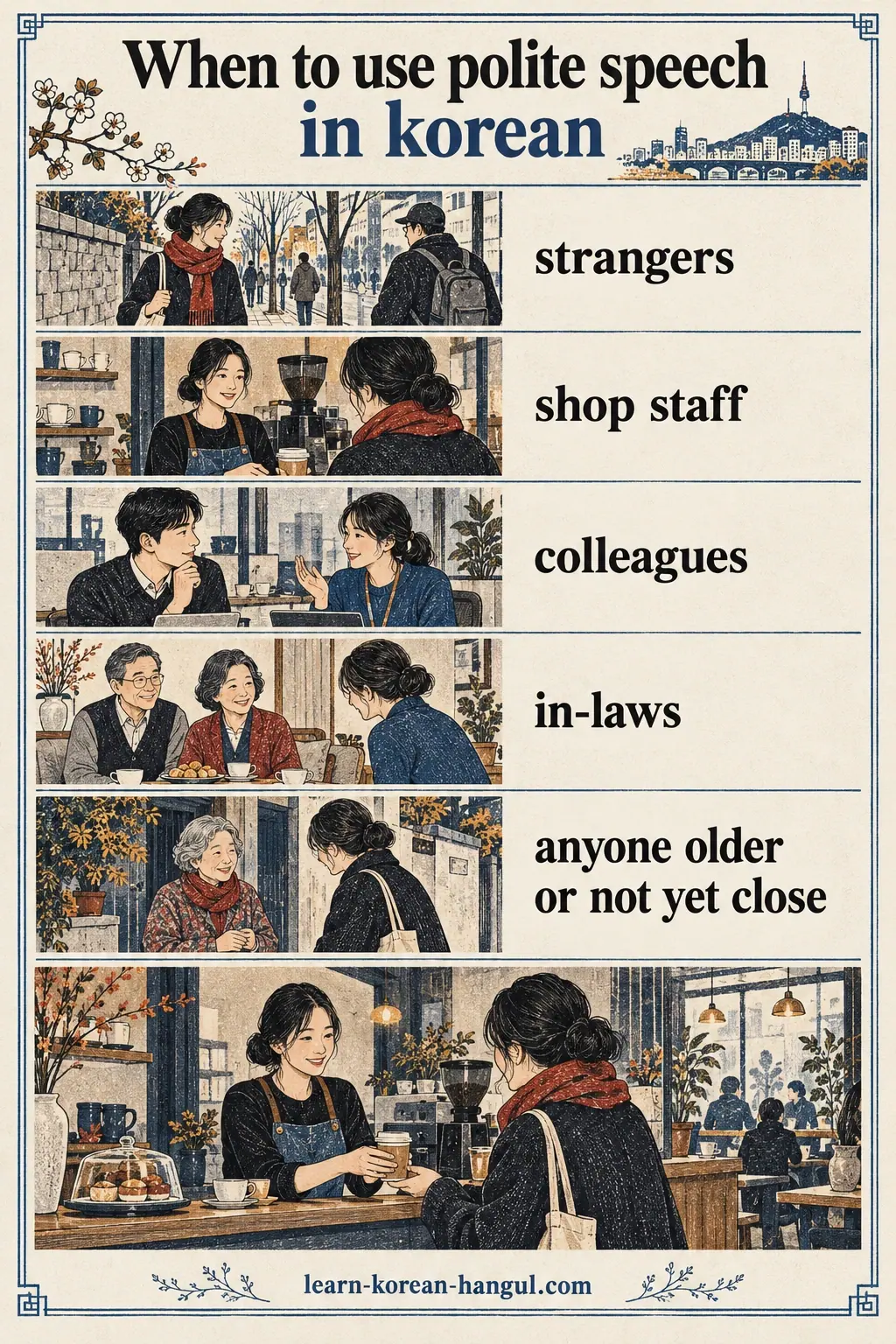
The rule is that the listener decides the speech level. Polite speech is the default for every listener who is a stranger, older, higher in rank or not yet close. Three factors set the level: how close you are, how old or senior the listener is, and how formal the setting is.
| Listener | Level | Example |
|---|---|---|
| Shop staff, waiters, taxi drivers | polite | 이거 주세요. |
| Colleagues and bosses | polite (or formal in meetings) | 내일 회의 있어요? |
| New acquaintances | polite | 만나서 반가워요. |
| Anyone older, not yet close | polite | 어디 가세요? |
| Close friend your age, after agreement | casual | 밥 먹었어? |
| Children and much younger people | casual or polite | 밥 먹었어? |
| Audience, customers, public announcements | formal | 감사합니다. |
Pronunciation: 내일 회의 있어요? is [내일 회의 이써요] (naeil hoeui isseoyo), and 어디 가세요? is [어디 가세요] (eodi gaseyo). The table shows the default, not a law: practice varies with region, workplace and family, and a learner who follows the other person's lead is rarely wrong.
A First Example
Listen to each sentence at normal speed, then slowly.
1. 이거 주세요. (igeo juseyo) "Please give me this."
Pronunciation: [이거 주세요]. This is the usual way to ask for something in a shop, café or restaurant. 주세요 is the polite request form of 주다 ("to give").
2. 만나서 반가워요. 잘 부탁드려요. (mannaseo bangawoyo. jal butakdeuryeoyo.) "Nice to meet you. I look forward to working with you."
Pronunciation: [만나서 반가워요. 잘 부탁뜨려요]. The 드 of 부탁드려요 is spoken tense, as 뜨, after the final ㄱ of 탁. This is a common phrase for a first meeting with a colleague or neighbour.
Both sentences end in 요, so both are polite. The next section turns the rule into a decision you can run in your head.
How Do You Choose a Speech Level in Three Questions?

To choose a speech level, ask three questions in order and stop at the first yes. The questions cover the setting, the invitation and the relationship, and the last answer is always polite speech. This keeps the decision fast enough for a real conversation.
- Is the setting formal and public? A speech, a presentation, a news broadcast or an official announcement calls for formal speech with -ㅂ니다/습니다.
- Has the other person invited casual speech, or is the person a close friend or a child? Then casual speech is allowed.
- Otherwise, use polite speech. This answer covers strangers, elders, colleagues, shop staff and anyone you are unsure about.
You'll know it worked when the ending of your sentence matches the listener: -ㅂ니다 in a presentation, 요 in a shop, no 요 only with a friend. Common mistake at this step: choosing by the topic. A joke is still told in polite speech to a new colleague.
Situation Table
| Situation | Level | Why | Example |
|---|---|---|---|
| Ordering food | polite | staff are strangers | 물 좀 주세요. |
| Asking directions | polite | strangers, possibly older | 화장실이 어디예요? |
| First day at work | polite | colleagues, not close | 잘 부탁드려요. |
| Talking to a friend's parent | polite or honorific | older, not close | 식사하셨어요? |
| Talking to a classmate of your age, first week | polite | not yet close | 같이 가요? |
| Texting a close friend | casual | close, same age | 밥 먹었어? |
| Giving a presentation | formal | public, official | 발표를 시작하겠습니다. |
Pronunciation: 식사하셨어요? is [식싸하셔써요] (siksahasyeosseoyo), and 발표를 시작하겠습니다 is [발표를 시자카겓씀니다] (balpyoreul sijakagetseumnida). With the decision clear, the next section compares the three levels side by side.
How Is Polite Speech Different from Casual and Formal Speech?
Polite speech is the default, casual speech needs an invitation, and formal speech belongs to public or official settings. The three differ in ending, in listener and in risk, so the safest choice for a learner is polite speech.
| Feature | Polite (default) | Casual (invited) | Formal (public) |
|---|---|---|---|
| Ending of 가다 | 가요 | 가 | 갑니다 |
| Ending of 먹다 | 먹어요 | 먹어 | 먹습니다 |
| Listener | strangers, elders, colleagues | close friends, younger people | audience, customers, superiors |
| Sounds | friendly, respectful | intimate, direct | official, distant |
| Risk if wrong | slightly distant with friends | rude to strangers and elders | stiff in chat |
Pronunciation: 먹어 is [머거] (meogeo), and 먹습니다 is [먹씀니다] (meokseumnida). An expert rule of thumb: if you hesitate for even a second about dropping 요, keep it. Relaxing later is always possible, while a casual start is hard to undo. A mistake in the polite direction is cheap: a friend may say 말 편하게 해요 ("speak casually") and the conversation moves on. A mistake in the casual direction can offend. The details of each level are covered in 해요체 polite speech -아요/어요, when to use formal speech in korean and when to use banmal. The next section covers how to know when you may relax.
A Short Dialogue between New Colleagues

A first day at work shows the rule in action. Both speakers are adults who have just met, so both use polite speech from the first line.
| Speaker | Korean | Meaning |
|---|---|---|
| A | 안녕하세요. 오늘 처음 왔어요. | Hello. I came here for the first time today. |
| B | 어서 오세요. 만나서 반가워요. | Welcome. Nice to meet you. |
| A | 잘 부탁드려요. | I look forward to working with you. |
| B | 점심 같이 먹어요. | Let us have lunch together. |
Pronunciation: 오늘 처음 왔어요 is [오늘 처음 와써요] (oneul cheoeum wasseoyo), and 점심 같이 먹어요 is [점심 가치 머거요] (jeomsim gachi meogeoyo). Notice that B's last line is a suggestion, not a statement, and still uses the same 요 form. The ending 요 therefore does not mean "I am being formal"; it means "I am being respectful and friendly". If B were much older or senior, the lines would be the same and only a title, such as 부장님, might be added.
The dialogue shows the default at work. The next section explains how to know when to relax.
When Can You Relax from Polite Speech?

You can relax when the other person invites it, when you are clearly close friends of similar age, or when you speak to a child. The strongest signal is a direct invitation, and an invitation from an older or senior person is the clearest.
Three common invitations and one polite request:
| Phrase | Meaning | Who says it |
|---|---|---|
| 말 편하게 하세요. | Please speak comfortably (casually). | an older or senior person |
| 말 놓으세요. | Please drop the formal speech. | an older or senior person |
| 편하게 말해요. | Speak comfortably. | a peer or friend |
| 말 놓아도 돼요? | May I speak casually (with you)? | you, asking politely |
Pronunciation: 말 편하게 하세요 is [말 편하게 하세요] (mal pyeonhage haseyo), often relaxed to [펴나게] in fast speech, 말 놓으세요 is [말 노으세요] (mal noeuseyo), and 말 놓아도 돼요 is [말 노아도 돼요] (mal noado dwaeyo).
Age, Rank and Titles
Rank and age add one more layer on top of polite speech. To a superior or an older client, add the honorific infix -(으)시- and use a title with 님 (nim), the respectful suffix, such as 부장님 (bujangnim, "department head") or 선생님 (seonsaengnim, "teacher"). Use a name with 씨 (ssi) for peers and juniors, as in 민수 씨. Korean speakers generally avoid 씨 for people of higher rank, so a title is the safer choice.
Pronunciation: 부장님 is [부장님] (bujangnim), and 민수 씨 is [민수 씨] (minsu ssi). Example: 부장님, 어디 가세요? ("Department head, where are you going?") combines a title, a polite ending and the honorific infix.
Two Limits to Remember
Two limits matter. First, an invitation from an elder usually covers that person's own speech to you, and it does not make casual speech safe with everyone around. Second, many Korean speakers ask about age early in a friendship to pick the level, so a question about age is usually practical, not rude, but a learner can answer and keep polite speech. Polite speech also does not honor the subject by itself: 선생님이 와요 is polite, and 선생님이 오세요 is polite and respects the teacher. For the question tone that goes with these sentences, see korean polite question intonation. The next section lists the errors to avoid.
What Mistakes Do Learners Make?
Five mistakes cover most wrong choices of level.
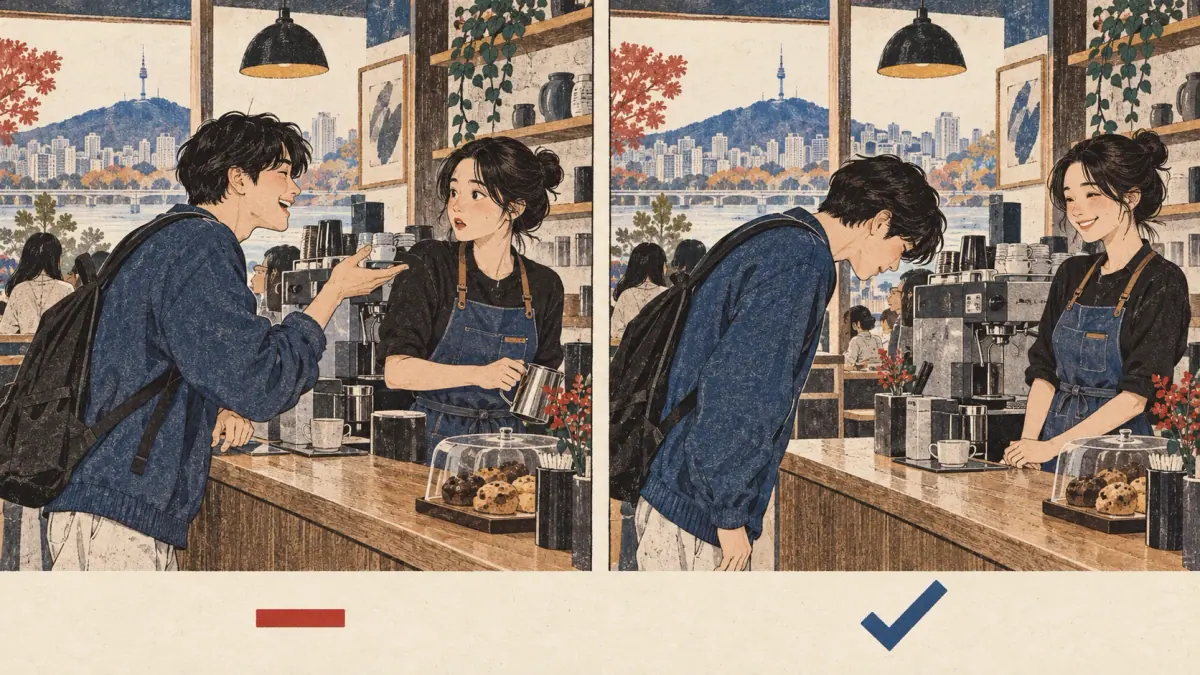
- Starting with casual speech because the other person is young or friendly. Learners think friendliness allows casual speech. The person must invite it, or the relationship must be close. Say 가요 and wait for a cue.
- Using casual speech with shop staff because they are young. Customers are not close to staff. Say 이거 주세요, not 이거 줘.
- Switching to casual speech in the middle of a first conversation. A sudden drop sounds like a loss of respect. Make the switch after an invitation, and not before.
- Using formal speech in light chat. 먹습니다 in a café sounds like a news report. Use 먹어요.
- Thinking polite speech honors an older subject. 할머니가 와요 is polite but plain. For a grandmother, say 할머니가 오세요.
Pronunciation: 이거 줘 is [이거 줘] (igeo jwo), and 할머니가 오세요 is [할머니가 오세요] (halmeoniga oseyo). The same habits carry over to which Korean speech level to use. Now test yourself.
Practice and Answers
Try all four items before you read the answers. Each answer has audio, normal and slow.
Sentence
Please give me this.
Show answer
이거 주세요
Practice · 7
What decides the speech level in Korean, according to the rule?
Show answer
The listener
The listener decides: polite speech is the default for anyone who is a stranger, older, higher in rank or not yet close.
You ask a shop clerk where the restroom is. Which is right?
Show answer
화장실이 어디예요?
A clerk is a stranger, so use polite speech with 요.
You met an older colleague today and want to ask if they ate. Which fits?
Show answer
밥 먹었어요?
An older colleague you just met gets polite speech. Adding 요 makes 먹었어 polite.
An older person says 말 편하게 하세요. What does this mean for you?
Show answer
It is an invitation to speak more casually with them.
말 편하게 하세요 ("Please speak comfortably") is the clearest cue to relax a level with that person.
Which sentence is polite and also shows respect to the grandmother as the subject?
Show answer
할머니가 오세요.
Polite speech alone does not honor the subject. 와요 is polite but plain; the infix -시- in 오세요 adds respect.
You hesitate about whether to drop 요 with someone. What does the rule of thumb say?
Show answer
Keep 요; relaxing later is easy, a casual start is hard to undo.
A mistake in the polite direction is cheap, while a mistake in the casual direction can offend.
Which situation calls for formal speech rather than polite speech?
Show answer
Giving a presentation
A public, official setting such as a presentation calls for -ㅂ니다/습니다, as in 발표를 시작하겠습니다.
- Choose the level. You ask a shop clerk where the restroom is. Which is right: 화장실이 어디예요? or 화장실이 어디야?
- Fix the error. You met an older colleague today and said 밥 먹었어? Rewrite the question in polite speech.
- Translate. "Nice to meet you."
- Write your own. Ask an older neighbour where they are going, using the honorific polite ending of 가다.
Answer Key
- 화장실이 어디예요? (hwajangsiri eodiyeyo) Pronounced [화장시리 어디예요], often softened to [어디에요] in everyday speech. A clerk is a stranger, so use polite speech.
- 밥 먹었어요? (bap meogeosseoyo) Pronounced [밥 머거써요]. Adding 요 makes the sentence polite.
- 만나서 반가워요. (mannaseo bangawoyo) Pronounced [만나서 반가워요]. This is the standard polite greeting at a first meeting.
- Sample answer: 어디 가세요? (eodi gaseyo) "Where are you going?" Pronounced [어디 가세요]. The infix -시- adds respect for an older person.
If you chose the wrong level, ask who the listener is: a stranger or an elder gets polite speech. Then continue with the next lessons.
Next Lessons and Where to Go from Here
After when to use polite speech in korean, the natural next lesson is mixing -요 and -ㅂ니다 in korean, which explains why one speaker uses both endings in one conversation. For the full decision guide, read which Korean speech level to use. To review the ending itself, return to 해요체 polite speech -아요/어요. The set overview, korean polite speech, lists every lesson in order.
This page uses Revised Romanization only as a learning aid; the Hangul is the reference. To remember the idea in one line: when to use polite speech in korean depends on the listener, so use 요 with strangers, elders and colleagues, and switch to casual speech only after an invitation.
Frequently Asked Questions
When Should I Use Polite Speech in Korean?
Use polite speech with strangers, shop staff, colleagues, in-laws and anyone older or not yet close. It is the safe default when you are unsure. Switch to casual speech only when the other person invites you or is clearly younger and close. Use formal -ㅂ니다 for announcements, presentations and official settings.
Is Polite Speech the Same as Honorific Speech?
No. Polite speech (해요체) respects the listener through the ending. Honorific speech respects the person the sentence is about through -(으)시-. 선생님이 와요 is polite, while 선생님이 오세요 is polite and honors the teacher. You often combine the two when speaking to or about an older person.
What Is the Most Common Mistake with Polite Speech?
The most common mistake is switching to casual speech because the other person is young or friendly. Friendliness does not invite casual speech; the person must offer it, or the relationship must be close. Starting casual with a stranger sounds rude, so begin with 요 and wait for a cue such as 말 편하게 하세요.
How Do I Know When to Switch to Casual Speech?
Wait for an invitation, such as 말 편하게 하세요 ("speak comfortably"), or ask politely: 말 놓아도 돼요? Elders and seniors usually decide first. With people your age, the switch often follows a few meetings. If you are unsure, stay polite, because being too polite rarely causes offense.
Do Koreans Always Use Polite Speech with Friends?
No. Close friends of the same age usually use casual speech, called 반말 (banmal), and some friends keep polite speech for years by habit. Family practice varies: many people use casual speech with parents, while others use polite or honorific forms. As a learner, follow the other person's lead.