What you'll learn
- Build -아/어 줄래요? and the casual 줄래? from regular, irregular and 하다 verbs.
- Understand why it sounds friendlier than 주세요.
- Pick the right listener for it.
- Reply to a request that uses it.
- Avoid the two most common mistakes.
Before you start: you should know -아/어 주세요, the standard polite request, because this lesson compares with it all the way through. Audio plays only when you press a button.
What Does -아/어 줄래요? Grammar Mean?
-아/어 줄래요? grammar means "will you do (this) for me?" The verb 주다 means "to give", so the pattern treats an action as a favour given to you. The ending -(으)ㄹ래요 asks about the listener's wish, so the full meaning is close to "do you feel like doing this for me?"
Two examples show the idea.
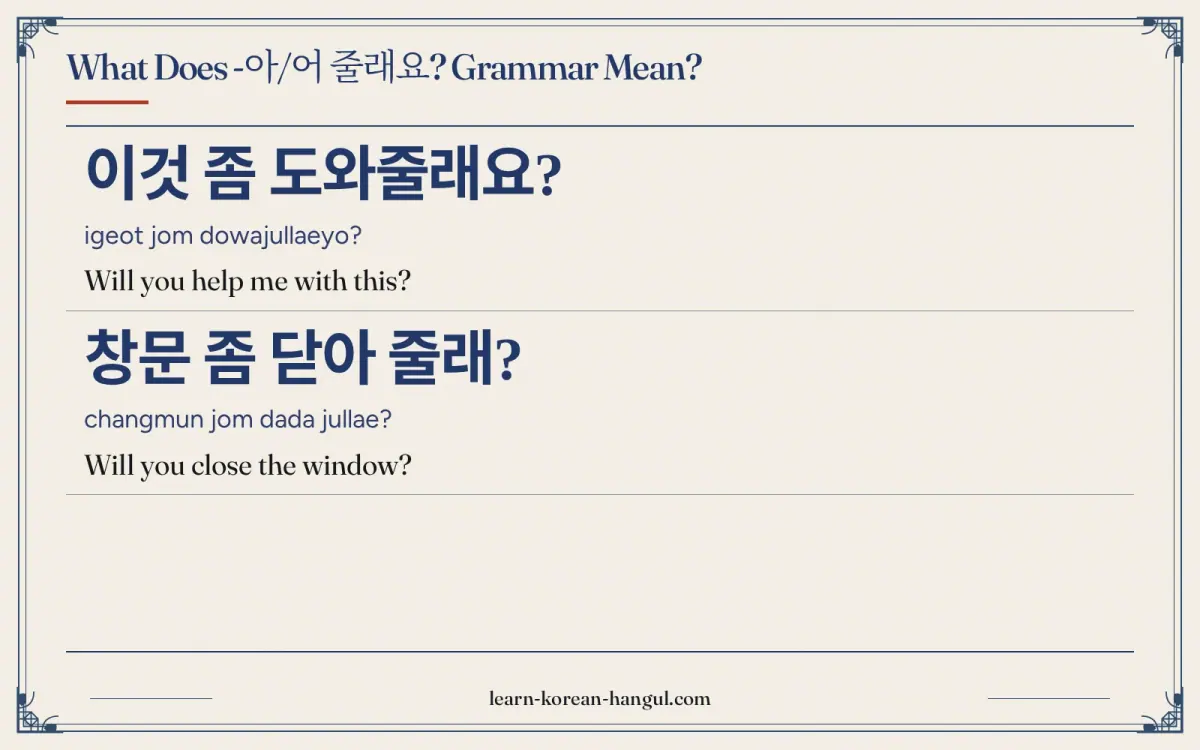
이것 좀 도와줄래요?
igeot jom dowajullaeyo?
Will you help me with this?
창문 좀 닫아 줄래?
changmun jom dada jullae?
Will you close the window?
The first sentence uses the polite ending -요, which suits a colleague of the same age. The second drops -요, which suits a friend. The word 좀 ("a little") softens both. Next comes the formation rule.
How Do You Form -아/어 줄래요?
-아/어 줄래요? is formed by taking the -아/어 form of the verb and writing 줄래요 after it. The first part is the same form used for the polite present: 먹어요 gives 먹어. Then 줄래요 follows, with a space, except in 도와줄래요 and 빌려줄래요, which are single words.
The vowel rule is short. After ㅏ or ㅗ, add -아. After other vowels, add -어. 하다 verbs take 해.
| Dictionary form | -아/어 form | Request | Casual | Meaning |
|---|---|---|---|---|
| 닫다 | 닫아 | 닫아 줄래요? | 닫아 줄래? | Will you close it? |
| 읽다 | 읽어 | 읽어 줄래요? | 읽어 줄래? | Will you read it? |
| 설명하다 | 설명해 | 설명해 줄래요? | 설명해 줄래? | Will you explain? |
| 기다리다 | 기다려 | 기다려 줄래요? | 기다려 줄래? | Will you wait? |
| 오다 | 와 | 와 줄래요? | 와 줄래? | Will you come? |
| 빌리다 | 빌려 | 빌려줄래요? | 빌려줄래? | Will you lend (it to me)? |
Note that 빌리다 means "to borrow", but 빌려주다 means "to lend". The verb 주 in the pattern changes the direction. Dictionaries write 빌려주다 as one word, like 도와주다, so 빌려줄래요 has no space. The next parts take the stem types one at a time.
Stems Ending in a Vowel
Vowel stems often contract. 오 + 아 becomes 와, 기다리 + 어 becomes 기다려, and 바꾸 + 어 becomes 바꿔.
잠깐 와 줄래요?
jamkkan wa jullaeyo?
Will you come over for a moment?
Stems Ending in a Consonant
Consonant stems add -아 or -어, and the final consonant moves to the next syllable when you speak. 닫아 is written with ㄷ but said [다다]. 읽어 is said [일거].
사진 좀 찍어 줄래요?
sajin jom jjigeo jullaeyo?
Will you take a photo for me?
The pronunciation follows the 국립국어원 standard pronunciation rules (표준 발음법): a final consonant followed by a vowel moves across. The spelling does not show the move, so write 찍어 and say [찌거].
Do Irregular Verbs Change?
The stem changes are the usual ones, applied before -아/어.
- ㅡ-stems drop ㅡ. 쓰다 becomes 써, so 이름 좀 써 줄래요? means "Will you write your name?"
- ㄷ-irregular verbs change ㄷ to ㄹ. 듣다 becomes 들어, so 내 얘기 좀 들어 줄래? means "Will you listen to me?"
- 르-irregular verbs double the ㄹ. 부르다 becomes 불러, so 노래 한 곡 불러 줄래요? means "Will you sing a song?"
- ㅂ-irregular verbs change ㅂ to 와 or 워. 돕다 becomes 도와, and the common request is the one word 도와줄래요?
노래 한 곡 불러 줄래요?
norae han gok bulleo jullaeyo?
Will you sing one song?
Dictionaries write 도와주다 as one word, so 도와줄래요 has no space. With the forms clear, you can build a full sentence.
Worked Example: Building a Sentence with -아/어 줄래요?
-아/어 줄래요? grammar works the same way every time, so a five-step routine is enough. Follow it with a common request: borrowing an umbrella from a friend.
- Start with the dictionary form. The verb is 빌리다 (to borrow; with 주다, to lend).
- Drop 다 to find the stem. The stem is 빌리.
- Make the -아/어 form. 빌리 + 어 contracts to 빌려.
- Add 줄래요 or 줄래. For a friend, drop 요: 빌려줄래?
- Add the object and 좀. 우산 좀 빌려줄래? (usan jom billyeojullae?) = "Will you lend me an umbrella?"
Sentence
Will you lend me an umbrella?
Show answer
우산 좀 빌려줄래
You will know it worked if the verb is in its -아/어 form, 줄래 follows it, and your voice rises at the end. The most common slip is writing 줄래요 without the -아/어 form: 빌리 줄래요 is wrong. The next question is when the pattern can appear.
Which Tenses and Sentence Types Work with -아/어 줄래요?
-아/어 줄래요? works only as a present-time question that asks for a favour. A request is about the future, so no tense marker goes inside it. Other meanings come from changing the ending.
| Meaning | Form | Example |
|---|---|---|
| Friendly request, polite | -아/어 줄래요? | 문 좀 열어 줄래요? (Will you open the door?) |
| Friendly request, casual | -아/어 줄래? | 문 좀 열어 줄래? (Will you open the door?) |
| Blunt casual command | -아/어 줘 | 문 좀 열어 줘. (Open the door for me.) |
| Standard polite request | -아/어 주세요 | 문 좀 열어 주세요. (Please open the door.) |
| Careful request | -아/어 주시겠어요? | 문 좀 열어 주시겠어요? (Could you open the door?) |
| Friendly offer | -아/어 줄게 | 내가 열어 줄게. (I will open it for you.) |
The last row is a useful contrast. With 줄게 ([줄께], 내가 열어 줄게), the speaker offers to act. With 줄래, the speaker asks the listener to act. That difference matters in the mistakes section. The pattern for tenses is simple: there is none, and the neighbours differ only in who is asked.
How Is -아/어 줄래요? Different from -아/어 주세요?
-아/어 줄래요? asks what the listener wants to do. -아/어 주세요 states what the speaker wants. 주세요 contains the honorific -시-, which shows respect, while 줄래요 contains nothing like it. That is the whole difference in feeling.
-아/어 줄래요?
will you: friendly request
-아/어 주세요
please: standard polite request
-아/어 주시겠어요?
could you please: careful request
| Comparison | -아/어 줄래요? | -아/어 주세요 | -아/어 주시겠어요? |
|---|---|---|---|
| Honorific -(으)시- | no | yes | yes |
| Feels like | warm and casual | polite and direct | very polite |
| Best listener | friends, juniors, peers | almost anyone | strangers, seniors |
| Example | 문 좀 열어 줄래요? | 문 좀 열어 주세요. | 문 좀 열어 주시겠어요? |
Use -아/어 줄래요? with friends and juniors, -아/어 주세요 as the safe polite request, and -아/어 주시겠어요? with strangers and seniors.
The standard request is in -아/어 주세요. The careful version is in -아/어 주시겠어요?, where the 시 and 겠 add extra respect. For the wider picture of politeness, see Korean Speech Levels. These contrasts lead to a few variations.
Variations and Edge Cases of -아/어 줄래요?
-아/어 줄래요? has four common variations. Each one helps you sound natural.
- Casual form. Between friends, the -요 drops, giving 줄래?. This is the form you hear most often in dramas and chat messages.
- Replies. Say 응, 알았어 ("Yes, okay") or 그래요 ("Sure"). A promise is 그럴게요 [그럴께요] ("I will do that").
- Softening. 좀 and 혹시 ("by any chance") make the request lighter: 혹시 이것 좀 도와줄래요? ("By any chance, could you help me with this?").
- Negative tone. Adding a negative, as in 도와주지 않을래요?, makes the request even more tentative: "Wouldn't you help me?" It is gentle, but it is a longer and more indirect sentence.
Think of it as a ladder of directness: 줘 (blunt) < 줄래 (friendly) < 주세요 (polite) < 주시겠어요? (careful). The honorific marker that appears in the upper rungs is explained in honorific -(으)시-.
What Mistakes Do Learners Make with -아/어 줄래요?
Learners usually mix up the listener, the direction of the favour or the verb form. Four mistakes appear again and again.
- Using it with someone who deserves respect. 선생님, 문 좀 열어 줄래요? sounds too casual for a teacher. Use 문 좀 열어 주시겠어요? instead.
- Using it to offer help. 제가 해 줄래요? asks the listener to do the job. Among friends, offer with 내가 해 줄게. With respect, use 제가 해 드릴까요?
- Leaving out the -아/어 form. 열 줄래요 is wrong. The verb must be in its -아/어 form: 열어 줄래요?
- Using it as a statement. 줄래요 almost always ends in a question mark. Without the rise, it can sound like an announcement, "I will give."
A quick check: Is the listener a friend, peer or junior? Is the verb in the -아/어 form? Is the voice rising at the end? If all three answers are yes, the request is sound.
The practice set below tests these four points.
Practice and Answers
Try the four items before you read the answer key. Cover the answers with your hand.
- Choose the form. Complete: 창문 좀 ___ 줄래요? (닫 / 닫아 / 닫어)
- Make the request. Use 쓰다 with a friend: "Will you write it for me?"
- Choose the register. Ask your older neighbour to help you, using a careful form of 도와주다.
- Fix the error. A learner offers help with 제가 해 줄래요? Correct it for a friend.
Practice · 5
Which request is best for asking a close friend to lend you an umbrella?
Show answer
우산 좀 빌려줄래?
빌려줄래? is the casual, friendly request between friends. The other options are too formal for a friend or are plain statements.
Which form is correct for 닫다 (to close)?
Show answer
닫아 줄래요?
The stem 닫 has the vowel ㅏ, so it takes -아: 닫아 줄래요?
Your teacher is carrying a heavy box. Which sentence is safest to use?
Show answer
제가 들어 드릴까요?
To offer help to a teacher, use the humble 드리다: 제가 들어 드릴까요? The 줄래요 patterns ask the listener to do something and are too casual.
What does 도와줄래요? ask?
Show answer
"Will you help me?"
도와줄래요? is a friendly request meaning "Will you help me?"
Which sentence offers help to a friend instead of asking for it?
Show answer
내가 해 줄게.
줄게 says "I will do it for you." The 줄래 forms and 해 줘 ask the listener to act.
Answer key
- 닫아. The stem 닫 has the vowel ㅏ, so it takes -아: 창문 좀 닫아 줄래요?
- 써 줄래? The vowel ㅡ drops before -어, so 쓰다 becomes 써.
- 도와주시겠어요? (dowajusigesseoyo?) or 도와주세요. The honorific 시 is needed for a neighbour who is older than you.
- 내가 해 줄게. The offer uses -ㄹ게, which says "I will".
If you can complete items 1 to 3 without the key, you can make friendly requests with confidence. The final section points to the next lessons.
What Should You Learn Next after -아/어 줄래요? Grammar?
After -아/어 줄래요? grammar, learn the offer and the formal request. This lesson teaches the friendly request and does not cover the humble offer or the honorific system in depth. Those live on separate pages.
- Learn how to offer help with -아/어 드릴까요?.
- Review the standard request in -아/어 주세요.
- Read Suggestions and Requests to see every request and suggestion ending in one place.
- Return to the Intermediate Grammar list for the other patterns at this level.
With these steps, the choice becomes automatic: use 줄래요 with friends, 주세요 with most people, and 주시겠어요? with those who deserve extra care.
Frequently Asked Questions
What does -아/어 줄래요? mean?
-아/어 줄래요? means "Will you do this for me?" It joins the -아/어 form of a verb with 줄래요, a friendly question form of 주다 ("to give"). 이것 좀 도와줄래요? means "Will you help me with this?" It sounds warm and relaxed, like a request to a friend or a colleague.
How do I attach -아/어 줄래요? to a verb?
Drop 다, add -아 after ㅏ or ㅗ and -어 after other vowels, then write 줄래요. 닫다 becomes 닫아 줄래요?, and 읽다 becomes 읽어 줄래요? 하다 verbs use 해: 설명하다 becomes 설명해 줄래요? ㅡ-stems drop ㅡ: 쓰다 becomes 써 줄래요?
Can -아/어 줄래요? be used in the past tense?
No. A request asks for a future action, so 줄래요 stays in this form. To say that a friend already did something for you, use 해 줬어요 ("he or she did it for me"). To ask whether someone already did it, ask 해 줬어요? with a rising voice.
Is -아/어 줄래요? used in speech or only in writing?
It is mainly spoken. You hear it among friends, family, classmates and colleagues of the same age, and you see it in chat messages and in dialogue. In formal writing, notices and business e-mails, -아/어 주세요 or -아/어 주시겠어요? is the normal choice.
What is the most common mistake with -아/어 줄래요?
The most common mistake is using it with someone who deserves respect. 줄래요 has no honorific, so it can sound too casual to a teacher, a boss or an older stranger. A second mistake is using it to offer help: 제가 해 줄래요? asks the listener to do the job.