What you'll learn
- Build -아/어라 from regular, irregular and 하다 verbs.
- Make a negative command with -지 마라.
- Recognise when the plain command is natural and when it is rude.
- Choose between -아/어라, -(으)세요 and the casual -아/어.
- Understand the set forms you meet in books and lyrics.
Before you start: you should know how to make the -아/어 form of a verb and the polite command -(으)세요. This lesson compares with it throughout. Audio plays only when you press a button.
What Does -아/어라 Grammar Mean?
-아/어라 grammar means "do (this)!" in the plain speech style, called 해라체 in Korean grammar books. It is the command form used by someone who does not need to show respect to the listener, such as a parent speaking to a child. It gives an order and nothing more.
Two examples show the idea.
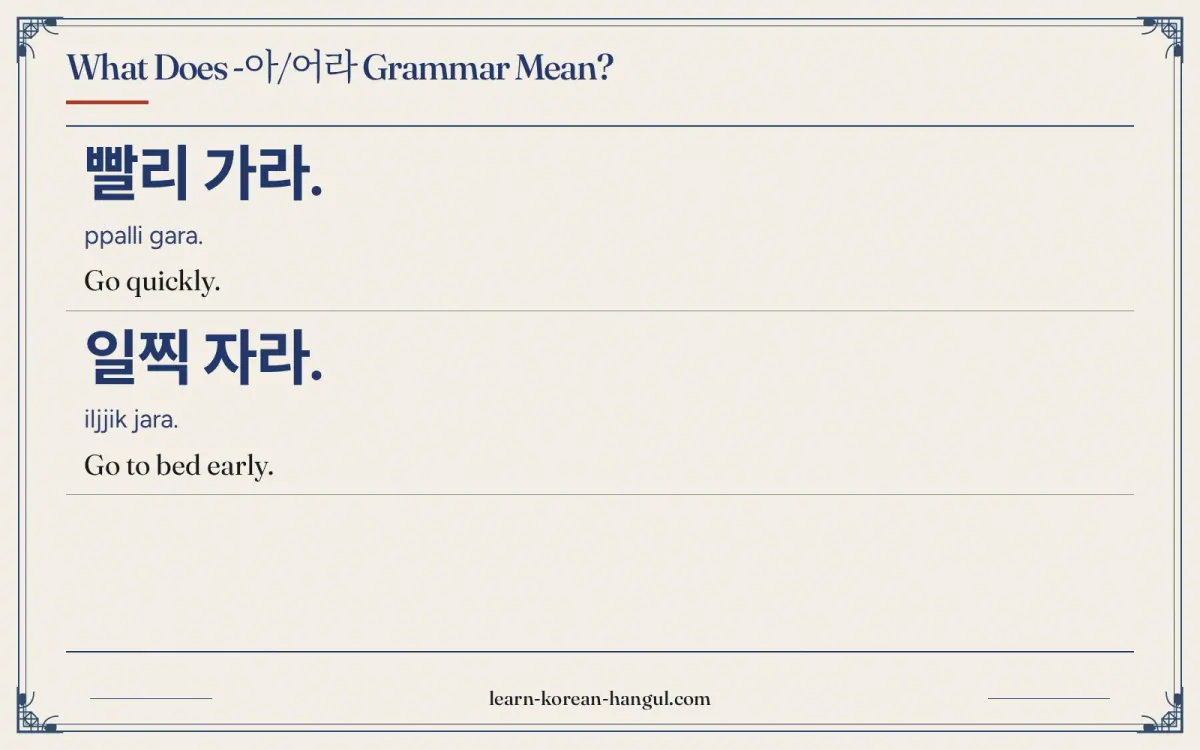
빨리 가라.
ppalli gara.
Go quickly.
일찍 자라.
iljjik jara.
Go to bed early.
Both sentences are short and direct. There is no 요, no honorific and no softener. That is why the ending sounds warm in a family, firm in a classroom and rude in a shop. Next comes the formation rule.
How Do You Form -아/어라?
-아/어라 is formed by taking the -아/어 form of the verb and adding 라. The first part is the same -아/어 form that you use for the polite present. If you know 먹어요, you know that the -아/어 form is 먹어, and the command is 먹어라.
The vowel rule is short. After ㅏ or ㅗ, add -아라. After other vowels, add -어라. 하다 verbs take 해라.
| Dictionary form | -아/어 form | Command | Meaning |
|---|---|---|---|
| 먹다 | 먹어 | 먹어라 | Eat! |
| 닫다 | 닫아 | 닫아라 | Close it! |
| 읽다 | 읽어 | 읽어라 | Read it! |
| 씻다 | 씻어 | 씻어라 | Wash! |
| 하다 | 해 | 해라 | Do it! |
| 조심하다 | 조심해 | 조심해라 | Be careful! |
| 가다 | 가 | 가라 | Go! |
| 자다 | 자 | 자라 | Sleep! |
The next parts take the stem types one at a time.
Stems Ending in a Vowel
Vowel stems contract with 아 or 어, so you do not write the extra vowel. 가 + 아라 is written 가라, 자 + 아라 is 자라, 서 + 어라 is 서라, and 보 + 아라 becomes 봐라. 오다 becomes 와라, 주다 becomes 줘라, and 기다리다 becomes 기다려라.
조용히 해라.
joyonghi haera.
Be quiet.
Stems Ending in a Consonant
Consonant stems simply add -아라 or -어라, and the final consonant moves to the next syllable when you speak. 먹어라 is written with a final ㄱ but said [머거라]. 앉아라 is said [안자라], and 읽어라 is said [일거라].
밥 먹어라.
bap meogeora.
Eat your meal.
The pronunciation follows the 국립국어원 standard pronunciation rules (표준 발음법): a final consonant followed by a vowel moves across. The spelling does not show the move, so write 먹어라 and say [머거라].
Do Irregular Verbs Change?
The stem changes are the usual ones, applied before -아/어.
- ㅡ-stems drop ㅡ. 쓰다 becomes 써, so 써라 means "Write it."
- ㄷ-irregular verbs change ㄷ to ㄹ. 듣다 becomes 들어, so 잘 들어라 means "Listen well."
- 르-irregular verbs double the ㄹ. 서두르다 becomes 서둘러, so 서둘러라 means "Hurry up."
- ㅂ-irregular verbs change ㅂ to 와 or 워. 돕다 becomes 도와, so 도와라 means "Help."
- ㄹ-stems keep ㄹ. 만들다 becomes 만들어라, and 열다 becomes 열어라.
서둘러라.
seodulleora.
Hurry up.
Stems that end in 하다 are the most common. They take 해라: 공부하다 becomes 공부해라, and 열심히 공부해라 means "Study hard." With the forms clear, you can build a full sentence.
Worked Example: Building a Sentence with -아/어라
-아/어라 grammar works the same way every time, so a five-step routine is enough. Follow it with a parent telling a child to do homework first.
- Start with the dictionary form. The verb is 하다 (to do).
- Find the -아/어 form. 하다 verbs take 해, so you get 해.
- Add 라. 해 + 라 gives 해라.
- Add the object. The object is 숙제부터 ("homework first"). 부터 means "starting with."
- Put it together. 숙제부터 해라. (sukjebuteo haera.) [숙쩨부터 해라] = "Do your homework first."
Sentence
Do your homework first.
Show answer
숙제부터 해라
You will know it worked if the verb is in its -아/어 form and the sentence ends in 라 with no 요. The most common slip is adding 요, as in 해라요, which is not standard. The next question is which tenses and sentence types work with the ending.
Which Tenses and Sentence Types Work with -아/어라?
-아/어라 works only as a present-time command with action verbs. A command asks for a future action, so no tense marker goes inside it, and ordinary adjectives cannot be commanded. Other meanings are built by changing the ending.
| Meaning | Form | Example |
|---|---|---|
| Plain command | -아/어라 | 일찍 자라. (Go to bed early.) |
| Negative command | -지 마라 | 거짓말하지 마라. (Do not lie.) |
| Polite command | -(으)세요 | 일찍 주무세요. (Please sleep early.) |
| Casual command | -아/어 | 일찍 자. (Go to sleep early.) |
| Reported command | -(으)라고 하다 | 일찍 자라고 했어요. (He or she told me to sleep early.) |
| Wish with an adjective | adjective + -아/어라 | 건강해라. (Be healthy.) |
The negative command uses 말다, "to stop, to refrain." 가지 마라 (gaji mara) means "Do not go," and 먹지 마라 (meokji mara) means "Do not eat." You also see the longer variant -지 말아라. The polite negative is in the lesson on -지 마세요 don't. Adjectives usually cannot take the command ending, because you cannot be ordered to be tall. A few adjectives become wishes: 건강해라 (geonganghaera) means "Be healthy," and 행복해라 (haengbokaera) means "Be happy." The pattern for tenses is simple: there is none.
How Is -아/어라 Different from -(으)세요?
-아/어라 is a plain command with no honorific, and -(으)세요 is a polite command with the honorific -(으)시-. Both tell the listener to do something. The difference is the relationship between the speaker and the listener. The choice follows from who is speaking to whom.
-아/어라
do it: plain command
-(으)세요
please do: polite command
-아/어
do it: casual style
| Comparison | -아/어라 | -(으)세요 | -아/어 |
|---|---|---|---|
| Politeness | none, direct | polite | casual, friendly |
| Typical speaker | adult to child, written slogan | anyone to a stranger or elder | friend to friend |
| Example | 빨리 가라. | 빨리 가세요. | 빨리 가. |
| Negative | 가지 마라 | 가지 마세요 | 가지 마 |
Use -아/어라 only for children, juniors and set expressions; use -(으)세요 for polite commands, and -아/어 for casual talk with friends.
The polite command is explained in -(으)세요. The casual command, which friends use, is shown in banmal commands and suggestions. The casual 빨리 가 sounds friendlier than 빨리 가라. The plain form gives an order, and the casual form talks to a friend. These contrasts lead to a few variations.
Variations and Edge Cases of -아/어라
-아/어라 has four common variations. Each one helps you read real Korean.
- Old-fashioned set forms. 가거라 ("Go, now") and 오너라 ("Come here") are older, literary forms. You meet them in historical dramas, fairy tales and from grandparents.
- Slogans and signs. Short plain commands appear in slogans and mottos, such as 열심히 공부해라 ("Study hard"). Public notices usually choose -(으)십시오 instead.
- Proverbs and lyrics. Many proverbs and song lyrics use the plain command because it feels direct and timeless.
- Playful use. Friends use it as a joke: 먹어라, 먹어라 ("Go on, eat!"). The tone shows the words are not an order.
The ending is also the base of the reported command. 먹어라 becomes 먹으라고 했어요 inside a quotation, which is covered in direct and indirect quotation. For the wider picture of speech styles, see Korean Speech Levels. For the honorific marker used in the polite alternative, see honorific -(으)시-.
What Mistakes Do Learners Make with -아/어라?
Learners usually mix up the register, the form or the sentence type. Four mistakes appear again and again.
- Using it to someone who deserves politeness. 앉아라 to a teacher or a stranger is rude. Use 앉으세요.
- Adding 요. 먹어라요 is wrong. If you want to be polite, change the whole ending to 먹으세요.
- Using it with adjectives. 예뻐라 sounds like an exclamation ("How pretty!"), not an order. The ending also works as an exclamation, but that is a different pattern.
- Forgetting the contraction. 가아라 and 자아라 are wrong. Write 가라 and 자라.
A quick check: Is the listener someone you can speak to bluntly? Is the verb an action verb in the -아/어 form? Does the command end in 라 with no 요? If all three answers are yes, the command is sound.
The practice set below tests these four points.
Practice and Answers
Try the four items before you read the answer key. Cover the answers with your hand.
- Choose the form. Complete: 문 ___. (닫 / 닫아라 / 닫어라)
- Make the command. Use 자다: "Go to sleep early."
- Make a negative. How do you tell a child "Do not eat"?
- Choose the register. You want to tell your older neighbour to sit. Which ending do you use?
Practice · 5
Which form is the plain command for 먹다 (to eat)?
Show answer
먹어라
The stem 먹 has the vowel ㅓ, so it takes -어: 먹어라.
A mother tells her small child to wash his hands. Which sentence fits?
Show answer
손 씻어라.
씻어라 is the plain command that an adult uses to a young child. The other forms are formal or humble.
What is the correct negative command for 가다?
Show answer
가지 마라
The negative command uses 말다: 가지 마라 means "Do not go."
You want to tell your teacher to sit down. What is the best choice?
Show answer
앉으세요.
To a teacher, use the polite command 앉으세요. 앉아라 and 앉아 are too direct, and 앉아라요 is not standard.
Which plain command of 서두르다 (to hurry) is correct?
Show answer
서둘러라
서두르다 is a 르-irregular verb, so the ㄹ doubles: 서둘러, then 서둘러라.
Answer key
- 닫아라. The stem 닫 has the vowel ㅏ, so it takes -아라: 문 닫아라.
- 일찍 자라. The stem 자 contracts, so 자 + 아라 is written 자라.
- 먹지 마라. The negative command uses 말다.
- -(으)세요: 앉으세요. The plain 앉아라 is too direct for an older neighbour.
If you can complete items 1 to 3 without the key, you can read and use the plain command. The final section points to the next lessons.
What Should You Learn Next after -아/어라 Grammar?
After -아/어라 grammar, learn the polite command, then the neighbours. This lesson teaches the plain command and does not cover reported speech or the full speech-level system. Those live on separate pages.
- Start with -(으)세요, the everyday polite command.
- Learn the casual command in banmal commands and suggestions.
- Read Suggestions and Requests to see every command, request and suggestion ending in one place.
- Return to the Intermediate Grammar list for the other patterns at this level.
With these steps, the choice becomes automatic: use -아/어라 for children and set phrases, and -(으)세요 for everyone else.
Frequently Asked Questions
What does -아/어라 mean?
-아/어라 is the plain-style command ending, so it means "Do it!" It joins the -아/어 form of a verb with 라. 밥 먹어라 means "Eat your meal," and 일찍 자라 means "Go to bed early." It is direct, with no politeness marker, so who says it and to whom matters a great deal.
How do I attach -아/어라 to a verb?
Drop 다, add -아 after ㅏ or ㅗ and -어 after other vowels, then add 라. 닫다 becomes 닫아라, and 읽다 becomes 읽어라. 하다 verbs use 해라, and vowel stems contract: 가다 becomes 가라, 보다 becomes 봐라, and 쓰다 becomes 써라. Use it with action verbs.
Can -아/어라 be used in the past tense?
No. A command asks for a future action, so -아/어라 has no past form. To report a past command, use a quotation: 먹으라고 했어요 means "He or she told me to eat." For a negative command, use -지 마라, which means "do not."
Is -아/어라 used in speech or only in writing?
Both. In speech, parents, teachers and older siblings use it to children and juniors, and friends use it playfully. In writing you meet it in proverbs, song lyrics, slogans and fiction. It is rarely used with adults who deserve politeness, where -(으)세요 is normal.
What is the most common mistake with -아/어라?
The most common mistake is using it to someone who should receive politeness, because it sounds like an order or an insult. 앉아라 to a teacher is rude. Use 앉으세요 instead. A second mistake is adding 요, as in 먹어라요, which is not standard Korean.