What you'll learn
- Tell direct quotation (라고) from indirect quotation (고) and choose between them.
- Build indirect quotations for statements, questions, commands and suggestions.
- Change the person, the ending and the honorifics when you report speech.
- Avoid the common errors with 요, 이라고 and adjectives.
Before you start: you should know the polite ending -아요/어요 and the plain-style endings -ㄴ/는다 and -다. Time: about 30 minutes. This site places the topic at level B1, which is an editorial estimate. The official TOPIK information is published at topik.go.kr.
What Is Korean Direct and Indirect Quotation?
Direct quotation keeps the original words. Indirect quotation keeps the meaning but changes the words so they fit your own sentence. English does the same: "She said, 'I love you'" is direct, and "She said that she loves me" is indirect. Korean marks the difference with a particle, 라고 for direct and 고 for indirect.
| Direct quotation | Indirect quotation | |
|---|---|---|
| Marker | 라고 (or colloquial 하고) | 고 |
| The quoted words | unchanged, in quotation marks | reshaped into plain style |
| Ending of the quote | whatever the speaker said (요, 습니다, 다) | -ㄴ/는다, -냐, -(으)라, -자 |
| Sounds like | a recording of the speaker | a summary by the reporter |
Here is one idea in both forms. Listen to each at normal speed.
1. "사랑해요"라고 말했어요. (saranghaeyorago malhaesseoyo.) "She said, 'I love you.'"
Pronunciation: [사랑해요라고 말해써요].
2. 사랑한다고 말했어요. (saranghandago malhaesseoyo.) "She said that she loves me."
Pronunciation: [사랑한다고 말해써요].
In sentence 1 you hear the polite ending 요 inside the quotation, because the speaker said 사랑해요. In sentence 2 that 요 is gone. The verb is in plain style, 사랑한다, and 고 joins it to the verb of speaking. The speaking verb stays polite, because it belongs to your sentence.
How Do You Make a Direct Quotation?
Put the speaker's words in quotation marks, attach 라고 straight after the closing mark, and finish with a verb of speaking. No space comes before 라고.
- Quote the exact words. Keep whatever ending the speaker used: 요, 습니다, plain 다, or casual 야.
- Add 라고 with no space.
- Add the speaking verb: 말하다, 하다, 묻다, 대답하다 and so on.
| Original words | Direct quotation |
|---|---|
| 내일 가요. | 민지가 "내일 가요"라고 했어요. |
| 비싸요? | 민지가 "비싸요?"라고 물었어요. |
| 일찍 와. | 어머니가 "일찍 와"라고 했어요. |
| 같이 가자. | 친구가 "같이 가자"라고 했어요. |
민지가 "내일 가요"라고 했어요. (minjiga naeil gayorago haesseoyo.) "Minji said, 'I'm going tomorrow.'" Pronunciation: [민지가 내일 가요라고 해써요].
In speech and informal writing you will also hear 하고 in place of 라고, especially with sounds and short words: 개가 "멍멍" 하고 짖었어요 (gaega meongmeong hago jijeosseoyo), "The dog barked 'woof woof.'" Pronunciation: [개가 멍멍 하고 지저써요]. The 하고 form is common when you imitate a voice or a sound. For ordinary reporting, 라고 is the standard choice.
How Do You Make an Indirect Quotation?
Reshape the quoted sentence into plain style, add 고, and finish with 하다 or another speaking verb. The plain-style ending depends on the sentence type: statement, question, command or suggestion.
| Sentence type | Pattern | Example | RR and spoken form |
|---|---|---|---|
| Statement, verb | stem + ㄴ/는다고 | 간다고 해요 | gandago haeyo |
| Statement, adjective | stem + 다고 | 비싸다고 해요 | bissadago haeyo |
| Statement, noun | noun + (이)라고 | 학생이라고 해요 | haksaengirago haeyo [학쌩이라고 해요] |
| Statement, past | stem + 았/었다고 | 갔다고 해요 | gatdago haeyo [갇따고 해요] |
| Statement, future | stem + (으)ㄹ 거라고 | 갈 거라고 해요 | gal georago haeyo [갈꺼라고 해요] |
| Question, verb | stem + 냐고 | 가냐고 해요 | ganyago haeyo |
| Question, adjective | stem + 냐고 | 비싸냐고 해요 | bissanyago haeyo |
| Question, noun | noun + (이)냐고 | 학생이냐고 해요 | haksaenginyago haeyo [학쌩이냐고 해요] |
| Command | stem + (으)라고 | 가라고 해요 | garago haeyo |
| Command, consonant stem | stem + 으라고 | 먹으라고 해요 | meogeurago haeyo [머그라고 해요] |
| Negative command | stem + 지 말라고 | 가지 말라고 해요 | gaji mallago haeyo |
| Suggestion | stem + 자고 | 가자고 해요 | gajago haeyo |
Verbs of statements add ㄴ/는, and adjectives do not, just as in -다고 해서. A question takes 냐고, a command takes (으)라고, and a suggestion takes 자고. An ㄹ-stem drops its ㄹ before ㄴ and ㄴ-based endings: 산다고, 사냐고. Each type has its own lesson: -(느)ㄴ다고 하다 for statements, -냐고 하다 for questions, -(으)라고 하다 and -지 말라고 하다 for commands, -아/어 달라고 하다 for requests and -자고 하다 for suggestions.
Statements
민지가 내일 간다고 했어요. (minjiga naeil gandago haesseoyo.) "Minji said that she is going tomorrow." Pronunciation: [민지가 내일 간다고 해써요].
민지가 이 옷이 예쁘다고 했어요. (minjiga i osi yeppeudago haesseoyo.) "Minji said that this outfit is pretty." The adjective 예쁘다 keeps its plain form. Pronunciation: [민지가 이 오시 예쁘다고 해써요].
Questions
선생님이 "숙제했어요?"라고 물었어요. (seonsaengnimi sukjehaesseoyorago mureosseoyo.) is direct. The indirect version is 선생님이 숙제했냐고 물었어요. (seonsaengnimi sukjehaennyago mureosseoyo.) "The teacher asked whether I had done the homework." Pronunciation: [선생니미 숙쩨핸냐고 무러써요]. The ㅆ of 했 is said as [ㄷ] and turns into [ㄴ] before ㄴ.
Commands and Suggestions
어머니가 일찍 오라고 했어요. (eomeoniga iljjik orago haesseoyo.) "Mother told me to come early." Pronunciation: [어머니가 일찍 오라고 해써요].
의사가 술을 마시지 말라고 했어요. (uisaga sureul masiji mallago haesseoyo.) "The doctor told me not to drink alcohol." Pronunciation: [의사가 수를 마시지 말라고 해써요].
친구가 같이 가자고 했어요. (chinguga gachi gajago haesseoyo.) "My friend suggested going together." Pronunciation: [친구가 가치 가자고 해써요].
Worked Example: Changing a Direct Quotation into an Indirect One
Goal: turn 선생님이 "내일 시험을 봐요"라고 하셨어요 into an indirect quotation.
- Find the quoted words. 내일 시험을 봐요. "We have the exam tomorrow."
- Identify the sentence type. It is a statement, and the verb is 보다 (to take a test).
- Put the verb in plain style. 보 + ㄴ다 → 본다.
- Add 고. 본다고.
- Choose the speaking verb and its honorific. The teacher is respected, so keep 하셨어요.
Result: 선생님이 내일 시험을 본다고 하셨어요. (seonsaengnimi naeil siheomeul bondago hasyeosseoyo.) "The teacher said we have an exam tomorrow."
Pronunciation: [선생니미 내일 시허믈 본다고 하셔써요].
Sentence
Show answer
선생님이 내일 시험을 본다고 하셨어요
What Changes When You Report Someone's Words?
Three things change when you move from direct to indirect: the ending, the people and the honorifics. English changes tense and pronouns, and Korean does the same with its own tools.
| What changes | Direct | Indirect |
|---|---|---|
| Ending | 가요 (polite) | 간다고 (plain) |
| First person | 저는 학생이에요 | 자기는 학생이라고 or 학생이라고 |
| Respect for the speaker | 가요 | 가신다고 하셨어요 |
| Command from a respected person | "가세요" | 가라고 하셨어요 |
The first person needs care. When Minji says "저는 학생이에요" ("I am a student"), you cannot keep 저는 in your report, because 저 would mean you. You can drop the subject or use 자기, a reflexive word that means "herself" or "himself": 민지가 자기는 학생이라고 했어요. (minjiga jagineun haksaengirago haesseoyo.) "Minji said she is a student." Pronunciation: [민지가 자기는 학쌩이라고 해써요].
For respect, the honorific goes on the person who spoke: 선생님이 내일 가신다고 하셨어요. (seonsaengnimi naeil gasindago hasyeosseoyo.) "The teacher said he is going tomorrow." Pronunciation: [선생니미 내일 가신다고 하셔써요]. The -(으)시- on 가신다고 respects the teacher as the one who goes, and the 시 in 하셨어요 respects the teacher as the one who spoke. See honorific -(으)시- for the rule.
When a respected person gives you a command, the command itself is plain and the speaking verb carries the respect: 선생님이 가라고 하셨어요. (seonsaengnimi garago hasyeosseoyo.) "The teacher told me to go." Pronunciation: [선생니미 가라고 하셔써요].
Which Verbs Can Introduce a Quotation?
Most quotation sentences use 하다, but other verbs of speaking, asking and thinking work in the same way.
| Verb | Meaning | Example |
|---|---|---|
| 하다 | say | 간다고 해요 |
| 말하다 | say, tell | 간다고 말했어요 |
| 묻다 | ask | 가냐고 물었어요 |
| 대답하다 | answer | 간다고 대답했어요 |
| 쓰다 | write | 간다고 썼어요 |
| 생각하다 | think | 맞는다고 생각해요 |
One more use of the same marker is naming. 제 이름은 민수라고 해요. (je ireumeun minsurago haeyo.) "My name is called Minsu." Pronunciation: [제 이르믄 민수라고 해요]. The pattern here is noun + (이)라고 하다, "to be called". It is not a quotation of speech, but it is built from the same 라고. A shortened form of the quotation endings with 해요, such as 간대요 for 간다고 해요, is also common in speech. The lesson on -대요/-냬요/-재요/-래요 covers these contractions.
How Is the Quotation System Different from -(느)ㄴ다고요? and -다고 해서?
The overview gives you the general rule. The patterns built on top of it each do one job.
| Pattern | Job | Example |
|---|---|---|
| Direct and indirect quotation | report what was said | 간다고 했어요 |
| -(느)ㄴ다고요? | echo what you just heard | 간다고요? |
| -(느)ㄴ다니까 | insist on what you said | 간다니까요 |
| -다고 해서 | because they said / just because | 간다고 해서 갔어요 |
All of them reuse the same plain-style front half, 간다 or 비싸다 or 학생이라. Once you can build the indirect quotation, you can build the rest.
Variations and Edge Cases
Quoting thoughts. A thought is quoted just like a statement: 맞는다고 생각해요 ("I think it is right"). 맞다 is a verb, so it takes 는다. Pronunciation: [만는다고 생가캐요]. The ㄱ of 생각 joins the ㅎ of 해요 and sounds like [ㅋ]. The -다고 생각하다 lesson covers this use.
Quoting writing. 편지에 보고 싶다고 썼어요 (pyeonjie bogo sipdago sseosseoyo) means "I wrote in the letter that I miss her." Pronunciation: [편지에 보고 십따고 써써요].
Spacing. The marker 고 attaches to the clause with no space, and the speaking verb after it is a separate word: 간다고 해요.
Quoting a quote. Indirect speech can contain another indirect quotation, but it quickly becomes hard to follow. Break it into two sentences.
What Mistakes Do Learners Make with Direct and Indirect Quotation?

- Keeping 요 in an indirect quotation. 가요고 했어요 is wrong. Say 간다고 했어요.
- Adding ㄴ/는 to an adjective. 예쁜다고 했어요 is wrong. Say 예쁘다고 했어요.
- Using 이라고 after a vowel. 의사이라고 했어요 is wrong. Say 의사라고 했어요.
- Keeping 저/나 for someone else. In 민지가 저는 학생이라고 했어요, 저 means you. Drop it or use 자기.
- Using a polite command inside the quote. 가세요고 했어요 is wrong. Say 가라고 했어요 or, for a respected person, 가라고 하셨어요.
- Adding a space before 라고 or 고. Write "사랑해요"라고, not "사랑해요" 라고.
Practice and Answers
Try all four items before you read the answers. Each answer has audio.
- Choose the form. Make this indirect: 친구가 "비싸요"라고 했어요. 비싸다고 했어요 or 비싼다고 했어요?
- Fix the error. 어머니가 일찍 와요고 했어요.
- Translate. "The doctor told me not to drink coffee." (Use 의사 and 커피를 마시지 말라고.)
- Write your own. Report something a friend told you using 간다고 했어요 or 가자고 했어요.
Answer Key
- 친구가 비싸다고 했어요. (chinguga bissadago haesseoyo.) Pronunciation: [친구가 비싸다고 해써요]. 비싸다 is an adjective, so it keeps the plain 다.
- 어머니가 일찍 오라고 했어요. (eomeoniga iljjik orago haesseoyo.) Pronunciation: [어머니가 일찍 오라고 해써요]. A reported command takes (으)라고, not 요고.
- 의사가 커피를 마시지 말라고 했어요. (uisaga keopireul masiji mallago haesseoyo.) Pronunciation: [의사가 커피를 마시지 말라고 해써요]. A negative command takes 지 말라고.
- Sample answer: 친구가 내일 간다고 했어요. (chinguga naeil gandago haesseoyo.) "My friend said he is going tomorrow." Pronunciation: [친구가 내일 간다고 해써요]. Any statement, question, command or suggestion in plain style plus 고 is correct.
Practice · 5
Which sentence is a direct quotation?
Show answer
민지가 "내일 가요"라고 했어요.
A direct quotation keeps the exact words in quotation marks and adds 라고.
Which marker joins an indirect quotation to the speaking verb?
Show answer
고
Indirect quotation uses 고 after the plain-style clause.
How do you report the command "먹어" (eat)?
Show answer
먹으라고 했어요
A reported command takes (으)라고. A consonant stem uses 으라고.
Which is correct for reporting the suggestion "같이 가요"?
Show answer
같이 가자고 했어요
A reported suggestion takes 자고. A polite 요 is never kept inside an indirect quotation.
Which is correct for reporting the question "학생이에요?"
Show answer
학생이냐고 물었어요
A noun question takes (이)냐고. After a consonant it is 이냐고.
If a sentence went wrong, check three things: the sentence type, the plain-style ending and whether any 요 is left in an indirect quote.
What Should You Learn Next?
The most useful next steps are the patterns built on the quotation system. Start with -(느)ㄴ다고요? for echo questions and -다고 해서 for "just because". For a related pattern with an embedded question, see -(으)ㄴ/는지. The Reported Speech section lists every pattern, and the Intermediate Grammar page shows where this topic sits among the B1 patterns.
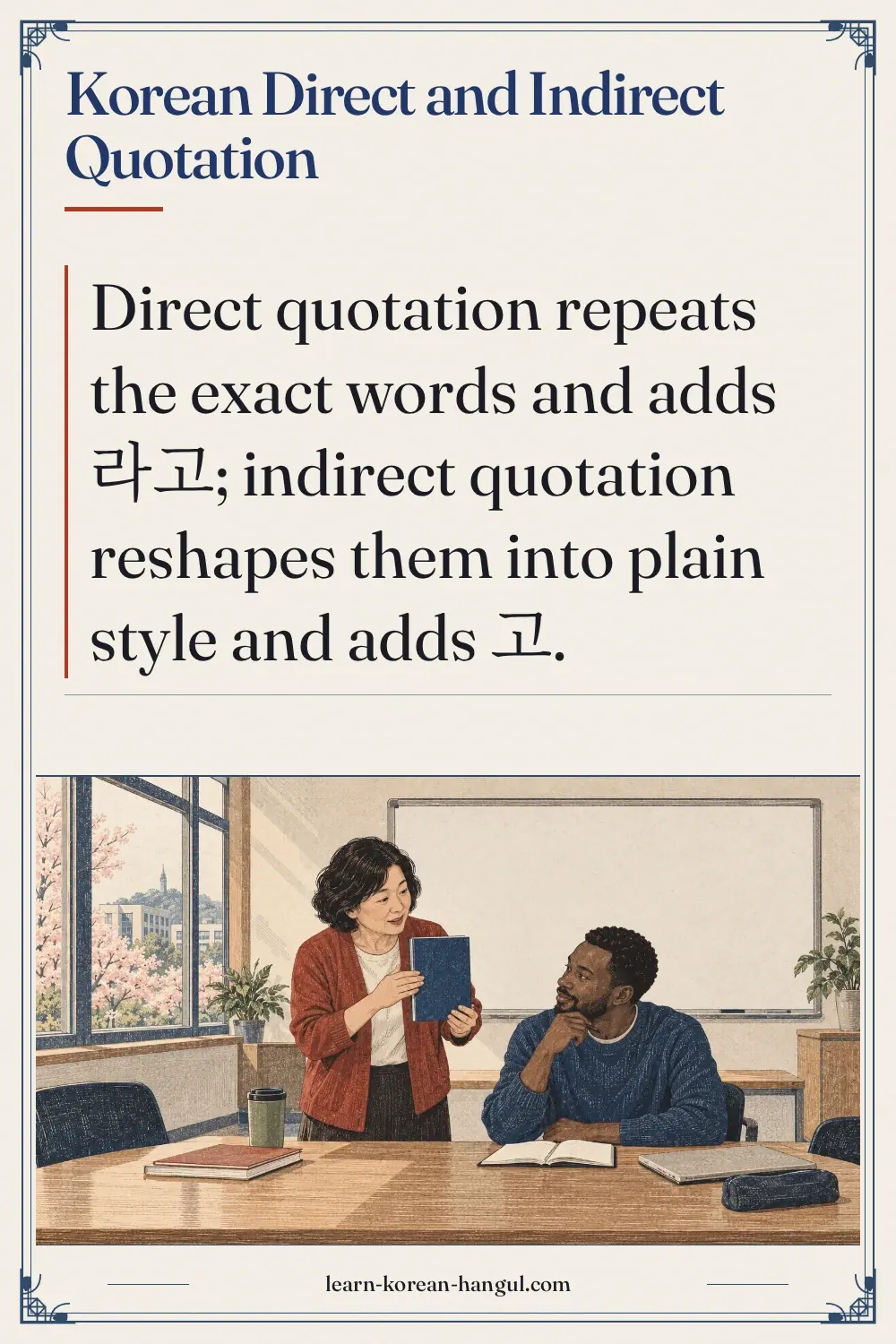
This page uses Revised Romanization only as a learning aid. The Hangul is the reference. To remember the idea in one line: direct quotation keeps the words and adds 라고, and indirect quotation reshapes them into plain style and adds 고.
Frequently Asked Questions
What Is the Difference between Direct and Indirect Quotation in Korean?
Direct quotation repeats the speaker's exact words in quotation marks and adds 라고: 민지가 "내일 가요"라고 했어요. Indirect quotation reshapes the words into plain style and adds 고: 민지가 내일 간다고 했어요. The direct form keeps endings such as 요, and the indirect form never does.
How Do I Report a Statement, a Question, a Command and a Suggestion?
Use four plain-style endings before 고. A statement takes -ㄴ/는다고 for verbs, -다고 for adjectives and (이)라고 for nouns. A question takes -냐고, a command takes -(으)라고, and a suggestion takes -자고. Then add 하다 or another speaking verb: 간다고, 가냐고, 가라고, 가자고 해요.
Why Is 가요고 했어요 Wrong?
The polite ending 요 cannot appear inside an indirect quotation. You must change the quoted sentence to plain style first. The correct form is 간다고 했어요 for a statement, 가라고 했어요 for a command and 가자고 했어요 for a suggestion.
How Do I Report What a Respected Person Said?
Put -(으)시- on the speaker and on the speaking verb: 선생님이 내일 가신다고 하셨어요. When the respected person gives you a command, the command stays plain and the speaking verb carries the respect: 선생님이 가라고 하셨어요.
What Happens to 저 and 나 in Indirect Speech?
They refer to the reporter, so you cannot keep them for another person. Drop the pronoun or use 자기, which means "herself" or "himself": 민지가 자기는 학생이라고 했어요. Context usually makes the subject clear without any pronoun.
Is 하고 the Same as 라고 in a Direct Quotation?
They are close. 라고 is the standard marker for direct quotation. 하고 is more colloquial and is common with sounds and imitations, as in 개가 "멍멍" 하고 짖었어요. For ordinary reporting in writing, use 라고.