
Key facts
- The rule has three parts: 아요 after the vowels ㅏ and ㅗ, 어요 after other vowels, and 해요 for 하다 verbs.
- The same polite form works for statements, questions, suggestions and, with context, commands.
- This set contains 4 lessons at level A1.
Listen to the simplest polite sentence.
The next section defines the topic and shows how the polite form is built.
What Is Korean Polite Speech?
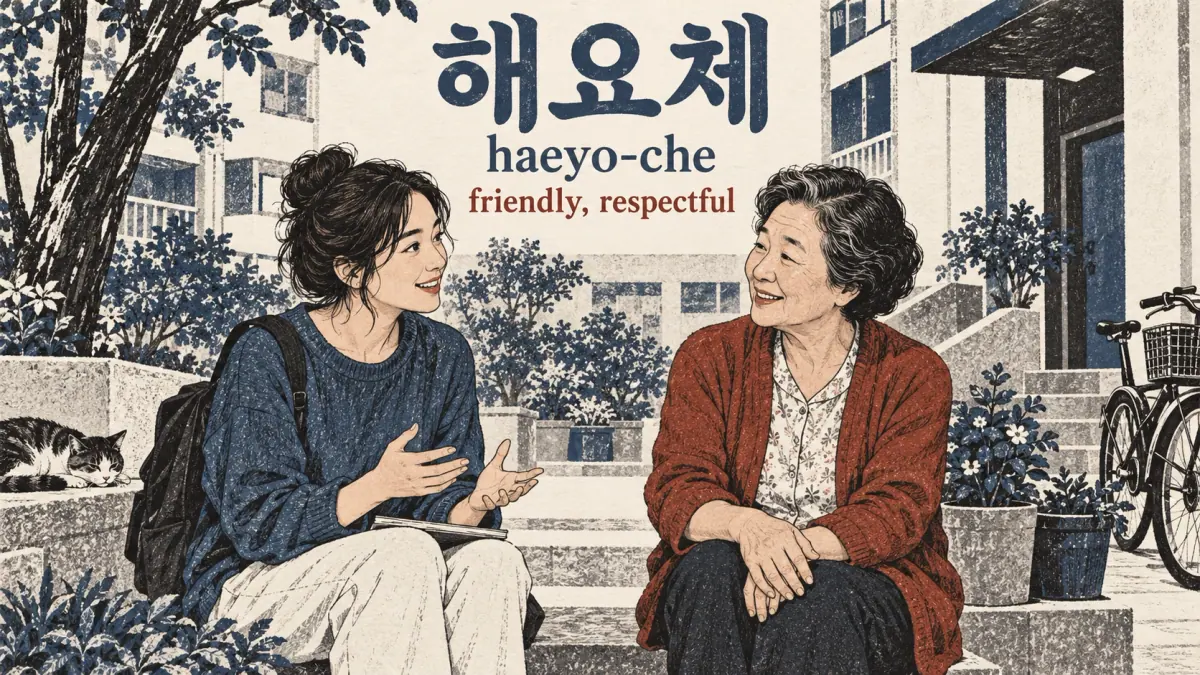
Korean polite speech is the sentence-ending style that adds 요 to a casual ending, so that the sentence shows respect to the listener without sounding stiff. Its Korean name is 해요체, where 체 (che) means "style" and 해요 is the model verb "do" in that style.
A useful shortcut is to think of polite speech as casual speech plus 요:
| Verb | Casual (해체) | Polite (해요체) | Formal (하십시오체) |
|---|---|---|---|
| 가다 (to go) | 가 | 가요 | 갑니다 |
| 먹다 (to eat) | 먹어 | 먹어요 | 먹습니다 |
| 하다 (to do) | 해 | 해요 | 합니다 |
| 학생이다 (to be a student) | 학생이야 | 학생이에요 | 학생입니다 |
Pronunciation: 먹어요 is [머거요] (meogeoyo), 먹습니다 is [먹씀니다] (meokseumnida), 합니다 is [함니다] (hamnida), and 학생이에요 is [학쌩이에요] (haksaengieyo). The shortcut fails only for 이다: the casual 이야 does not become 이야요, but 이에요 or 예요. The full rule is in the lesson on 해요체 polite speech -아요/어요.
Polite speech sits inside the wider system described in Korean speech levels. For the sentence pattern it attaches to, see basic Korean grammar. The next section gives a route through the lessons.
Where Should You Start with Korean Polite Speech?
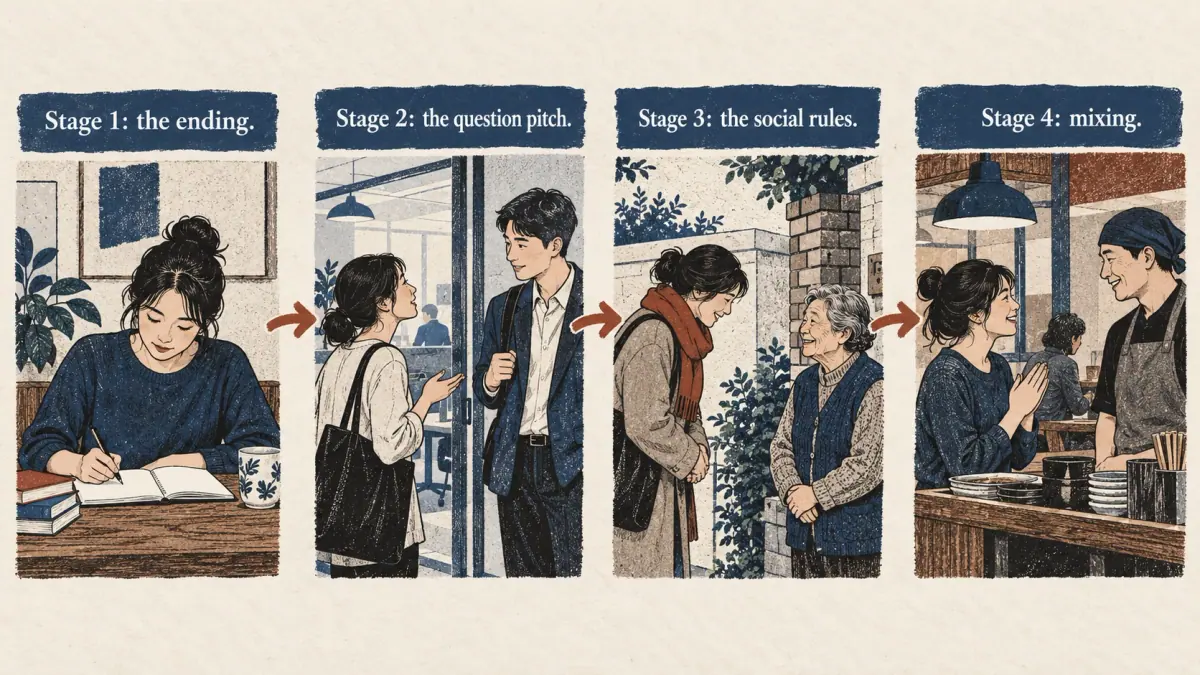
Start with the ending itself, then the pitch of questions, then the social rules, then the mix with formal endings. Four stages cover the whole set.
- Stage 1: the ending. Read 해요체 polite speech -아요/어요, which teaches how to form it from any verb.
- Stage 2: the question pitch. Read korean polite question intonation, because the same 요 form is a statement or a question depending on pitch.
- Stage 3: the social rules. Read when to use polite speech in korean to learn who gets it and when to relax.
- Stage 4: mixing. Read mixing -요 and -ㅂ니다 in korean for the cases where one conversation uses both.
Who can skip ahead? A learner who already forms 가요, 먹어요 and 해요 correctly can start at stage 2. A learner who has not read about speech levels in general should start with Korean speech levels. The next section describes each lesson.
Browse by Topic

Each lesson below has a short description, one example sentence with Revised Romanization (RR, the official Latin spelling, shown only as an aid) and audio.
해요체 Polite Speech -아요/어요
This lesson teaches how to attach -아요/어요 to a stem, how 하다 becomes 해요 and how 이다 becomes 이에요/예요. It also covers the common contractions such as 가+아요 to 가요. Example: 같이 가요. (gachi gayo.) "Let us go together." Spoken [가치 가요].
Korean Polite Question Intonation
This lesson in the pronunciation hub teaches how the same polite sentence turns into a question when the pitch rises on the last syllable. It also shows how wh-questions usually end with a fall or a rise-fall. Example: 지금 가요? (jigeum gayo?) "Are you going now?" Spoken [지금 가요].
When to Use Polite Speech in Korean
This lesson teaches who receives polite speech: strangers, shop staff, colleagues, in-laws and anyone older or not yet close. It also shows the cues that invite you to relax. Example: 이거 주세요. (igeo juseyo.) "Please give me this." Spoken [이거 주세요].
Mixing -요 and -ㅂ니다 in Korean
This lesson explains why one speaker can use 감사합니다 and 맛있어요 in the same conversation. It teaches which fixed phrases stay formal and which sentences stay polite. Example: 감사합니다. 정말 맛있어요. (gamsahamnida. jeongmal masisseoyo.) "Thank you. It is really tasty." Spoken [감사함니다. 정말 마시써요].
The next section helps you choose a lesson for your own sentence.
Which Lesson Fits Your Sentence?
Match the sentence you want to say to the lesson in the table.
| If you want to say... | Open | Why |
|---|---|---|
| "I eat" or "Let us go" in everyday Korean | 해요체 polite speech -아요/어요 | the ending is built from the stem |
| "Are you going?" as a question | korean polite question intonation | pitch separates question from statement |
| a sentence for a shop owner or an older neighbour | when to use polite speech in korean | the listener decides the level |
| "Thank you" followed by a casual comment | mixing -요 and -ㅂ니다 in korean | fixed formal phrases mix with polite ones |
| a choice between 요 and 습니다 | Korean speech levels | the parent hub compares all levels |
The next section shows the most useful contrast in the set.
How Is Polite Speech Different from Formal and Casual Speech?
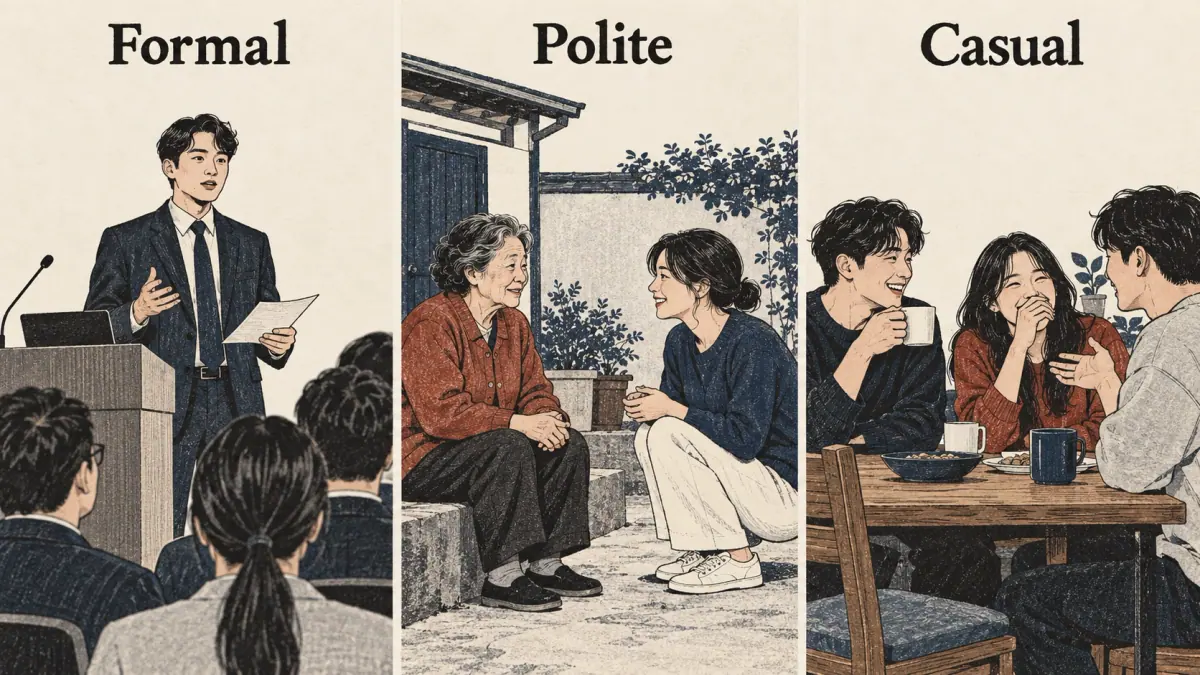
Polite speech sits between formal and casual speech: it is warmer than -ㅂ니다 and more respectful than the bare casual ending. The table compares the three on the questions learners ask first.
| Question | Formal 하십시오체 | Polite 해요체 | Casual 해체 |
|---|---|---|---|
| Ending of 먹다 | 먹습니다 | 먹어요 | 먹어 |
| Question form | 먹습니까? | 먹어요? | 먹어? |
| Typical listener | audience, customers | strangers, colleagues, elders | close friends |
| Sounds | official, distant | friendly, respectful | intimate, direct |
| Risk | stiff in chat | none in most settings | rude to strangers |
The formation rule is short. Add 아요 after a stem whose last vowel is ㅏ or ㅗ, add 어요 after any other vowel, and use 해요 for verbs ending in 하다. The copula 이다 becomes 이에요 after a consonant and 예요 after a vowel. Example: 좋다 becomes 좋아요, 먹다 becomes 먹어요, 공부하다 becomes 공부해요, and 의사 becomes 의사예요. Pronunciation: 좋아요 is [조아요], and 공부해요 is [공부해요].
For the comparison with the formal style, read -ㅂ니다 vs -아요/어요. The next section lists the mistakes to avoid first.
Mistakes to Avoid First
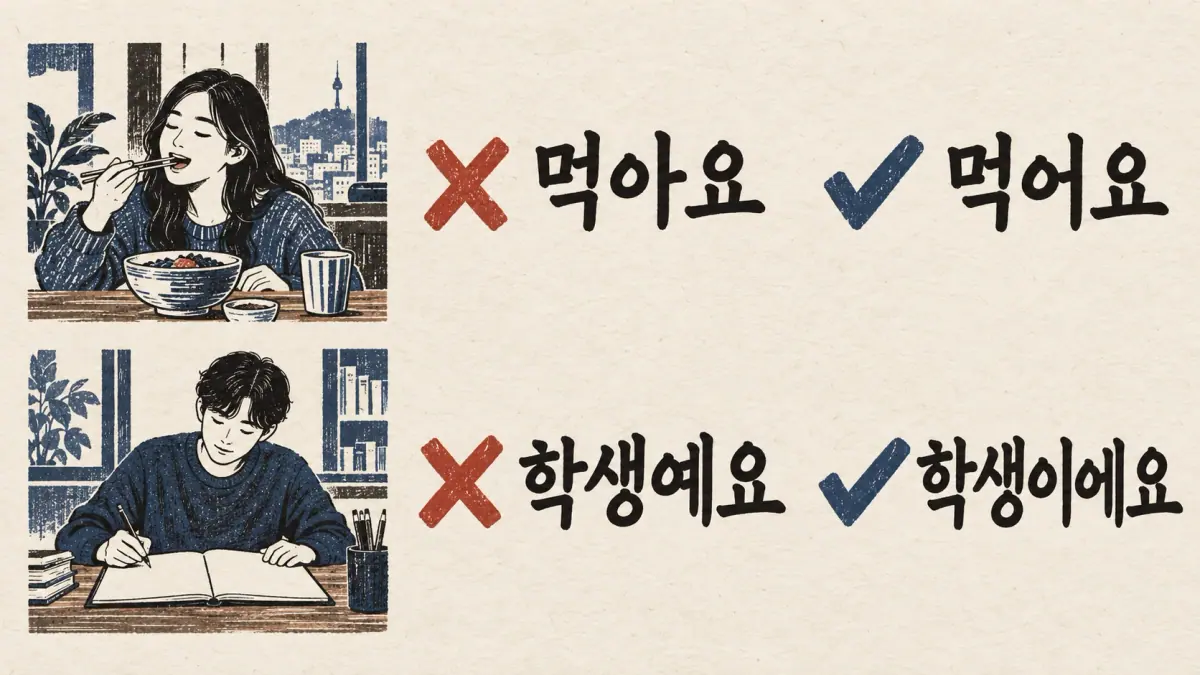
Four mistakes appear in most beginner sentences in this area.
- Treating -아요/어요 as only for questions, or only for statements. The same form does both, and pitch tells them apart: 가요. is a statement and 가요? is a question.
- Using the wrong vowel. 먹아요 is wrong, because the last vowel of 먹 is ㅓ. Say 먹어요.
- Mixing up 이에요 and 예요. 학생예요 is wrong, because 학생 ends in a consonant. Say 학생이에요, and 의사예요 after a vowel.
- Assuming polite speech honors the subject. 선생님이 와요 is polite, but 선생님이 오세요 also respects the teacher. The infix is covered in the Korean honorifics lesson.
Each lesson in the set explains these in detail. The next section shows what the set leaves out.
Scope of This Set
The Korean polite speech set covers the 해요체 ending, its question pitch, its social rules and its mix with formal endings. It does not cover the formal -ㅂ니다 style in depth, which belongs to Formal Polite Speech, or the casual style, which belongs to Casual Speech (Banmal).
All Korean text, spoken forms and audio on this page were machine-generated and reviewed and signed off by Min-ji Park on 15 October 2026. The next section shows how to practise.
How Do You Practise Korean Polite Speech?
Practise Korean polite speech by turning plain dictionary forms into polite sentences and checking them against a key. A short routine works well across a week.
- Read one lesson and say its model sentences aloud with the audio.
- Take ten verbs, remove 다, and add 아요, 어요 or 해요 by the vowel rule.
- Take the grammar quizzes to check the pattern.
- Review the forms with the grammar flashcard decks.
- Print a grammar worksheet and fill it in by hand.
- Check how a verb changes with the Korean verb conjugator.
Each lesson ends with a practice set and an answer key, so you can check your work immediately. After finishing the set, return to Korean speech levels for the other styles.
Frequently Asked Questions
What Is Polite Speech in Korean?
Polite speech, called 해요체, is the Korean sentence-ending style formed by adding -아요/어요 to a verb stem, as in 가요 and 먹어요. It shows respect to the listener without the stiffness of -ㅂ니다. It is the default for strangers, shop staff, colleagues and anyone older, and it works for statements and questions.
How Do You Form 해요체?
Remove 다 from the verb, then add 아요 after a stem whose last vowel is ㅏ or ㅗ, and 어요 after other vowels. Use 해요 for 하다 verbs. 좋다 becomes 좋아요, 먹다 becomes 먹어요, and 공부하다 becomes 공부해요. The copula 이다 becomes 이에요 after a consonant and 예요 after a vowel.
How Is Korean Polite Speech Different from Formal Speech?
Polite speech ends in -아요/어요 and sounds friendly and respectful, while formal speech ends in -ㅂ니다/습니다 and sounds official. 먹어요 and 먹습니다 mean the same thing. Formal speech suits announcements, news and service. Polite speech suits ordinary conversation with people you do not know well.
Can I Use Polite Speech with Everyone?
Polite speech works with almost everyone as a safe default, which is why learners start there. It can sound distant with close friends who prefer casual speech, and it is too relaxed for formal presentations, where -ㅂ니다 is expected. The lesson on when to use polite speech lists the cues for each case.